

The best crypto staking platforms fall into three groups: centralized exchanges that stake on your behalf, non-custodial liquid staking protocols that hand you a tradable token in return, and DeFi staking platforms built around a specific chain or pool. Which one is “best” depends on what you’re optimizing for — convenience, control, or yield — because no single platform wins on all three at once.
This guide walks through what a staking platform does, why it beats solo staking for most people, and how the leading options compare on rewards, fees, and risk.
What Is a Crypto Staking Platform?
A crypto staking platform is a service that lets you earn rewards on a proof-of-stake token without running your own validator. You deposit crypto, the platform (or a pool of validators behind it) does the technical work of confirming blocks, and you receive a share of the rewards minus a fee.
That’s the core mechanic whether it’s a crypto exchange for staking like Coinbase, a DeFi staking platform like Lido, or a staking-as-a-service provider used by institutions. The differences show up in who holds your keys and how the fee is structured, not in the basic idea.
Why Use a Staking Platform Instead of Staking Directly?
Running your own validator has a real barrier to entry. Ethereum still requires 32 ETH to activate a solo validator — worth well over $100,000 at current prices — plus hardware that stays online continuously. Miss that uptime and you leak small rewards; misbehave and the protocol slashes your stake.
A staking platform removes that barrier. Pooled staking lets you deposit any amount, from a few dollars to a full position, and the platform handles validator uptime, key management, and slashing exposure on its side of the arrangement. That’s the entire reason staking platforms exist: they trade a slice of the reward for removing the capital and technical minimum that direct staking demands.
Who Actually Stakes Crypto?
Four groups make up most of the demand for staking platforms, and each wants something slightly different from one.
- Retail holders who want passive yield on coins they’d otherwise leave idle, usually picking whichever platform their funds already sit on.
- DeFi users who stake through a liquid staking protocol to get a tradable receipt token they can then lend or pool for a second layer of yield.
- Long-term holders treating staking rewards as a way to offset a token’s own inflation rate rather than actively trading around price.
- Institutions and treasuries that need compliance-oriented, audited staking infrastructure rather than a retail exchange product.
That range is why “best staking platform” doesn’t have one answer — a retail holder optimizing for a simple crypto exchange for staking has different needs than a DAO treasury choosing an institutional provider with a much larger minimum position.
What Types of Staking Platforms Exist?
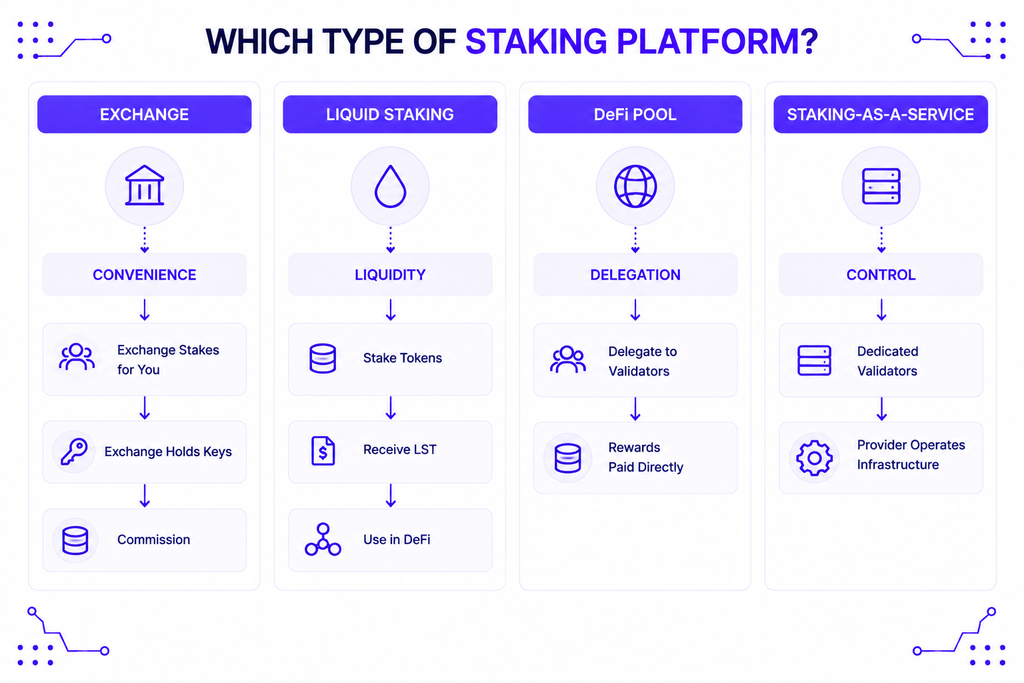
Every staking platform on the market today falls into one of four categories, and picking the right category matters more than picking a specific brand within it.
Custodial Exchange Staking
Exchanges like Coinbase, Kraken, and Binance let you stake directly from your trading balance in a few clicks. The exchange holds your keys and takes a commission — Coinbase charges a standard 35% cut of rewards (lower for subscribers), while Kraken uses a tiered structure roughly between 10% and 30% depending on the asset and balance, according to Kraken’s own staking comparison. Regional platforms like Australia’s CoinSpot staking service work the same way, trading convenience for a bigger cut of the yield.
Liquid Staking Protocols
Liquid staking platforms such as Lido, Rocket Pool, and ether.fi are non-custodial: you keep control through a smart contract instead of handing coins to a company, and you receive a liquid staking token (LST) like stETH or rETH that keeps earning while you trade, lend, or pool it elsewhere. This is currently the largest category of DeFi staking platform by deposited value, and our guide to liquid staking covers the mechanics in more depth.
DeFi Staking Pools
Among the best DeFi staking platforms, some are chain-specific pools rather than general liquid staking issuers — think of a Solana or Cardano-native pool that delegates your tokens to a set of validators and pays out rewards directly, often without minting a separate LST at all.
Staking-as-a-Service (Institutional)
Providers like Figment, Blockdaemon, and Kiln run validator infrastructure for institutions that need audited processes and dedicated support rather than a retail app, usually behind a minimum position size that puts this tier out of reach for individual stakers.
Which Coins Are Best to Stake?
Not every proof-of-stake coin behaves the same way, so a “best crypto for staking” list has to be read asset by asset rather than as one ranking — the mechanism, minimum, and unbonding period all shift by network.
| Coin | Staking mechanism | Typical route |
|---|---|---|
| ETH | Validator staking (32 ETH solo, or pooled via exchange/liquid staking) | Exchange, Lido, Rocket Pool |
| SOL | Delegated staking to any active validator, no protocol minimum | Wallet delegation, exchange |
| ADA | Delegated staking to a stake pool, no lock-up | Wallet delegation (Daedalus, Yoroi) |
| DOT | Bonded staking with a fixed unbonding window | Exchange (bonded) or nomination pools |
| ATOM | Delegated staking with a 21-day unbonding period | Wallet delegation, exchange |
ETH and SOL dominate search interest around “best eth staking” and “best ethereum staking” alike because they combine large market caps with mature staking infrastructure. ADA stands out for having no lock-up at all — you can redelegate or withdraw at will, which is unusual among major proof-of-stake assets. DOT and ATOM sit at the other end, trading a higher headline APY for unbonding periods measured in weeks rather than days.
How Do the Best Crypto Staking Platforms Compare?
People searching for the best exchange for staking, or specifically the best crypto exchange for staking a single asset like ETH, are really asking two questions: which platform is easiest to use, and which one keeps the most of the reward for you. The table below covers the fundamentals that don’t change week to week.
| Platform | Type | Typical commission | Notable trait |
|---|---|---|---|
| Coinbase | Custodial exchange | 35% standard (~25–32% with Coinbase One) | Simplest onboarding, lowest net yield |
| Kraken | Custodial exchange | 10–30%, tiered by asset/balance | Better net APY than Coinbase on most assets |
| Binance | Custodial exchange | Varies by product; promotional rates common | Broadest asset coverage among major exchanges |
| Lido | Liquid staking (non-custodial) | 10% of rewards | Largest liquid staking protocol; ~46% of category TVL |
| Rocket Pool | Liquid staking (non-custodial) | 14% of rewards | Lower node-operator bond (4 ETH since Saturn 1) for more decentralization |
| ether.fi | Liquid staking (non-custodial) | Varies by vault | Fast-growing alternative to Lido |
| Coinbase (institutional) / Figment / Kiln | Staking-as-a-service | Custom | Built for treasuries, not retail |
None of these is the best staking exchange or protocol in every situation. Coinbase wins on simplicity if you already hold funds there; Kraken usually nets a better rate for the same risk profile; Lido and Rocket Pool trade a small custody risk for full liquidity and DeFi composability.
How Much Can You Earn Staking Crypto?
Rewards depend on the network’s own issuance rate first, and the platform’s fee second — the platform doesn’t set the base yield, it only decides how much of it you keep.
| Asset | Approximate base yield | Where the range comes from |
|---|---|---|
| ETH | 2.6% consensus-layer APR; 3–3.8% all-in with MEV | Post-Pectra network data, per CryptoTimes’ 2026 Ethereum staking guide |
| SOL | Roughly 7–9% APY | Helius’ Solana staking calculator |
| DOT | Roughly 10–14% gross APY (bonded) | Kraken’s published bonded-staking rate, with a 28-day unbonding period |
These are protocol-level figures before any exchange commission is deducted, so a 35% cut on a 2.6% base ETH yield nets meaningfully less than the same cut on Solana’s higher issuance rate. This is critical: a platform advertising the “best crypto staking” APY on one asset can still be a mediocre choice on another, because the underlying network sets the ceiling.
What Should You Check Before Choosing a Staking Platform?
Is the platform custodial or non-custodial?
Custodial platforms hold your private keys, so you’re trusting the exchange’s solvency on top of the protocol’s own risk. Non-custodial liquid staking keeps you in control through a smart contract instead, trading one risk (a company failing) for another (a contract bug).
What’s the lock-up or unbonding period?
Direct exchange staking on Ethereum now settles through the network’s own exit queue — minutes to a few days depending on how many validators are exiting at once. Other networks vary widely: DOT’s roughly 28-day unbonding period is far longer than an LST’s instant on-exchange liquidity.
How big is the real fee?
A tiered commission structure like Kraken’s can be meaningfully cheaper than a flat 35% cut over a year of compounding rewards. Always check the current rate directly on the platform, since these numbers move.
Which assets and chains does it actually support, and in your region?
A platform advertising itself as the best defi staking platform for one chain may support only a handful of others — and some exchanges restrict staking products in specific countries for regulatory reasons. Match the platform to the specific asset and check its current terms for your region, rather than assuming broad availability.
Is Crypto Staking Regulated?
In the US, the regulatory picture shifted meaningfully in 2025. On May 29, 2025, the SEC’s Division of Corporation Finance concluded that protocol staking — solo staking, custodial staking, and staking-as-a-service — generally doesn’t meet the legal definition of a securities offering, because the operator’s role is “administrative or ministerial” rather than the kind of managerial effort the Howey test requires.
That statement explicitly does not cover liquid staking, restaking, or similar derivative products — the distinction matters if you’re choosing between a plain custodial stake and an LST. Not everyone at the SEC agreed with the conclusion. Commissioner Caroline Crenshaw dissented, warning plainly about what staking actually exposes you to:
“Staked assets are subject to the risk of loss through protocol operation (i.e. ‘slashing’), protocol failure or errors, and hacking or other theft.” — Commissioner Caroline A. Crenshaw, SEC statement, May 29, 2025
She also flagged something worth reading literally: many staking user agreements contain “lulling” language that implies your assets are protected if the provider goes bankrupt, when that language often carries no real legal weight. Regulatory clarity on staking’s legal status doesn’t remove the underlying operational risk — it just settles who can offer the product.
What Are the Risks of Staking Platforms?
Slashing Still Reaches You
If the validator behind your deposit misbehaves or goes offline long enough to trigger a penalty, that loss is typically passed through the pool to everyone staked in it — including you, even though you never touched the hardware.
Custodial Risk on Exchanges
Staking through an exchange means trusting that exchange’s solvency on top of the protocol’s own risk. If the platform fails, your staked position is only as safe as the exchange’s own financial standing and insurance.
LSTs Can Trade Below Peg
A liquid staking token isn’t hard-pegged; its market price floats. During the 2022 Terra/Celsius collapse, stETH traded at a 5–8% discount to ETH because instant redemption wasn’t live yet — a scenario post-Shapella withdrawals have made less likely, but not impossible under a severe liquidity crunch.
Concentration in a Handful of Protocols
Lido alone holds close to half of all liquid-staked value across the market. That concentration is exactly what Ethereum co-founder Vitalik Buterin warned about when he flagged the risk of “proof-of-stake centralizing due to economic pressures” — a single dominant liquid staking token pulling too much of the network’s stake under one protocol’s logic.
How Do Staking Platforms Actually Run the Infrastructure Behind This?
Every platform in this comparison — exchange, liquid staking protocol, or institutional provider — needs the same underlying thing: reliable, always-on access to the blockchain it’s staking on, to confirm balances, track validator status, and broadcast transactions. Building and maintaining that node infrastructure across dozens of networks is its own operational cost, separate from running the validators themselves.
That’s an infrastructure problem rather than a staking one, and it’s why some platforms and staking dashboards connect through a provider such as NOWNodes instead of running every node in-house. NOWNodes gives API access to shared and dedicated nodes across 120-plus blockchain networks, which covers the on-chain reads a staking product needs without that product’s team maintaining a full node for every supported chain.
How to Start Staking Safely
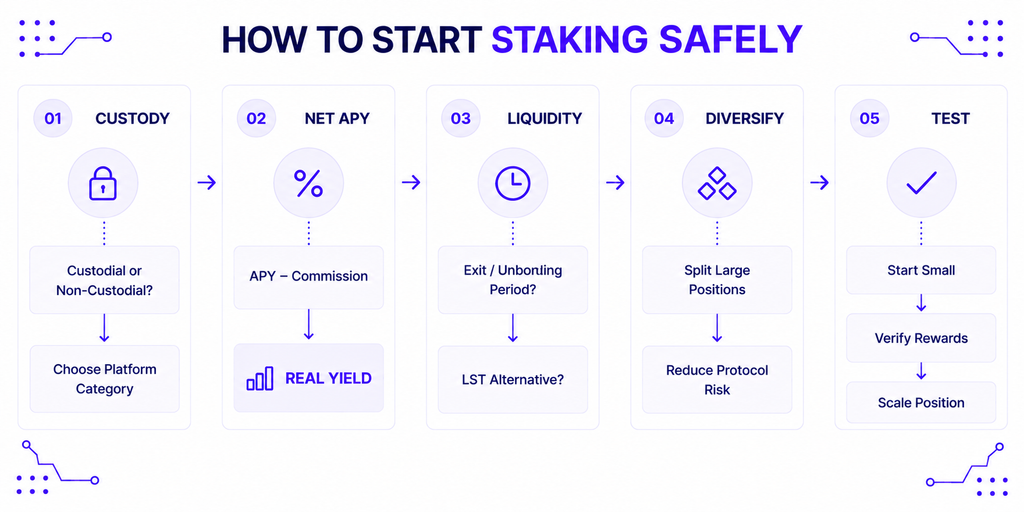
- Decide custodial or non-custodial first — this determines which category of platform you’re even comparing.
- Check the current commission and net APY on the specific asset you’re staking, not a generic advertised rate.
- Confirm the unbonding or exit period for that asset, and whether an LST alternative gives you instant liquidity instead.
- Split large positions across more than one protocol if you’re using liquid staking, to avoid concentrating risk in whichever platform holds the largest share.
- Start small and verify the reward actually lands in your account before committing a full position.
Conclusion
There’s no single best place to stake crypto, only the best fit for how much control, liquidity, and yield you’re prioritizing. A custodial exchange is the fastest way to start, a liquid staking protocol keeps your capital usable while it earns, and an institutional provider exists for treasuries that need more than a retail product offers.
What stays constant across all of them is the underlying trade: you give up some yield or some control in exchange for not running validator infrastructure yourself. Check the current commission, the unbonding terms, and — since the SEC’s 2025 statement doesn’t cover every staking structure — which legal category your chosen platform actually falls into, before moving a meaningful position.
FAQ
What is the best crypto to stake right now?
There’s no universal answer, and no fixed leaderboard of best staking coins — it depends on the yield you’re chasing versus the lock-up you’re willing to accept. ETH offers lower yield (roughly 3–3.8% all-in) with fast liquidity through LSTs, while assets like DOT offer higher gross APY in exchange for a much longer unbonding period. Chasing an unfamiliar token purely for a higher advertised APY usually adds more risk than the extra yield is worth.
Is staking on an exchange safer than DeFi staking?
Not automatically. Exchange staking removes smart contract risk but adds custodial risk — you’re trusting the exchange’s solvency. DeFi staking removes that custodial risk but adds exposure to smart contract bugs and, with an LST, price-peg risk.
Can I unstake my crypto at any time?
It depends on the platform and asset. Liquid staking tokens can typically be sold on the open market instantly, while direct protocol unstaking goes through a network-specific exit queue that can take anywhere from minutes to several weeks.
Do I have to pay taxes on staking rewards?
In most jurisdictions, yes — staking rewards are generally treated as taxable income at the time you receive them, with capital gains rules applying again when you later sell. Tax treatment varies by country, so check current local guidance rather than assuming one rule applies everywhere.
What happens to my stake if the platform shuts down?
For custodial platforms, that depends entirely on the exchange’s own liquidation and insurance process — a risk regulators have specifically flagged. For non-custodial liquid staking, the underlying stake lives in a smart contract rather than the company itself, so it isn’t directly exposed to the platform’s business failing, though the protocol’s own risks still apply.