
A cold storage wallet keeps your private keys on a device that never touches the internet, so malware on your laptop or phone cannot reach them. The market looks different from even a year ago: Trezor shipped a quantum-ready flagship, Ledger replaced its entire Nano line, and seedless designs moved from novelty to mainstream.
Here’s the short version. Trezor Safe 7 is the strongest all-rounder at $249, Ledger Nano Gen5 offers the best value at $179, and Tangem gets you certified protection under $70 with no seed phrase to lose.
What Is a Cold Storage Wallet?
Let’s define the term properly before comparing products. It’s a physical device that generates and stores your private keys in an offline chip, and signs transactions inside that chip so the key never leaves.
Cold storage wallet: a hardware device that keeps cryptographic private keys permanently offline. Transactions are constructed on a connected computer or phone, sent to the device for signing, and returned as a signed message. The private key never crosses the boundary.
One misconception is worth clearing up immediately. Your coins do not live on the device — they live on the blockchain. The wallet holds the credential proving you can move them, which is why a lost device is recoverable and a lost backup usually is not.
How It Actually Works
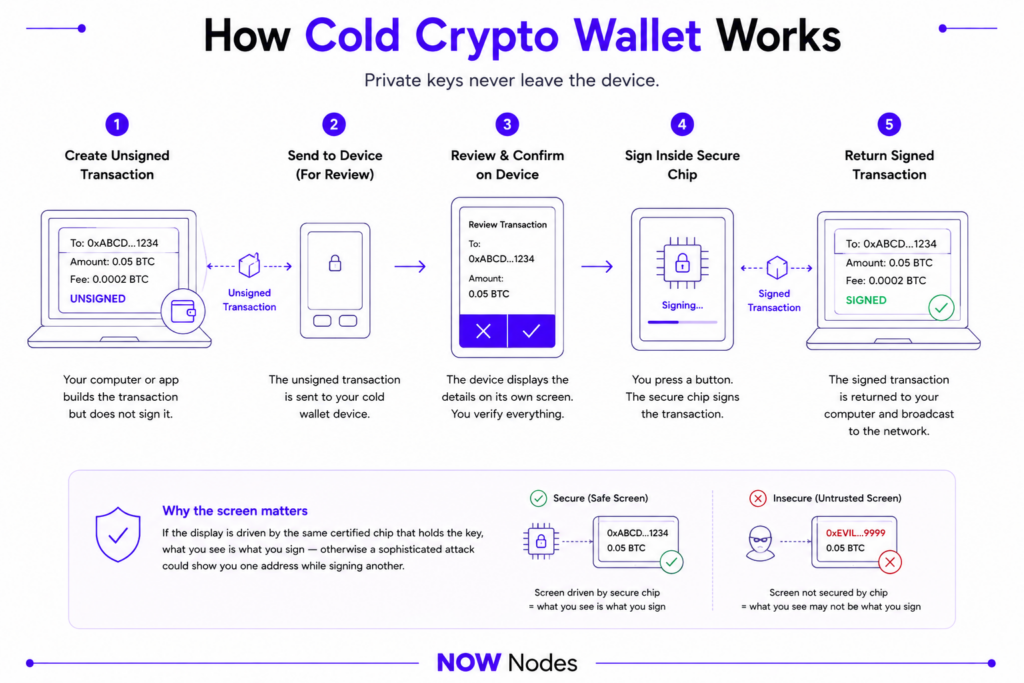
Your computer builds an unsigned transaction, hands it to the device, and the device asks you to confirm the amount and destination on its own screen. You press a button, the chip signs, and the signed transaction goes back out to be broadcast.
That screen matters more than most buyers realise. If the display is driven by the same certified chip that holds the key, what you see is what you sign — otherwise a sophisticated attack could in principle show you one address while signing another.
Why It Matters More in 2026
The numbers explain the shift better than any argument. According to the Chainalysis 2026 Crypto Crime Report, more than $3.4 billion was stolen from the crypto ecosystem between January and early December 2025, with the February Bybit compromise alone accounting for roughly $1.5 billion. North Korea–linked groups took $2 billion of that total.
Charles Guillemet, CTO of Ledger, put the underlying logic plainly in a 2026 interview with CoinDesk: “When you have a dedicated device not exposed to the internet, it is more secure by design.” That’s the whole argument in one sentence — you remove the attack surface rather than defending it.
The Threats a Cold Wallet Doesn’t Stop
This is critical, and most listicles skip it. Hardware protects your key from remote extraction, but does nothing about you being tricked into typing your recovery phrase somewhere.
Recent campaigns show the gap. Scammers mailed physical letters with convincing Ledger and Trezor branding, holographic seals and forged signatures, demanding a “mandatory authentication check” by a deadline — 15 October 2025 for the Ledger variant, 15 February 2026 for Trezor. The QR codes led to lookalike domains harvesting seed phrases.
Then there is coercion. Security researcher Jameson Lopp, who has logged physical attacks on crypto holders since 2014, recorded roughly 70 assaults in 2025 — a 169% increase and the highest in his decade-long dataset. No secure element defends against a threat that already knows your address.
Who Actually Needs One?
Not everyone, and it’s worth being honest about that. If you hold $200 in tokens you trade every week, the friction of a hardware device will cost you more than it saves.
It earns its place once one of three things is true: you hold an amount you’d be genuinely upset to lose, you plan to hold for years rather than weeks, or you sign transactions with contracts you cannot fully audit. The adoption gap here is striking — of roughly 400 million crypto users worldwide, industry estimates suggest only about 10 million secure holdings with a hardware wallet.
How to Choose the Best Cold Storage Wallet
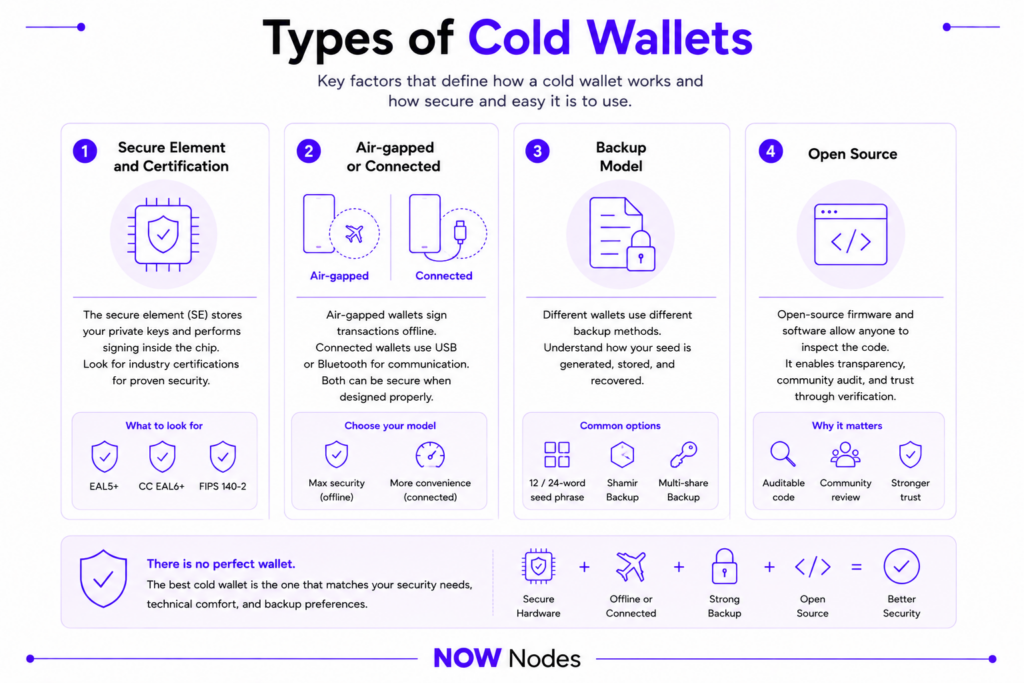
Four criteria do most of the work here. Price is the least important of them, and the one most buyers weigh first.
Secure element and certification. This is a tamper-resistant chip built to resist physical attacks — the same class of component used in payment cards and biometric passports. Its rating comes from the Common Criteria framework (ISO/IEC 15408), expressed as an EAL level. EAL6+ adds more rigorous verification of the chip logic than EAL5+, but either is adequate for personal holdings.
Air-gapped or connected. An air-gapped device has no USB data path, no Bluetooth and no Wi-Fi, communicating only by QR code or microSD. That eliminates an entire class of remote attack, at the cost of turning every transaction into a scan-and-confirm ritual. Match this to your actual behaviour, not your aspirational one.
Backup model. This is where most real-world losses happen. The classic approach is a BIP39 seed phrase — 12 or 24 words that reconstruct your keys anywhere, and that anyone who reads them can also use. Three alternatives have matured: Shamir splitting, seedless card cloning, and encrypted microSD.
Open source. Open firmware lets independent researchers find flaws before attackers do. The catch has always been that secure element chips ship under NDA, so the most security-critical component stayed a black box — a gap Trezor’s TROPIC01 is the first to close.
The 7 Best Cold Wallets in 2026
| Wallet | Best For | Security | Backup Model | Price (USD) |
|---|---|---|---|---|
| Trezor Safe 7 | Best overall | TROPIC01 + EAL6+ SE + MCU, quantum-ready | 12/20/24-word, multi-share | $249 |
| Ledger Nano Gen5 | Best value multi-chain | EAL6+ SE, SE-driven screen | 24-word + Recovery Key | $179 |
| Tangem | Best budget / seedless | EAL6+ chip | Card-to-card, seedless | $54.90–$69.90 |
| Cypherock X1 | Best for inheritance | 2-of-5 Shamir across 5 components | Seedless, no single point | $99–$199 |
| ELLIPAL Titan 2.0 | Best air-gapped | CC EAL5+ SE, sealed metal body | 24-word BIP39 | ~$169 |
| D’CENT Biometric | Best biometric access | Fingerprint + PIN, certified chip | 24-word BIP39 | ~$109 |
| BC Vault | Best for many wallets | Per-wallet encryption, FRAM storage | Encrypted microSD | from ~$175 |
1. Trezor Safe 7 — Best Overall
The Safe 7 is the most significant hardware wallet release in years, and the reason is one chip. TROPIC01 is the first secure element whose complete hardware design, firmware and specification are published for public review, ending the long-standing compromise where the most sensitive component was the least verifiable.
It doesn’t stand alone. Trezor pairs it with an NDA-free EAL6+ Optiga secure element and an STM32U5 microcontroller, so keys are protected by three chips from three vendors. The Safe 7 is also the first such device to use post-quantum cryptography — the SLH-DSA-128 scheme standardised in 2024 — to verify its bootloader and firmware at every power-on.
The hardware matches the security work. You get a 2.5″ colour touchscreen 62% larger than the Safe 5, an aluminium unibody, IP54 rating, encrypted Bluetooth, Qi2 wireless charging and a LiFePO₄ battery rated for four times the cycles of standard lithium.
Trade-off: $249 is the top of the mainstream range, and the Bluetooth radio will bother purists — though it can be disabled and the device works fine over USB-C.
2. Ledger Nano Gen5 — Best Value
Ledger retired the old Nano line and replaced it with the Gen5, the clearest value proposition in the category at $179. You get a 2.76″ E Ink touchscreen, USB-C, Bluetooth 5.2 and NFC for $70 less than the Flex.
An EAL6+ certified secure element runs Ledger OS and drives the touchscreen directly, so the display cannot be spoofed by malware on your host machine — a guarantee MCU-driven screens cannot make. Clear Signing renders contract interactions in readable terms rather than hex, and Transaction Check flags known scam patterns before you approve. Every Gen5 also ships with the Ledger Recovery Key, an NFC smart card that stores your recovery phrase on a PIN-protected secure element instead of paper.
Trade-off: the firmware is closed-source, and Ledger’s 2020 customer data leak — plus further exposure in early 2026 via a third-party payment processor — is why its users keep receiving phishing letters. That’s a privacy failure rather than a key-security one, but it’s a fair mark against them.
3. Tangem — Best Budget and Seedless Option
Tangem’s answer to the seed phrase problem is to not have one. Keys are generated by a certified random number generator inside an EAL6+ chip — the same certification level as a biometric passport — and never exist outside the cards.
Backup works by cloning the key to additional cards over encrypted NFC during setup. A three-card set at $69.90 lets you keep one at home, one elsewhere and one with someone you trust, and any card restores full access. There is no battery, no cable and no screen — you tap a card to your phone, confirm in the app, and you’re done.
Trade-off: your phone is the confirmation display, so you’re trusting the app more than with a device that has its own trusted screen.
4. Cypherock X1 — Best for Inheritance Planning
Cypherock splits your secret across five physical components — the X1 Vault and four NFC cards — using a 2-of-5 Shamir Secret Sharing scheme. Any two recover the wallet, so losing three still leaves you fine, and any single stolen piece is worthless.
That design solves a problem most vendors ignore: what happens to your crypto when you can’t manage it. Distributing cards to family creates a real inheritance plan without handing anyone a phrase that gives full control today. The device has been independently audited by Keylabs, the firm that previously disclosed vulnerabilities in earlier Ledger and Trezor hardware.
Trade-off: mobile support still hasn’t shipped as of 2026, so the cySync app needs a desktop. Pricing runs from a $99 Basic tier up to around $199.
5. ELLIPAL Titan 2.0 — Best Air-Gapped Option
The Titan 2.0 is the strictest interpretation of offline here. No USB data connection, no Bluetooth, no Wi-Fi — every transaction is signed by scanning QR codes between the device and your phone, so no data channel to an internet-connected machine exists at all.
A CC EAL5+ secure element sits inside a sealed metal body built to resist tampering, with anti-tamper logic that wipes the device if the case is breached. The 4-inch touchscreen makes address verification far easier than squinting at a one-inch display, and coverage spans 40+ blockchains and 10,000+ tokens at around $169.
Trade-off: the screen is driven by the device’s own processor rather than the secure element, and the QR workflow adds a step to every transaction.
6. D’CENT Biometric — Best for Fingerprint Access
D’CENT built the first biometric crypto wallet back in 2018, and the pitch still holds. A fingerprint sensor replaces PIN entry, which is faster in practice and immune to shoulder-surfing.
IoTrust, the company behind it, was founded by former Samsung security engineers, and the device now covers 4,900+ assets with more than 700,000 users. Bluetooth allows mobile use without a cable, at roughly $109.
Trade-off: biometrics are convenience, not an extra cryptographic layer — the fingerprint unlocks the device, it doesn’t protect the key.
7. BC Vault — Best for Managing Many Wallets
BC Vault takes an approach nobody else does. Rather than deriving every address from one master seed, it stores up to 2,000 independently encrypted wallets on ferroelectric RAM, each with its own password and a global PIN.
The consequence is real compartmentalisation. Compromise one and the rest stay sealed, which suits people running separate wallets for trading, storage and contract interaction. Backup is an encrypted microSD card, and pricing starts around €159.99 (roughly $175).
Trade-off: the non-BIP39 architecture means you cannot restore into another brand — you’re committed to BC Vault’s ecosystem and its continued existence.
Setting Up a Cold Wallet Safely
The device is only as good as its first hour. These steps prevent the mistakes that actually lose people money.
- Buy direct from the manufacturer. Never a marketplace listing, never secondhand — supply-chain tampering is real.
- Verify authenticity during setup. Every reputable wallet runs an attestation check on first connection.
- Generate the keys yourself. If a device arrives with a recovery phrase already printed, it is compromised.
- Record your backup on something durable. Steel plates cost $30 and survive most of what a house can do.
- Test the recovery before funding it. Wipe, restore from backup, confirm the addresses match — while the balance is still zero.
- Send a small amount first, and confirm it arrives before moving the rest.
The rule underneath all of them is simple. No legitimate company will ever ask for your recovery phrase — not by email, not by phone, not by an official-looking letter with a holographic seal.
Checking Your Balance Without Trusting One Source
Here’s something the hardware doesn’t fix by itself. Your wallet app displays balances by querying servers, usually the manufacturer’s own, and those servers see which addresses you ask about. If they go down or return bad data, you have no independent picture of your holdings.
Anyone building a portfolio tracker, custody dashboard or inheritance tool hits this quickly. NOWNodes provides API access across 110+ networks, so a tool you build can verify balances and broadcast signed transactions without routing everything through a vendor’s backend — the difference between trusting a balance and verifying it.
Conclusion
The best cold storage wallet in 2026 depends on what you’re protecting against. Trezor Safe 7 is the strongest overall choice, with three security chips, the first auditable secure element and quantum-ready firmware justifying its $249. Ledger Nano Gen5 delivers the best value at $179, and Tangem removes the seed phrase entirely for under $70.
Beyond those, pick by need rather than ranking. Cypherock X1 suits inheritance planning, ELLIPAL Titan 2.0 uncompromising air-gapped signing, D’CENT fingerprint convenience, and BC Vault compartmentalising many wallets at once.
One closing thought. With $3.4 billion stolen in 2025 and physical coercion up 169%, the device is now the easy part — buy direct, test your recovery before funding, tell nobody what you hold, and treat every unexpected message about your wallet as hostile until proven otherwise.
FAQ
What is the best cold storage wallet in 2026?
Trezor Safe 7 is the strongest all-round choice at $249, combining an auditable TROPIC01 secure element, an EAL6+ Optiga chip and a separate microcontroller with quantum-ready firmware. Ledger Nano Gen5 at $179 is the better value if you want broad multi-chain support and a secure-element-driven screen.
What is the best Bitcoin cold wallet in 2026?
Every cold crypto wallet on this list stores Bitcoin securely. If you hold only BTC, Bitcoin-only firmware editions — available for Trezor Safe 7 and several competitors — reduce the codebase and therefore the attack surface.
Are cold wallets really safer than exchanges?
Yes, for a structural reason. An exchange holds your keys, so its breach, insolvency or withdrawal freeze becomes your loss — FTX’s 2022 collapse cost users an estimated $8 billion. Self-custody means no third party can lose, freeze or misuse your assets.
What happens if I lose my cold wallet?
Your funds stay on the blockchain and are recoverable from your backup. Buy a replacement device, choose “restore wallet,” and enter your recovery phrase or insert your backup cards. This is exactly why testing recovery before funding matters.
Is EAL6+ meaningfully better than EAL5+?
It is a higher assurance level, requiring more rigorous verification of the chip logic, and it’s the standard used in government cryptographic systems. In practice both resist realistic attacks on personal holdings, and your backup model matters far more.
Can a cold wallet be hacked?
Not remotely, in any practical sense — that’s the point of keeping keys offline. Losses almost always come from the owner being deceived into revealing a recovery phrase, buying a tampered device from a reseller, or approving a malicious transaction they didn’t read.