
A smart contract is a program stored on a blockchain that runs automatically when specific conditions are met. Nobody approves it, nobody processes it, and nobody can quietly change their mind halfway through. If the conditions written into the code are satisfied, the code executes — and the result is recorded on the blockchain for everyone to see.
That single idea powers most of what people mean by “crypto” beyond simply holding coins. Stablecoins, decentralized exchanges, NFTs, lending protocols, DAOs — all of them are smart contracts underneath. In Q4 2025 alone, developers deployed a record 8.7 million of them on Ethereum, according to Token Terminal data reported by Cryptopolitan.
This guide covers smart contract basics from the ground up: what they are, how smart contracts work step by step, what they’re used for, who uses them, and — the part most introductions skip — what goes wrong. No code, no prior blockchain knowledge assumed.
What Is a Smart Contract?
Start with the plainest version. A smart contract is software that lives on a blockchain instead of a company’s server, and it does exactly one thing: follow its own rules, every time, without asking permission.
Smart contract: a program deployed to a blockchain at a permanent address, which executes predefined logic when it receives a valid transaction. Its code and its data are public, and once deployed it usually cannot be altered.
Compare that to a normal app. When you tap “transfer” in a banking app, a company’s server checks your request against internal rules and updates a private database — and the bank controls all three. A smart contract removes the company from that loop: the rules are published in advance, the database is the blockchain itself, and execution is verified by thousands of independent computers rather than one.
The Vending Machine That Came First
The concept is older than Bitcoin. Computer scientist and cryptographer Nick Szabo coined the term in 1994, more than a decade before any blockchain existed, and his favourite illustration was deliberately unglamorous.
“A canonical real-life example, which we might consider to be the primitive ancestor of smart contracts, is the humble vending machine… The vending machine is a contract with bearer: anybody with coins can participate in an exchange with the vendor.” — Nick Szabo, The Idea of Smart Contracts, 1997
Here’s why the vending machine works so well as a mental model. You put in coins, the machine checks the amount against the price, and it either dispenses the snack or it doesn’t. There’s no cashier to negotiate with, no manager to appeal to, and the machine has no opinion about who you are.
Szabo’s insight was that the same logic could apply to far more than snacks. What he lacked in 1994 was a neutral place to put the code where nobody could tamper with it — a problem blockchains solved twenty years later.
Why “Contract” Is a Misleading Word
Worth clearing up early, because the name confuses almost everyone: a smart contract is neither smart nor a contract. It contains no intelligence, no judgment, and no legal standing on its own — it’s a script that runs when poked.
Ethereum’s co-founder has said as much publicly. In an October 2018 post on X, Vitalik Buterin wrote: “To be clear, at this point I quite regret adopting the term ‘smart contracts’. I should have called them something more boring and technical, perhaps something like ‘persistent scripts’.”
“Persistent scripts” is a better description, and holding it in your head will save you confusion later. A smart contract doesn’t understand intent, interpret fairness, or handle situations its author didn’t anticipate. It does what it was written to do — including when that turns out to be a mistake.
How Do Smart Contracts Work?
Now for the mechanics. The lifecycle of a smart contract has four stages, and understanding them is most of what “how smart contracts work” really means.
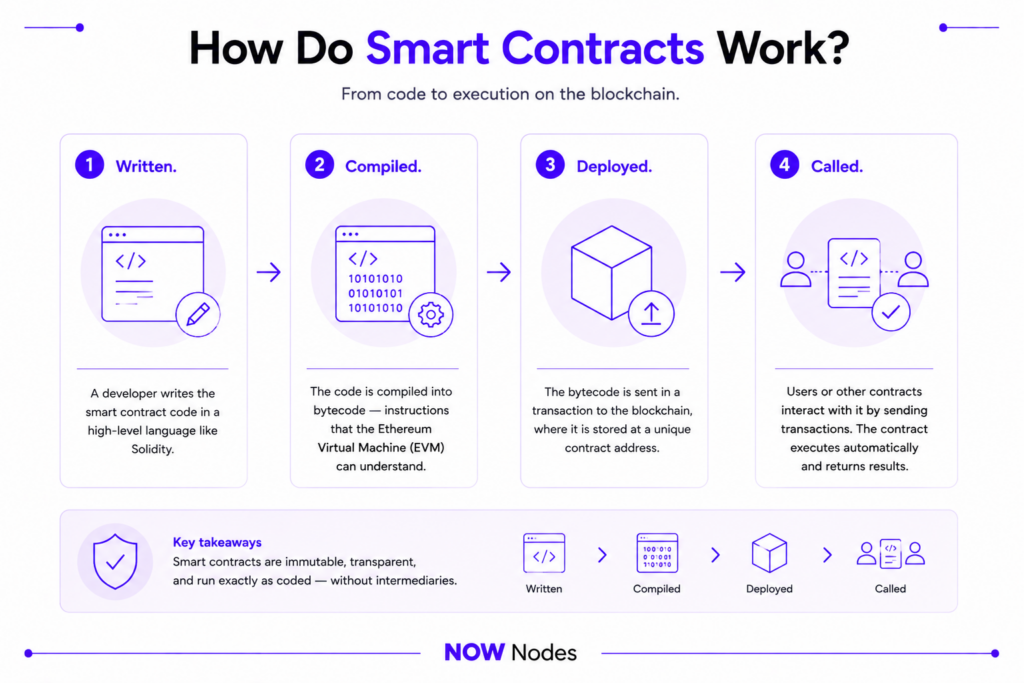
- Written. A developer writes the logic in a blockchain language — Solidity is the most common on Ethereum, with Vyper as an alternative — defining what the contract stores and what anyone is allowed to trigger.
- Compiled. The human-readable code becomes bytecode, the low-level format the blockchain’s virtual machine can execute.
- Deployed. The bytecode is sent to the network, which stores it permanently and assigns it a unique address — the contract’s forever home.
- Called. Anyone can now send a transaction to that address to trigger a function. The network runs the code, updates the stored data, and records the result in a block.
Once stage three is complete, the contract is public property in a very literal sense. Its code and stored data can be read by anyone with a block explorer, and no single party — including its author — can pause it, edit it, or take it offline.
Why “Self-Executing” Is Slightly Misleading
You’ll see smart contracts described as “self-executing” everywhere, and it’s the most common misconception in the space. Contracts do not wake up on their own — they have no timer, no background process, and no way to check whether a condition has been met. A contract sits completely inert until a transaction arrives at its address.
So “if X happens, pay out Y” really means “if someone sends a transaction telling me X happened, I will verify it and then pay out Y.” This is also why oracles exist: since a contract can’t see anything outside its own blockchain — not stock prices, not weather, not football scores — services like Chainlink push external data on-chain so contracts can react to the real world.
Gas: Why Running Code Costs Money
Every computation a contract performs is executed and verified across the entire network, and that work has to be paid for. The fee is called gas, priced in the blockchain’s native currency — ETH on Ethereum, BNB on BNB Chain, and so on.
Gas does two jobs: it compensates the network for the resources your transaction consumes, and it stops anyone from deploying an infinite loop that would grind the chain to a halt. Run out mid-execution and the transaction reverts — your state change is undone, but the fee is not refunded. One detail beginners miss is that reading data is free; only writing costs gas.
What Makes Smart Contracts Different From Normal Software
Putting the two side by side makes the trade-offs concrete. Every row below is a deliberate design decision:
| Traditional application | Smart contract | |
|---|---|---|
| Where it runs | A company’s servers | Every node on the network |
| Who can change it | The owner, any time | Usually nobody, once deployed |
| Can you read the code? | Rarely | Always — it’s public |
| Cost to run | Paid by the operator | Paid by the user, per transaction |
| Downtime | Server outages happen | Runs as long as the chain does |
| Reversing a mistake | Support ticket, refund, rollback | Almost never possible |
| Who you’re trusting | The company | The code, and whoever audited it |
The bottom row is the one that matters most. Smart contracts don’t eliminate trust — they relocate it. You stop trusting an institution’s promises and start trusting a piece of code you probably can’t read, reviewed by auditors you’ve probably never heard of.
Why Do Smart Contracts Matter?
The practical argument is that they remove intermediaries from transactions that previously required them. A currency exchange, an escrow agent, a clearing house — each exists partly to guarantee that both sides hold up their end, and a contract that can’t break its own rules performs that guarantee structurally.
The scale is no longer theoretical. As of mid-June 2026, roughly $71.77 billion sits locked in DeFi protocols across 453 chains, with Ethereum holding 53.1% of it, according to DefiLlama data. Stablecoins — every major one of which is a smart contract — crossed $322 billion in total supply that same month.
Individual applications tell the same story. Uniswap, a decentralized exchange that is essentially a set of contracts with no company holding customer funds, processed over $1 trillion in trading volume in the past year and roughly $3 trillion across its lifetime. No custodian, no account approvals, no closing time.
The Trade-Off Nobody Advertises
This is critical, and it’s usually buried in the fine print: the properties that make smart contracts trustworthy also make them unforgiving. Send funds to the wrong address and there’s no recovery process; interact with a buggy contract and there’s no chargeback.
Developers have workarounds — proxy patterns that allow logic upgrades, multi-signature controls, time-locked admin functions. But every one reintroduces central control, which is precisely what the contract was meant to remove. There’s no free lunch here, only different distributions of risk.
What Are Smart Contracts Used For?
Activity clusters into a handful of categories. The pattern running through them is worth noticing:
| Use case | What the contract does | Real-world scale |
|---|---|---|
| Tokens & stablecoins | Tracks who owns how much and moves balances on request | $322B+ in stablecoins (June 2026) |
| Decentralized exchanges | Swaps one token for another against a liquidity pool | ~$3T lifetime volume on Uniswap alone |
| Lending protocols | Holds collateral, issues loans, liquidates underwater positions | A large share of DeFi’s $71.77B TVL |
| NFTs | Records ownership of unique items and enforces royalties | Powers digital art, gaming, ticketing |
| DAOs | Counts votes and releases treasury funds by rule | Governs many major protocols |
| Tokenized real-world assets | Represents Treasuries, gold, or equities on-chain | ~$25–33B tokenized by mid-2026 |
Notice what these have in common: each involves holding value and applying a rule to it, over and over, with no room for discretion. That’s the shape of problem smart contracts are genuinely good at. They’re a poor fit elsewhere — anything needing human judgment, private data, negotiation, or the ability to be undone belongs in a conventional system or an actual legal agreement.
Who Actually Uses Smart Contracts?
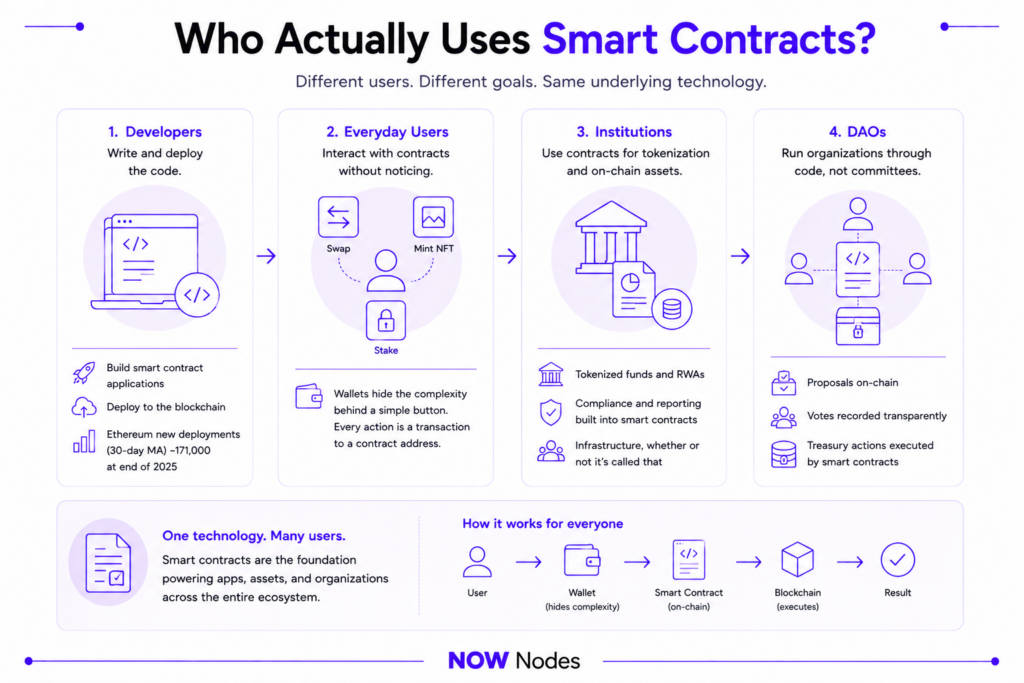
Developers write and deploy the code — Ethereum’s 30-day moving average of new deployments sat near 171,000 at the end of 2025. Everyday users interact with contracts constantly without noticing: swapping a token, minting an NFT, or staking all mean sending a transaction to a contract address, with the wallet hiding it behind a button.
Institutions arrived more recently through tokenization, since an asset manager issuing an on-chain Treasury fund is deploying smart contract infrastructure whether or not the press release says so. DAOs go furthest, using contracts as an operating system where proposals, votes, and treasury payouts run through code rather than a board.
Beyond Ethereum: Where Smart Contracts Run
Ethereum introduced general-purpose smart contracts in 2015 and remains the default choice. It is far from the only option:
| Network | Main language | Distinguishing trait |
|---|---|---|
| Ethereum | Solidity, Vyper | Largest ecosystem, deepest tooling and liquidity |
| BNB Chain | Solidity | EVM-compatible, cheaper fees, faster blocks |
| Polygon, Arbitrum, Optimism, Base | Solidity | Layer 2 and sidechain scaling with Ethereum-grade tooling |
| Solana | Rust, C | High throughput; contracts are called “programs” |
| Cardano | Plutus, Aiken | Formal-verification-oriented design |
| Avalanche, Tron, Fantom | Solidity | Alternative Layer 1s, mostly EVM-compatible |
The phrase to know here is EVM-compatible. Chains implementing the Ethereum Virtual Machine run the same code with minimal changes, which is why a developer can deploy nearly identical contracts across Ethereum, BNB Chain, Polygon, and a dozen others. Solana and Cardano took different paths, but the core concept — public code at a fixed address, executed by the network — holds everywhere.
The Risks Every Beginner Should Know
Smart contracts fail, and they fail expensively. Two numbers frame the problem.
The DAO: The Hack That Split Ethereum
In 2016, an investor-directed fund called The DAO raised over 11.5 million ETH through a smart contract. On 17 June 2016, an attacker exploited a reentrancy flaw and drained roughly 3.6 million ETH — about a third of the fund, worth around $60 million at the time.
The code had done exactly what it was written to do. The community’s response was to hard-fork Ethereum to reverse the theft, permanently splitting the network into Ethereum and Ethereum Classic, the chain that kept the original history intact.
That episode remains the clearest lesson in smart contract basics. “Code is law” sounds elegant until the code produces an outcome nobody wanted, at which point the only remedy is a social one.
What the Numbers Say Today
The losses haven’t stopped. Chainalysis recorded $3.4 billion stolen across crypto in 2025, a record year, with February’s $1.5 billion Bybit breach alone accounting for roughly 44% of the total.
The attack surface has shifted, though. Recent large incidents leaned less on flaws in contract code and more on compromised keys, infrastructure poisoning, and long-running social engineering — a sign that auditing has improved faster than the operational security around it. For anyone new, the safeguards are unremarkable but effective: prefer contracts that have been audited and running a while, check that source code is verified on a block explorer, start small, and read what you’re approving before you sign.
How Applications Connect to Smart Contracts
Here’s the piece that surprises beginners: a wallet or app can’t talk to a blockchain directly. To read a contract’s data or send it a transaction, it routes the request through a node — a server that maintains the chain’s state and broadcasts transactions to the network.
That connection is the unglamorous foundation under every dApp. If it’s slow, balances lag and pages hang; if it drops, the interface breaks even though the contract itself is fine. Running that infrastructure yourself means maintaining a synced server per network, which is why most teams don’t.
NOWNodes provides that layer as a service, with access to 120+ blockchain networks, over 99.95% uptime, and a free START plan covering 100,000 requests. You generate an API key, point your application at the relevant network endpoint, and interact with smart contracts without operating any servers.
Conclusion
A smart contract is a program on a blockchain that enforces its own rules automatically — Szabo’s vending machine, generalized to almost anything expressible in code. It sits at a permanent address, does nothing until called, charges gas for the work, and can rarely be changed once deployed. That combination explains both the enthusiasm and the wreckage: predictable, always-on execution now underpins hundreds of billions of dollars in value, while the same rigidity makes bugs permanent and mistakes final.
If you’re starting out, the useful mental shift is this: stop reading the term as a legal document and start reading it as Buterin’s “persistent script.” It’s a small, stubborn program that follows its instructions precisely — whether or not those instructions were correct.
FAQ
What are smart contracts in simple terms?
A smart contract is a program stored on a blockchain that runs automatically when its conditions are met. Think of a vending machine: you put in the right amount, it gives you the item, and no employee is involved in the decision.
How do smart contracts work?
A developer writes the contract’s logic, compiles it, and deploys it to a blockchain, where it receives a permanent address. From then on, anyone can send a transaction to that address to trigger a function, and the network executes the code and records the result.
Are smart contracts legally binding?
Generally not on their own. A smart contract enforces an outcome technically, not legally, and its standing in court depends on the jurisdiction and whether a corresponding legal agreement exists.
Can a smart contract be changed or deleted?
Usually not. The code is immutable by default once deployed, though developers can build in upgrade patterns or admin controls — at the cost of reintroducing central control.
What happens if there’s a bug in a smart contract?
The bug executes along with everything else. The 2016 DAO hack drained around 3.6 million ETH through a reentrancy flaw, and the only fix was a hard fork that split Ethereum into two chains. This is why audits matter.
Do smart contracts only exist on Ethereum? No. They also run on Solana, BNB Chain, Cardano, Avalanche, Tron, and Layer 2 networks like Arbitrum, Optimism, and Base. EVM-compatible chains run essentially the same code as Ethereum.
Why do smart contracts cost money to use?
Every node executes and verifies your transaction, and gas fees pay for that work while preventing spam. Reading data is free; changing state is not.
Do I need to be a developer to use smart contracts?
No. If you’ve swapped tokens, minted an NFT, or staked crypto through a wallet, you’ve already used smart contracts — the interface just hid the contract address behind a button.