
Gas fees are what you pay to get a transaction processed on a blockchain. Every time you move ETH, swap a token, or mint an NFT, the network does a small amount of computing work — and that work has a price. On Ethereum you pay for it in ETH, and the amount shifts constantly depending on how busy the network is. This guide starts with the plain-English basics and builds toward the mechanics, so by the end you’ll know exactly why the number in your wallet keeps moving.
What Is a Transaction Fee?
Think of a blockchain as a shared computer that thousands of people run together. Doing anything on it — sending funds, running a smart contract — consumes computational resources, and someone has to cover that cost. “Gas” is simply the unit that measures how much computing effort a given action takes, and the fee is what you pay for that effort.
Ethereum’s own documentation puts it plainly: “Gas is essential to the Ethereum network. It is the fuel that allows it to operate, in the same way that a car needs gasoline to run.” The heavier the task, the more gas it burns. A basic transfer is cheap; a complex DeFi interaction that touches several contracts costs more, because it asks the network to do more work.
These costs are quoted in gwei, a small denomination of ETH that keeps the numbers readable instead of a long string of decimals. When someone mentions the current Ethereum gas price, they almost always mean a gwei figure.
Why Is It Called “Gas”?
The word started as Ethereum slang. Ethereum was the first major smart contract network, and its designers needed a way to price computation — so they borrowed the fuel metaphor and called the unit “gas.”
Over time it stuck everywhere. Bitcoin calls its version a “miner fee,” other chains say “network fee,” but people now use “gas” as a catch-all for transaction costs on almost any blockchain — the way “Kleenex” ends up meaning any tissue. Whatever the label, it’s the same idea: a payment for getting your transaction included.
Who Pays and Who Gets Paid?
Anyone who does anything on-chain pays. That covers a first-timer sending ETH between two wallets, a trader using a decentralized exchange, an NFT collector minting art, and a developer deploying a contract. If your action changes the state of the network, it carries a charge.
On the receiving end are validators — the participants who stake ETH, process transactions, and add new blocks. Their reward for that work is part of what you cover, which keeps them online and honest. Under the current model, though, not all of your payment reaches them: a chunk is permanently destroyed, which we’ll get to shortly.
How Is the Cost Calculated?
The final price of any Ethereum transaction comes down to two things multiplied together: how much computing it needs, and the going rate for that computing. Get a feel for these two levers and the rest falls into place.
Gas Limit and Unit Price
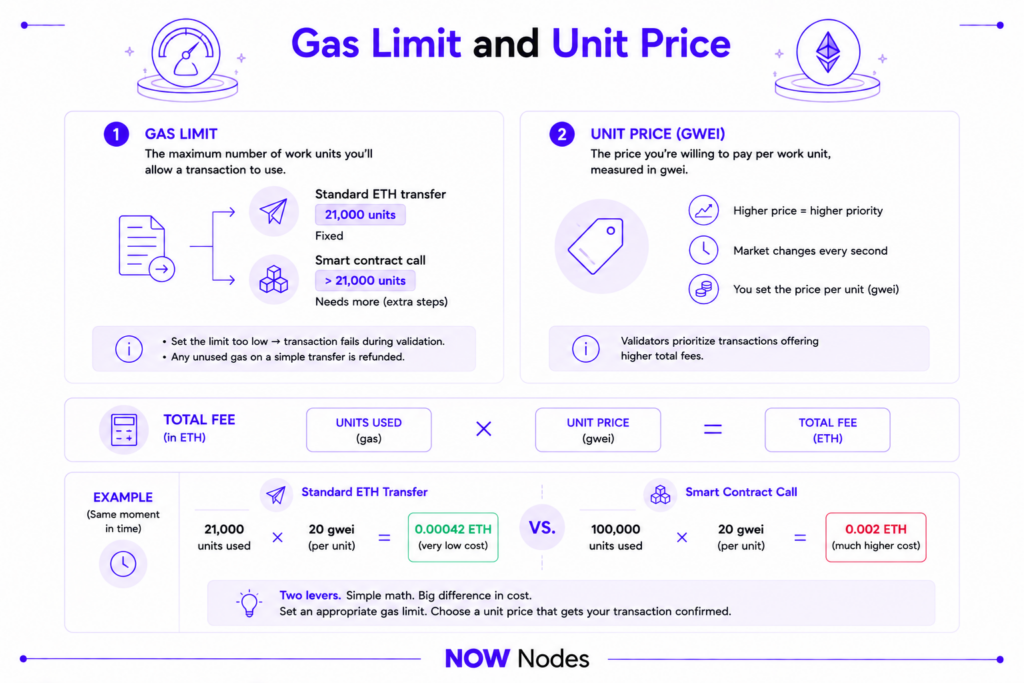
The first lever is the gas limit — the maximum number of work units you’ll allow a transaction to use. A standard ETH transfer is fixed at 21,000 units, while smart contract calls need more because they involve extra steps. Set the limit too low and the transaction fails during validation; anything you don’t use on a simple transfer is refunded.
The second lever is the price per unit, measured in gwei. Multiply the units actually used by that per-unit price and you get the total. So a transfer using 21,000 units at a modest rate costs a small fraction of what a multi-step contract call costs at the very same moment.
Base Fee and Priority Fee
Since the London upgrade in August 2021, Ethereum has split the per-unit price into two parts. There’s a base fee set automatically by the protocol, and a priority fee — a tip you add to jump the queue. The base fee rises and falls with demand and, crucially, gets burned rather than handed to anyone, permanently removing that ETH from supply.
Here’s a concrete example drawn from Ethereum’s docs. If the base fee is 10 gwei and you tip 2 gwei on a 21,000-unit transfer, you pay 21,000 × (10 + 2) = 252,000 gwei, or 0.000252 ETH. The tip goes to the validator; the base-fee portion is destroyed.
This design replaced an older system where everyone blindly bid against one another. The EIP-1559 proposal, authored by Vitalik Buterin and collaborators, argued that the old auction was “well-known in mechanism design literature to be highly inefficient, and so complex fee estimation algorithms are required.” By fixing a predictable base fee for each block, the network made costs far easier to estimate — even if they still move.
Why Do Networks Charge Fees?
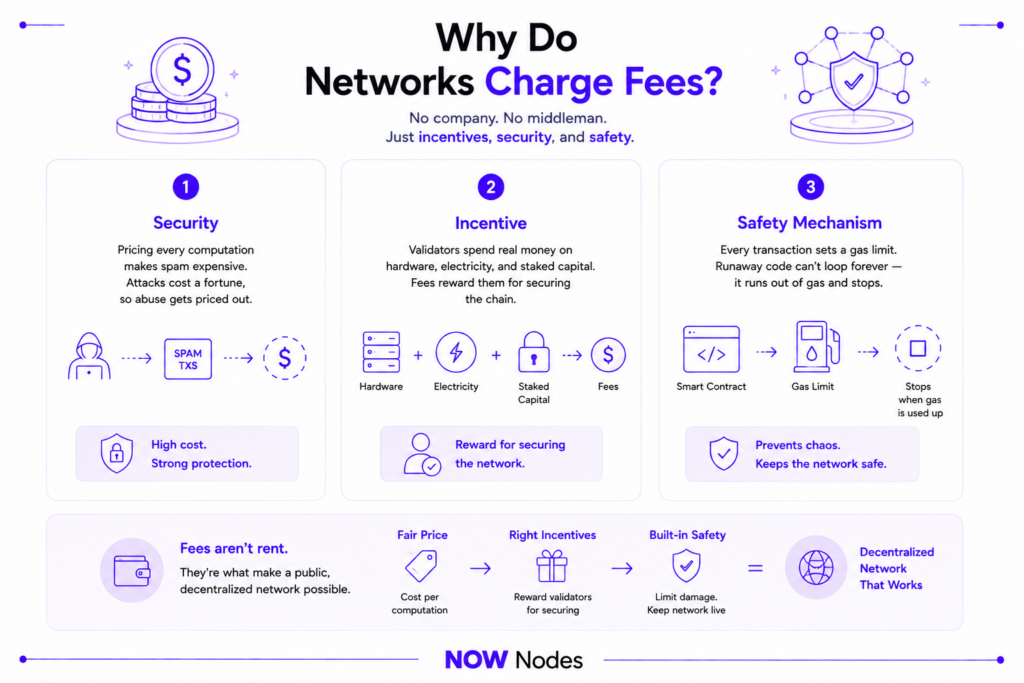
It’s fair to ask why a decentralized system needs charges when there’s no company collecting them. The first reason is security. Pricing every computation makes spam expensive: flooding the network with junk transactions would cost an attacker a fortune, so gas fees quietly prices out that kind of abuse.
The second reason is incentive. Validators spend real money on hardware, electricity, and staked capital, and they won’t keep doing it for nothing. These payments reward them for securing the chain, which is what lets a public network run without anyone in charge.
There’s a third, subtler job too. Because each transaction must set a gas limit, runaway code can’t loop forever and freeze the network — it simply runs out of gas and stops. The model is as much a safety mechanism as a payment system.
Why Do the Costs Change?
This is the part everyone actually wants explained. Ethereum gas fees aren’t set by a committee; they emerge from supply and demand for a scarce resource — space inside the next block. When that space is contested, prices climb. When it’s quiet, they drop. Three forces drive most of the movement.
Network Demand and Congestion
Every block can only hold so many transactions. When more people want in than there’s room for, they compete by tipping higher, and the base fee ratchets up automatically — by design, it can move up to 12.5% per block. It works a bit like surge pricing on a ride-share app: the busier it gets, the more a fast ride costs.
The reverse is just as true. During calm stretches — overnight, or on a slow weekend — demand for block space falls and the base fee slides back down. That’s why the same transfer can cost noticeably different amounts just a few hours apart.
Transaction Complexity
Not every action asks the same amount of work from the network. Sending ETH is light. Approving a token, swapping on a DEX, or opening a leveraged position runs through far more contract logic, so it consumes more units and costs more — even when the per-unit price is identical.
That’s why two transactions submitted in the same minute can carry very different totals. The price per unit is the same for both; the workload isn’t.
Market Events and Launches
Big events are where you see costs go vertical. A hyped NFT drop or token launch sends thousands of people racing to transact in the same few minutes, and they bid one another up fast. Sudden market volatility does the same, as traders rush to move funds all at once.
The classic example is Yuga Labs’ Otherside land sale on April 30, 2022. Demand was so intense that the daily average gas price topped 800 gwei, simple transfers briefly cost around $500, and one user paid roughly $44,000 in fees for a single mint. More than 10,000 transactions failed after users underpaid, burning about $4 million with nothing to show for it — a blunt lesson in what congestion can do.
How Much Do Transactions Cost in 2026?
Here’s the good news: on a normal day in mid-2026, ETH gas fees are dramatically lower than those headlines suggest. Mainnet gas has frequently sat well under 1 gwei, with trackers routinely showing readings near 0.1 gwei during quiet periods. With ETH trading around $1,950 in late July 2026, a standard transfer at those levels costs a fraction of a cent; even during busier windows, base fees in the low single-digit gwei range keep most transfers to a few cents.
Layer-2 networks are cheaper still. Rollups like Base and Arbitrum bundle many transactions together and settle them on Ethereum in batches, spreading the underlying cost across everyone in the group. The result is effective fees under $0.05 for routine activity — which is where a lot of everyday usage has migrated.
Protocol upgrades keep pushing costs down. The Fusaka upgrade, live since December 3, 2025, raised Ethereum’s block gas limit from roughly 36 million to about 60 million units — a 67% jump in capacity — and expanded the “blob” space that rollups rely on. Average fees fell by as much as a third in the first month. The next upgrade, Glamsterdam, is expected in the second half of 2026 and could lift the block limit further, toward 200 million.
How to Pay Less
You can’t control demand, but you can work around it. A few habits make a real difference to what you pay in crypto gas fees.
The biggest lever is where you transact. Moving routine activity to a Layer-2 rollup can cut costs by orders of magnitude versus mainnet, using the same assets and wallets. For anything that doesn’t have to settle on Ethereum’s base layer, it’s usually the obvious choice.
Timing helps too. Because fees track demand, sending non-urgent transactions during quiet hours often means a lower base fee. A quick look at a live tool like Etherscan’s gas tracker, or a gwei calculator, tells you what you’d pay right now before you commit.
Finally, be deliberate about complexity. Batching several actions into one, avoiding unnecessary token approvals, and letting your wallet estimate the fee rather than overriding it all trim what you spend. Most wallets already set a sensible base-fee-plus-tip by default.
Conclusion
Gas fees are the price of using a shared, decentralized computer — a payment for computation that keeps the network secure and its validators motivated. They change because block space is finite and demand for it never stops moving: more traffic, heavier transactions, or a viral launch all push the number up, while quiet periods and scaling upgrades bring it back down.
The encouraging trend is that Ethereum gas fees are far lower and more predictable than in the frenzied days of 2021 and 2022, thanks to EIP-1559 and a steady run of upgrades.
FAQ
Why are Ethereum fees sometimes so high?
Because block space is limited. When lots of people try to transact at once — during an NFT mint, a token launch, or a sharp market move — they bid against each other and the base fee climbs. It falls again once demand cools.
Are transaction fees always paid in ETH?
On Ethereum, yes. The fee is settled in ether, with the price per unit usually quoted in gwei. Other blockchains charge in their own native coin.
Who receives it?
Part of it — the priority fee, or tip — goes to the validator who includes your transaction. The base fee is burned, meaning it’s permanently removed from circulation rather than paid to anyone.
What happens if I set the gas limit too low?
The transaction won’t go through. If the limit is below what the action requires, it’s rejected before it ever reaches a block. If a contract call runs out partway through, the network reverts the changes but still charges you for the work already done.
How can I check the current price?
Use a live gas tracker such as Etherscan’s, or a gwei calculator, before sending. These show the going base fee and a suggested tip, so you can decide whether to transact now or wait for a cheaper window.
Do fees change from minute to minute?
They can. The base fee adjusts every block — by up to 12.5% at a time — based on how full the previous block was, so the price genuinely moves in real time with demand.
Are Layer-2 fees cheaper than mainnet?
Usually far cheaper. Rollups like Base and Arbitrum batch transactions and share Ethereum’s cost across them, often bringing fees under a few cents for everyday activity.