
The Lightning Network is a payment layer built on top of Bitcoin that lets you send BTC in about a second for a fraction of a cent — instead of waiting roughly ten minutes and paying a full on-chain fee. It does this by moving most transactions “off-chain,” settling them directly between users and only touching the main blockchain when it has to. Picture the base Bitcoin blockchain as a busy motorway and Lightning as an express lane running alongside it: same road, far less traffic.
So what is the Lightning Network in practice, and what is Bitcoin Lightning actually good for once you get past the “instant cash” headlines? This guide starts with the plain idea, then works up to how the network actually runs in 2026 — the wallets, the routing, the trade-offs, and the numbers. No prior background needed to follow the first half; the technical parts come later, once the basics are in place.
Why Bitcoin Needed a Second Layer
Bitcoin was designed to be secure and decentralized first, fast second. That order matters. Every transaction on the base chain has to be verified by thousands of computers worldwide and packed into a block, and a new block only appears about every ten minutes. Blockspace is limited, so when demand spikes, fees climb and confirmations slow down.
Here’s the tension. In his 2008 whitepaper, Satoshi Nakamoto described Bitcoin as “peer-to-peer electronic cash” — something you’d use to buy things. But the base layer handles roughly seven transactions per second, which is nowhere near enough to run global payments. For comparison, Visa averages around 1,700 per second. Paying $3 for a coffee and watching a ten-minute confirmation clock isn’t cash — it’s friction.
That gap is exactly the problem this second layer was built to solve. In 2015, developers Joseph Poon and Thaddeus Dryja published a paper titled “Scalable Off-Chain Instant Payments”, laying out how Bitcoin could handle everyday spending without bloating the main chain. The core insight: not every payment needs to be written to the blockchain immediately. Most can be settled between two parties and recorded later, in bulk.
The Numbers, Side by Side
The difference isn’t marginal. Off-chain channels remove the ten-minute wait and the per-transaction race for blockspace, which changes both the speed and the cost profile completely.
| Property | Base Bitcoin blockchain | Lightning (second layer) |
|---|---|---|
| Speed per payment | ~10 minutes to confirm | Under 1 second |
| Typical fee | Varies with demand, can spike | Fractions of a cent |
| Throughput | ~7 per second | Millions per second (theoretical) |
| Best suited for | Large, final settlement | Small, frequent spending |
This is the critical thing to hold onto: Lightning doesn’t replace the base chain, it complements it. The blockchain stays the secure vault for final settlement; the second layer handles the fast, small stuff.
How Off-Chain Payment Channels Work
At the heart of the system is the payment channel — a private two-way ledger between two people. To open one, both parties lock some BTC into a shared, multi-signature address with an on-chain transaction. That opening transaction is the only thing recorded publicly at the start.
Once the channel is open, the two can send funds back and forth as many times as they like, instantly, just by re-signing an updated balance. None of those updates hit the blockchain. When either party decides they’re done, they close the channel, and the final balance — not every individual payment in between — gets written to the main chain. A thousand back-and-forth transfers can settle as two on-chain entries: one to open, one to close.
Payment channel: a funded, off-chain agreement between two Bitcoin users that lets them exchange signed balance updates instantly. Only the opening and closing transactions are broadcast to the blockchain; everything in between stays off-chain.
Paying Someone You Don’t Share a Channel With
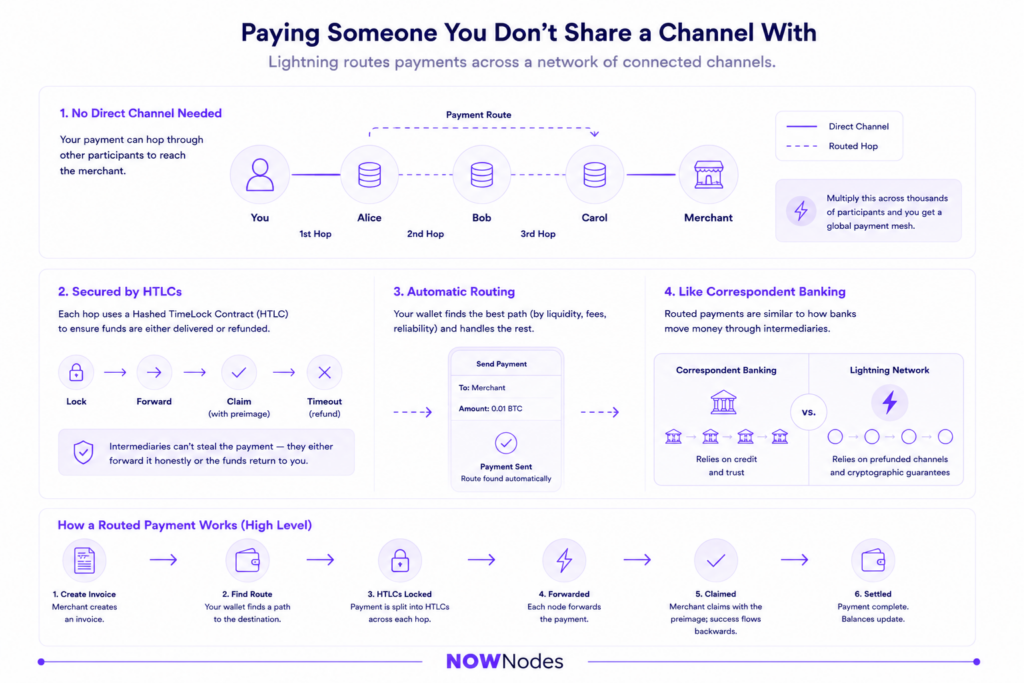
The clever part is that you don’t need a direct channel with everyone you want to pay. If you have a channel with Alice, and Alice has a channel with a merchant, your payment can hop through Alice to reach the merchant. Multiply that across thousands of connected participants and you get a mesh where funds route across several hops to almost anyone.
These hops are held together by a mechanism called a Hashed TimeLock Contract (HTLC). In short, an HTLC uses a cryptographic condition to guarantee that intermediaries either forward the payment honestly or the funds bounce back — nobody along the route can steal them. You can read the exact rules in the open Lightning protocol specifications if you want the mechanics. For everyday use, the takeaway is simple: routing is automatic, and your wallet handles the path-finding.
A useful analogy comes from banking. Routed Lightning payments resemble correspondent banking, where money moves through intermediary institutions rather than a single direct line. The difference is that Lightning uses prefunded channels and cryptographic guarantees instead of credit and trust.
What People Actually Use Lightning For
Early on, this was mostly a micropayments story — tiny amounts that on-chain fees would otherwise make absurd. That’s still a strength, but the real-world uses of the Lightning Network have widened a lot. Here’s where the technology has found genuine traction.
Cross-border remittances are the standout. El Salvador’s state-backed Chivo wallet processed 4.2 million Lightning transactions in 2025, largely remittances and retail purchases. In Africa, Bitnob runs Lightning-based salary payments for remote workers across 23 countries, and Machankura lets people transact over plain SMS on feature phones — no smartphone required. For anyone sending money home across borders, near-instant transfers that cost cents are a real upgrade over legacy transfer fees.
Content tipping has become its own culture. On the Nostr protocol, Lightning-based “zaps” — small tips attached to posts — passed 5 million cumulative transactions by May 2025. Merchant adoption is climbing too: the payments processor CoinGate reported that Lightning made up over 16% of its Bitcoin orders in 2024, up from about 6.5% two years earlier.
Then there’s the exchange side, which is where the volume lives. Coinbase completed its integration in 2024, and by mid-2025 more than 15% of its Bitcoin withdrawals were going out over Lightning. Binance, OKX, Kraken, and Bitget all support it, and Block has been rolling out Lightning to roughly 4 million point-of-sale merchants. These fast BTC Lightning transfers are quietly becoming default plumbing rather than a novelty.
Running Your Own Node: The Honest Trade-offs
You do not need to run anything technical to use Lightning — a wallet is enough. But if you want to route payments, earn fees, or build an application, you can operate your own node. This is where the topic gets genuinely harder, and where a lot of beginners hit walls.
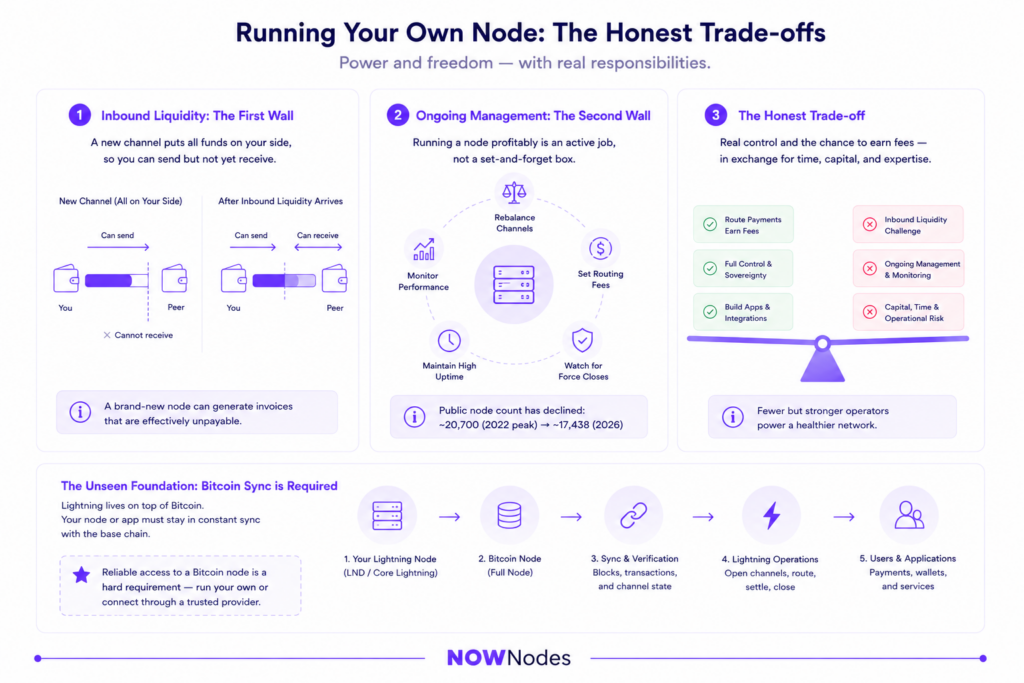
The first wall is inbound liquidity. When you open a fresh channel, all the balance sits on your side, which means you can send but can’t yet receive until capacity flows the other way. As Bitcoin Core developer Matt Corallo has pointed out, a one-click node install can hand you an invoice that’s effectively “unpayable” until it has inbound capacity. It surprises almost everyone the first time.
The second wall is ongoing management. Running a node profitably means rebalancing channels, setting sensible routing fees, watching for “force closes” that can lock funds for days, and keeping uptime high. It’s a real skill, not a set-and-forget box — which is part of why public node counts have actually declined, from a 2022 peak near 20,700 to about 17,438 in 2026, as capital concentrates into fewer, better-run operators.
There’s also an infrastructure point that’s easy to miss. Because Lightning is built directly on Bitcoin, any node or app has to stay in constant sync with the base chain to open channels, verify transactions, and settle closes. That means a reliable connection to a Bitcoin node is a hard requirement — you either run a full node yourself or connect through a provider that maintains one for you. It’s the unglamorous backbone that everything above it depends on.
Where the Network Stands in 2026
After several years of building, the BTC Lightning network has matured into real infrastructure — with real limits. As of May 2026, the network holds around 4,898 BTC in public channel capacity across 41,080 channels and 17,438 nodes, and public capacity hit an all-time high of 5,637 BTC in December 2025. Private channels, which the public figures don’t count, are estimated to hold twice that or more, so the true network is bigger than the headline numbers suggest.
Usage has grown faster than capacity. Monthly Lightning volume crossed $1.17 billion in November 2025 — roughly 266% year-over-year growth — across about 12 million monthly transactions. The technology is also moving upmarket: in February 2026, Secure Digital Markets executed a pilot transfer of around $1 million to Kraken over Lightning, a signal that the rails can carry serious size when liquidity is engineered for it.
Two shifts are worth watching. First, stablecoins have arrived: through Taproot Assets, dollar-denominated tokens like USDT can now move over Lightning rails, which broadens its appeal well beyond BTC-only spending. Second, the mission behind it all remains ambitious. As Lightning Labs CEO Elizabeth Stark has framed it, the goal is “bringing this technology to the next billion people” — turning Bitcoin from a store of value back into everyday money.
Conclusion
Strip away the jargon and the picture is straightforward. The Lightning Network is Bitcoin’s fast lane: a second layer that settles small payments off-chain in under a second for fractions of a cent, while leaning on the base blockchain for the security that makes it all trustworthy. It doesn’t compete with Bitcoin — it finishes the job Satoshi started, making the currency usable for coffee, tips, salaries, and cross-border transfers, not just long-term holding. That, in a sentence, is the Bitcoin Lightning Network explained.
For a newcomer, the on-ramp is a single decision: pick a bitcoin lightning wallet, custodial to start, and send a tiny amount to feel how instant Lightning payments work. For builders and node operators, the deeper challenges — liquidity, routing, and staying synced with the base chain — are where the real work lives. Either way, with over a billion dollars a month now flowing across it, this is no longer an experiment. It’s payment infrastructure that happens to run on Bitcoin.
FAQ
How much does a Lightning payment cost?
Usually a fraction of a cent. Fees are made of a tiny base fee plus a small percentage of the amount routed, which is why the network suits micropayments that would be uneconomical on the base chain. Opening and closing a channel does incur a normal on-chain Bitcoin fee, since those steps are written to the blockchain.
Can I send US dollars over Lightning, or only Bitcoin?
Historically it settled only in BTC, but that’s changing. Through Taproot Assets, dollar-backed stablecoins such as USDT can now move over the same rails, though support is still early and depends on your wallet.
How is paying over Lightning different from using an exchange?
An exchange holds your funds and moves balances inside its own system. Lightning is a peer-to-peer network: you (or your wallet) send value directly to the recipient across payment channels, settling on Bitcoin’s base layer when channels open or close. Many exchanges now let you withdraw over Lightning, which bridges the two.