
An AI coding agent that’s supposed to check a wallet’s balance, read a contract’s state, or broadcast a transaction can’t do any of that on its own — a language model has no live connection to a blockchain by default. Three pieces of infrastructure close that gap in different ways. Model Context Protocol (MCP) gives an agent a live call into chain data, Agent Skills give it a stable procedure to follow once it has that data, and llms.txt helps any AI tool find a project’s documentation in the first place.
A single agent action can touch several chains in one reasoning step, each with its own RPC methods and quirks — NOWNodes alone lists support for 120-plus networks, so wiring an agent into blockchain data is really a fan-out problem, not one API integration. This guide covers how MCP, Agent Skills, and llms.txt each handle a piece of that, from the basic mechanics to the trade-offs that matter once an agent is live.
How Does an AI Agent Actually Reach Blockchain Data?
An agent “talking to a blockchain” sounds abstract until you follow one request end to end. Strip away the terminology, and a single agent action follows a short, mechanical sequence:
- The agent gets a goal, such as checking whether a wallet can cover a 2 ETH payment.
- It calls a tool exposed by a blockchain MCP server — something like
get_balance. - The server translates that into a real RPC call, such as
eth_getBalance, against a node. - The result comes back as plain data the agent reasons over, not a raw response it has to parse itself.
MCP is the layer that makes step two possible without a developer hand-building that translation for every chain and every AI tool. That’s the specific gap it closes, and it’s worth being precise about it, since “the agent talks to the blockchain” hides a few real engineering steps.
What Is MCP (Model Context Protocol)?
MCP is an open standard, introduced by Anthropic in November 2024, that lets an AI model discover and call external tools and data through one interface instead of a custom integration for every pairing. Before MCP, connecting an assistant to a blockchain node and a project-management tool meant writing two separate, incompatible plugins. MCP replaces that with a single specification: any MCP-compatible client can talk to any MCP-compatible server, the same way any browser can talk to any website over HTTP.
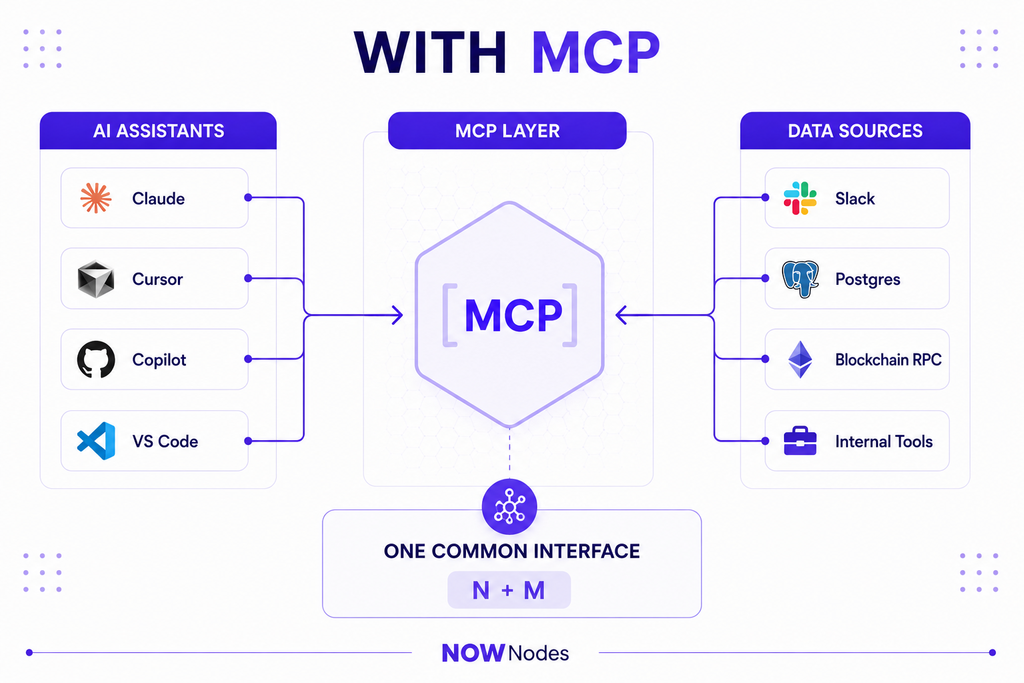
The AI doesn’t need to know the underlying JSON-RPC method name or authentication scheme; it just calls the tool, and the server handles the translation. Some comparisons frame this as agent skills vs. MCP vs. tools, since MCP’s building blocks are literally called “tools” — distinct from the simpler, built-in tool-calling most providers also support for a single hard-coded function.
Dhanji R. Prasanna, CTO at Block, described the goal at MCP’s launch this way: “Open technologies like the Model Context Protocol are the bridges that connect AI to real-world applications…” MCP has since moved beyond Anthropic’s own tools: Google confirmed it would adopt the standard in April 2025, and OpenAI added support to ChatGPT the same year. See the official documentation for the full spec.
What Are Agent Skills, and Where Do They Fit for a Blockchain Team?
Agent Skills are folders — typically one markdown file plus optional scripts — giving Claude step-by-step instructions for a task, loaded automatically only when relevant. Anthropic introduced the format in October 2025. Each skill centers on a file called SKILL.md, built from plain YAML metadata and a body of instructions Claude reads like a procedure manual, and Anthropic’s own documentation describes three loading stages: metadata sits in context at all times at roughly 100 tokens, full instructions load only once a skill is triggered, and reference files stay on disk until actually opened.
For a blockchain team, Skills are built for knowledge that doesn’t change from chain to chain: a checklist for auditing a new contract before mainnet, an address-verification routine, the exact order a team wants its pre-deployment checks run. There’s no server to host and no protocol to implement — just a markdown file describing the procedure, plus whatever scripts the task needs. This is often shortened to Claude agent skills vs. MCP in search, though the format isn’t exclusive to Claude — Anthropic published it as an open specification too.
What Is llms.txt?
llms.txt is a plain markdown file placed at a website’s root that gives AI tools a short, structured map of a site’s content instead of leaving them to parse navigation and ad markup out of raw HTML. Jeremy Howard proposed the format in September 2024; a revised version 2 shipped on August 10, 2026. It’s descriptive, not functional — a signpost, not a tool call — and isn’t specific to Claude or any single model.
For a blockchain project with API references spread across dozens of network-specific pages, publishing one is a low-effort way to make the whole set legible to any AI coding assistant at once. OpenAI, Anthropic, and Google all publish their own llms.txt files, and platforms like Mintlify now generate one automatically for every site they host.
Why Can’t an Agent Just Call a Blockchain’s API Directly?
It can, and plenty of agents still do — MCP is a convenience layer, not the only path in. The problem it solves shows up once an agent needs more than one chain: without a shared interface, closing the gap means hand-building a plugin for every tool-and-data-source pairing, one integration per chain per AI client.
That’s an N-times-M problem: N assistants, M data sources, a custom connector for every combination. MCP collapses it to roughly N-plus-M — build one server per data source, and every MCP-compatible assistant can use it, instead of a developer maintaining a separate integration for Ethereum, one for Solana, and one for every other network a product touches.
That covers the execution half of the problem: reaching live data. The other half is procedural — making sure an agent follows a team’s actual process once it has that data — which is where Skills and llms.txt come in from different angles.
Who’s Building AI Agents on Blockchain Data Today?
The honest answer is anyone building software with an AI agent in the loop, but the split gets clearer once you look at specific blockchain roles. A few patterns show up consistently:
- Wallet and exchange teams reach for MCP when a support agent needs live balances, pending transactions, or deposit confirmations, not static documentation.
- Smart-contract and protocol teams encode Skills for the parts of their process that don’t change chain to chain — a pre-deployment checklist, an audit-writeup style guide, how to verify a contract address before interacting with it.
- Trading and analytics builders typically need both: MCP for the live feed, a Skill for the logic a strategy follows once new data arrives.
- Docs and developer-relations teams publish llms.txt so any AI assistant, not just one wired to a specific MCP server, can find integration guides without scraping styled HTML.
NOWNodes is one concrete example of the first category. Its MCP Server connects assistants including Claude Desktop, Claude Code, Cursor, VS Code, and Windsurf to blockchain API references across 120-plus networks, generating request examples in curl, JavaScript, and Python. It doesn’t hand an agent standing control over a wallet or a chain — it supplies documentation-backed context so a developer can build the right request faster, which matters for developers wiring up node infrastructure generally, not only inside an AI client. For a side-by-side of which provider’s MCP server supports which AI tool, see this comparison across NOWNodes, Chainstack, QuickNode, Alchemy, and Infura — this guide focuses on what MCP, Skills, and llms.txt actually are, not on ranking providers.
Where Do Agent Skills and MCP Diverge?
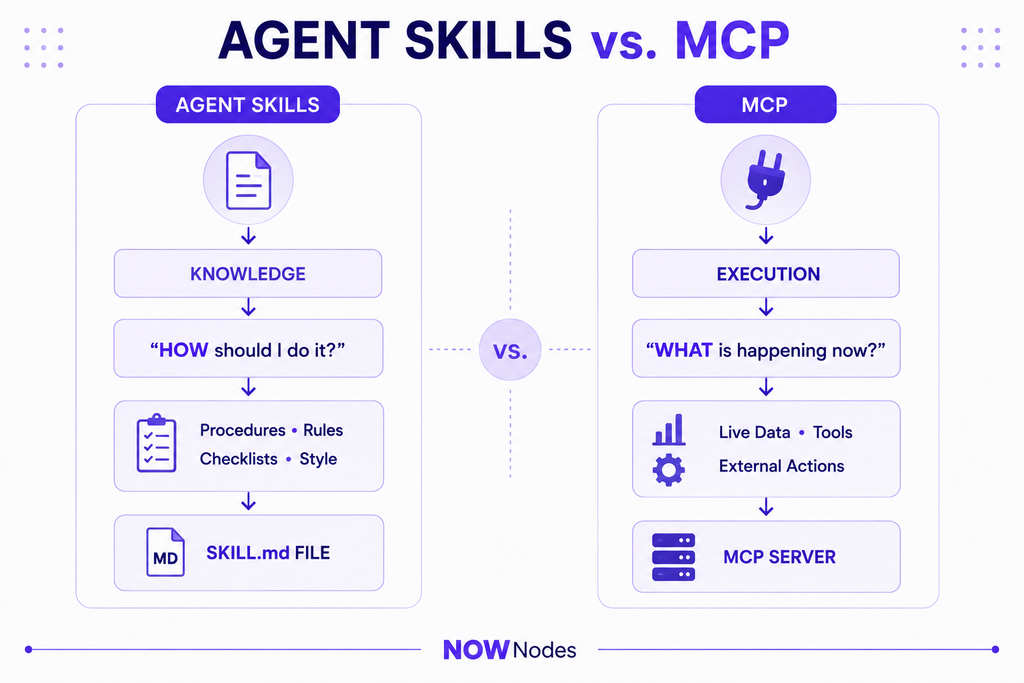
Strip away the implementation details and the agent skills vs. MCP difference comes down to knowledge versus execution. Anthropic’s own developer blog puts it plainly: “MCP connects Claude to data; Skills teach Claude what to do with that data.” One is a live wire to the outside world; the other is a memory of how to use whatever comes through that wire.
| MCP | Agent Skills | |
|---|---|---|
| What it is | An open protocol connecting an agent to external tools and data through a server | A markdown file (SKILL.md) plus optional scripts, loaded on demand |
| Best for | Live, changing data and actions — balances, blocks, broadcasting transactions | Stable, repeatable procedures — checklists, style, workflows |
| Setup | Hosting a server, plus auth and transport configuration | Writing a markdown file; no server or hosting involved |
| Typical context cost | Full tool schemas load upfront — tens of thousands of tokens for a large server | About 100 tokens until triggered, then under 5,000 |
| Maintenance | Centralized — the server owner’s update reaches every connected agent at once | Manual — each file is edited and version-controlled like code |
| Blockchain example | Reading a live balance or broadcasting a signed transaction | Encoding a contract-audit checklist or an address-verification routine |
The context-cost gap is bigger than it sounds in practice. Janakiram MSV explored the skills vs. MCP agent architecture question in The New Stack, measuring a GitHub MCP server’s tool definitions at roughly 23,000 to 50,000 tokens against 200 to 500 tokens for an equivalent skill file — close to two orders of magnitude apart. One real-world setup he cites runs 12 skill files, about 2,000 lines of markdown, connected to 8 separate MCP servers.
Maintenance favors Skills in one specific way: a markdown file lives in a normal git repository and goes through the same pull-request review as any other code, where an MCP server’s behavior changes by editing and redeploying the server itself. Simon Willison, an independent software engineer who writes widely on AI tooling, went further after Skills shipped: “I expect we’ll see a Cambrian explosion in Skills which will make this year’s MCP rush look pedestrian by comparison.”
MCP or Agent Skills: Which Does a Blockchain Team Need First?
The honest answer is “it depends on the job,” but a few rules of thumb make the choice fast. Reach for MCP when an agent needs something true right now: a balance, the current block height, a transaction that has to broadcast. Reach for a Skill when the need is procedural and stable — the same checklist, the same style, the same verification steps every time, regardless of which chain is involved.
In practice, the two compose rather than compete. A contract-audit skill can define the procedure — check the verified source, compare it against a known-vulnerability checklist, flag anything unusual — while calling an MCP server mid-procedure to pull the live contract state it needs. Neither replaces the other; the skill supplies the judgment, the protocol supplies the connection.
None of the three is free of failure modes, either. A skill only fires if Claude matches the task to its description correctly, so a vaguely written skill can simply never trigger. An MCP server is a live dependency — if it goes down, the agent loses that capability until it’s back, whereas an inert skill file just sits there unused. llms.txt, meanwhile, is entirely voluntary: nothing forces a crawler or agent to respect it, so it works as guidance, not access control.
Conclusion
For a blockchain team, the practical starting point is usually MCP, since live chain data is the one thing a generic assistant has no other way to reach. Skills tend to get added once a team notices the same instructions being retyped into every prompt, and llms.txt is worth the half hour it takes to publish either way. None of the three replaces the other two — MCP stays current, Skills stay consistent, and llms.txt just makes sure an AI tool can find the documentation behind both.
FAQ
Is MCP the Same Thing as an API?
Not quite. An API is the interface a service exposes; MCP is a standard way for an AI agent to discover and call whatever APIs a server exposes as “tools,” without custom code for each one. Think of MCP as a common adapter in front of many APIs, not a replacement for them.
Does an MCP Server Work the Same Way on Every Blockchain?
No. Method names and available data differ by chain and interface — a UTXO-based chain like Bitcoin exposes different calls than an EVM chain like Ethereum, and features such as archive data or WebSocket subscriptions aren’t available on every network. A blockchain MCP server has to account for that variation rather than treating every chain identically.
Can Agent Skills Work Without Any MCP Server Connected?
Yes. A skill encoding a writing style, a testing checklist, or a code-review routine needs no live data source, and plenty of skills run entirely on what’s already in the conversation or filesystem. MCP only becomes necessary once the task needs something outside that — a live price, a current balance, an action on a remote system.
Can You Run Your Own MCP Server Instead of Using a Third-Party One?
Yes — MCP is an open specification, and Anthropic publishes SDKs for building a server in Python, TypeScript, and other languages. Teams do this when they need tools tied to internal systems a third-party server wouldn’t reach, such as a proprietary database or deployment pipeline, while still relying on third-party servers for things like blockchain data.
Do I Need to Be a Developer to Write an Agent Skill?
Not necessarily. A skill’s core is a markdown file with plain-language instructions — closer to writing documentation than code — though one with scripts needs someone comfortable writing them. Setting up an MCP server is the bigger technical lift, since it involves hosting, authentication, and an actual running service.