
Lazy minting is a way to create an NFT without paying gas upfront: the creator signs a free, off-chain authorization instead of broadcasting a transaction, and the actual on-chain mint only happens once a buyer completes a purchase. Nothing is written to the blockchain until that first sale goes through.
Here’s the short version: a regular mint costs the creator gas the moment they publish a piece, whether it ever sells or not. A lazy mint costs the creator nothing — the buyer’s transaction covers both the price and the minting gas in one step, and a piece that never sells never touches the chain at all. This guide moves from what that signature-based process looks like to who still uses it, what it costs the buyer, and where it can go wrong.
What Does It Mean to Mint at the Point of Sale?
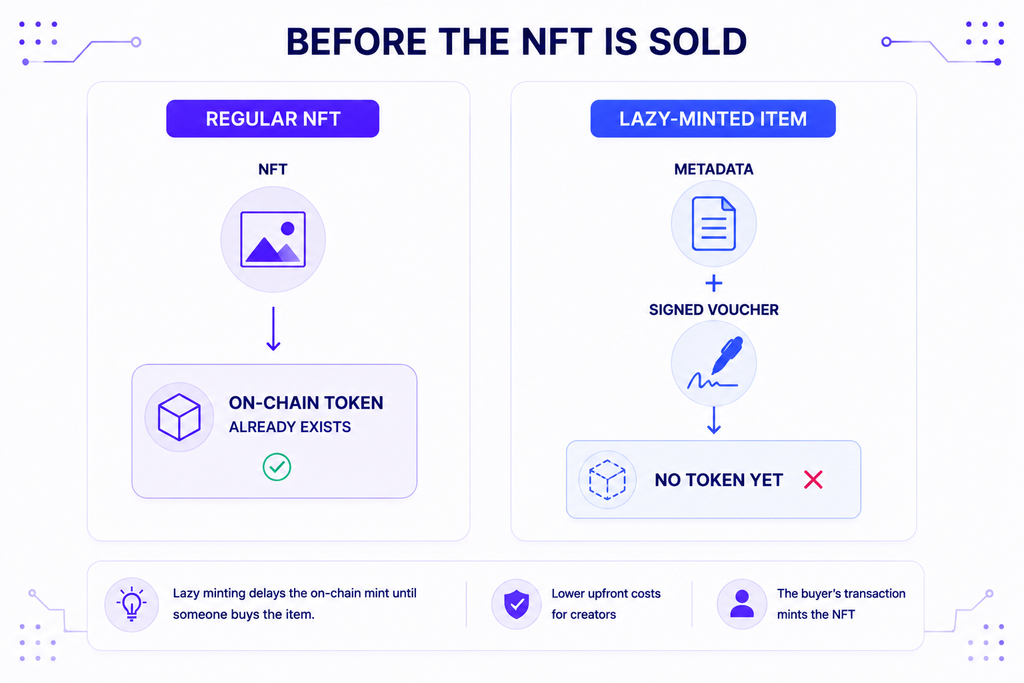
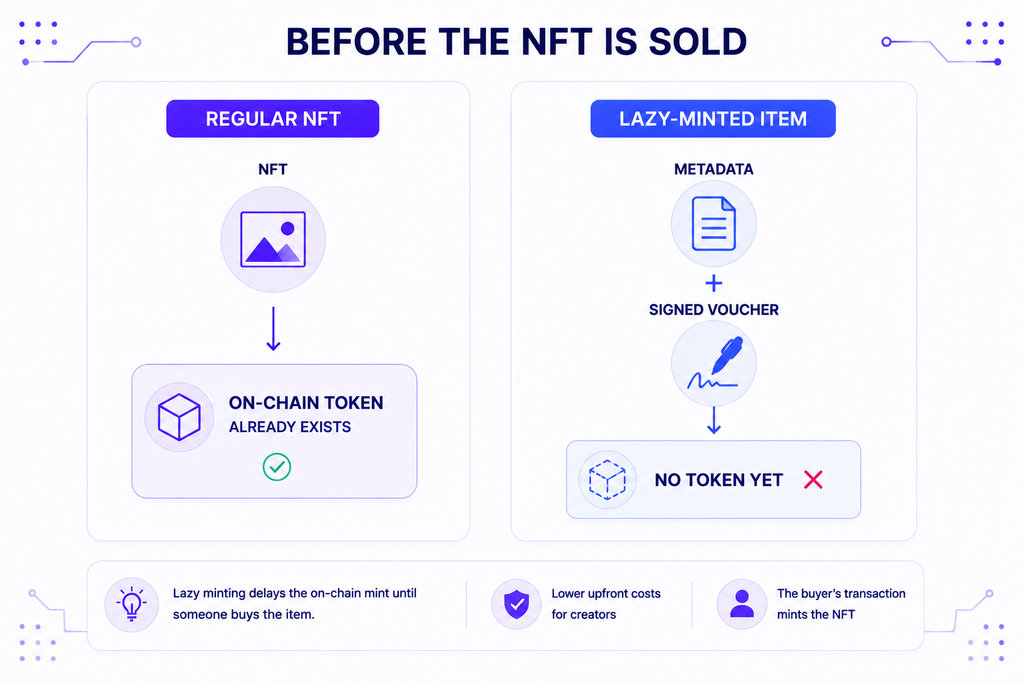
Lazy minting delays the on-chain minting transaction until someone actually buys the NFT, instead of executing it the moment a creator uploads a file. The creator’s only action upfront is signing a message with their wallet — a free, off-chain step, not a transaction — that authorizes a specific token to be created later, on specific terms.
Lazy minting: an NFT creation method where the mint transaction is deferred until the point of sale. The creator signs an off-chain voucher instead of paying gas to mint immediately; the buyer’s purchase transaction executes the mint. See Rarible’s documentation of the mechanism.
OpenSea popularized both the term and the technique. “We call this lazy minting,” the platform wrote in the December 29, 2020 thread announcing its gas-free Collection Manager, adding that the approach “unbundles on-chain issuance from metadata.” That one design choice — letting an item’s metadata exist before the token itself does — is what makes everything else about lazy minting possible.
This is different from a token simply sitting unsold in a wallet. A regularly minted NFT already exists on-chain the moment it’s created, listed or not, but a lazy-minted item isn’t a token yet at all. It’s a signed promise that only becomes one when someone pays for it.
Why Defer the Mint Until Someone Pays?
Lazy minting exists to remove the financial risk of minting pieces that might never sell. Before it existed, publishing an NFT meant paying real gas for the chance a piece would find a buyer, and paying it again for every piece in a collection, sold or not.
That risk got expensive fast whenever Ethereum was busy, and NFT launches are exactly the kind of event that makes a network busy. During the October 2021 NFT boom, the average Ethereum transaction fee reached $151.93 over a 24-hour span and $502 over a trailing 30 days, according to InvestorPlace’s analysis of on-chain data — gas alone ran to roughly 5.23% of the transaction’s total value.
A creator minting a 100-piece collection at those prices risked losing more to gas than they’d earn back if even half the pieces went unsold. Lazy minting removes that bet: pay gas for exactly the pieces that sell, nothing for the rest.
Here’s the honest caveat: Ethereum gas today isn’t what it was in 2021. Mainnet’s average gas price sits around 0.039 gwei as of this writing, keeping most transactions under a cent, according to Etherscan’s live tracker. That doesn’t make lazy minting pointless — it makes it optional on a calm day and worth using again the moment gas spikes, something Ethereum’s fee market has done before and can do again.
Who Actually Uses Deferred Minting?
Lazy minting mainly serves creators who don’t know in advance which of their pieces will sell, which describes most NFT launches. A few groups lean on it hardest:
- Independent artists and PFP projects listing large collections without fronting gas for items that might never find a buyer.
- First-time creators testing whether there’s demand at all before risking their own money.
- Marketplaces that want new users to list a piece without first acquiring ETH just to pay gas.
Not every platform still offers it, though. Support has shifted a lot since 2020:
| Platform | Lazy minting today | Notes |
|---|---|---|
| OpenSea | Retired | Phased out October 3, 2023 in favor of OpenSea Studio, where creators deploy and mint from their own contract immediately. Items lazy-minted earlier still trade normally. |
| Rarible | Active | Rarible’s “Free minting” option currently works only on Ethereum, using Rarible’s own default collection. |
| thirdweb / Manifold | Active, developer-facing | Studios build custom drops on rel=”nofollow noopener noreferrer”signature-based minting contracts instead of a marketplace UI. |
| Solana marketplaces | Rarely offered | Minting already costs a fraction of a cent, leaving little gas risk to defer. |
A large collection is where the math changes most. Ten thousand pieces minted upfront means ten thousand gas payments regardless of demand, while ten thousand lazy-minted vouchers cost the creator nothing until buyers actually show up.
How Does the Signature-to-Token Process Work?
Lazy minting runs on a signature, not a transaction, until a buyer actually pays. The contract on the receiving end is almost always built on the ERC-721 or ERC-1155 standard, just with a signature-verification step bolted onto the mint function.
Here’s the sequence a typical lazy mint follows:
- The creator prepares the NFT’s metadata — the file, name, description, and traits — the same information any mint eventually needs.
- The creator signs an off-chain voucher describing the token and its terms, using their wallet’s private key. No transaction is broadcast, so no gas is spent.
- The marketplace lists the signed voucher as if it were a normal NFT, storing it in its own database rather than on-chain.
- A buyer initiates a purchase, sending one transaction that covers both the item’s price and the gas needed to mint it.
- The smart contract verifies the creator’s signature, mints the token, transfers it to the buyer, and pays the creator, all inside that single transaction.
Only step five ever touches the blockchain. Everything before it is off-chain coordination between a signature and a database entry.
What Is EIP-712, and Why Does It Matter Here?
EIP-712: an Ethereum standard for signing structured, human-readable data off-chain instead of an opaque hash. See the official specification.
Most lazy-minting implementations sign their vouchers using EIP-712, the same typed-data standard behind gasless meta-transactions. It matters because a plain signature can be replayed or misread by the wrong contract, and EIP-712 ties a signature to a specific contract, chain, and set of fields, so a voucher signed for one lazy mint can’t quietly be reused somewhere else.
Deferred Minting vs. Regular Minting
The two approaches produce the same kind of token. They just disagree about timing, and about who carries the risk until it sells.
| Regular minting | Lazy minting | |
|---|---|---|
| Who pays gas | Creator, upfront | Buyer, at the moment of sale |
| When the token exists on-chain | Immediately | Only after the first sale |
| Cost if the piece never sells | Gas already spent | Nothing spent |
| Can terms change before it sells | No — already immutable on-chain | Yes — the voucher can be reissued or withdrawn |
| Visible on other marketplaces before sale | Yes | Usually no, since it isn’t minted yet |
Neither option is strictly better. A creator confident every piece will sell gains little from lazy minting and picks up a dependency on the marketplace’s off-chain listing system instead, while a creator testing demand for 500 speculative pieces faces the opposite calculation entirely.
What Are the Risks of This Approach?
The main risk is fraud. Because listing is free and instant, that same ease extends to anyone copying someone else’s work, not just legitimate creators.
OpenSea confirmed exactly how large that problem got. More than 80% of the items created with its free minting tool were plagiarized works, fake collections, or spam, the company acknowledged in January 2022, according to Gizmodo’s reporting on the statement. OpenSea said it had “recently seen misuse of the feature increase exponentially” before introducing minting limits in response.
There’s a second risk that has nothing to do with bad actors: a lazy-minted item is only a promise until it sells. Because nothing exists on-chain yet, ownership isn’t independently verifiable the way a regularly minted token’s is — a buyer is trusting the marketplace’s off-chain record and the creator’s signature, not a public ledger entry.
That dependency has a practical downside, too. Rarible’s own help documentation notes that a lazy-minted listing stays on its platform indefinitely, and canceling one — “burning” it — means going through Rarible’s support and paying a gas fee, since there’s no on-chain token yet to simply delete.
How Does It Compare to Gasless Meta-Transactions?
Lazy minting isn’t the only pattern that keeps gas out of a user’s hands, it’s just the one built specifically around the mint function. Meta-transactions solve a broader version of the same problem: a user signs off-chain, and a separate relayer broadcasts the transaction and pays the fee.
The difference is who ends up paying, and when. In lazy minting, the buyer pays at the moment of sale, so there’s no third party fronting anything; in an ERC-2771 meta-transaction, a relayer or paymaster covers the gas regardless of whether a sale happens at all, which is why platforms use it for onboarding, gasless voting, and other actions that aren’t a purchase.
A project sponsoring a free NFT claim, rather than a paid mint, is closer to a meta-transaction than to lazy minting, even though both start with an off-chain signature. The mint function is the giveaway: lazy minting only defers cost when a buyer’s payment is what ultimately covers it.
What Infrastructure Does a Signature-Based Minting Platform Need?
A lazy-minting platform runs on the same RPC infrastructure any minting flow needs. Something has to verify a signature is genuine, confirm it hasn’t already been used, and then check that the resulting mint transaction actually landed on-chain once a buyer pays.
Each of those checks is a blockchain read or a broadcast: querying the contract for a used-signature record, submitting the buyer’s transaction, and watching for the confirmation that the token now has an owner. A marketplace running that at any scale is making those calls constantly, not just at the moment a sale closes.
That’s the same infrastructure layer covered in our guide to minting an NFT. A provider such as NOWNodes offers RPC access to Ethereum and 120-plus other networks, so a marketplace’s own backend can make those checks and broadcast the final mint transaction without running and syncing its own Ethereum client.
Conclusion
Lazy minting doesn’t make an NFT cheaper to create. It changes who pays and when: a creator signs a free voucher instead of a paid transaction, and the buyer’s purchase is what actually turns that voucher into a token.
That trade-off made the most sense when Ethereum gas was volatile and expensive, and it still matters anywhere gas spikes or a creator is testing demand for dozens of unproven pieces. It matters less on a chain where minting already costs a fraction of a cent, and it comes with a trade-off of its own: until someone buys, what a collector is looking at is a promise, not a token, which is exactly the gap platforms have had to police against plagiarism and spam.
The question worth asking before using it is simple: does this creator already know their pieces will sell, or are they finding out? Lazy minting exists for the second case.
FAQ
Is Deferred Minting Still Available on OpenSea?
No. OpenSea retired lazy minting on October 3, 2023, replacing it with OpenSea Studio, where creators deploy their own contract and mint immediately. Items lazy-minted before that date still exist and trade normally.
Does Signature-Based Minting Work the Same Way on Every Blockchain?
Not really, since it mainly matters on chains where gas is expensive enough to bother deferring. Rarible’s version currently works only on Ethereum, and low-fee chains like Solana rarely implement it since there’s little cost left to defer.
Can an Unsold Voucher Be Edited or Canceled?
Usually, yes, since nothing is on-chain yet to make immutable. The creator can typically update or withdraw a listing through the marketplace, though some platforms charge a small fee to formally cancel one and remove it from their system.
Is a Signed-but-Unminted NFT Safe to Buy?
It depends on trusting the creator and the marketplace’s listing, since there’s no on-chain history to check before the sale happens. The same precaution applies as with any NFT: buy from verified creator accounts and official collection links, not an unsolicited offer.
Do I Need to Know How to Code to Use This Method?
No, not on a marketplace like Rarible, where signing the voucher happens automatically through the normal wallet-connect flow. Coding becomes necessary only when building a custom drop on a signature-based minting contract instead of using an existing marketplace.