
The optimistic virtual machine, or OVM, is the execution environment Optimism built to run Ethereum smart contracts on a Layer-2 rollup while still supporting fraud proofs on Layer 1. The OVM meaning boils down to one design goal: let a contract run off-chain exactly as it would on Ethereum, but leave a way to replay and check that execution on Ethereum if someone disputes the result.
That sounds simple. In practice it was hard enough that Optimism eventually retired its own OVM and rebuilt the network around something closer to plain Ethereum. Understanding what is Optimistic Virtual Machine, and why it didn’t survive in its original form, says a lot about how optimistic rollups evolved between 2019 and today.
This guide walks through what the OVM actually did, why Optimism needed a custom virtual machine in the first place, who used it, and what took its place once the approach hit its limits.
Why Did Optimism Need a Separate Virtual Machine at All?
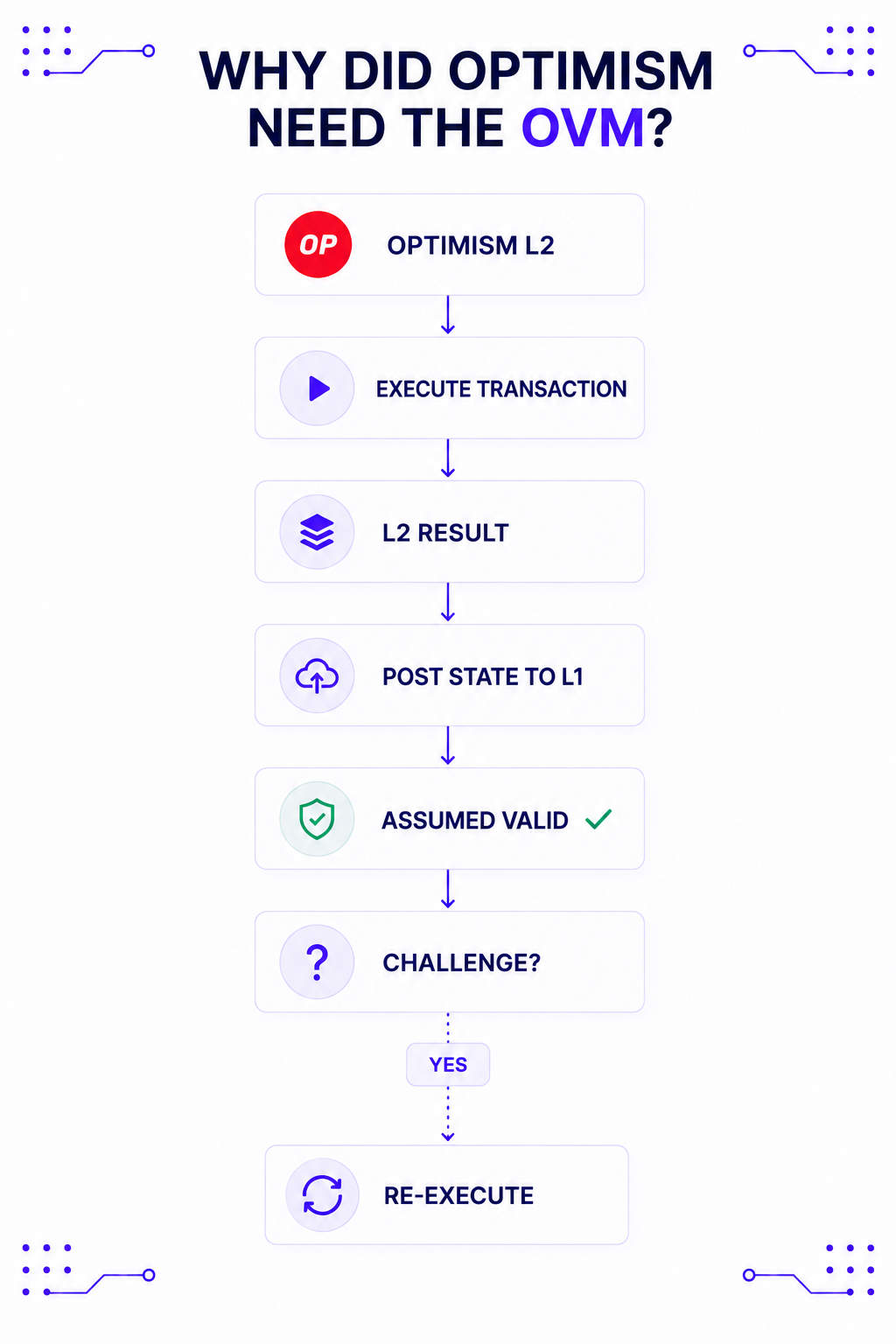
An optimistic rollup processes transactions off-chain and only occasionally posts a compressed summary back to Ethereum. Ethereum accepts that summary as correct by default, then gives anyone a window to challenge it if they think the operator made a mistake.
That challenge is where the trouble starts. Proving a challenge means re-executing the disputed transaction on Ethereum itself, and Ethereum’s own EVM has no idea it’s supposed to be simulating a different chain.
Optimistic rollup: a Layer-2 scaling design that assumes transaction batches are valid by default and relies on a fraud-proof challenge period, rather than upfront cryptographic proof, to catch bad results. See ethereum.org’s optimistic rollup documentation.
Here’s the specific snag. A smart contract that reads block.timestamp on Layer 2 gets the L2 block’s timestamp. Redeploy that exact same contract to Ethereum for a fraud-proof check, and it reads Ethereum’s timestamp instead — a different number, which can produce a different, “correct-looking” result that doesn’t match what actually happened on L2.
Optimism’s engineering team summed up the core problem plainly in their own technical writeup: “nesting Ethereum transactions within each other is incredibly tricky — especially when the L2 transaction wasn’t even meant for the L1 chain in the first place,” as they explained in the OVM Deep Dive post. The OVM was the answer to that specific problem, not scaling in general — Ethereum already had other L2 designs, like zk-rollups, tackling the same throughput ceiling a different way.
How Did the OVM Actually Work?
Rather than rewriting the EVM from scratch, Optimism built the OVM as a layer that sat on top of a modified Geth client and intercepted the handful of operations that behave differently between L1 and L2. Three components did the real work.
The Execution Manager Virtualized Chain-Specific Opcodes
The Execution Manager sat between a contract and the raw EVM, intercepting roughly 15 opcodes whose result depends on which chain they run on — TIMESTAMP, NUMBER, SLOAD, SSTORE, and similar chain-context or storage instructions. Instead of returning Ethereum’s native value, it returned the virtualized L2-equivalent value, computed identically whether the code was executing on L2 or being replayed on L1 during a dispute.
The Purity Checker Blocked Unsafe Contracts
A contract that skipped the Execution Manager and called a raw opcode directly would break that guarantee — it might read the wrong chain’s state during a replay. The Purity Checker enforced that every deployed contract routed its chain-dependent calls through the Execution Manager before it was allowed onto the network at all.
The Transpiler Hid the Complexity From Developers
Manually rewriting every contract to call virtualized functions instead of native opcodes wasn’t realistic for developers already comfortable with Solidity. A solc-transpiler converted standard EVM bytecode into OVM-compatible bytecode automatically, so a developer could deploy ordinary Solidity code without knowing the virtualization layer existed underneath it.
Who Used the OVM, and Who Relies on Its Successor Today?
DeFi protocols and application developers who wanted lower Ethereum fees were the OVM’s original audience — Synthetix and Uniswap were among the earlier projects that deployed on Optimism while it still ran the Optimistic Virtual Machine directly. The pitch was straightforward: keep writing Solidity, get L2 fees, and trust that fraud proofs would catch anything wrong.
That audience hasn’t changed even though the underlying execution engine has. Traders, DeFi protocols, and consumer apps still pick optimistic rollups like OP Mainnet, Base, and Arbitrum specifically because they run near-identical EVM semantics to Ethereum with minimal code changes, which matters more to most teams than a faster challenge period.
Any of those applications still needs a reliable way to actually reach the chain — reading balances, submitting transactions, watching for new blocks. NOWNodes provides RPC access to OP Mainnet, Base, and Arbitrum alongside more than 120 other supported networks, so a team building across several optimistic rollups isn’t stitching together separate node infrastructure for each one.
OVM vs. EVM vs. zkEVM: How Do the Execution Models Compare?
Each of these three environments makes a different trade-off between speed, safety, and complexity. None is a strict upgrade over the others — the right choice depends on what a network is optimizing for.
| EVM (Ethereum L1) | OVM (Optimism’s original L2 VM) | zkEVM | |
|---|---|---|---|
| Validity check | Every node re-executes every transaction | Assumed valid; disputed via fraud proof if challenged | Proven correct upfront with a cryptographic proof |
| Finality | Immediate, by consensus | Only after the challenge window closes | Minutes to hours, once the proof verifies |
| Compatibility | Native | Required bytecode transpilation | Varies by implementation; some are near-fully EVM-equivalent |
| Implementation complexity | Baseline | Moderate — custom opcode virtualization | Higher — requires a proving system |
The OVM’s core trade-off against plain EVM execution was speed for certainty: a single sequencer could write new state almost instantly, but that state wasn’t truly final until nobody challenged it during the dispute window. Against a zkEVM, the OVM was simpler to build and cheaper to run, but it couldn’t offer the same immediate cryptographic finality a validity proof provides. For a fuller breakdown of how fraud proofs and validity proofs each secure a rollup, see NOWNodes’ comparison of the two models.
Why Did Optimism Retire the OVM for EVM Equivalence?
The OVM worked, but it created real friction that grew heavier over time. Optimism’s team documented the shift plainly in their October 2021 announcement, Introducing EVM Equivalence.
Three problems stood out. Tooling fragmentation meant Solidity, Vyper, and Hardhat maintainers had to build and support separate OVM-specific versions of their own developer tools, a burden most small teams couldn’t sustain indefinitely. Client diversity suffered too, since every OVM-specific modification made it harder to adopt newer or alternative Ethereum clients like Erigon down the line. And virtualizing opcodes added gas overhead compared to Ethereum’s already hyper-optimized EVM implementation, making Optimistic Virtual Machine transactions costlier than they needed to be.
Optimism’s conclusion was that “complete compliance with the Ethereum yellow paper” — full EVM equivalence, not just compatibility — was the more sustainable target. That decision reshaped the network’s entire architecture.
What Replaced the OVM? Bedrock and the Cannon Fault-Proof VM
The Bedrock upgrade, which went live on OP Mainnet in June 2023, is what actually retired the Optimistic Virtual Machine in production. Instead of virtualizing opcodes inside contracts, Bedrock runs an essentially unmodified Ethereum execution client and moved the L1-vs-L2 differences out of the contract layer entirely.
Fraud proving needed its own replacement too, and that’s Cannon: a Fault Proof Virtual Machine that resolves disputes by executing MIPS64 instructions instead of EVM opcodes. Rather than trying to make Ethereum understand an L2 transaction directly, Cannon compiles the entire node’s execution logic down to a MIPS instruction set that a small on-chain verifier contract can check one instruction at a time.
Permissionless, governance-approved fault proofs went live on OP Mainnet on June 10, 2024, bringing the network to L2Beat’s Stage 1 decentralization classification — anyone can now challenge an invalid state without needing special permission. As of this writing, OP Mainnet secures roughly $1.57 billion in value locked, smaller than Base’s $13.07 billion or Arbitrum One’s $11.56 billion, though all three currently share that same Stage 1 rating on L2Beat’s live scaling summary, so check it directly for a current snapshot.
How Does a Fraud-Proof Dispute Actually Get Resolved?
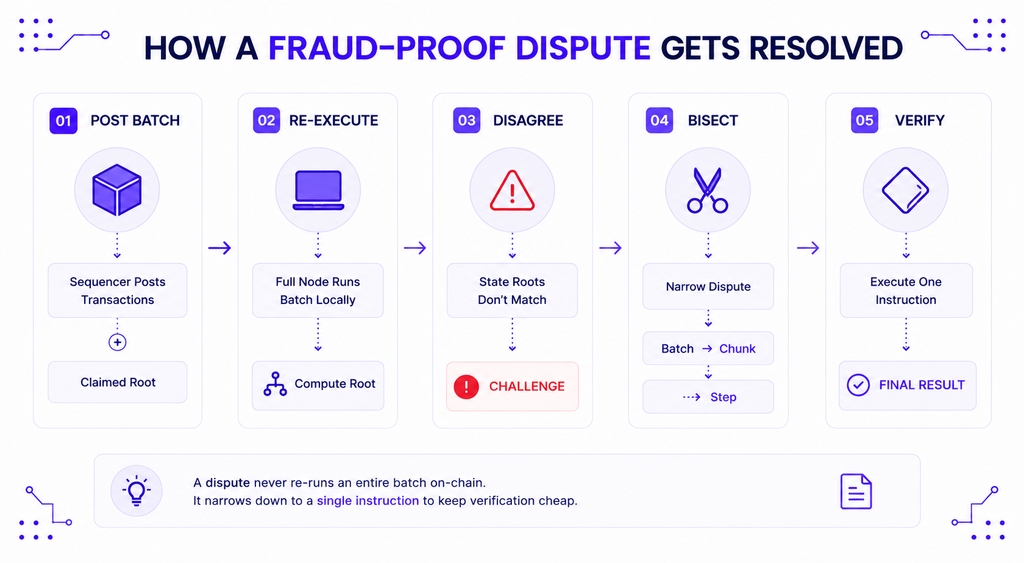
Both the old Optimistic Virtual Machine and its Cannon-based successor share the same basic dispute shape, even though the execution details changed underneath. A dispute never re-runs an entire batch on Ethereum — that would defeat the purpose of a rollup in the first place.
- A sequencer posts a batch of transactions and a claimed new state root to Ethereum.
- Anyone running a full node can re-execute that batch locally and compare the result.
- If the results disagree, a bisection game narrows the dispute — splitting the batch into smaller chunks until both sides agree on everything except a single instruction.
- Only that one instruction gets executed on Ethereum, keeping the on-chain verification cheap regardless of how large the original batch was.
This is critical: the whole design assumes at least one honest, watchful participant exists to raise a challenge when something’s wrong. No challenge during the window means the result is treated as final — not because it was proven correct, but because nobody proved it wrong.
Conclusion
The OVM was Optimism’s answer to a narrow but stubborn problem: how do you let Ethereum verify a Layer-2 transaction that was never meant to run on Layer 1 in the first place? Virtualizing chain-specific opcodes solved that problem well enough to launch a working rollup, but the tooling burden and gas overhead it created eventually outweighed the benefit.
Bedrock and Cannon solved the same underlying problem differently — running near-native Ethereum execution and pushing dispute resolution down to a general-purpose instruction set instead of the EVM itself. For anyone building on an optimistic rollup today, the OVM is mostly history, but it’s the history that explains why OP Mainnet, Base, and every other OP Stack chain look the way they do now.
FAQ
Is the OVM Still Used on Optimism Today?
No. Optimism replaced it in production with the June 2023 Bedrock upgrade, which runs a near-unmodified Ethereum execution client instead of virtualizing opcodes through a custom OVM layer.
Does the OVM Still Matter If Optimism No Longer Runs It?
Yes, mainly for understanding rollup history and architecture decisions. Several other OP Stack-based chains and early forks were built around the same OVM concepts before the ecosystem standardized on Bedrock’s EVM-equivalent approach.
What Is the Difference Between the OVM and the Current OP Stack?
The OVM was a specific execution engine that virtualized L1/L2 differences inside contract bytecode. The OP Stack is the broader, modular framework Optimism now maintains, which includes Bedrock’s execution layer and the Cannon fault-proof system as separate components.
Can a Contract Written for the Original OVM Run on OP Mainnet Now?
Generally yes, without the OVM-specific modifications it once needed. Bedrock’s EVM equivalence means most contracts deploy the same way they would on Ethereum mainnet, without the transpilation step the original OVM required.