
QuickNode is a blockchain infrastructure company that gives developers hosted access to RPC nodes across roughly 79 blockchains and 135+ networks, so applications can read and write blockchain data without running that infrastructure themselves. Instead of syncing a Solana validator or an Ethereum full node, you send requests to a QuickNode endpoint and get balances, transactions, or contract state back. It’s one of several providers solving the same problem, alongside NOWNodes, Alchemy, and Infura, and the differences between them come down to pricing structure and how each one weighs raw feature depth against predictable cost.
What Is QuickNode, Exactly?
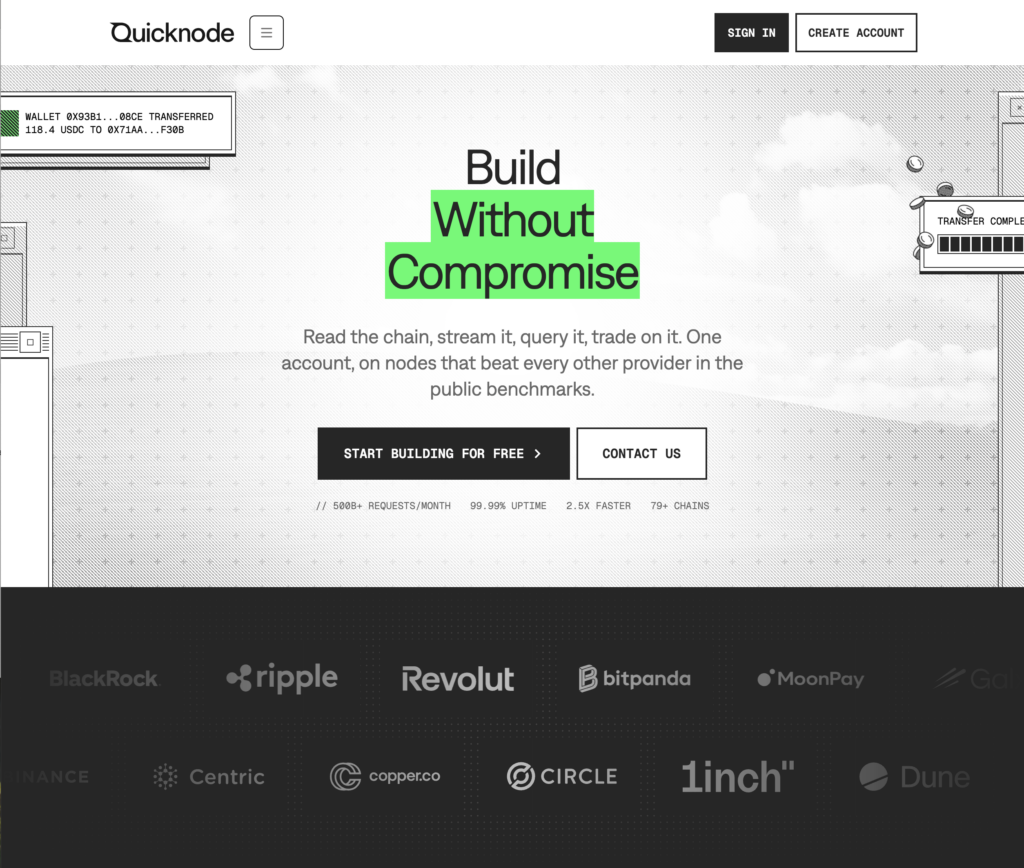
QuickNode was founded in 2017 by Alex Nabutovsky, Dmitry Shklovsky, Auston Bunsen, and Manuel Kreutz, and it launched publicly in 2020. The company operates managed RPC nodes on behalf of customers and wraps them in a dashboard, endpoint-monitoring tools, and a marketplace of add-ons.
A remote procedure call (RPC) is a way of asking a server to run a function and return the result over a network, and it’s the mechanism every blockchain client — Geth, Erigon, Solana’s Agave — uses to expose data. QuickNode’s core product is that RPC layer, billed through a credit system rather than a flat per-request rate, which is the detail that shapes almost everything else about using the platform.
The company raised a $60 million Series B in 2021 at an $800 million valuation, led by 10T Holdings with Tiger Global and SoftBank’s SB Opportunity Fund among the participants. That funding backed the expansion from a handful of chains to its current multi-chain footprint.
Why Do Developers Need a Provider Like QuickNode?
Running your own node is a real infrastructure commitment, not a config file. A synced Ethereum full node needs roughly 650–700 GB of disk and keeps growing, and it has to be patched through every protocol upgrade the network ships — the same operational burden covered in more depth in what RPC nodes and endpoints actually do.
QuickNode’s co-founder Auston Bunsen described that maintenance load directly in an interview with Sacra: “You have to deal with server upgrades, protocol upgrades, etc. and the same thing applies to blockchains. The London Hard Fork, the Berlin Hard Fork, the merge, etc.” Each of those events means a client update and a resync before production traffic can safely touch the new version.
A provider absorbs that work. You get an authenticated endpoint, the provider keeps the node software current, and your team writes application logic instead of babysitting servers. QuickNode currently states it processes more than 500 billion requests a month across its customer base, according to its own homepage statistics.
Who Actually Uses QuickNode?
QuickNode’s tooling — Streams, Functions, endpoint analytics — points at teams building request-heavy, often trading-adjacent products rather than simple backends.
- Trading bots and MEV-aware applications, which need low latency and high request throughput during volatile market windows.
- NFT platforms and marketplaces, pulling metadata and ownership data at scale during mint events.
- Analytics platforms and indexers, using Streams to pipe real-time and historical blockchain data into S3 or PostgreSQL instead of polling RPC endpoints directly.
- DeFi protocols and Solana-native apps, both markets where QuickNode has built a visible customer base, including analytics platform Dune, which the company says scaled from 16 to 91 supported chains on QuickNode infrastructure within 12 months.
A wallet that only checks balances and broadcasts transactions is a lighter case. It touches a small slice of what QuickNode’s add-on marketplace offers, and that unused surface area is worth weighing against what a flatter-priced provider would charge for the same job — the comparison this article gets to below.
QuickNode’s Core Products
Past the base RPC endpoint, QuickNode sells a set of products aimed at different stages of a data pipeline.
Core RPC API
The base product: authenticated JSON-RPC and WebSocket access across QuickNode’s supported chains, with endpoint-level analytics and method-based rate limiting on higher tiers. This is the layer most applications actually touch day to day.
Streams
Streams is a real-time and historical data pipeline that pushes blockchain events to a destination — webhooks, Amazon S3, or PostgreSQL — with server-side filtering, so an application doesn’t have to poll for new blocks itself. It currently covers 60+ networks and is aimed at teams building indexers or analytics dashboards.
Functions and add-on marketplace
Functions let developers run custom logic (JavaScript or Rust) close to the data layer instead of shipping it as a separate backend service. The marketplace layers in third-party add-ons for things like NFT metadata, gas estimation, and compliance screening, billed on top of the base plan.
Dedicated clusters
Enterprise customers can move onto dedicated infrastructure with burst capacity QuickNode advertises at up to 50,000 requests per second. This tier is not available on the standard published plans — it requires a custom Enterprise agreement.
How Much Does QuickNode Cost?
QuickNode prices its standard plans by monthly API credits rather than a flat request count, and separately caps requests per second by tier.
| Plan | Monthly price | Credits | RPS | Support |
|---|---|---|---|---|
| Free Trial | $0 | 10M | 15 | Community |
| Build | $49 | 80M | 50 | 24 hours |
| Accelerate | $249 | 450M | 125 | 12 hours |
| Scale | $499 | 950M | 250 | 8 hours |
| Business | $999+ | 2B | 500 | 8 hours |
| Enterprise | Custom | Custom | Custom | Premium |
Prices shown are standard monthly rates; QuickNode discounts roughly 15% for annual billing. Figures are current as of publication — check QuickNode’s pricing page before budgeting against them, since plans and limits change.
How the credit system works
QuickNode’s own documentation defines the formula as “Method Responses x Multipliers = API Credits,” where multipliers apply only to valid 200-status responses and vary by method. A light call like a balance check costs fewer credits than a heavier one like a log scan, which mirrors the compute-unit model other providers use — Alchemy weights its own calls the same way.
That method-weighted approach is more granular than flat billing, but it also means two apps sending an identical number of requests can land on different bills depending on which methods dominate their traffic. Overage beyond the monthly credit allowance is billed at $0.50 to $0.62 per million additional credits depending on tier, and usage over $200 on paid plans is billed immediately rather than waiting for the next cycle.
Archive and log retention is tiered too: Free and Build plans keep logs for one hour, Accelerate through Business extend that to a day, and only Enterprise gets 14 days. A team relying on historical log data for debugging needs to plan around that window rather than assume it’s available by default.
QuickNode’s Performance and Compliance Claims
QuickNode advertises 99.99% uptime and average Ethereum response times around 83 milliseconds on its marketing pages, positioning itself as roughly 2.5 times faster than unnamed competitors. Those are self-reported marketing figures rather than an independently audited benchmark, so they’re worth testing against your own workload and region rather than taken as a universal guarantee.
On the compliance side, QuickNode states SOC 1, SOC 2, and ISO 27001 certification, which matters for regulated customers — exchanges and payment platforms in particular — that need documented security controls before they’ll sign a vendor contract.
QuickNode vs. NOWNodes: Which Fits Your Project?
This is where the two providers actually diverge, and it’s not really about raw speed. It’s about pricing predictability and how wide the chain coverage needs to run.
| Factor | QuickNode | NOWNodes |
|---|---|---|
| Pricing model | Credit-based, method-weighted | Flat request quota per plan |
| Free tier | 10M credits, 15 RPS | 100,000 requests, 15 RPS |
| Network coverage | ~79 chains / 135+ networks | 120+ networks, including Bitcoin, Monero, and other non-EVM chains |
| Add-on tooling | Streams, Functions, marketplace add-ons | Market Data API, MCP Server, gRPC streaming |
| Dedicated infrastructure | Enterprise-only clusters | Available from mid-tier plans, no predefined RPS cap |
| Log/archive retention | 1 hour to 14 days by tier | Archive access on supported networks |
The practical difference shows up the moment your traffic mix gets heavy on expensive methods. Because credits are weighted per method, a getLogs-heavy indexing job can burn through QuickNode’s allowance faster than the headline credit number suggests, and the resulting bill is genuinely hard to forecast month to month.
NOWNodes prices its shared plans by flat request count instead — a Start plan with 100,000 free requests, scaling to a Business tier with 30 million requests a month for a fixed price — so a team can predict its bill from request volume alone, without modeling which specific RPC methods it calls most. That’s a structurally different trade, not automatically a better one: predictable pricing means you’re not rewarded for a workload skewed toward cheap calls.
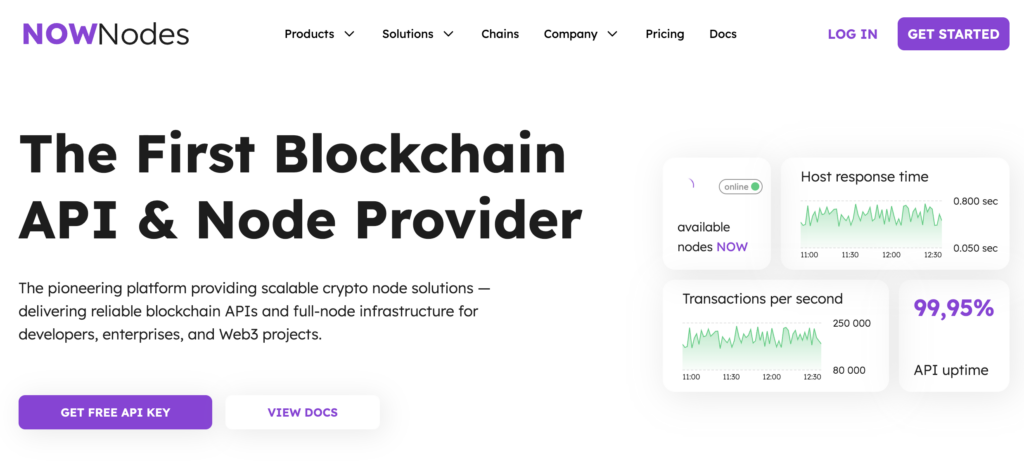
Chain coverage is the other real gap. QuickNode’s 79-chain list leans heavily EVM and Solana-ecosystem, which covers most trading and DeFi use cases well. NOWNodes covers 120+ networks under one API key, including Bitcoin, Litecoin, Dogecoin, and privacy-focused chains like Monero and Zcash — chains a multi-asset wallet or exchange needs but that sit outside QuickNode’s core EVM/Solana focus.
For a team that needs deep Solana tooling, indexing pipelines through Streams, or enterprise burst capacity, QuickNode’s feature depth is a genuine advantage worth paying credit-based rates for. For a wallet, exchange, or payment platform juggling a wide non-EVM chain list on a budget that needs to be forecastable, NOWNodes tends to be the more practical starting point — a case covered in more detail in the broader Ethereum RPC provider comparison.
Switching Between Providers Is Rarely a Rewrite
Because JSON-RPC is a standardized protocol, moving between QuickNode, NOWNodes, or any other compliant provider is usually an endpoint and API-key change, not an application redesign. Bunsen made this point himself in the same Sacra interview: “Most of the libraries are open source and provider-agnostic, so switching cost is almost nonexistent.”
That’s a useful fact to sit with before committing to any single vendor’s ecosystem lock-in. Running a staging environment against a second provider for a week is usually enough to compare latency, credit consumption, and real invoice size against your actual traffic, not the marketing page’s best-case numbers.
Limitations Worth Knowing Before You Commit
The credit system is QuickNode’s biggest planning risk. A method-weighted model rewards light, simple calls and penalizes heavier ones unpredictably, so the advertised credit count on any plan is a starting estimate, not a guaranteed runway for a getLogs-heavy or archive-dependent workload.
Log and archive retention windows are short on the lower tiers — one hour on Free and Build — which limits how much post-incident debugging you can do without upgrading. And while 135+ networks sounds broad, the list is concentrated in EVM and Solana chains; a product that also needs Bitcoin-family or privacy-coin support should check the current network list rather than assume coverage.
None of this makes QuickNode a weak product — its uptime claims, Streams pipeline, and Solana-specific tooling are real strengths for the audience it’s built for. The mismatch only shows up when your project’s chain list or budget model doesn’t match that audience.
Conclusion
QuickNode is a strong fit for trading bots, NFT platforms, and Solana- or EVM-heavy products that need deep tooling and can absorb a credit-based bill that scales with method complexity. Its Streams pipeline and endpoint analytics genuinely save engineering time for teams building indexers from scratch.
For a project where chain breadth and predictable monthly cost matter more than method-level tooling, NOWNodes is worth benchmarking directly against QuickNode before you commit — particularly if Bitcoin, Litecoin, or non-EVM assets sit anywhere on your roadmap. Since switching between standards-compliant providers costs little more than an endpoint change, there’s no real reason to decide without testing both against your own traffic first.
FAQ
Is QuickNode free to use?
QuickNode’s Free Trial plan includes 10 million API credits a month at up to 15 requests per second on a single endpoint. It’s enough for prototyping, but production traffic with method-heavy calls will exhaust that allowance quickly.
How many blockchains does QuickNode support?
QuickNode currently states support for 79 blockchains across 135+ networks, according to its own network page. Coverage changes over time and leans toward EVM and Solana-ecosystem chains, so check the current list before building against a specific network.
What is a QuickNode API credit?
A credit is QuickNode’s billing unit, calculated as the method response multiplied by a per-method multiplier, counted only on successful (200-status) responses. Heavier methods, like log scans, consume more credits per call than a simple balance check.
Is QuickNode better than NOWNodes?
Neither is universally better. QuickNode offers deeper add-on tooling and Solana-specific infrastructure billed by method-weighted credits, while NOWNodes uses flat request quotas and covers a wider set of non-EVM chains, including Bitcoin and Monero, under one API key.
Can I use QuickNode and another RPC provider together?
Yes, and it’s a common production pattern. Running a second provider as failover means a rate-limit spike or outage on one endpoint doesn’t take the whole application down with it.