
NOWNodes gives you API access to 120+ blockchain networks under one flat-rate account, while Chainstack and Alchemy solve the same basic problem in narrower, pricier ways. Chainstack leans on request-unit billing and a compliance layer built for regulated buyers; Alchemy leans on compute-unit billing and a bundled NFT and token API layer for consumer apps. For most teams building across more than one chain — or that just want a predictable bill — NOWNodes’ broader coverage and flat pricing end up doing more for less than either alternative.
What Are NOWNodes, Chainstack, and Alchemy, Exactly?
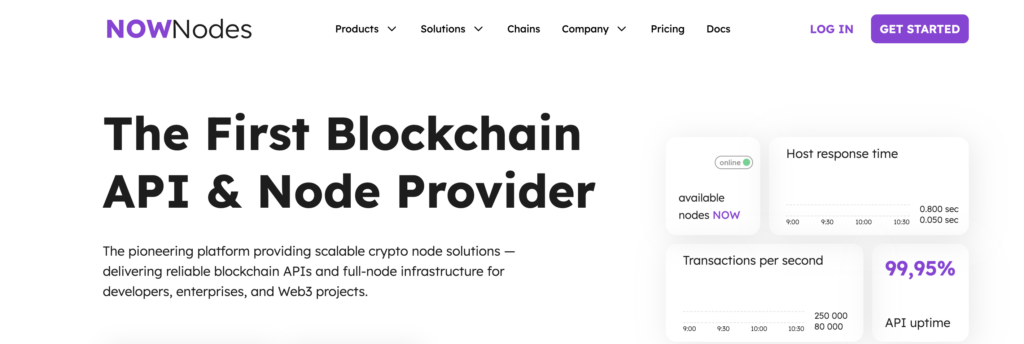
NOWNodes is a blockchain infrastructure provider that gives developers API-based access to shared and dedicated nodes across 120+ networks, from Bitcoin and Ethereum to Solana, Polygon, and privacy coins like Monero. You get an endpoint and an API key, and NOWNodes runs the client software behind it.
Chainstack is a managed blockchain infrastructure company, founded in 2018, that hosts endpoints across 70+ networks and layers compliance tooling — SOC 2 Type II and ISO 27001 certifications — on top. Alchemy is a Web3 development platform, founded in 2017, that operates RPC nodes on more than 100 chains and adds its own tooling: enhanced NFT and token APIs, webhooks, and a usage dashboard.
All three describe themselves as infrastructure, but they emphasize different things. NOWNodes leads with chain breadth and flat pricing, Chainstack leads with compliance documentation, and Alchemy leads with a developer platform built around consumer Web3 products.
RPC (remote procedure call) is the mechanism underneath all three services: a way of asking a remote server to run a function, such as “return this address’s balance,” and getting the result back over the network. Every blockchain client exposes its data this way, which is why an application can move between providers without rewriting its core logic, as ethereum.org’s JSON-RPC documentation explains.
Why Do You Need a Provider Like This at All?
Running your own node is a real operational job, not a side task. A synced Ethereum full node currently needs roughly 650–700 GB of disk and keeps growing, and it has to be patched and resynced through every protocol upgrade the network ships.
A managed provider takes that maintenance off your plate. You get an authenticated endpoint, the provider keeps the client software current and the hardware scaled, and your team spends its time on application logic instead of server operations — whether that means NOWNodes’ flat-rate shared plans, Chainstack’s request-unit billing, or Alchemy’s compute-unit billing.
Mohammad Zahwy, Chief Business Development Officer at NOWNodes, put the underlying goal plainly in an interview with crypto.news: the aim is to “make blockchain infrastructure simple, fast, and reliable so builders can focus on building, rather than on node maintenance, syncing, and DevOps overhead.” That’s the shared pitch behind all three providers — the difference is how each one prices and scopes the work it takes off your hands.
Who Actually Uses NOWNodes, Chainstack, and Alchemy?
NOWNodes attracts teams whose product spans several blockchains at once — wallets, exchanges, and payment platforms that need Bitcoin, Ethereum, and a dozen other chains under a single account rather than a separate vendor per network. Trading tools and monitoring systems leaning on WebSocket or gRPC streaming fit the same profile, and a flat request quota means the bill doesn’t move just because a workload gets heavier.
Chainstack’s customer list — Circle, Trust Wallet, Ripple, TradingView, and Anchorage Digital among them — points at a narrower buyer: a regulated or larger organization that needs documented security posture alongside blockchain access, not just an API key. Alchemy’s own positioning, and its enhanced NFT and token APIs, points at a different kind of team again: one building a consumer-facing product where blockchain data becomes a polished screen, not just a backend value.
| Use case | NOWNodes | Chainstack | Alchemy |
|---|---|---|---|
| Multi-chain wallet or exchange (BTC + ETH + others) | Yes — one account, 120+ networks | Requires checking non-EVM coverage first | Requires checking non-EVM coverage first |
| Regulated fintech needing SOC 2 / ISO 27001 | Not published | Yes — built into every plan | Not published |
| NFT marketplace needing metadata indexing | Possible, but you index it yourself | Possible, but you index it yourself | Yes — built-in NFT API |
| Trading bot needing predictable monthly cost | Yes — flat request quota | Depends on method mix | Depends on method mix |
| Backend that only checks balances and broadcasts transactions | Yes — lighter, cheaper fit | Works, but pays for unused compliance tooling | Works, but pays for unused NFT/token tooling |
A team that just reads balances and sends transactions rarely touches the layer Chainstack or Alchemy charge extra for — and that gap is worth weighing before committing to the pricier option.
Pricing: Flat Quotas, Request Units, and Compute Units
This is where the three diverge the most. NOWNodes’ shared plans bill on a flat request-quota model: pick a monthly tier, get a fixed number of requests, and every call — light or heavy — counts the same against that number.
Chainstack bills through request units (RUs), a weight assigned to each method based on how much server-side work it takes to answer. Alchemy bills through compute units (CUs), the same idea under a different name: a light call like eth_blockNumber costs far less than a heavier one like eth_getLogs, according to Alchemy’s own compute unit reference.
| Plan tier | NOWNodes (flat quota) | Chainstack (request units) | Alchemy (compute units) |
|---|---|---|---|
| Free | 100,000 requests/month, 1 API key | 3M RUs/month, 25 RPS | 30M CUs/month, 25 RPS |
| Entry paid | ~€20/month, 1M requests, 3 API keys | $49/month, 20M RUs, 250 RPS | Pay-as-you-go, $0.525/1M CUs, from 300 RPS |
| Mid tier | ~€200/month, 30M requests, 25 API keys | $199/month, 80M RUs, 400 RPS | Scales with CU consumption |
| Enterprise | ~€500/month, 100M requests, 100 API keys | $990+/month, 400M RUs, custom RPS | Custom, from 1,000 RPS |
Both competitors also sell dedicated infrastructure: Chainstack’s dedicated nodes start near $678 a month, and Alchemy’s enterprise tier is custom-quoted. NOWNodes configures a dedicated node per network with no fixed RPS cap. Pricing changes often on all three sides, so treat this table as a snapshot to re-verify against Chainstack’s pricing page and Alchemy’s pricing page before budgeting.
The practical difference is predictability. A flat quota costs the same dollar amount whether those requests were balance checks or heavy log scans, while an RU or CU bill shifts with whatever methods your app happens to lean on that month.
Network and Feature Coverage
NOWNodes advertises 120+ blockchain networks, including non-EVM chains like Bitcoin, Dogecoin, Litecoin, and Monero alongside Ethereum, Solana, and other EVM chains. Chainstack lists 70+ networks, skewing toward EVM-compatible chains plus Solana. Alchemy lists 100+ chains, broad but also EVM- and Solana-heavy.
That gap matters more for some products than others. An EVM-only dApp won’t notice much difference in raw chain count, but a wallet or exchange that also needs Bitcoin, Litecoin, or a privacy coin will find several of those missing from both competitors — something NOWNodes’ node directory covers under a single account instead.
Feature-for-feature, the three overlap on the essentials, with real differences at the edges:
- RPC and WebSocket access — all three support this on their major networks.
- Archive data and Debug/Trace APIs — available on all three, gated to specific plans and networks.
- gRPC streaming — NOWNodes offers multichain streaming across 25+ blockchains with sub-200ms latency; Chainstack and Alchemy offer comparable streaming, chain-dependent.
- Compliance certifications — Chainstack publishes SOC 2 Type II and ISO 27001; neither NOWNodes nor Alchemy advertises equivalent certifications on public pages.
- Enhanced NFT/token APIs — an Alchemy specialty; neither NOWNodes nor Chainstack indexes this layer for you.
- Market data — a NOWNodes product covering 9,000+ cryptocurrencies and 90+ fiat assets; not part of either competitor’s core offering.
Chainstack vs. Alchemy vs. NOWNodes at a Glance
| NOWNodes | Chainstack | Alchemy | |
|---|---|---|---|
| Network coverage | 120+ blockchains, including Bitcoin, Litecoin, Monero | 70+ blockchains, mostly EVM plus Solana | 100+ chains, EVM- and Solana-heavy |
| Pricing model | Flat request quota | Request units, tiered | Compute units, method-weighted |
| Free tier | 100,000 requests/month | 3M RUs/month, 25 RPS | 30M CUs/month, 25 RPS |
| Entry paid plan | ~€20/month | $49/month | Pay-as-you-go |
| Compliance certifications | Not published | SOC 2 Type II, ISO 27001 | Not published |
| Standout extra | Market data, multichain gRPC | Enterprise compliance tooling | NFT/token indexing APIs |
| Best fit | Multi-chain products, cost-predictable teams | Regulated enterprises | Consumer NFT/wallet apps |
How Hard Is It to Switch Between Them?
Because JSON-RPC is a standardized protocol, moving core traffic between any of the three is usually a configuration change, not a rewrite. Auston Bunsen, co-founder of QuickNode, described the dynamic plainly in an interview with Sacra: “I can go from Alchemy to Infura to QuickNode relatively quickly, unless I’m using one of their sort of custom APIs.”
That caveat is the whole story. An app built purely against eth_getBalance and eth_sendRawTransaction can point at a new endpoint with a URL and key change. An app leaning on Alchemy’s getNftsForOwner or Chainstack’s compliance-gated dedicated clusters has real migration work to do if it ever needs to leave, because those features don’t have direct equivalents elsewhere.
Which One Should You Choose?
Is NOWNodes better than Chainstack and Alchemy for a multi-chain product? Generally, yes — one account covering 120+ networks, including non-EVM chains, under a flat request quota is simpler and more predictable than running either competitor plus a second provider to fill chain gaps.
Is Chainstack worth the extra cost for a regulated enterprise? For that specific case, its published SOC 2 and ISO 27001 certifications save a vendor-review headache, provided the narrower chain list and higher entry price fit the project.
Is Alchemy worth it for a consumer NFT or wallet app? Its built-in NFT and token APIs save real indexing work, as long as the app stays within Alchemy’s supported chains and the team accepts compute-unit billing that’s harder to forecast than a flat quota.
For the large majority of teams building wallets, exchanges, trading tools, or backends that need reliable multi-chain access, NOWNodes’ combination of broader coverage and simpler, cheaper pricing is the more practical starting point. The other two only pull ahead on a specific, narrower requirement — compliance paperwork or NFT tooling — that most projects never actually need.
Limitations Worth Knowing Before You Commit
Chainstack’s request-unit model rewards light, simple calls and penalizes heavier ones; a workload leaning on log scans or contract traces can burn through a monthly allowance faster than the headline RU number suggests. Its narrower, EVM-heavy network list is also worth checking carefully if Bitcoin-family or privacy coins are part of the roadmap.
Alchemy’s compute-unit model has the same shape, and its NFT and token tooling is baked into every plan’s pricing whether or not your app ever calls it. Both competitors’ dedicated and enterprise tiers also start well above NOWNodes’ entry point — Chainstack near $678 a month for dedicated nodes, Alchemy’s enterprise tier custom-quoted from 1,000 RPS.
NOWNodes’ flat quota removes the method-weighting guesswork but comes with its own ceiling: once you exceed a plan’s request allowance, overage rates apply regardless of whether those extra requests were cheap or expensive to serve. It also doesn’t publish the compliance certifications that some enterprise buyers require during procurement, and its webhook product currently covers only Bitcoin and Dogecoin address-balance changes rather than general-purpose events.
None of the three is a universal answer. A regulated custodian with a compliance mandate may reasonably choose Chainstack despite the cost, and a consumer NFT platform may reasonably choose Alchemy despite the pricier billing model — but nearly everyone else building a multi-chain product gets more for less with NOWNodes.
Conclusion
All three providers solve the same underlying problem — connecting an application to a blockchain without the team running a node — but they’re priced and scoped for different buyers. NOWNodes covers more networks, including the non-EVM chains both competitors skip, under a flatter and cheaper pricing model, which is why it’s the more practical default for wallets, exchanges, and multi-chain backends. Chainstack earns its higher price only when a SOC 2 or ISO 27001 certificate needs to exist on paper for a compliance team, and Alchemy earns its compute-unit pricing only when NFT or token indexing is a core part of the product. Since standard RPC calls migrate between providers with little more than a URL change, testing NOWNodes against your actual traffic for a week is cheaper than guessing which one fits.
FAQ
Is NOWNodes cheaper than Chainstack and Alchemy?
At the entry level, yes — NOWNodes’ paid tier starts around €20 a month against Chainstack’s $49 Growth plan and Alchemy’s pay-as-you-go billing, which has no flat starting price at all. NOWNodes’ flat quota also keeps costs predictable regardless of which methods you call, while both competitors’ method-weighted billing can climb quickly for heavier calls.
Do Chainstack or Alchemy support Bitcoin?
Neither covers Bitcoin, Litecoin, or privacy coins like Monero the way a broader multi-chain provider such as NOWNodes does. Both skew toward EVM-compatible networks and Solana, so check each provider’s current network list before assuming coverage for a specific non-EVM chain.
Is Chainstack or Alchemy worth it for a small team or side project?
Usually not. Most of what differentiates each one — Chainstack’s SOC 2 documentation and dedicated clusters, Alchemy’s NFT and token APIs — goes unused at that scale, and a flatter-priced, broader-coverage provider typically covers the same core need for less.
Can I run NOWNodes alongside Chainstack or Alchemy?
Yes. Running two providers side by side — one as primary, one as failover, or split by chain — is a common production pattern that limits how much a single provider’s outage or rate-limit spike can affect your app.
Which of the three is easiest to migrate away from later?
NOWNodes and Chainstack, since neither locks core functionality behind proprietary APIs the way Alchemy’s NFT and webhook endpoints do. Standard JSON-RPC calls move between any of the three with a URL and key change; it’s the provider-specific extras that require rebuilding elsewhere.