
NOWNodes, Chainstack, and QuickNode all solve the same underlying problem — connecting an application to a blockchain without anyone on your team running the underlying node — but they price, scope, and target that access in three different ways. NOWNodes covers 120+ networks under a flat monthly request quota, including Bitcoin, Litecoin, and other non-EVM chains that its two competitors don’t touch. Chainstack and QuickNode both concentrate on EVM-compatible chains and Solana, billing through weighted units that charge more for heavier calls.
For a team building a wallet, exchange, or payment platform that spans several chains at once, that difference in scope tends to matter more than either competitor’s tooling. NOWNodes’ broader non-EVM coverage and simpler flat pricing generally do more with less, while Chainstack and QuickNode each carve out a narrower niche — one in compliance documentation, the other in Solana-specific add-ons.
What Are NOWNodes, Chainstack, and QuickNode?
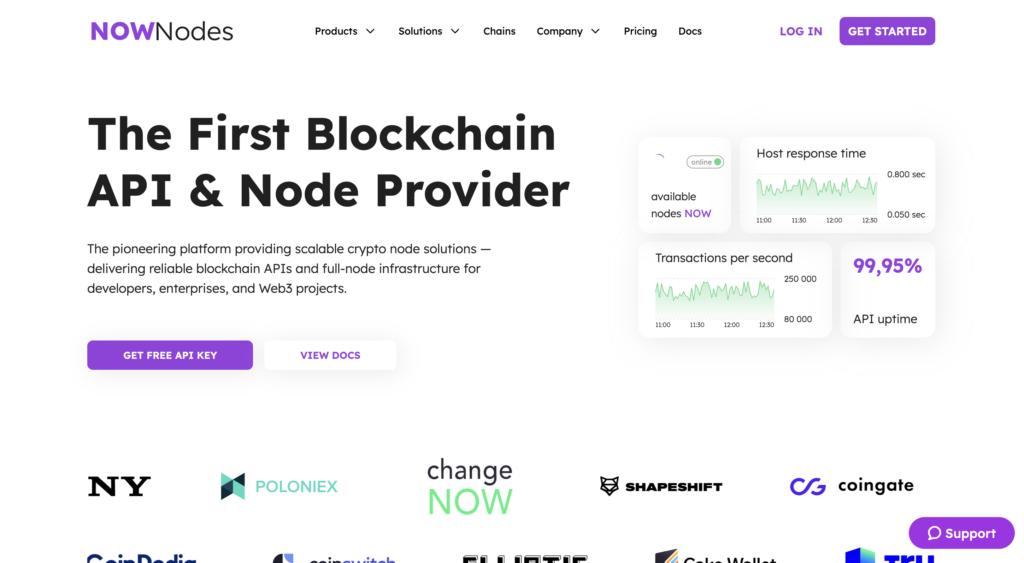
NOWNodes is a blockchain infrastructure provider that gives developers API access to shared and dedicated nodes across 120+ networks, from Bitcoin and Ethereum to Solana, Polygon, and privacy coins like Monero. You get an endpoint and an API key, and NOWNodes keeps the client software behind it synced and running.
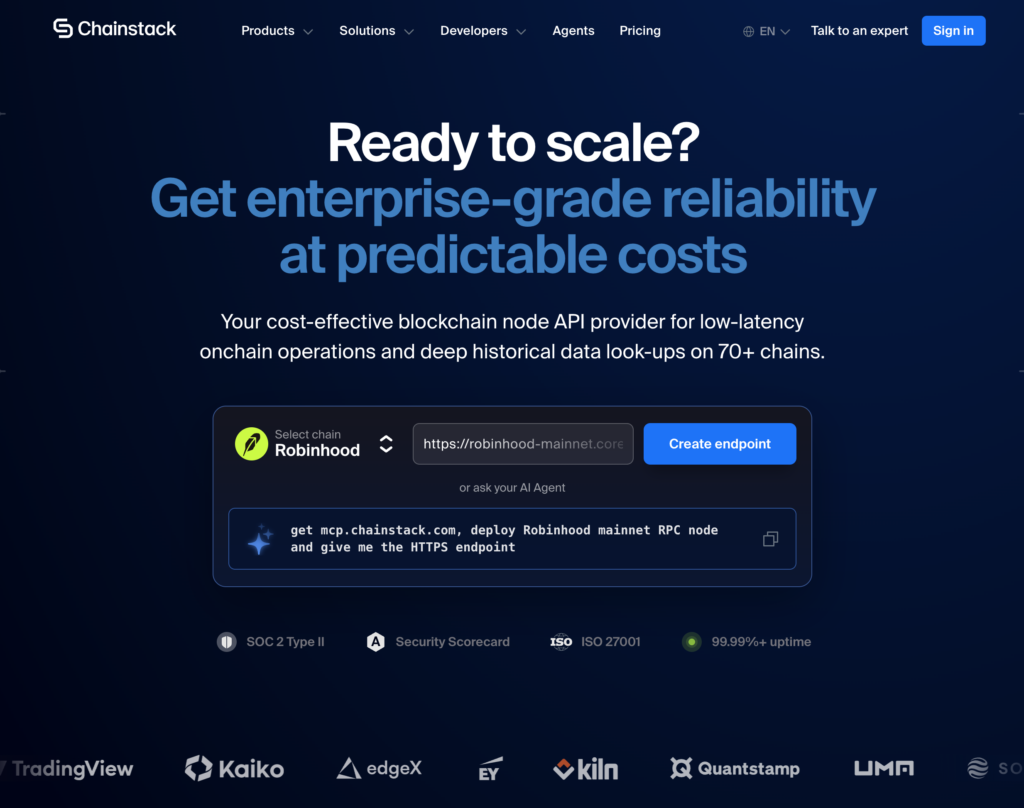
Chainstack is a managed infrastructure company, founded in 2018, that hosts endpoints across 70+ networks and layers compliance tooling — SOC 2 Type II and ISO 27001 certifications — on top. It positions itself toward regulated enterprises that need documented security posture, not just an API key.
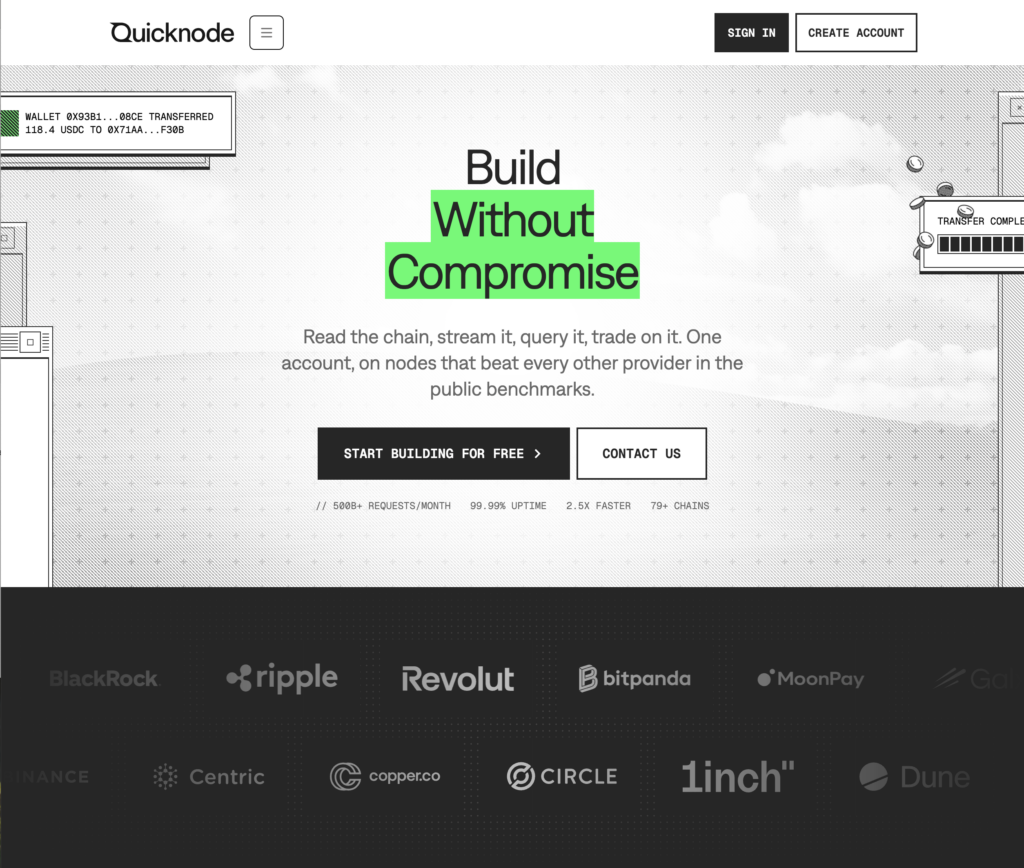
QuickNode, founded in 2017 and launched publicly in 2020, covers roughly 79 blockchains across 135+ networks. It wraps its endpoint access in a dashboard, an indexing product called Streams, and a marketplace of add-ons for things like NFT metadata and gas estimation.
RPC (remote procedure call) is the mechanism underneath all three services: a way of asking a remote server to run a function, such as “return this address’s balance,” and getting the result back over the network. Every blockchain client exposes its data this way, which is why an application can move between providers without rewriting its core logic, as ethereum.org’s JSON-RPC documentation explains.
Why Do You Need a Managed Provider Like These?
Running your own node is a genuine operational job, not a background task. A synced Ethereum full node currently needs roughly 650–700 GB of disk space and keeps growing, and it has to be patched and resynced through every protocol upgrade the network ships.
A managed provider takes that maintenance off your plate. You get an authenticated endpoint, the provider keeps the software current and the hardware scaled, and your team spends its time on application logic instead of server operations.
Mohammad Zahwy, Chief Business Development Officer at NOWNodes, put the underlying goal plainly in an interview with crypto.news: the aim is to “make blockchain infrastructure simple, fast, and reliable so builders can focus on building, rather than on node maintenance, syncing, and DevOps overhead.” That’s the pitch behind all three providers — the difference is how each one prices and scopes the work it takes off your hands.
Who Actually Uses Each Provider?
NOWNodes attracts teams whose product spans several blockchains at once — wallets, exchanges, and payment platforms that need Bitcoin, Ethereum, and a dozen other chains under a single account rather than a separate vendor per network. Trading tools and monitoring systems that lean on WebSocket or gRPC streaming fit the same profile, and a flat quota means the bill doesn’t move just because a workload gets heavier.
Chainstack’s customer list — Circle, Trust Wallet, Ripple, TradingView, and Anchorage Digital among them — points at a narrower kind of buyer: a regulated or larger organization that needs documented security posture alongside blockchain access. Its SSO, dedicated clusters, and compliance paperwork go largely unused at a smaller scale.
QuickNode’s tooling — Streams, Functions, endpoint analytics — points at request-heavy, often trading-adjacent products: MEV-aware bots, NFT marketplaces during mint events, and analytics platforms piping blockchain data into a database instead of polling for it. Its own case studies cite analytics platform Dune scaling from 16 to 91 supported chains on its infrastructure within 12 months.
| Use case | NOWNodes | Chainstack | QuickNode |
|---|---|---|---|
| Multi-chain wallet or exchange (BTC + ETH + others) | Best fit — 120+ networks, one account | Requires checking non-EVM coverage first | Requires checking non-EVM coverage first |
| Regulated fintech needing SOC 2 / ISO 27001 | Not published | Best fit — built into every plan | Available on paid tiers |
| Real-time indexing pipeline into a database | Possible, self-built | Possible, self-built | Best fit — built-in Streams product |
| Predictable monthly cost regardless of call mix | Best fit — flat request quota | Depends on which methods dominate | Depends on which methods dominate |
| Solana-native app needing deep ecosystem tooling | Possible | Possible | Best fit — a QuickNode specialty |
A backend that only checks balances and broadcasts transactions rarely touches the layer that Chainstack or QuickNode charge extra for, and that unused surface area is worth weighing before committing to either.
How Do Their Prices Compare?
This is where the three diverge the most. NOWNodes’ shared plans bill on a flat request-quota model: pick a monthly tier, get a fixed number of requests, and every call — light or heavy — counts the same against that number.
Chainstack and QuickNode both bill by a weighted-unit system instead. Chainstack calls its unit a request unit (RU); QuickNode calls its unit an API credit, defined in its own documentation as “Method Responses x Multipliers.” In both models, a light call like a balance check costs less than a heavier one, such as a log scan, so the same nominal quota can drain at very different speeds depending on what your app actually calls.
| Plan tier | NOWNodes (flat quota) | Chainstack (request units) | QuickNode (credits) |
|---|---|---|---|
| Free | 100,000 requests/mo, 1 API key | 3,000,000 RUs/mo, 25 RPS | 10,000,000 credits/mo, 15 RPS |
| Entry paid | ~€20/mo, 1M requests, 3 keys | $49/mo, 20M RUs, 250 RPS | $34–49/mo, 80M credits, 50 RPS |
| Mid tier | ~€200/mo, 30M requests, 25 keys | $199/mo, 80M RUs, 400 RPS | $424–499/mo, 950M credits, 250 RPS |
| Enterprise | ~€500/mo, 100M requests, 100 keys | $990+/mo, 400M RUs, custom RPS | $849–999+/mo, 2B credits, 500 RPS |
Both Chainstack and QuickNode also sell dedicated infrastructure separately — Chainstack’s starts around $678 a month, according to its own pricing page — while NOWNodes configures a dedicated node per network with no fixed RPS cap. Pricing changes often across all three, so treat this table as a snapshot to re-verify before budgeting. The practical takeaway is predictability: a flat quota costs the same whether those requests were balance checks or heavy log scans, while a weighted-unit bill shifts with whatever methods your app happens to lean on that month.
Network and Feature Coverage: Who Covers the Most Chains?
Does any of the three cover meaningfully more blockchains than the others? Yes — NOWNodes’ 120+ networks include non-EVM chains like Bitcoin, Dogecoin, Litecoin, and Monero, while Chainstack’s 70+ and QuickNode’s roughly 79 both concentrate on EVM-compatible chains plus Solana.
That gap matters more for some products than others. An EVM-only application won’t notice much difference in raw chain count between the three, but a wallet or exchange that also needs Bitcoin, Litecoin, or a privacy coin will find several of those missing from both competitors — something NOWNodes’ node directory covers under a single account instead.
Feature-for-feature, the three overlap on the basics and differ at the edges:
- RPC and WebSocket access — supported by all three on their major networks.
- Archive data and Debug/Trace APIs — available on all three, gated to specific plans and networks.
- Indexing and streaming — QuickNode’s Streams product is a genuine specialty; NOWNodes offers multichain gRPC streaming across 25+ blockchains with sub-200ms latency; Chainstack offers gRPC data delivery on a chain-dependent basis.
- Compliance certifications — Chainstack and QuickNode both publish SOC 2 and ISO 27001; NOWNodes doesn’t advertise equivalent certifications on its public pages.
- Market data — a NOWNodes product covering 9,000+ cryptocurrencies and 90+ fiat assets isn’t matched by either competitor’s core offering.
Does Compliance Documentation Actually Matter for Your Project?
Should you pick a provider based on its compliance certifications? Only if a compliance mandate — not a preference — requires it. Chainstack and QuickNode both publish SOC 2 and ISO 27001 documentation, which is a real requirement for exchanges, custodians, and other regulated buyers going through vendor security review.
That documentation is priced into every plan on both platforms, whether or not a given customer’s use case requires it. A team without a compliance mandate is paying for paperwork it will never open, and NOWNodes’ broader non-EVM coverage at a lower entry price is the more direct route to the same underlying node access.
How Hard Is It to Switch Providers Later?
Because JSON-RPC is a standardized protocol, moving core traffic between NOWNodes, Chainstack, and QuickNode is usually a configuration change, not a rewrite. QuickNode co-founder Auston Bunsen made this point in an interview with Sacra: “Most of the libraries are open source and provider-agnostic, so switching cost is almost nonexistent… unless I’m using one of their sort of custom APIs.”
That caveat is the whole story. An application built against standard methods like eth_getBalance and eth_sendRawTransaction can point at a new endpoint with a URL and key change. An app that leans on QuickNode’s Streams pipeline or Chainstack’s dedicated tooling has real migration work ahead if it ever needs to leave, because those specific features don’t exist the same way elsewhere.
Chainstack vs. QuickNode vs. NOWNodes at a Glance
| NOWNodes | Chainstack | QuickNode | |
|---|---|---|---|
| Network coverage | 120+, including Bitcoin, Litecoin, Monero | 70+, mostly EVM plus Solana | ~79 chains / 135+ networks, EVM plus Solana |
| Pricing model | Flat request quota | Request units, tiered | API credits, method-weighted |
| Free tier | 100,000 requests/mo | 3M RUs/mo, 25 RPS | 10M credits/mo, 15 RPS |
| Entry paid plan | ~€20/mo | $49/mo | ~$34–49/mo |
| Compliance certifications | Not published | SOC 2, ISO 27001 | SOC 1, SOC 2, ISO 27001 |
| Standout product | Market data, multichain gRPC | Compliance, dedicated clusters | Streams indexing, Solana tooling |
| Best fit | Multi-chain products, cost-predictable teams | Regulated enterprises | Indexing pipelines, Solana-native apps |
Which One Should You Choose?
For most teams building wallets, exchanges, trading tools, or backends that need reliable multi-chain access, NOWNodes’ combination of broader non-EVM coverage and simpler, flatter pricing is the most practical starting point — you can check current plans before committing to anything pricier.
Chainstack pulls ahead only when a SOC 2 or ISO 27001 report has to sit in a vendor-review folder, a real requirement for some regulated buyers but an unnecessary cost for almost everyone else. QuickNode makes sense when your product is a Solana-native application or an indexing pipeline that would otherwise take real engineering time to build from scratch, and your budget can absorb a bill that scales with method complexity.
Conclusion
NOWNodes, Chainstack, and QuickNode all give applications API access to blockchain nodes, but they’re scoped for different buyers. NOWNodes covers more networks — including the non-EVM chains its two competitors skip — under a flatter, cheaper pricing model, which is why it’s the more practical default for wallets, exchanges, and multi-chain backends.
Chainstack earns its higher price only when compliance paperwork needs to exist on record for a security review, and QuickNode earns its keep mainly on Solana-heavy or indexing-dependent products willing to trade pricing predictability for bundled tooling. Since standard RPC calls migrate between all three providers with little more than a URL change, testing each against your actual traffic for a week is cheaper than guessing which one fits before you commit.
FAQ
Is NOWNodes cheaper than Chainstack and QuickNode?
At the entry level, yes — NOWNodes’ paid tier starts around €20 a month against Chainstack’s $49 and QuickNode’s roughly $34–49, for a broadly comparable request volume. NOWNodes’ flat quota also keeps costs predictable regardless of which methods you call, while both competitors’ weighted-unit pricing can climb quickly for heavier calls.
Do Chainstack or QuickNode support Bitcoin?
Neither does, in the way a broader multi-chain provider does. Chainstack’s 70+ chains and QuickNode’s roughly 79 both skew toward EVM-compatible networks and Solana, leaving out Bitcoin, Litecoin, and privacy coins like Monero, which NOWNodes covers under one account.
Can I use more than one of these providers at the same time?
Yes. Running two providers side by side — one as primary, one as failover, or split by chain — is a common production pattern that limits how much a single provider’s outage or rate-limit spike can affect your app.
Which provider is best for a small team or side project?
NOWNodes’ free tier and flat entry pricing generally cost less for light, exploratory traffic, and its broader chain list avoids a second vendor if the project later needs a non-EVM chain. Most of what Chainstack and QuickNode differentiate on — compliance documentation, Streams, dedicated clusters — goes unused at that scale.
How is Chainstack different from QuickNode on features?
Chainstack differentiates mainly on compliance certifications and dedicated infrastructure for a narrower set of chains. QuickNode differentiates on its Streams indexing product and deeper Solana-specific tooling, both billed through the same style of method-weighted credit system.