
Chainlink CCIP, LayerZero, and Wormhole all do the same basic job: they carry tokens and data from one blockchain to another. The real difference is who checks that a message is genuine before it executes on the other side, and how much of that checking you get to control.
That single question — the verification model — is worth understanding before you pick one. Cross-chain bridges have been among the most expensive failure points in crypto. Between February and August 2022, three bridge exploits drained more than $1.1 billion from users. When you compare these protocols, you’re really comparing how each one tries not to become the next headline.
This guide breaks down what each protocol is, how it verifies transfers, and which situations suit which tool.
What Is Cross-Chain Messaging, and Why Does It Matter?
Cross-chain messaging is the act of passing information — including instructions to move tokens — from a source blockchain to a destination blockchain. It’s the layer underneath most bridges, swaps, and multichain apps.
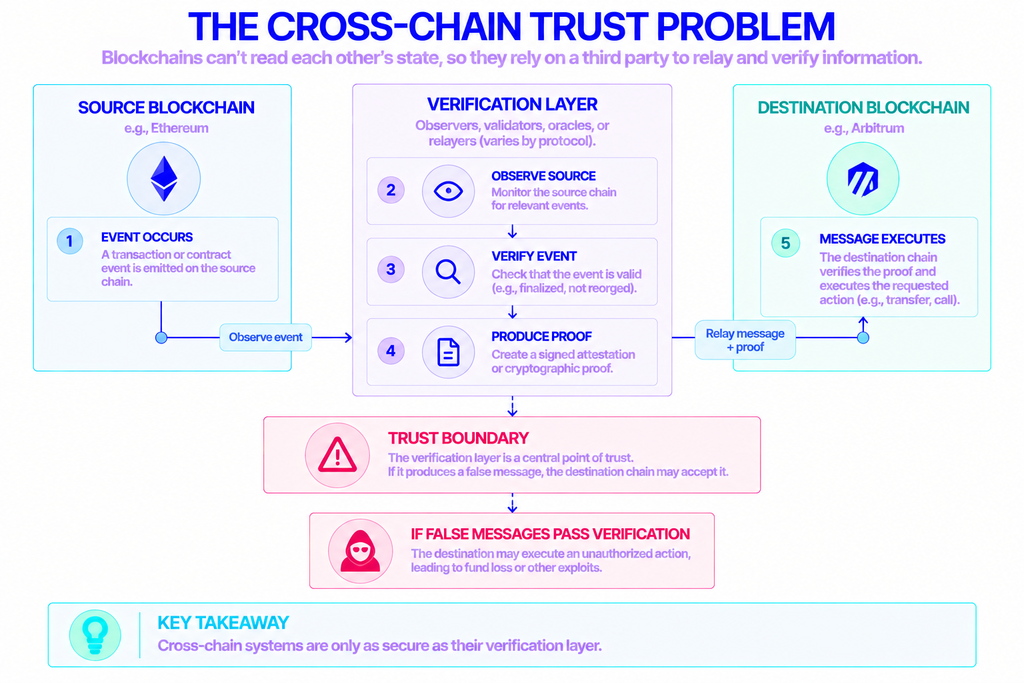
The problem it solves is simple to state and hard to fix. Blockchains can’t read each other’s state. An Ethereum contract has no native way to know what just happened on Solana. So a third party has to watch the source chain, confirm an event occurred, and relay a signed attestation to the destination chain. That attestation layer is where trust concentrates — and where attackers aim.
Token bridging is a subset of this. Early bridges locked an asset on chain A and minted a wrapped copy on chain B. Messaging protocols generalize the idea: they can move arbitrary data, so a transfer becomes one kind of message among many. The three protocols here are all messaging layers first, with token transfers built on top.
What Is Chainlink’s Cross-Chain Interoperability Protocol?
Chainlink CCIP (Cross-Chain Interoperability Protocol) is a messaging and token-transfer standard that uses Chainlink’s oracle network to verify what happens between chains. It’s aimed heavily at institutions and regulated asset issuers, which shapes most of its design choices.
The current release, CCIP 2.0, went live in September 2026. By Chainlink’s own figures, CCIP secures over $84 billion in total cross-chain token value, and roughly $15 billion migrated to it in the four months before launch — including BitGo’s wrapped Bitcoin (WBTC) and Coinbase’s cbBTC.
How does CCIP verify a transfer?
Every CCIP transaction is checked by a default verifier, then optionally by layers an issuer adds on top.
The default layer is the Chainlink Committee Verifier: 16 independent, security-reviewed node operators who must reach consensus before a message can execute on the destination chain. On top of that, CCIP 2.0 lets an institution run its own Cross-Chain Verifier (CCV), or hire a third party to run one. When a CCV is active, both the Chainlink committee and the independent verifier must cryptographically sign a transaction before it clears. Chainlink calls this additive security — you can only make a transfer harder to forge, not easier.
Two more controls matter for larger players. CCIP 2.0 offers configurable finality: low-value, high-frequency transfers can move faster, while high-value settlements wait for full source-chain finality. And it integrates the Automated Compliance Engine (ACE), so issuers can enforce KYC, AML, and sanctions screening on transfers directly.
The Cross-Chain Token standard
For moving tokens specifically, CCIP uses the Cross-Chain Token (CCT) standard. It supports both burn-and-mint and lock-and-mint token pools, and it lets a token issuer keep control of supply and permissions across every chain the token lives on. New tokens are added to the standard most weeks.
To move anything across chains, you still need reliable access to the underlying networks on both ends — which is where node infrastructure like NOWNodes fits, covering the chains these protocols connect.
How Does LayerZero Work?
LayerZero is an omnichain messaging protocol built around one idea: each application configures its own security. Instead of trusting a single fixed validator set, a developer picks who verifies their messages.
LayerZero V2, which launched in January 2024, splits message handling into separate verification and execution phases. That separation is the core of how it works.
The protocol has four main parts. Endpoints are immutable smart contracts on every supported chain — the entry and exit points. The Message Library (MessageLib) holds append-only validation logic. Decentralized Verifier Networks (DVNs) check that a source-chain transaction actually happened. Executors deliver the verified message and run whatever logic the app defines.
The part that sets LayerZero apart is DVN choice. An application assembles a “Security Stack” — a set of DVNs in an X-of-Y-of-N configuration, plus a block-confirmation threshold — and can even run its own DVN. There’s no whitelist or governance gate; any party can operate one, and well-known operators include Google Cloud and Polyhedra. More configurability means more responsibility: the security of a LayerZero app is only as strong as the DVN set its developers chose.
For tokens, LayerZero uses the Omnichain Fungible Token (OFT) standard, which burns on the source chain and mints on the destination rather than wrapping. More than 733 OFTs exist in production, including Tether’s omnichain USDT0 and PayPal’s PYUSD. LayerZero spans the widest footprint of the three, reaching 90-plus blockchains.
How Does Wormhole Work?
Wormhole is a generic message-passing layer secured by a fixed, named group of validators. Where LayerZero hands security settings to each app, Wormhole applies one shared trust model to everything built on it.
That model runs on 19 validator companies called Guardians, Google Cloud among them. Guardians watch a Core Contract on each connected chain and produce Verified Action Approvals (VAAs) — signed messages confirming an event occurred. A supermajority, 13 of the 19, must sign before a VAA is valid. The approach favors speed and simplicity over broad decentralization.
Wormhole offers two ways to move tokens. The original Token Bridge (Portal) mints wrapped assets on the destination chain. The newer Native Token Transfers (NTT) standard moves tokens without wrapping, letting issuers keep the token’s native properties and control. NTT adds a defense-in-depth feature called Global Accountant, which isolates each chain’s balance so no chain can send out more tokens than were ever minted to it; Guardians won’t attest to a transfer that breaks that check.
Wormhole’s history is part of its story. In February 2022, an attacker exploited a signature verification bug to steal about $325 million in wrapped ETH. The funds were replaced by Jump Crypto, and the incident drove much of the protocol’s later security hardening. Today Wormhole connects more than 30 networks, with strong coverage of Solana, Sui, Aptos, and Cosmos.
CCIP vs LayerZero vs Wormhole: Key Differences
The protocols overlap in purpose but diverge on security philosophy, token standards, and target users. The table sums up where they differ.
| Chainlink CCIP | LayerZero | Wormhole | |
|---|---|---|---|
| Current version | CCIP 2.0 (Sep 2026) | V2 (Jan 2024) | Guardian network + NTT |
| Verification model | 16-node Committee Verifier + optional CCVs | App-chosen DVN set (X-of-Y-of-N) | 19 Guardians, 13-of-19 signatures |
| Who sets security | Chainlink default, issuer can add layers | Each application | Fixed for all apps |
| Token standard | CCT (burn/mint, lock/mint) | OFT (burn/mint) | NTT + wrapped Token Bridge |
| Compliance tooling | Built-in (ACE: KYC, AML, limits) | Not native | Not native |
| Finality | Configurable, secure by default | Configurable per app | Guardian attestation |
| Chain coverage | Major EVM and non-EVM networks | 90+ (broadest) | 30+ |
Which security model should you trust?
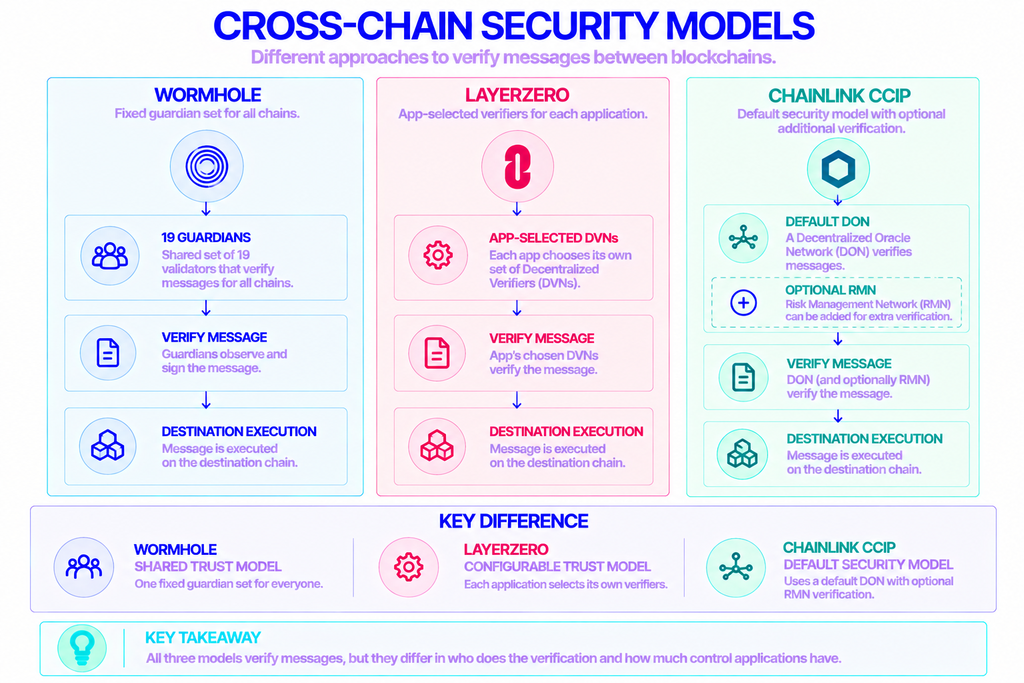
The three sit on a spectrum. Wormhole uses one fixed set of 19 Guardians for everyone — straightforward, but you take the trust model as given. LayerZero gives each app full control over its verifier set, which is powerful for teams that know what they’re doing and risky for those who misconfigure it. CCIP ships a default committee and lets issuers stack extra verification on top, trading some flexibility for a strong baseline.
No model is foolproof, and track record matters as much as architecture. As Erin Plante, VP of investigations at Chainalysis, put it: “a valuable first step towards addressing security issues is for extremely rigorous code audits to become the gold standard.” Cross-chain bridges accounted for 64% of all crypto hacked that year, which is why every protocol here now treats verification as its headline feature.
Token transfers: CCT, OFT, and NTT
All three have moved away from pure wrapped assets toward native, burn-and-mint transfers that preserve issuer control — CCT for CCIP, OFT for LayerZero, NTT for Wormhole. The practical upshot is similar: a single token can exist across many chains without a pile of wrapped derivatives fragmenting its liquidity. The differences are in governance, rate-limiting controls, and which chains each standard reaches.
Who should use which?
Pick based on what you’re optimizing for. Regulated issuers and institutions that need compliance controls and additive verification lean toward CCIP. Teams launching an omnichain token that needs to reach the most chains, with security they tune themselves, tend to choose LayerZero. Projects deep in the Solana ecosystem or with existing wrapped-asset liquidity often stay with Wormhole.
Running the Infrastructure Behind Cross-Chain Apps
Whichever messaging protocol you build on, it sits on top of individual blockchains — and it can only confirm and execute transfers if it can read the source and destination chains reliably. That means stable RPC access to every network in the flow.
This is the quiet dependency behind cross-chain work. A verifier that can’t reach a chain can’t attest to it, and an app that loses connection to a destination chain can’t finalize a transfer. NOWNodes provides access to 120-plus blockchain networks, covering the chains CCIP, LayerZero, and Wormhole connect to, so the underlying access isn’t the weak link.
Conclusion
Chainlink CCIP, LayerZero, and Wormhole solve the same problem and differ most in one place: how messages get verified, and how much of that you control. Wormhole gives you a fixed Guardian set, LayerZero gives each app a configurable verifier stack, and CCIP gives you a strong default with optional layers and built-in compliance.
There’s no universal winner. The right choice depends on whether you value compliance tooling, the broadest chain reach, or an existing liquidity footprint — and, in every case, on access to the chains underneath that stays reliable.
FAQ
Do these protocols support non-EVM chains like Solana?
Yes, all three reach beyond EVM chains. Wormhole has deep Solana, Sui, and Aptos support. LayerZero spans EVM and non-EVM networks across its 90-plus chains. CCIP connects major EVM networks alongside non-EVM chains, with new networks added regularly.
Does CCIP require the LINK token?
Not strictly. CCIP fees can be paid in LINK or in the source chain’s native gas token. LINK is Chainlink’s native asset and can earn a small fee discount, but there’s no separate “CCIP token.”
How long do cross-chain transfers take?
It depends on the destination chain’s finality and the protocol’s settings. Transfers can range from seconds to several minutes. CCIP and LayerZero both allow faster execution for lower-value transfers while reserving full finality for larger ones; the slowest step is usually waiting for the source chain to finalize.
Can I use these protocols to move stablecoins?
Yes. Stablecoins are a primary use case. Tether’s USDT0 runs on LayerZero’s OFT standard, CCIP supports native USDC transfers and a growing list of stablecoins through CCT, and Wormhole moves stablecoins via both its Token Bridge and NTT.