
ERC-404 is an experimental token standard on Ethereum that merges two older standards — ERC-20 for fungible tokens and ERC-721 for NFTs — so a single asset can behave as both a tradable coin and a unique collectible. Buy a whole token and an NFT lands in your wallet. Sell part of it and that NFT disappears. The result is often called a semi-fungible or hybrid token.
One detail matters before anything else: despite the “ERC” label, ERC-404 is not an official Ethereum standard. It never passed the formal review process that gives standards like ERC-20 their number. The creators borrowed the naming convention, and the “404” has no approved proposal behind it. That gap between the branding and the reality shapes almost everything else about it.
What makes ERC-404 a hybrid token?
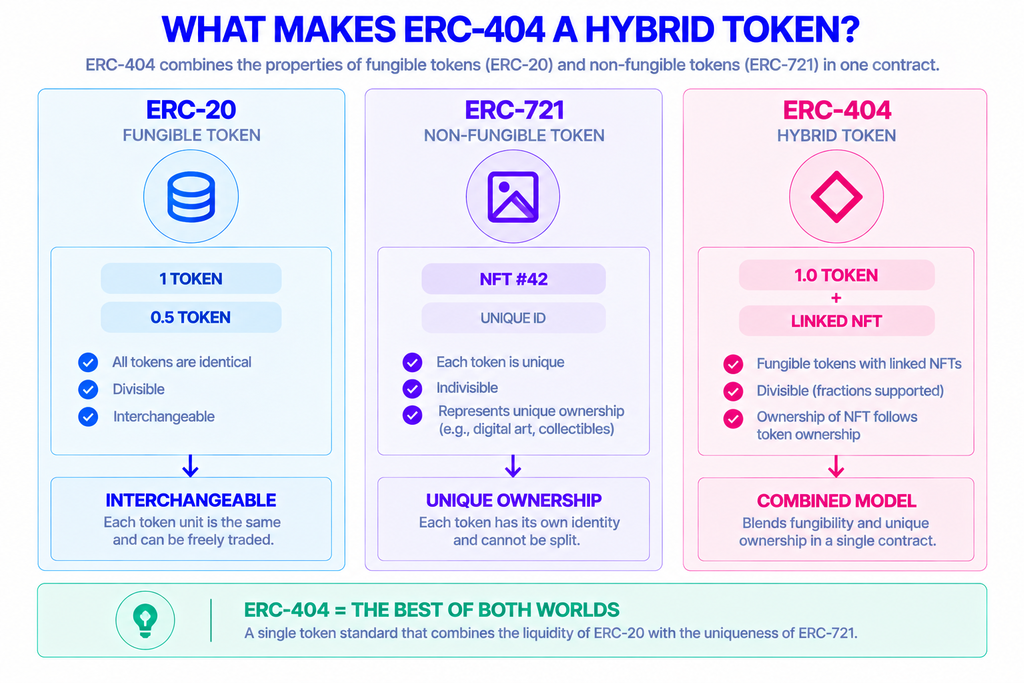
A hybrid token is one asset that carries the properties of two different token types at once. To see why that’s unusual, it helps to separate the two standards it combines.
ERC-20 defines fungible tokens. Every unit is identical and interchangeable, the way one dollar equals any other dollar. Most cryptocurrencies you can name are ERC-20 tokens. ERC-721 defines non-fungible tokens, or NFTs, where each token is unique and indivisible — one specific artwork, one specific collectible, with its own ID.
ERC-404 ties these together. Each token is linked to an NFT, and ownership of the NFT follows ownership of the token. Hold one full token and you hold the matching NFT. Hold a fraction, and you hold a fraction of something that can’t normally be split. That blending is why supporters describe the tokens as “semi-fungible,” and why critics argue the two models were never meant to share a contract.
| ERC-20 | ERC-721 | ERC-404 | |
|---|---|---|---|
| Token type | Fungible | Non-fungible (NFT) | Hybrid / semi-fungible |
| Divisible | Yes | No | Yes, with a linked NFT |
| Official standard | Yes | Yes | No (experimental) |
| Typical use | Currencies, utility tokens | Art, collectibles | Fractional NFTs, trading |
What problem does ERC-404 try to solve?
The core problem is NFT liquidity. A high-value NFT is hard to sell quickly because it trades as a single, whole item — you either find a buyer for the entire thing or you wait.
Fractional ownership has long been proposed as a fix: split an expensive NFT into smaller shares so more people can buy in and trade out. Earlier attempts usually relied on locking an NFT in a separate vault contract and issuing tokens against it, which added steps and friction.
ERC-404 pushes fractionalization into the token itself. Because each token is natively divisible and tied to an NFT, holders can trade fractions directly on automated market makers (AMMs) — the decentralized exchanges, such as Uniswap, that let users swap tokens against a shared liquidity pool. In theory, that gives an NFT collection the constant, liquid trading of a regular token while keeping the collectible layer intact.
How does the token-to-NFT mechanism work?
ERC-404 mints and burns NFTs automatically based on how many whole tokens an address holds. The process happens inside the contract whenever tokens move.
Picture a collection where one NFT equals one token, and that token can be split into 100 fractional shares:
- Buy a whole token (all 100 shares). The contract mints the NFT directly to your wallet.
- Sell part of it — say 25 shares. The contract burns the NFT. You keep 75 shares, the buyer holds 25, and neither of you holds a complete NFT.
- Buy the shares back up to a full token. A new NFT is minted to your wallet again.
So the NFT is not a fixed object you keep forever. It appears when your balance crosses a full unit and vanishes when it drops below one. This is the behavior that makes ERC-404 feel novel, and it’s also the behavior that runs up gas costs, because each crossing triggers extra on-chain work that a plain token transfer would never need.
Who uses ERC-404 tokens?
ERC-404 found its first audience among NFT projects and traders who wanted collectibles that trade like liquid tokens. The standard arrived through a single project that made the idea concrete.
Pandora was the first ERC-404 token, launched on February 5, 2024, by two pseudonymous developers known as “ctrl” and “Acme.” It paired a 10,000-item NFT collection with a fungible token, and the price reacted fast — Pandora gained more than 1,850% in its first four days and reached a market cap near $293 million, according to CoinGecko data reported at the time. A wave of copycat projects followed within weeks.
Those 2024 figures reflect the launch frenzy, not a steady valuation; prices for Pandora and its imitators fell sharply once the initial hype cooled, and ERC-404 has since settled into a niche, experimental corner of the market rather than a mainstream standard. Today the main users are still the same two groups: NFT teams experimenting with built-in liquidity, and traders drawn to the novelty of an asset that is part coin, part collectible.
Why isn’t ERC-404 an official standard?
Because it never went through the Ethereum Improvement Proposal (EIP) process — the public, community review that vets a standard before it earns an official number. ERC-404’s creators adopted the “ERC” name without that approval, which is why many developers say the label is misleading.
The creators were open about the choice. Getting a standard formally ratified is “one of the more bureaucratic things you can do,” said ctrl, one of ERC-404’s pseudonymous authors, in comments reported in February 2024, while adding that the team hoped to submit a proposal later. As of now, no ERC-404 proposal has been accepted as an official EIP.
This isn’t just a naming dispute. The project’s own repository has described the standard as experimental and noted that the two standards it fuses were not designed to be mixed. Contracts built on it are typically unaudited. For anyone deploying or buying these tokens, that means fewer guarantees and more unknowns than a battle-tested ERC-20 contract carries.
What are the risks and limitations of ERC-404?
The three biggest issues are cost, safety, and compatibility.
Gas inefficiency. ERC-404 transfers aren’t optimized. Minting and burning NFTs on balance changes makes each transaction heavier than a standard ERC-721 transfer, and during the 2024 hype this contributed to higher gas prices on Ethereum. Gas is the fee paid to process a transaction, so heavier logic means a more expensive token to move.
Unaudited, untested code. Because the standard skipped formal review, most implementations haven’t been through the scrutiny that catches bugs and exploits. Mixing fungible and non-fungible logic in one contract also creates edge cases — around transfers, approvals, and marketplace compatibility — that simpler standards avoid.
Marketplace and wallet support. Tools built around clean ERC-20 or ERC-721 behavior don’t always know how to handle a token that switches between the two. An NFT that can silently burn when a holder sells a fraction breaks assumptions some platforms rely on.
None of this makes ERC-404 unusable, but it does make it a standard for experimentation rather than for holding serious value without caution.
ERC-404 vs DN-404: what’s the difference?
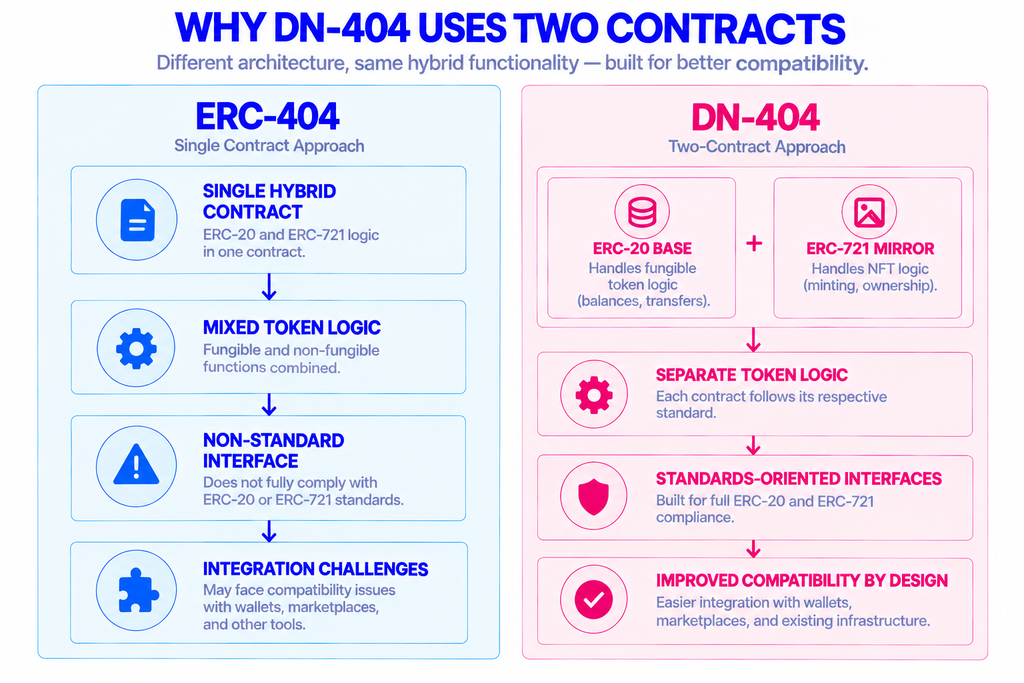
DN-404 is a rival implementation built to deliver the same hybrid behavior more cheaply and more safely. Short for “Divisible NFT-404,” it was introduced by a separate group of Ethereum developers in early 2024 as a direct response to ERC-404’s inefficiency.
The key design difference is architecture. ERC-404 packs both roles into a single contract. DN-404 uses two linked contracts — one ERC-20 contract for the fungible balances and one ERC-721 contract for the NFTs — working together behind the scenes. Its authors argue this makes it fully compliant with both existing standards, which improves compatibility with wallets and marketplaces, and cuts costs. One report put the saving at about 20% cheaper gas fees than ERC-404, though that figure came without published test conditions.
| ERC-404 | DN-404 | |
|---|---|---|
| Architecture | Single combined contract | Two linked contracts (ERC-20 + ERC-721) |
| Standards compliance | Non-compliant (mixes standards) | Claims full ERC-20 and ERC-721 compliance |
| Gas cost | Higher | Lower (reported ~20% cheaper) |
| Status | Experimental, unofficial | Experimental, unofficial |
Both remain unofficial and experimental. Several other variants — with names like ERC-404m and ERC-X — have appeared since, each tweaking the same idea. DN-404 is simply the most cited alternative, and its existence underscores that ERC-404 was a first attempt, not a finished specification.
How do developers build and test with ERC-404?
Building an ERC-404 token means deploying a smart contract that handles the token-and-NFT logic, then testing it against Ethereum before any real money is involved. The usual path is to write the contract, deploy it to a testnet, send trial transfers, and watch the NFTs mint and burn as balances cross whole-token thresholds.
That workflow needs steady access to Ethereum — reading balances, broadcasting transactions, and tracing the internal calls that move NFTs around. NOWNodes provides API access to Ethereum mainnet and its test networks, so developers can deploy and inspect experimental contracts without maintaining the underlying infrastructure themselves. Because an ERC-404 transfer can trigger several internal actions at once, Trace and Debug methods are useful here for following exactly what a transaction did on supported networks. You can find the full network list and endpoint setup at NOWNodes.
Testing on a network like Sepolia first is especially important with an unaudited standard. It lets you confirm the mint and burn behavior works as expected, and measure gas costs, before deploying to mainnet.
Conclusion
ERC-404 is best understood as a clever experiment rather than a settled standard. It answered a real question — how do you make NFTs liquid and divisible — with a mechanism that turns token ownership into NFT ownership automatically. That idea was popular enough to spark a 2024 trading frenzy and a string of imitators.
The trade-offs are just as real. It isn’t an official standard, its contracts are usually unaudited, and its gas costs pushed developers toward cleaner alternatives like DN-404 almost immediately. If you’re exploring hybrid tokens, ERC-404 is worth understanding as the origin point of the concept. Treat anything built on it as experimental, test thoroughly, and don’t commit value you aren’t prepared to lose.
FAQ
Is ERC-404 an official Ethereum standard?
No. It never passed the Ethereum Improvement Proposal (EIP) review process, so the “ERC” in its name is informal. As of now, no ERC-404 proposal has been ratified as an official standard.
What was the first ERC-404 token?
Pandora, launched on February 5, 2024, by pseudonymous developers “ctrl” and “Acme.” It combined a 10,000-item NFT collection with a divisible token and briefly reached a market cap near $293 million.
Is ERC-404 safe to use?
It carries more risk than established standards. Most ERC-404 contracts are unaudited, the code mixes two standards that weren’t designed to be combined, and support across wallets and marketplaces is inconsistent. Research each project carefully.
Can you buy a fraction of an ERC-404 NFT?
Yes — that’s the point of the standard. Tokens are divisible, so you can hold a fraction of a unit. You only receive the linked NFT when your balance reaches a full token, and it’s burned if you drop below one.
Does ERC-404 work on blockchains other than Ethereum?
ERC-404 was created for Ethereum and EVM-compatible chains, which share Ethereum’s contract environment. Deployments have appeared on several EVM networks, but the standard itself is tied to that ecosystem.