
The web3 stack is the set of tools a developer combines to build an app that reads and writes to a blockchain: a network to build on, a way to connect to it, smart contracts, a wallet for users, and a frontend tying it together. Most of it looks like ordinary software engineering. The part that doesn’t is the piece running on infrastructure no single company owns.
That single fact is why web3 development can’t just borrow a standard web stack and swap out the database. Picking a network locks in a programming language. That language limits which tooling exists. And the whole thing has to work without anyone on the team able to quietly patch a bug after launch, the way a normal backend gets patched.
Rather than list the pieces in the abstract, this guide walks through them in the order a developer actually decides on them, then works through a real example and the mistakes that tend to show up once a project moves past a prototype.
What Is the Web3 Stack?
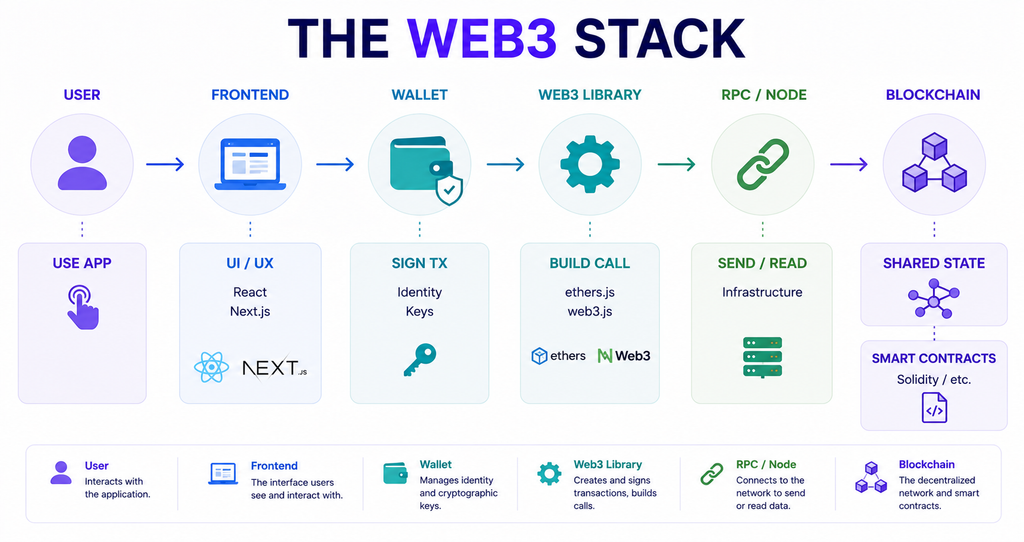
A web3 stack — sometimes called a web3 tech stack or blockchain technology stack — is the specific combination of blockchain network, connection infrastructure, contract language, wallet integration, and frontend tooling a project uses to talk to a blockchain and let people use it. It plays the same role a “MERN stack” or “LAMP stack” plays in ordinary web development: shorthand for “these are the pieces, and they’re built to work together.”
The difference is what sits in the middle. A typical web stack has a server and a database your team controls end to end. A web3 stack replaces that middle with a blockchain: a shared, append-only record that no one on the team can unilaterally edit once something is written to it. Everything else in the stack exists to read from that record, write to it, or make either of those things usable for a normal person.
Why It Doesn’t Look Like a Regular Web Stack
Start with what a blockchain actually removes. A conventional backend is a black box you fully control — you can inspect the database directly, roll back a bad migration, or ship a hotfix within minutes of finding a bug. None of that is true once logic lives in a deployed smart contract, which runs exactly as written across thousands of independent machines and, in most cases, can’t be altered after the fact.
That’s not a missing feature — it’s the reason a lending protocol can hold user funds without a company custodying them, and the reason users can trust an application’s rules without trusting whoever built it. Vitalik Buterin, who co-founded Ethereum, has argued the industry still underinvests in making that infrastructure accessible, writing that “running your own Ethereum infrastructure should be the basic right of every individual and household,” and rejecting the idea that heavy hardware requirements justify equally heavy DevOps effort, as reported by CryptoBreaking. Most teams still don’t run that infrastructure themselves, for reasons covered a little further down — but the tooling built around that trade-off is what makes the web3 stack look unfamiliar at first.
Who Actually Builds With This Stack
Four groups account for most of the work, and each one touches a different slice of it:
- Protocol and DeFi engineers write the contracts that move funds — lending markets, exchanges, staking pools — where a bug is a financial incident, not a bad deploy.
- Infrastructure and wallet teams build the layer everything else depends on: signing, key management, and the connections that reach the chain in the first place.
- Frontend and product developers turn contract state into something a normal user can click through, usually knowing far more JavaScript than Solidity.
- Enterprise teams experiment with settlement or tokenization on top of the same layers, even when the rest of their systems look like ordinary software.
That’s a bigger group than crypto’s reputation as a niche suggests. Ethereum alone added roughly 16,000 new developers between January and September 2025, taking its active base to 31,869; Solana added about 11,500 for 83% year-over-year growth, according to Electric Capital data reported by CoinLaw. One in three developers now build across more than one chain, up from under 10% in 2015 — which is a large part of why the tooling below is built to be chain-agnostic rather than locked to a single network.
Six Decisions Every Web3 Project Has to Make
There’s no single “correct” web3 stack, because the right answer at each step depends on the one before it. Here’s the order those decisions actually happen in, and what’s really being decided at each one.
1. Which Network You’re Building On
This decision constrains almost everything downstream, which is why it comes first regardless of what you’re building. Layer-1 networks like Ethereum, Solana, and Bitcoin settle transactions directly; layer-2s like Arbitrum, Optimism, and Base process them more cheaply and settle back to a layer-1 in batches.
More than 160 active blockchains exist as of 2026 — far more than any team needs to seriously evaluate, since the real question usually isn’t “which chain is best” but “where are the users I’m building for already active.” EVM-compatible chains (Ethereum, BNB Smart Chain, Polygon, Arbitrum) share a virtual machine and largely share tooling, which is a big part of why most new projects start there instead of a non-EVM chain like Solana or Aptos.
2. How You’ll Actually Reach That Network
Every layer above the network needs one thing before anything else works: a way to read and write blockchain data. That’s a node’s job, and it’s the piece newcomers most often assume they’ll just run themselves — until they see what that actually involves.
In practice, most teams don’t run their own node at all. They connect through a provider’s RPC endpoint instead, the same way most web apps use a managed database instead of racking their own server. NOWNodes, for instance, offers API-based access to shared and dedicated nodes across 120-plus blockchain networks, so a team can read balances, broadcast transactions, and query contract state without syncing that infrastructure themselves. Coverage isn’t identical everywhere — RPC, WebSocket, and Blockbook access vary by network, so it’s worth confirming a given chain supports what you need before building around it. Our guide to the different types of blockchain nodes covers what full, light, archive, and validator nodes each actually do.
3. What Language Your Contracts Are Written In
The network you picked in step one has effectively already picked this for you. Solidity runs most of Ethereum and BNB Smart Chain; Rust powers Solana and Polkadot; Move secures Aptos and Sui — and a contract written for one virtual machine generally doesn’t run on another.
The stakes are higher than in ordinary programming, since a deployed contract is expensive, sometimes impossible, to patch. That’s exactly why testing frameworks like Hardhat and Foundry exist — to catch mistakes before a contract goes live rather than after. Our comparison of blockchain programming languages goes deeper into which language fits which chain and why.
4. How Users Will Hold Keys and Sign Transactions
A wallet is how a person or an app proves control over an address, and it sits directly between the user and everything else in the stack. A standard externally owned account (EOA), like a MetaMask wallet, holds a private key directly; a smart contract wallet replaces that key with programmable logic — spending limits, social recovery, gas paid in a different token.
This is also where most real losses in web3 actually happen — rarely from broken cryptography, usually from a leaked private key or a transaction a user signed without understanding what it did. Any project touching real funds needs to treat this layer as a design problem from day one, not something bolted on once the contract works.
5. How the Frontend Talks to the Chain
The interface is the part users see, and it needs one capability an ordinary web frontend doesn’t: talking to a wallet and a blockchain at the same time. Libraries like ethers.js and viem handle reading contract state and submitting signed transactions, while connector libraries like wagmi or RainbowKit manage the wallet-connection flow itself.
Real-time updates are the part teams usually discover the hard way. Polling a node every few seconds for new transactions wastes requests and adds lag, so production apps typically switch to a WebSocket connection instead — one open channel that pushes updates as they happen rather than on a delay.
6. Where the Data That Doesn’t Belong On-Chain Lives
Blockchains are a genuinely expensive place to store large files, so most projects keep only what needs on-chain guarantees — ownership records, balances, contract state — on the network itself. Everything else, from NFT images to app metadata, typically lives on IPFS, Arweave, or Filecoin, with just a reference or hash stored on-chain.
The two halves fail in different ways, which is why that split matters. An on-chain record is essentially permanent and tamper-evident; an off-chain file only survives as long as someone keeps hosting it, which is why serious projects pin data to persistent, decentralized storage instead of a single server they control.
Putting It Together: A Token-Gated Community App
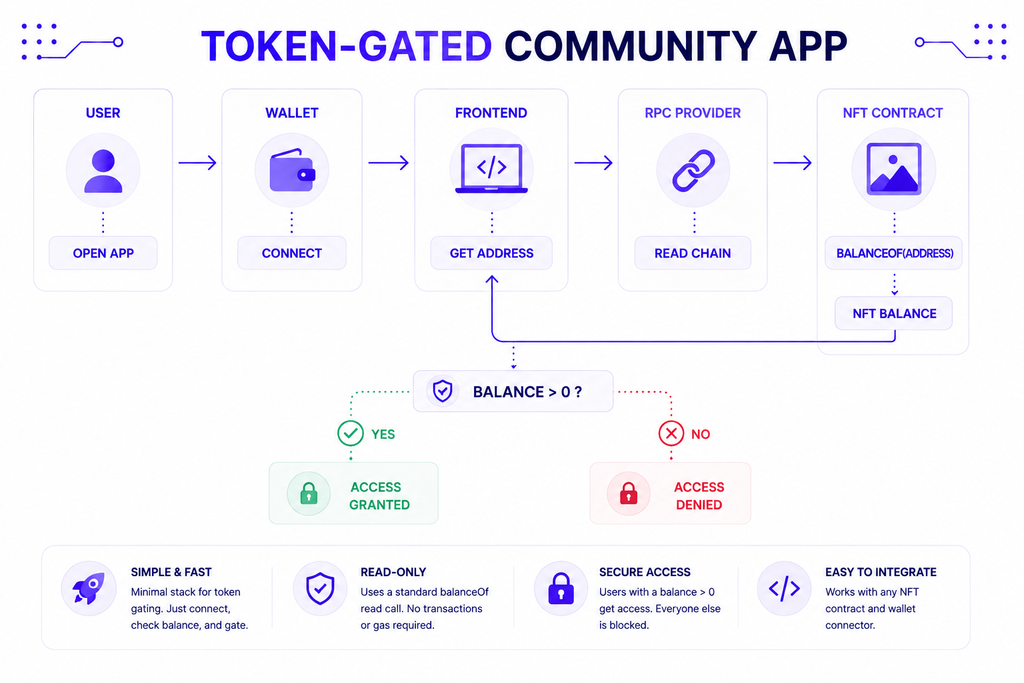
Abstract layers are easier to follow with one concrete case. Say the goal is a web app that only lets people in if their wallet holds a specific NFT — a common enough request that it exercises nearly every decision above.
The network choice comes down to where the target community’s wallets already are — Ethereum or an EVM L2 if it’s an existing NFT collection, since that’s where the contract and the users both already exist. Reaching that chain means an RPC connection through a provider rather than a self-hosted node, since a token-gating check is a simple, frequent read that doesn’t justify running infrastructure. The check itself is a single contract call — confirming balanceOf(address) > 0 for the collection’s contract — which needs no custom Solidity beyond what the NFT standard already provides.
The frontend then needs a wallet connector (wagmi is a common choice) to get the visitor’s address, an RPC call to check their balance, and nothing more elaborate than that to gate the page. No new storage layer is needed, because nothing about this project produces data that doesn’t already live in the NFT contract itself. That’s the whole stack for this use case — four of the six decisions resolve almost immediately once the first one is made.
Where Web3 Habits Diverge From Web2 Ones
A few contrasts trip up developers coming from conventional backend work more than any single tool does. Where a normal bug means a deploy, a contract bug can mean funds are gone permanently — there’s no rollback once a transaction confirms. Where identity is usually a password an app resets on request, it’s a private key only the user holds, and losing it is final.
None of that makes a web3 stack strictly harder — much of it is genuinely simpler once internalized, since there’s no auth system to build and no database schema to migrate. It just means the caution moves earlier, to the contract and wallet flow, instead of to a production incident after launch.
Mistakes That Show Up Once a Project Moves Past a Prototype
A handful of mistakes account for most of the trouble teams hit once real users show up. Deploying straight to mainnet, skipping a testnet entirely, turns every bug into a transaction that costs money and can’t be undone. Assuming a free public RPC endpoint holds up under real traffic is another — those tiers exist for prototyping, not production; most cap out around 5 requests per second.
Treating EVM and non-EVM chains as interchangeable is a third, and it usually surfaces the moment a team expands to a second network: a Solidity contract doesn’t run on Solana, and the RPC methods, wallet standards, and address formats all differ underneath. The fix is the same each time — test the assumption on a testnet, or with small amounts, before it’s load-bearing for real funds.
Conclusion
A web3 stack isn’t more complicated than a conventional one so much as it’s rearranged around a piece nobody on the team owns outright. Pick the network based on your users, let that choice determine your contract language, decide how you’ll reach the chain before assuming you’ll run your own node, and give the wallet and contract layers the security attention they need before real funds ever touch them.
A provider like NOWNodes fits into exactly one part of that picture: once a team knows which network and which layer it’s building on, it removes the work of running and syncing node infrastructure across 120-plus supported networks, so engineering time goes into the application instead of the plumbing underneath it.
FAQ
What’s the Difference Between Web3 Development and Blockchain Development?
Blockchain development often means building the protocol or chain itself — consensus, networking, client software. Web3 development means building applications on top of an existing chain, using its contracts, wallets, and RPC access.
Do I Need to Learn a New Programming Language for Web3?
For smart contracts, yes — Solidity, Rust, or another chain-specific language. For the frontend, no; JavaScript, TypeScript, and standard frameworks like React carry over directly.
Can I Build a Web3 App Without Running My Own Node?
Yes, and most teams do. Connecting through a provider’s RPC endpoint is standard, since it avoids the ongoing work of syncing and maintaining blockchain client software yourself.
Is the Web3 Stack the Same Across Every Blockchain?
The six decisions are the same — network, access, contracts, wallets, frontend, storage — but the tools rarely are. A stack for Ethereum (Solidity, viem, MetaMask) looks different from one for Solana (Rust, Phantom), even though both answer the same questions.
How Long Does It Take to Learn the Full Web3 Stack?
It depends on prior experience. A developer who already knows JavaScript can usually build a basic frontend integration within days, while becoming comfortable writing and securing smart contracts realistically takes weeks to months.