
Ankr and NOWNodes both give an application a way to talk to a blockchain without the team running its own node, and that’s where the similarity mostly ends. NOWNodes bills a flat monthly request quota across 120+ networks, including Bitcoin, Litecoin, and privacy coins most providers skip entirely. Ankr bills per method through a credit system, covers roughly 80 chains on its paid tier, and layers pre-indexed APIs and SDKs on top for teams that don’t want to build an indexing pipeline themselves.
For a product that spans several chains at once and needs to know its bill in advance, NOWNodes is usually the steadier starting point. Ankr earns its keep when a team is already inside its ecosystem — staking, App Chains, its Advanced API — or when a light, mostly-EVM workload fits comfortably inside its free credit allowance.
What Are NOWNodes and Ankr, Exactly?
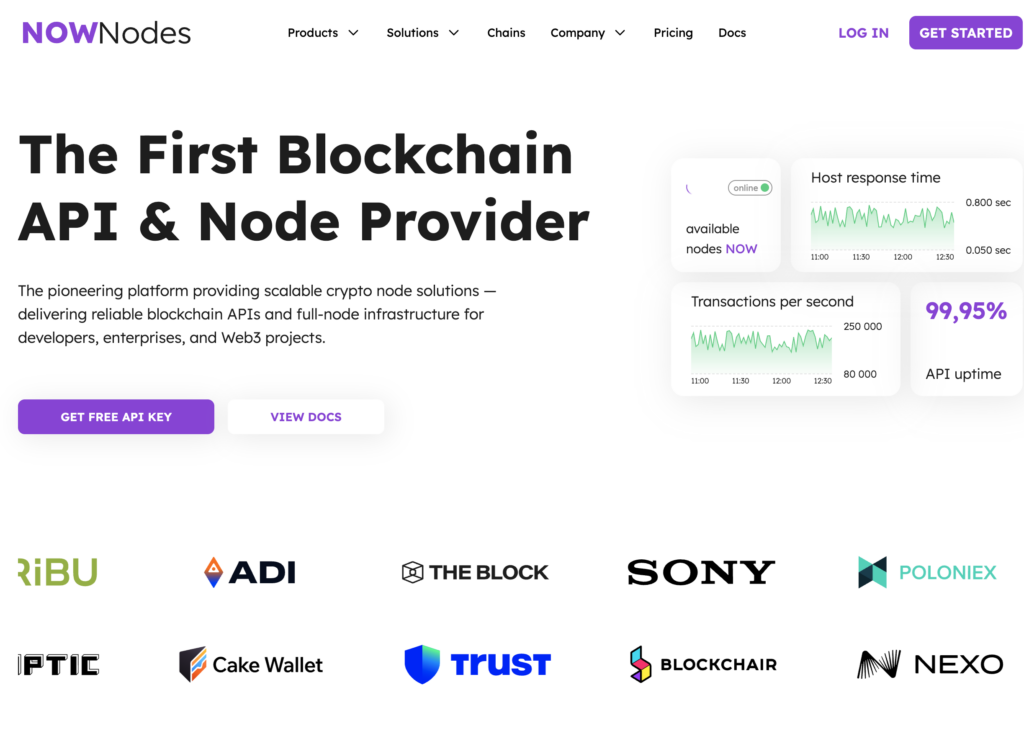
NOWNodes is a blockchain infrastructure provider that gives developers API-based access to shared and dedicated nodes across 120+ networks, from Bitcoin and Ethereum to Solana, Polygon, and Monero. You get an endpoint and an API key, and NOWNodes keeps the node behind it synced and running.
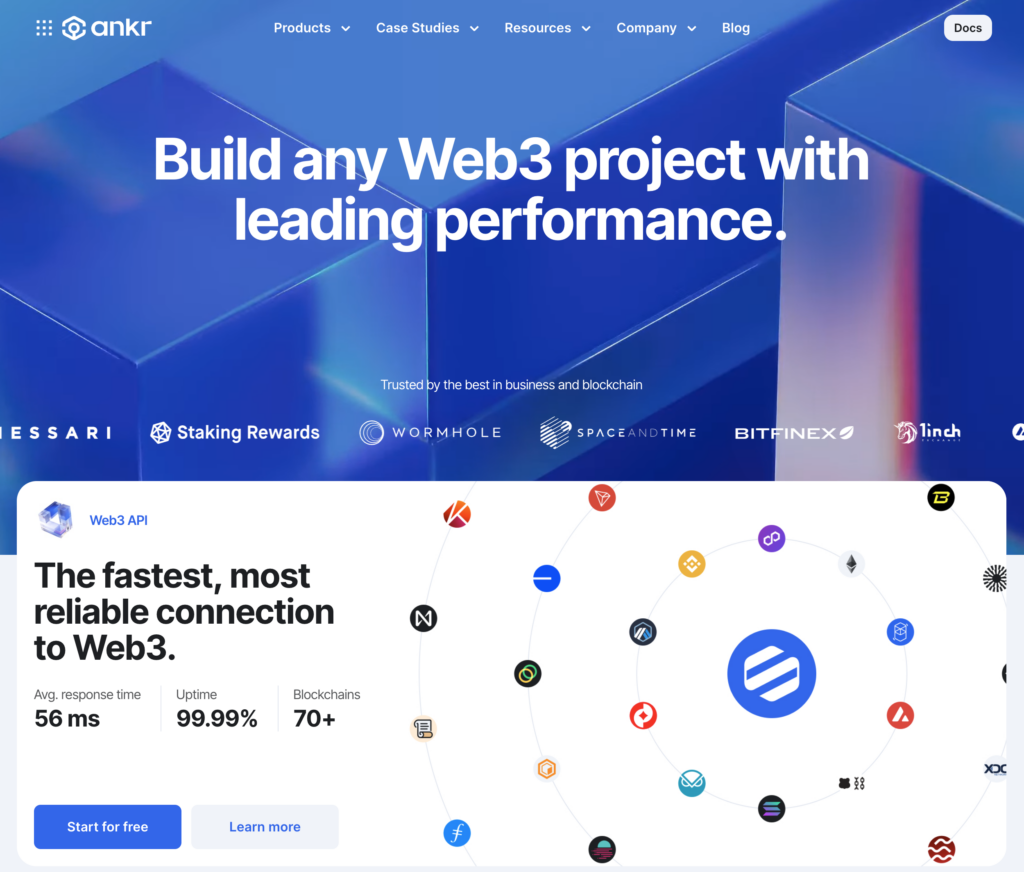
Ankr is a Web3 infrastructure provider founded in 2017 that operates blockchain nodes across more than 30 regions worldwide, with part of its capacity drawn from independent node operators rather than centralized servers alone — a setup it describes as a decentralized physical infrastructure network, or DePIN. On top of raw access, Ankr adds an Advanced API with pre-indexed methods and SDKs for JavaScript, Python, and React.
RPC (remote procedure call) is the mechanism underneath both services — a way of asking a remote server to run a function, such as “return this address’s balance,” and get the result back over the network. Every blockchain client, from Geth to Solana’s Agave, exposes its data this way, which is why standard JSON-RPC calls move between providers without an application rewrite.
Why Do You Need a Provider Like NOWNodes or Ankr?
Running a node yourself is a real operational job, not a background task. A synced Ethereum full node currently needs roughly 650–700 GB of disk space and keeps growing, and it has to be patched and resynced through every protocol upgrade the network ships.
A provider takes that maintenance off your team’s plate. You get an authenticated endpoint, the provider keeps the client software current and the hardware scaled, and your engineers spend their time on application logic instead of server operations. That trade-off holds whether you’re on NOWNodes’ flat-rate shared nodes or Ankr’s credit-billed endpoints — only the pricing mechanics differ.
Here’s why that distinction matters day to day: a payment backend doesn’t need to know how a validator prunes state. It needs a balance check to come back correctly, on every call, without the team babysitting a server at 2 a.m.
Who Actually Uses NOWNodes and Ankr?
NOWNodes tends to attract teams whose product spans several blockchains at once — wallets, exchanges, and payment platforms that need Bitcoin, Ethereum, and a dozen other chains under one account instead of a separate vendor per network. Trading tools and monitoring systems that lean on WebSocket or streaming data fit the same profile.
Ankr’s mix of a generous free tier and pay-as-you-go credits draws a wider spread of builders, including hobby projects and teams already using its staking or App Chain tooling. A DeFi dashboard tracking positions across Ankr’s 80-plus chain list, or a prototype testing traffic before committing to a paid plan, are both natural fits for its Freemium allowance.
| Use case | Better fit with NOWNodes | Better fit with Ankr |
|---|---|---|
| Multi-chain wallet or exchange (BTC + ETH + others) | Yes — one account, non-EVM coverage included | Requires checking chain coverage first |
| Prototype needing a large free allowance to test with | Possible — Start plan covers 100,000 requests | Yes — Freemium’s 200M credits/month goes further |
| Team already using staking or App Chain tooling | Not applicable | Yes — Ankr’s ecosystem overlaps |
| Backend needing predictable monthly cost | Yes — flat request quota | Depends on which methods dominate traffic |
| Debug/Trace access without a $500+/month commitment | Yes — available on lower shared tiers | No — gated to Ankr’s Premium plan |
A production exchange handling real deposit volume usually cares more about predictable throughput than a generous free tier, which is where the two providers’ pricing philosophies start to matter more than their chain counts.
Pricing: Flat Quotas vs. Credit-Weighted Billing
This is where the two providers diverge the most. NOWNodes’ shared plans bill on a flat request-quota model: pick a monthly tier, get a fixed number of requests, and every call counts the same against that number, light or heavy.
Ankr bills by API credit, a weight assigned to each method based on the network and call type. A standard EVM call such as eth_getBalance costs 200 credits, a Solana call costs 500 credits, and a Beacon Chain or Advanced API call costs 700 credits, according to Ankr’s own pricing documentation. At $0.10 per million credits on Premium’s pay-as-you-go rate, that works out to roughly $0.00002 per basic EVM call — cheap in isolation, but a workload leaning on heavier methods burns through an allowance faster than the sticker price suggests.
| Plan tier | NOWNodes (shared, flat quota) | Ankr (credit-based) |
|---|---|---|
| Free | 100,000 requests/month, 1 API key | 200M credits/month (Freemium), 45+ chains |
| Entry paid | €20/month, 1M requests, 3 API keys | Premium PAYG from $10, 80+ chains |
| Mid tier | €200/month, 30M requests, 25 API keys | Premium subscription, $500–$3,000/month |
| Top published tier | €500/month, 100M requests, 100 API keys | Enterprise, custom |
Both companies adjust pricing and quotas often — verify current numbers against NOWNodes’ pricing page and Ankr’s own docs before budgeting. NOWNodes charges overage per 100,000 requests, dropping from €5 on lower tiers to €0.50 on Enterprise, so the marginal cost of extra traffic actually falls as you scale up. Ankr’s Debug/Trace methods and WebSocket access sit entirely behind Premium, meaning a free-tier developer testing contract execution paths hits a wall before production even starts — NOWNodes offers those methods on its lower shared tiers instead.
Network and Feature Coverage
NOWNodes advertises 120+ blockchain networks, including non-EVM chains such as Bitcoin, Dogecoin, Litecoin, and Monero alongside Ethereum, Solana, and other EVM networks. Ankr’s Premium tier currently lists roughly 80-plus chains, concentrated in EVM-compatible networks with a smaller non-EVM footprint.
That gap matters most for multi-asset products. An EVM-only dApp won’t notice much difference in raw chain count between the two providers. A wallet or exchange that also needs Bitcoin, Litecoin, or a privacy coin will find several of those aren’t part of Ankr’s lineup, something NOWNodes’ node directory covers under a single account instead.
Feature-for-feature, both platforms cover RPC basics on their major networks, and both gate some advanced methods by plan. Past that baseline, the emphasis differs:
- Archive data — included on every Ankr tier, including the free ones; NOWNodes ties archive access to network support rather than guaranteeing it everywhere.
- Pre-indexed Advanced API and SDKs — an Ankr specialty for teams that don’t want to build their own indexing layer.
- Market data (prices, market cap, volume) — a NOWNodes product covering 9,000+ cryptocurrencies and 90+ fiat assets; not part of Ankr’s core RPC offering.
- Dedicated infrastructure — NOWNodes’ dedicated nodes carry no predefined RPS limit and are available from mid-tier plans; Ankr reserves comparable isolation for custom Enterprise agreements.
- Token layer — Ankr runs ANKR, a utility token tied to its staking and node-operator ecosystem; using the RPC API itself doesn’t require holding it, but it does mean part of Ankr’s roadmap is shaped by tokenomics decisions a purely centralized competitor doesn’t have to weigh.
Does the DePIN Model Actually Change Anything for Developers?
Not much, day to day. Ankr’s positioning as a decentralized physical infrastructure network means part of its node capacity comes from independent operators rather than Ankr’s own servers, but the API you call still looks like a standard RPC endpoint.
Chandler Song, Ankr’s co-founder and CEO, frames the company’s role plainly: “Ankr’s job is to empower the developers who are building these new use cases with every tool and blockchain connection they need to create them,” he told TechBullion. That framing — infrastructure as an enabler, not the product itself — applies just as well to NOWNodes’ shared and dedicated nodes, which sit behind a comparable endpoint-and-API-key setup without a token layer attached.
Switching Providers: How Much Work Is It?
Because JSON-RPC is a standardized protocol, moving core traffic between providers is usually a configuration change, not a rewrite. An app built purely against methods like eth_getBalance and eth_sendRawTransaction can point at a new endpoint with a URL and key change.
The catch is method-specific tooling. An app that leans on Ankr’s Advanced API endpoints or a provider’s custom webhook schema has real migration work ahead if it ever needs to leave, because those calls don’t exist the same way anywhere else. That’s worth weighing before you’re six months into production, not after — a team that wants to keep its options open has less to untangle later by starting on a standards-first provider.
Ankr vs. NOWNodes: Which One Should You Choose?
Is NOWNodes better than Ankr for a multi-chain product? Generally, yes. One account covering 120+ networks, including non-EVM chains, under a flat request quota with Debug/Trace access on lower tiers is a simpler and more forecastable setup than running Ankr plus a second provider to cover chain gaps or unlock advanced methods.
Is Ankr better than NOWNodes for a team already in its ecosystem? For that specific case, yes — a project already using Ankr’s staking or App Chain products, or one whose traffic is light enough to live inside the Freemium tier’s 200 million monthly credits, gets real value from staying put.
For most other teams, NOWNodes is the more straightforward pick: predictable pricing that doesn’t shift with your method mix, deeper non-EVM coverage for anything beyond pure EVM traffic, and archive-adjacent methods that don’t require jumping to a $500-plus monthly plan first. Ankr’s credit model and pre-indexed API are genuinely useful, but they’re built for a narrower shape of workload than NOWNodes covers by default.
Limitations Worth Knowing Before You Commit
Ankr’s credit system is the first thing to plan around. A getLogs-heavy indexing job or an analytics backend scanning historical events can burn through the Freemium allowance far faster than a lighter wallet-style workload suggests, so the advertised 200 million credits is a starting estimate, not a guarantee of runway.
NOWNodes’ flat quota removes that guesswork but has its own ceiling: once a plan’s allowance is used, the account either upgrades or pays the overage rate, regardless of whether the extra requests were cheap or expensive to serve. Its webhook product is also narrower than a general-purpose event platform right now, currently limited to Bitcoin and Dogecoin address-balance changes.
Neither company is a universal answer. A provider that fits a Solana-heavy DeFi dashboard poorly may be exactly right for a Bitcoin-and-Ethereum payment backend, which is why matching the provider to your actual chain list and traffic pattern matters more than either company’s marketing page.
Conclusion
Ankr and NOWNodes both give applications API access to blockchain nodes, but they’re built for different bets. Ankr charges per method through a credit system and bundles a pre-indexed Advanced API for teams staying mostly within its 80-plus EVM-leaning chains, while NOWNodes prioritizes broad multi-chain coverage — including Bitcoin, Litecoin, and other non-EVM networks — under flat, predictable pricing.
For a team building across several chains at once, or one that wants to know its bill before the month starts, NOWNodes’ flat-quota model is the steadier fit — and it’s the provider worth benchmarking first if your roadmap includes anything outside the EVM world. Since standard JSON-RPC calls migrate between providers with little more than a URL change, testing both against a slice of real traffic for a week settles the question faster than any pricing page can.
FAQ
Is NOWNodes cheaper than Ankr?
For most workloads, yes, because NOWNodes’ flat request quotas make costs predictable regardless of which methods you call. Ankr’s credit pricing can undercut that for light, mostly-EVM traffic but climbs quickly once heavier methods like getLogs enter the mix.
Does Ankr support Bitcoin?
Ankr’s chain list leans heavily toward EVM-compatible networks and Solana; it doesn’t cover Bitcoin, Litecoin, or privacy coins like Monero the way a broader multi-chain provider such as NOWNodes does.
What is the ANKR token used for?
ANKR is a utility token tied to Ankr’s staking and node-operator ecosystem. Using Ankr’s RPC API doesn’t require holding it — a credit card and an API key are enough to get started.
Can I use NOWNodes and Ankr together?
Yes. Running two providers side by side — one as primary, one as failover, or split by chain — is a common production pattern that limits how much a single provider’s outage or rate-limit spike can affect an application.
Does Ankr’s free tier include archive data?
Yes. Archive data is included on Ankr’s Public, Freemium, and Premium tiers alike; it’s Debug/Trace methods and WebSocket access that are restricted to Premium, not historical state itself.