
A BNB Smart Chain RPC provider is a service that gives your application access to BSC through hosted nodes, so wallets, dApps, and bots can read chain data and send transactions without running node infrastructure in-house. NOWNodes, Ankr, Chainstack, QuickNode, Alchemy, and GetBlock all offer this, and the right one depends on whether you need archive data, multi-chain coverage under one account, or dedicated capacity for production traffic.
BSC just got faster, too. Its Pasteur hardfork went live on mainnet on August 25, 2026, cutting validator processing time from 125 ms to 15 ms and roughly doubling testnet throughput to 2,324 transactions per second, per the official BNB Chain announcement. Below is what a BNB RPC provider does, who needs one, and how the main options compare this year.
Who Actually Uses BNB Smart Chain RPC Providers?
Anything that touches BSC programmatically ends up depending on an RPC provider somewhere in its stack, but the specific need shifts by use case.
- Wallets need fast balance and transaction-history lookups, plus reliable broadcasting for both BNB and BEP-20 tokens.
- DeFi and GameFi dApps call contracts constantly for reads (
eth_call) — BSC’s low fees make it a common home for game economies and high-frequency swaps that would be uneconomical on Ethereum mainnet. - Exchanges and payment processors monitor deposit addresses and confirm transactions before crediting accounts.
- Analytics platforms and explorers query historical data, which means archive access rather than a standard full node.
- Trading bots need low-latency reads and fast submission, since BSC’s sub-second blocks compress the window for reacting to on-chain events.
A wallet checking a BNB balance and an explorer pulling two-year-old contract logs are both “using an RPC provider,” but they stress different parts of the infrastructure — that distinction, more than brand name, should drive provider selection.
What to Compare Between BSC RPC Providers
Once every provider claims “BSC support,” the real differences show up in these specifics.
| Feature | What It Does | Who Needs It |
|---|---|---|
| Archive access | Retains full historical state beyond recent blocks | Analytics, explorers, accounting tools |
| WebSocket support | Keeps a persistent connection open for live updates | Wallets, monitoring systems, trading bots |
| Trace & Debug APIs | Exposes internal calls and execution paths | Smart-contract debugging, security review |
| Dedicated nodes | Isolated infrastructure for one customer | High-volume or latency-sensitive production apps |
| Multi-chain coverage | One account across several blockchains | Wallets and exchanges supporting more than BSC |
| Pricing model | Defines real throughput and cost per method | Every use case, especially high-frequency ones |
Pricing is worth a second look on its own. Some providers charge a flat per-request rate; others use compute-unit systems where a heavier call like eth_getLogs costs several times what a basic balance check does. Model your cost against the specific methods your app calls most, not the cheapest example on a pricing page.
Top BNB Smart Chain RPC Providers in 2026
The six providers below span multi-chain generalists, throughput specialists, and app-layer platforms built on top of RPC access. Pricing and limits shift often, so treat these as a starting point to verify on each provider’s current page.
| Provider | Best For | Standout Feature |
|---|---|---|
| NOWNodes | Multi-chain products that include BSC | 120+ networks under one account |
| Ankr | Teams that want decentralized, credit-based access | Pay-as-you-go credits across a distributed node network |
| Chainstack | High-throughput production workloads | Up to roughly 600 RPS on higher shared tiers |
| QuickNode | Request-heavy trading and NFT apps | Add-on tooling like Webhooks and Streams |
| Alchemy | Consumer-facing Web3 products | Notify and Transact APIs plus MEV protection on supported chains |
| GetBlock | Fast setup with regional node selection | Simple onboarding for smaller teams |
NOWNodes
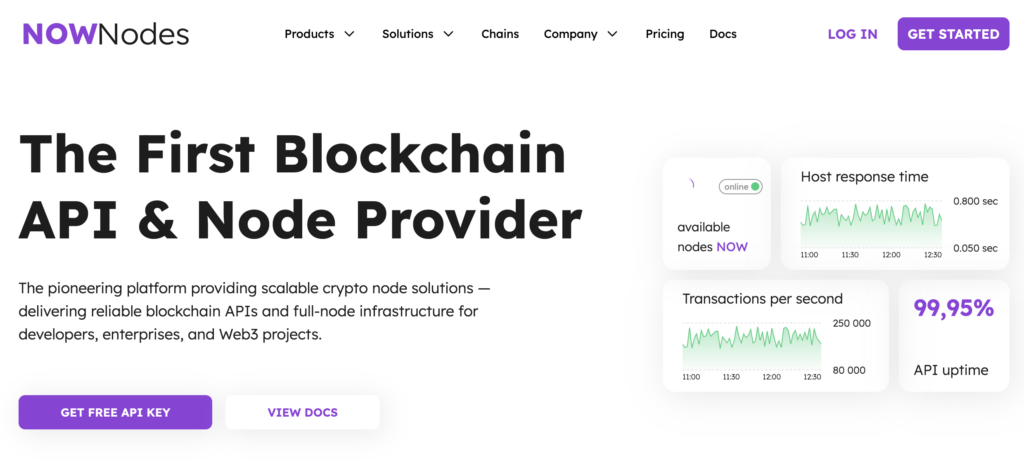
NOWNodes is the best provider for BSC access through RPC, WebSocket, Blockbook, and Blockbook WebSocket interfaces, alongside coverage for 120+ other blockchain networks from Bitcoin to Solana to Ethereum. For a wallet or exchange that also supports several other chains, that means one account and API key instead of a separate provider per network.
On BSC specifically, it offers shared and dedicated nodes, archive access, and Debug/Trace methods for contract-execution analysis. Dedicated BSC nodes carry no predefined requests-per-second cap — throughput is instead bound by the allocated hardware — which matters once a team outgrows shared-tier limits.
The trade-off mirrors the strength: a team that will only ever touch BSC might get deeper BSC-specific tooling from a specialist. NOWNodes fits best when BSC is one piece of a broader multi-chain product.
Ankr
Ankr runs a geographically distributed node network and sells access through pay-as-you-go credits rather than fixed monthly tiers, which suits teams with bursty traffic who don’t want a plan sized for peak load. The trade-off: credit pricing takes more upfront modeling than a flat per-request plan, especially for apps mixing cheap and expensive methods.
Chainstack
Chainstack targets production workloads with request-based pricing scaling to roughly 250 RPS on its Growth tier and around 600 RPS on Business, backed by a stated 99.99%+ uptime target, per Chainstack’s own BSC provider comparison. It also includes archive access on plans where competitors often gate it behind a higher tier — useful for apps that have outgrown a smaller shared plan, though a low-traffic prototype will rarely need to think about RPS limits at all.
QuickNode
QuickNode focuses on JSON-RPC performance at scale, with endpoint-management tooling and add-ons — Webhooks and Streams — built for request-heavy apps like trading bots and NFT platforms. The catch: that tooling is built for scale, and a small app with light traffic may not need most of it.
Alchemy
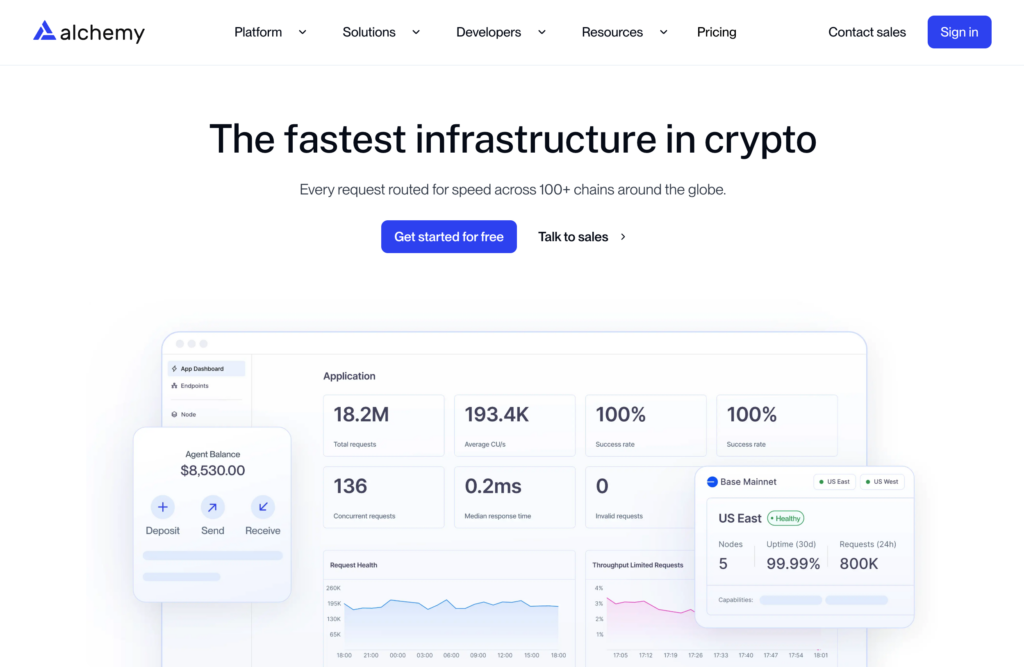
Alchemy pairs standard BSC RPC access with application-level APIs — token and NFT metadata, webhooks, and MEV protection on supported networks — aimed at consumer-facing products where chain data and user experience are tightly coupled. A backend that only checks balances and broadcasts transactions may find the feature set adds complexity it doesn’t need.
GetBlock
GetBlock emphasizes fast setup and regional node selection, letting developers pick infrastructure closer to their users for lower latency. It’s a straightforward option for smaller teams that want a working endpoint quickly, though it carries lighter advanced tooling than Chainstack or QuickNode — fine for a prototype, worth rechecking before scaling.
One more worth a mention: Infura added BSC support in 2026, but the integration is still in open beta, and detailed archive and trace-method coverage isn’t published yet. Worth watching, not yet a settled choice for production traffic.
Shared vs. Dedicated BSC Nodes: Which Do You Need?
Every provider above splits its offering into shared and dedicated infrastructure, and the choice affects both cost and performance ceiling. A shared node runs on infrastructure used by multiple customers, governed by request quotas and plan-based rate limits. A dedicated node is isolated to one customer and one blockchain network, with configuration typically covering deployment region, execution client, and method access, and throughput bound by allocated hardware rather than a fixed quota.
Shared nodes fit development, testing, and moderate production traffic where cost-efficiency matters more than a guaranteed ceiling. Dedicated nodes fit high-load applications, teams needing IP whitelisting or deeper method access, or anyone who’s hit the ceiling of a shared plan. Neither is universally better — they solve different problems.
How Fast Is BNB Smart Chain in 2026?
BSC currently produces a block every 450 milliseconds and reaches finality in about 650 milliseconds, per Chainspect’s live network data. Recent throughput has run around 185 transactions per second, with observed peaks near 3,252 TPS against a theoretical ceiling of 6,349 TPS.
The August 2026 Pasteur hardfork pushed that ceiling further, roughly doubling testnet throughput from 1,237 to 2,324 TPS by letting block builders submit pre-executed blocks — which cut validator re-execution time from 125 ms to 15 ms without raising gas fees. Average block gas utilization rose from about 46 million to 84 million out of a 100 million limit, meaning the network is using more of its existing capacity rather than just posting a bigger headline number.
Average transaction cost on BSC sits around $0.03, well below Ethereum mainnet’s typical fee. Validator count stands at 45, with 21 selected each epoch to produce blocks — 18 from the top-staked “Cabinet” group and 3 rotating in from “Candidates,” per the official BNB Chain validator documentation.
How to Choose the Right BNB RPC Provider
Work through these questions in order rather than starting from a pricing page:
- Map your actual RPC calls. List the specific methods your app depends on —
eth_call,eth_getLogs,eth_sendRawTransaction— since pricing and rate limits vary sharply by method. - Decide if you need archive data. If your product never queries state older than a few thousand blocks, skip archive access and cut cost accordingly.
- Check multi-chain needs. If you support more than BSC, weigh a multi-chain provider against running a separate account per network.
- Test latency under your own load, not just the advertised averages — a published SLA is a starting point, not a guarantee for every region.
- Confirm the migration cost. JSON-RPC is standardized, so switching later is usually just an endpoint change. It’s fine to start on a free public BSC RPC endpoint and upgrade once real traffic patterns emerge.
Risks and Limitations to Watch For
A single RPC provider is a dependency, and dependencies fail. If your application only points at one endpoint, an outage or rate-limit spike on that provider becomes your outage. The common mitigation is running a second provider as failover, switching automatically when error rates or latency cross a threshold — added complexity, but worth it once real user funds are involved.
Rate limits are the other recurring issue. A plan that looks generous on its headline request count can still throttle you hard if your workload leans on expensive methods like eth_getLogs. Model cost against your actual method mix, not the cheapest example on a pricing page.
Conclusion
There’s no single best BNB Smart Chain RPC provider — only the one that matches your traffic pattern, chain coverage needs, and tolerance for managing infrastructure yourself. A multi-chain wallet or exchange gets the most value from a provider like NOWNodes that covers BSC alongside 120+ other networks under one account; a high-volume trading bot may lean toward Chainstack’s or QuickNode’s throughput headroom; a consumer app juggling NFTs and notifications may prefer Alchemy’s application layer on top of RPC.
What matters more than the brand name is verifying the specifics before you build on them: archive availability, the real cost of your heaviest RPC methods, and what happens to your application the moment your provider has a bad day — the same fundamentals covered in our comparison of Ethereum RPC providers, since they hold regardless of which chain you’re building on.
FAQ
What chain ID does BNB Smart Chain use?
BNB Smart Chain mainnet uses chain ID 56. It’s how EVM-compatible wallets and applications distinguish BSC from Ethereum, Polygon, or any other EVM chain when signing and routing transactions.
Can I use the same RPC provider for both Ethereum and BSC?
Yes, if the provider supports both. Because both chains speak JSON-RPC and share the EVM, the same integration pattern works for each — you typically just point your application at a different endpoint and chain ID rather than rewriting request logic.
Are free public BSC RPC endpoints safe to use in production?
Free public endpoints are useful for prototyping but typically enforce strict rate limits, often in the single-digit requests-per-second range, and aren’t built for production load. Move to an authenticated plan once your application handles real user traffic.
Do I need an archive node just to check BEP-20 token balances?
No. Reading a current balance with a method like eth_call only needs current chain state, which any standard full node provides. Archive access only matters when you need historical state from blocks that have already been pruned.