
A Cardano node provider gives your application hosted access to the blockchain, so a wallet, DEX, or stake-pool tool can read chain data and submit transactions without running a full cardano-node yourself. NOWNodes, Blockfrost, Koios, Maestro, and Demeter all offer this, and the right pick depends on whether you need raw protocol access, indexed queries, or a fully managed Ogmios/Kupo stack.
Cardano isn’t just “another chain with an API.” It settles through Ouroboros, a proof-of-stake protocol with its own slot and epoch structure, and it tracks balances through the Extended UTXO (EUTXO) model rather than Ethereum-style accounts. That difference changes what “reading the chain” even means, which is exactly why not every multi-chain infrastructure company handles Cardano the same way. Here’s what a hosted Cardano node actually does, who relies on one, and how the main providers compare this year.
What Does a Cardano Node Provider Do?
A Cardano node provider runs cardano-node, the reference client maintained by Intersect, so your application can talk to the network instead of syncing the chain itself. It’s the layer between your code and the protocol.
Cardano doesn’t expose one universal method set the way Ethereum’s JSON-RPC does. Developers instead reach the chain through a mix of interfaces: Ogmios translates the node’s native protocol into JSON-RPC and WebSocket, Kupo indexes UTXOs for fast lookups, and third-party APIs like Blockfrost wrap all of that into one REST endpoint. Most developers never touch raw node protocol — they pick whichever layer matches how they query data.
Why Do You Need a Hosted Cardano Node?
Running cardano-node yourself means keeping a live, staying-synced participant in the network, not a one-time install. The current release, version 11.0.1, still lists real hardware requirements: an x86 CPU at 1.6GHz or faster, 300GB of storage, and either 24GB of RAM for the in-memory backend or 8GB for the on-disk option, according to Intersect’s release notes.
That’s before the operational load on top. Every hard fork — and Cardano has shipped several protocol-version bumps through 2025 alone — means updating the client and confirming your node handles the new rules before production traffic touches it.
Marek Mahut, founder of Blockfrost, made the practical case for outsourcing this when Input Output announced its investment in the project: Blockfrost has “established itself as a leading infrastructure provider within the Cardano ecosystem, supporting thousands of developers in bringing their projects to life,” he said, per IOG’s announcement. A managed provider takes on client upgrades and uptime, so your team calls an endpoint instead of babysitting a node.
Who Relies on Cardano Node Access?
Almost anything touching Cardano programmatically ends up behind a node provider somewhere in its stack, though the specific requirement shifts by use case.
- Wallets need fast UTXO and balance lookups, plus reliable submission for signed transactions.
- DEXs and DeFi protocols query script UTXOs and datum values constantly, since Cardano contracts store state differently than Ethereum’s accounts.
- Stake-pool tools and delegation dashboards track pool performance, rewards, and epoch-boundary changes.
- NFT marketplaces rely on indexed metadata and policy-ID lookups rather than raw block scans.
- Analytics platforms and explorers need historical data back to genesis, which only an archive-capable service serves.
A wallet checking one balance and an explorer reconstructing five years of stake-pool history are both “connecting to Cardano infrastructure,” but they load different parts of the stack — and that distinction should drive your provider and tier choice.
How Cardano’s EUTXO Model Changes Node Access
Cardano extends Bitcoin’s UTXO model instead of using Ethereum’s account-based approach — an architecture introduced with the Alonzo upgrade in 2021 and generally called EUTXO. Under this design, outputs can carry scripts and arbitrary data, not just an address and an amount, a distinction covered in more depth in NOWNodes’ comparison of the UTXO and account models.
Here’s why this matters for infrastructure: a EUTXO transaction’s success depends only on itself and the specific inputs it references, never on unrelated activity elsewhere on the chain. That determinism means fees are calculable before submission, but it also means an app can’t just query “the balance of an address” the way it would on Ethereum — it has to enumerate and filter individual UTXOs.
That’s why Kupo and Blockbook-style indexing exist as their own tool category on Cardano, separate from raw Ogmios access. An app that needs every UTXO locked by a specific script, or every token under a policy ID, needs an index built for that — not a node that only answers “what’s the current tip of the chain.”
What to Compare Between Cardano Providers
Once a provider confirms basic Cardano support, the real differences show up in specific capabilities.
| Feature | What It Does | Who Needs It |
|---|---|---|
| Indexed UTXO/address queries | Answers “what does this address hold” without scanning raw blocks | Wallets, explorers, DeFi dashboards |
| Ogmios/WebSocket access | Streams chain updates instead of polling | Trading tools, monitoring systems |
| Mainnet, Preprod, Preview coverage | Lets you test before mainnet deployment | Every development team |
| Decentralized vs. single-operator | Determines whether one entity is a single point of failure | Anyone weighing uptime risk |
| Multi-chain coverage | One account across Cardano and other networks | Wallets and exchanges supporting several assets |
Best Cardano Node Providers in 2026
The five options below span a multi-chain generalist, single-operator APIs, a community-run alternative, and a managed self-hosting platform. Pricing and limits change often — treat these as a starting point to verify on each provider’s current page.
| Provider | Best For | Standout Feature |
|---|---|---|
| NOWNodes | Multi-chain products that include Cardano | JSON-RPC, Blockfrost-compatible, and Ogmios WSS under one account |
| Blockfrost | Fast starts and broad SDK support | Large existing Cardano developer base |
| Koios | Teams wanting no single point of failure | Community-run, federated query layer |
| Maestro | DeFi apps needing deep UTXO indexing | Compute-credit pricing tuned for heavy queries |
| Demeter | Teams that want managed Ogmios/Kupo | Multiple protocols (WebSocket, REST, gRPC) on one backbone |
NOWNodes
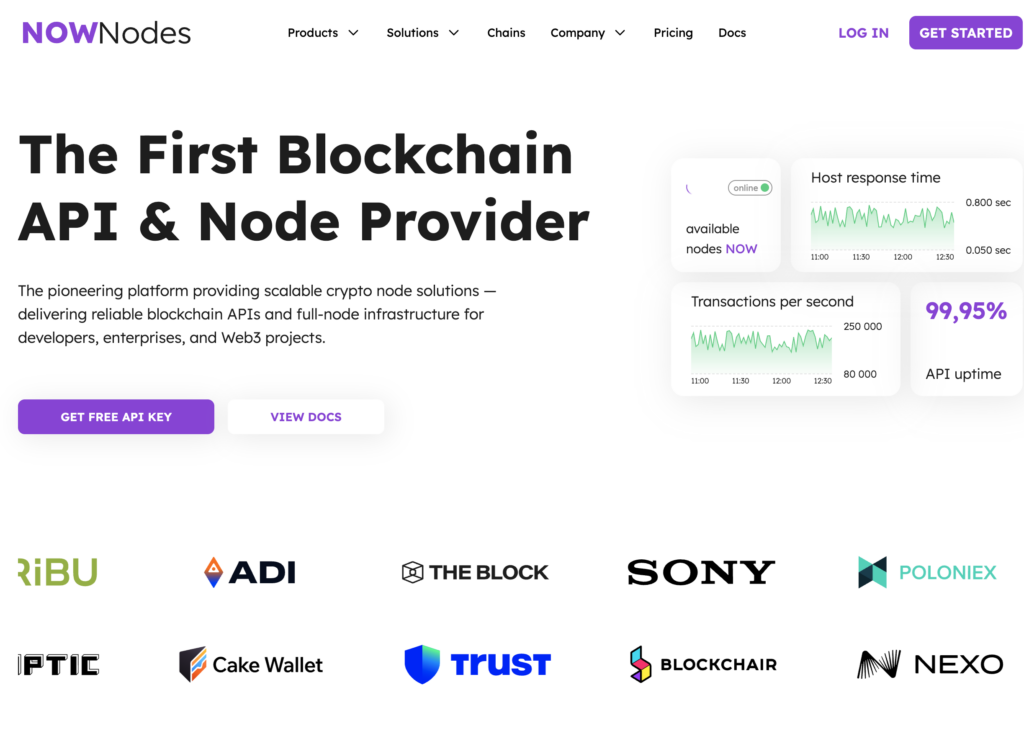
NOWNodes provides Cardano access through JSON-RPC, a Blockfrost-compatible API, GraphQL, and an Ogmios WebSocket endpoint, alongside coverage for 120+ other blockchain networks from Bitcoin to Ethereum to Solana — one account and API key instead of a separate provider per chain. Archive access covers full chain history, and both Mainnet and Testnet are available for pre-launch validation.
The free Start plan includes 100,000 requests for one month on shared infrastructure, with paid and dedicated tiers removing the predefined requests-per-second cap. The trade-off is the one every multi-chain provider carries: a team that only ever touches Cardano may find a Cardano-native specialist’s indexing tools go deeper out of the box.
Blockfrost
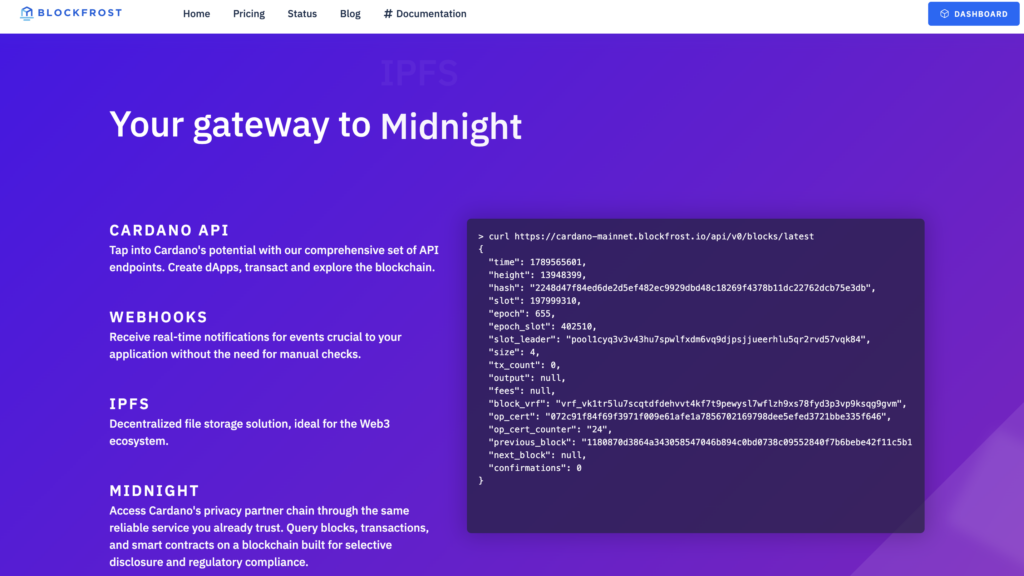
Blockfrost is a REST API purpose-built for Cardano, wrapping node access, IPFS, and Milkomeda sidechain data behind one interface with SDKs in multiple languages. Input Output made a strategic investment in the project in 2024, and Mike Ward, IOG’s Chief Product Officer, called it a product that “brings significant value to the Cardano developer ecosystem,” per IOG’s announcement.
That backing and its head start make it the default many tutorials point to first, with broad support across Cardano wallet SDKs. The catch is architectural: Blockfrost runs as a centralized service, so an outage there is your outage unless you’ve built in a fallback.
Koios
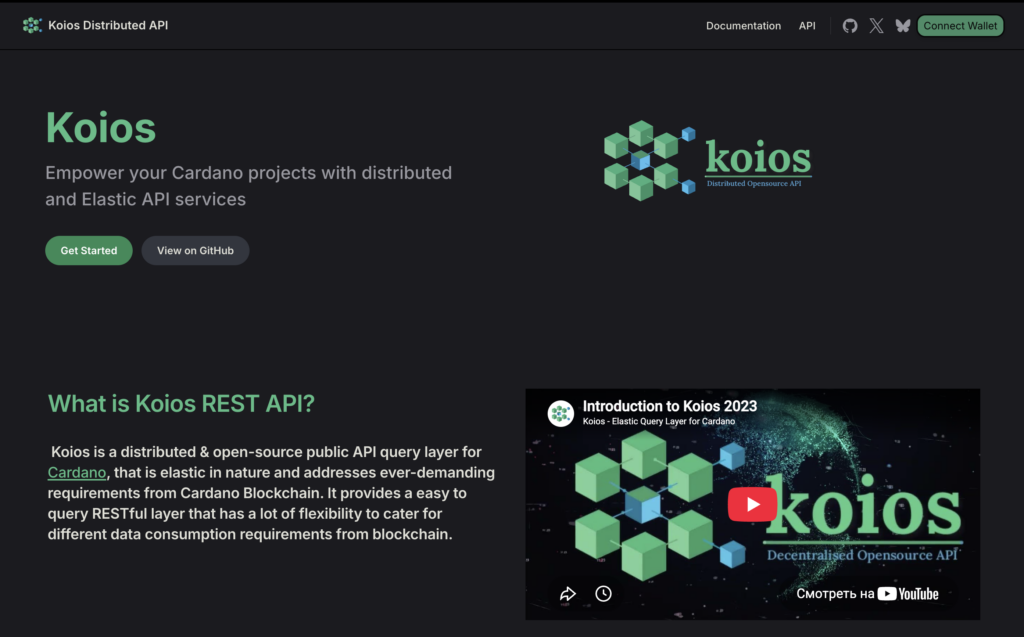
Koios takes the opposite approach: instead of one operator running the API, it’s “a decentralized and elastic RESTful query layer” maintained by a cluster of independently run servers that check each other’s health, per the Koios team’s own description. The team’s stated motivation was direct — as Cardano’s chain data grows, maintaining it gets expensive, concentrating access around “a few centralised API providers.”
That federated design removes a single point of failure, since a query can be answered by any of several independently operated nodes. The trade-off is less centralized support — there’s no single vendor for an enterprise SLA, which suits open-source projects more than teams needing a contract.
Maestro
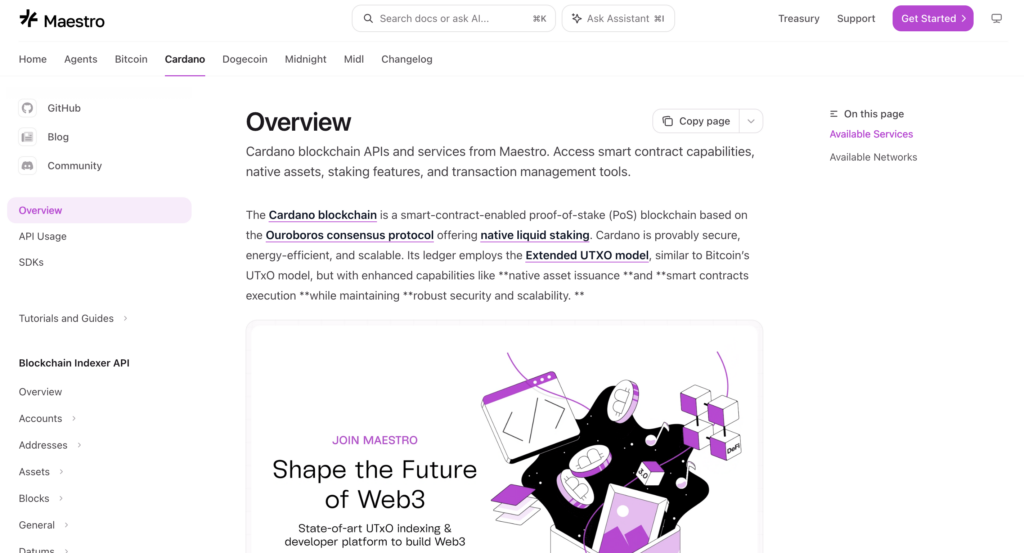
Maestro focuses on DeFi-grade UTXO indexing, with cursor-based pagination built to handle large result sets without duplicates as new blocks arrive, per its own developer documentation. Pricing runs on a compute-credit model, where cost scales with how much computation a query requires rather than a flat per-call rate.
Rate limits stack on top of that credit system — the entry-level Artist plan caps out at 10 requests per second. That combination suits DeFi protocols running heavy, filtered UTXO queries more than a wallet doing occasional balance checks.
Demeter
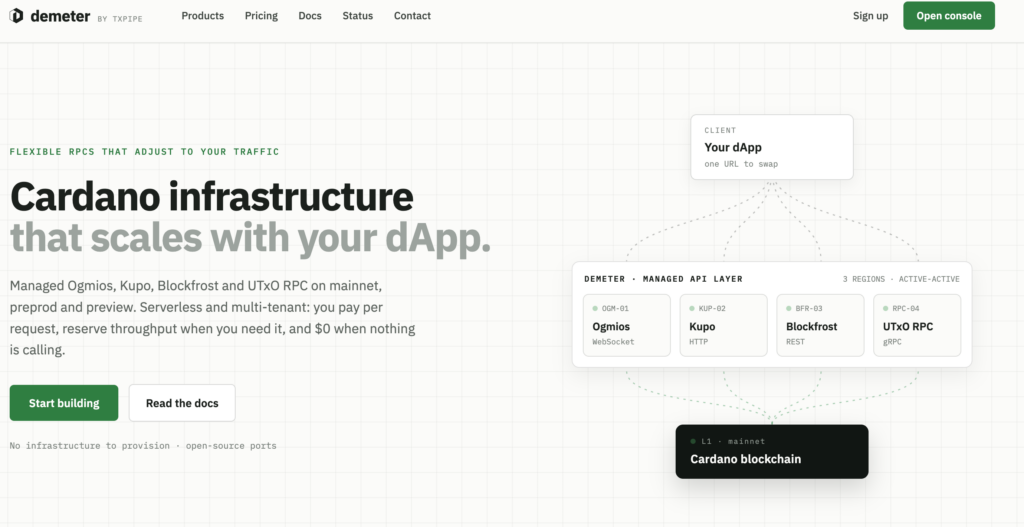
Demeter is a managed hosting platform, not one fixed API — it runs Ogmios (WebSocket/JSON-RPC), Kupo (REST indexing), a Blockfrost-compatible REST layer, and UTxO RPC over gRPC on the same backbone, operated jointly by TxPipe and Blink Labs. Everything is open-source with public specs, so a team can move to its own node later “and nothing in your code changes,” per Demeter’s site.
Pricing is consumption-based, starting around $0.30 per 100,000 requests with no minimum, dropping to $0.23 per 100,000 on committed tiers. It fits teams who want the standard open-source Cardano stack without operating servers themselves, though it’s a different product shape than a unified API like Blockfrost or Maestro.
Shared vs. Dedicated Cardano Infrastructure: Which Do You Need?
Most providers above split their offering into shared and dedicated tiers. A shared node runs on infrastructure used by multiple customers at once, governed by request quotas and plan-based rate limits; a dedicated node is isolated to one customer, with throughput bound by allocated hardware instead.
This matters more on Cardano than it might seem, since a stake-pool analytics tool pulling epoch-boundary data generates request patterns nothing like a wallet’s occasional balance check. Shared tiers fit development and moderate traffic; dedicated tiers fit high-load DeFi protocols and exchanges running constant deposit monitoring.
Client Diversity: Why Amaru Matters for Cardano Infrastructure
Every provider above still depends on cardano-node, the Haskell reference client — a single-implementation risk Cardano shares with many chains. Amaru, a Rust rewrite of the node maintained by PRAGMA, exists to change that.
Amaru “gives the network client diversity at the node level, analogous to how Ethereum benefits from running multiple independent clients,” per Cardano’s own glossary entry. It’s the same logic that pushes the Ethereum Foundation to discourage any single execution client from dominating: a bug in the dominant implementation can take down a disproportionate share of nodes if no independent alternative exists.
Amaru is still maturing toward full block-producing capability, so it isn’t yet a production backend on its own. It’s worth watching regardless — a second maintained node implementation is what would let a future provider genuinely diversify its infrastructure, rather than running every server on the same codebase.
How to Choose the Right Cardano Provider
Work through these questions in order rather than starting from a pricing page:
- Map your actual queries. Decide whether you need raw Ogmios-style protocol access, indexed UTXO lookups, or a Blockfrost-compatible REST layer — these are genuinely different products.
- Decide if centralization risk matters to you. A federated option like Koios removes a single point of failure; a single-operator API trades that for more unified support.
- Check multi-chain needs, weighing a multi-chain provider’s simpler stack against a Cardano-native specialist’s deeper tooling.
- Test against Preprod or Preview first — Cardano’s testnets exist so you can validate integration behavior before it touches real ADA.
- Confirm the migration cost. Since Ogmios and Kupo are open standards, a self-hosted or Demeter-based setup can usually switch providers without a rewrite; check whether your chosen API is proprietary before committing long-term.
Risks and Limitations to Watch For
A single provider is a dependency, and dependencies fail. If your application only points at one endpoint, an outage or rate-limit spike becomes your outage, regardless of how reliable Cardano itself is. The common mitigation is a second provider, or a federated option like Koios, so a query still resolves even if one operator has a bad day.
Cardano’s own numbers deserve a second look, too. Mainnet throughput runs at roughly 400+ transactions per second in practice, while the Hydra layer-2 protocol has demonstrated over 100,000 per second in controlled test environments, per CoinLaw’s 2026 network data. Don’t assume Hydra-level numbers apply to base-layer queries against your endpoint — they’re different infrastructure entirely.
Conclusion
There’s no single best Cardano node provider, only the one that matches your query pattern, tolerance for centralization risk, and appetite for managing infrastructure yourself. A multi-chain wallet gets the most value from a provider like NOWNodes covering Cardano alongside 120+ other networks; a DeFi protocol running heavy UTXO queries may lean toward Maestro; a team wary of single-vendor risk may prefer Koios’s federated model.
What matters more than the brand name is verifying the specifics first: which interface fits your query pattern, whether a provider is a single point of failure, and what happens the moment it has a bad day. With over 3,200 stake pools and 67.3% of circulating ADA staked, per CoinLaw’s 2026 figures, Cardano’s own network is genuinely decentralized — the infrastructure layer connecting your app to it is worth holding to the same standard.
FAQ
What’s the difference between Ogmios and Blockfrost?
Ogmios is a thin translation layer that exposes cardano-node‘s native protocol as JSON-RPC and WebSocket, staying close to raw node behavior. Blockfrost is a higher-level REST API that wraps node access, indexing, and additional services like IPFS behind one simplified interface.
Do I need Kupo if I’m already using Ogmios?
Usually yes, if your application needs to look up UTXOs by address or script rather than just streaming chain-tip updates. Ogmios handles protocol-level communication, while Kupo adds the indexed lookups Ogmios alone doesn’t provide.
Can I test against Cardano’s testnets before going live?
Yes. Cardano runs both Preprod and Preview testnets, and most providers, including NOWNodes, support both alongside Mainnet so you can validate an integration before it touches real ADA.