

A crypto staking platform is any service that lets you lock up coins to help run a proof-of-stake blockchain and earn a reward for it, without operating the machinery yourself. In 2026 they split into four groups: exchange apps like Coinbase and Kraken, liquid staking protocols like Lido and Rocket Pool, solo staking where you run your own validator, and restaking for people chasing extra yield.
Here’s the short version. Beginners should start on a regulated exchange, DeFi users get more flexibility from liquid staking, and anyone who wants the highest rewards with full control runs their own validator. The rest of this guide explains how each option works, what it pays, and where the catches are.
What Is a Crypto Staking Platform?
A crypto staking platform is software that stakes your coins for you and passes on most of the rewards, minus a fee. Instead of running a validator, buying hardware, and staying online around the clock, you deposit coins and the platform handles the technical side.
Staking is the act of locking cryptocurrency to help validate transactions on a proof-of-stake network. In return, the network pays you newly issued coins and a share of transaction fees. It’s the proof-of-stake equivalent of the work miners do on Bitcoin.
The reward comes from how proof-of-stake chains stay secure. Networks like Ethereum, Solana, and Cardano pick validators to confirm blocks based on how much they’ve staked. Put coins at stake and behave honestly, and the network pays you. Try to cheat or go offline, and you lose a slice of your deposit.
How Does Crypto Staking Work?
The flow is the same on almost every platform, whether it’s a phone app or a DeFi protocol:
- Deposit — you send eligible coins to the platform or connect a wallet.
- Delegate — the platform assigns your coins to one or more validators.
- Earn — rewards accrue, usually daily or every few days, in the same coin you staked.
- Unstake — you withdraw, sometimes after a waiting period set by the network.
Only proof-of-stake coins can be staked. Bitcoin uses proof-of-work, so there’s no native Bitcoin staking, and any product that claims to “stake” BTC is doing something else, usually lending, under a friendlier name.
Why Stake Crypto at All?
Because idle coins earn nothing, and staking turns a holding you’re keeping anyway into a source of yield. If you plan to hold ETH or SOL through the cycle, staking pays you to do what you were already doing.
The numbers show how normal this has become. About a third of all ETH, roughly 39 million coins, was staked by mid-2026, according to reporting from CoinDesk, with more than 900,000 active validators securing the network. Staking is now a core part of how these chains function, not a fringe activity.
There’s a catch worth stating early: a high advertised rate isn’t the same as a high real return. Some networks pay double-digit yields but inflate their supply just as fast, so weigh the headline APY against the coin’s inflation before chasing a big number.
Who Uses Crypto Staking Platforms?
Four groups, each with different priorities:
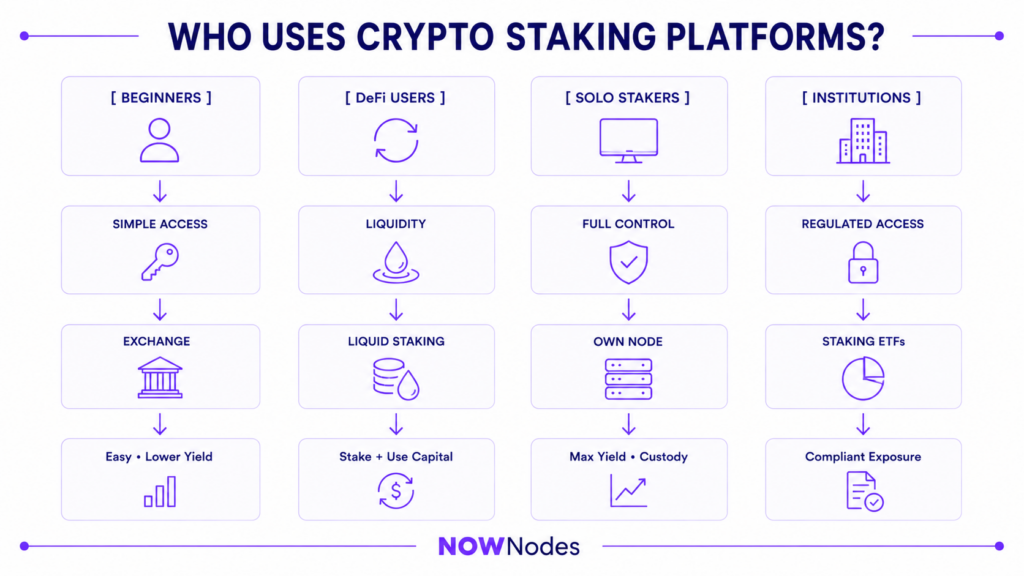
- Beginners want a simple app. They stake through an exchange, tap a button, and accept a lower net rate in exchange for not thinking about validators.
- DeFi users want their staked capital to stay liquid. They use liquid staking so they can keep earning while using the staked position elsewhere.
- Solo stakers and validators want maximum yield and full custody. They run their own node and answer to no middleman.
- Institutions want regulated exposure. Since 2025 they’ve had it, through staking-enabled exchange-traded funds.
That last group is the big shift of the past year. US regulators reversed course: the SEC dropped its cases against Coinbase and Kraken in early 2025 (SEC press release), Kraken switched US staking back on, and by 2026 staking-enabled Ethereum ETFs from Grayscale and BlackRock were trading. Staking went from legally murky to mainstream in about eighteen months.
Types of Crypto Staking Platforms
Before ranking specific names, it helps to see the four models side by side, because they differ more in custody and risk than in reward.
| Type | Custody | Ease | Typical net yield | Main trade-off |
|---|---|---|---|---|
| Exchange (custodial) | Platform holds coins | Easiest | Lower (after commission) | You trust the exchange |
| Liquid staking (DeFi) | You hold a staked token | Moderate | Mid | Smart-contract risk |
| Solo / native | You hold everything | Hardest | Highest | You run the infrastructure |
| Restaking | You hold a restaked token | Advanced | Highest, riskiest | Extra slashing exposure |
Exchange Staking Apps
Custodial crypto staking apps like Coinbase, Kraken, and Binance are the simplest way in. You already keep coins there, staking is a menu option, and the platform runs the validators. The cost is a commission, often 25% or more of your rewards, and the fact that the exchange holds your keys.
These apps suit anyone who values convenience over squeezing out the last basis point. They’re also the most regulated option now that US enforcement has eased.
Liquid Staking (DeFi Staking Platforms)
Liquid staking solves the biggest annoyance of normal staking: locked capital. When you stake ETH through Lido, you get back a token, stETH, that represents your staked position and keeps earning. You can hold it, trade it, or use it as collateral while the underlying ETH stays staked.
Lido and Rocket Pool are the largest Ethereum staking platforms of this kind, and Jito plays the same role on Solana. These DeFi staking platforms hold tens of billions of dollars between them, per DeFiLlama, which makes liquid staking one of the biggest categories in all of DeFi. The trade-off is that you’re now trusting smart contracts as well as the network.
Solo / Native Staking
Solo staking is the only model where you trust no one with your coins. You run a validator, keep both the keys and the full reward, and support the network directly. On Ethereum that means putting up exactly 32 ETH per validator and keeping a machine online continuously, as the Ethereum staking launchpad spells out.
The requirement is real: miss too much attestation time and rewards shrink; double-sign and you can be slashed. That uptime depends on a stable connection to the blockchain, which is why validator operators either run a full node themselves or lean on infrastructure providers.
NOWNodes is an example of the second route. It provides API access to Ethereum, Solana, Cardano, BNB Chain, and other proof-of-stake networks, which lets an operator reach a chain without maintaining the node hardware themselves.
Restaking
Restaking is the advanced layer. It lets you take already-staked ETH and reuse it to help secure other protocols, earning a second reward on the same capital. EigenLayer pioneered the idea and dominates it, holding roughly $15 billion in TVL and about 90% of the restaking market in early 2026.
The extra yield comes with extra danger. Restaked coins are exposed to slashing on every protocol they secure, so a single misbehaving operator can cost you more than plain staking ever would. This is a tool for people who understand exactly what they’re signing up for.
Best Crypto Staking Platforms in 2026
The best crypto staking platform depends on which of the four groups above you fall into. There’s no single winner, but these are the names that come up most across the market in 2026.
| Platform | Best for | Model | Notes |
|---|---|---|---|
| Coinbase | US beginners | Custodial | Simple, regulated, higher fees |
| Kraken | Security-minded users | Custodial | Strong track record; US staking restored |
| Binance / OKX | Choice and range | Custodial | Flexible and locked products |
| Lido | Ethereum liquid staking | DeFi | Largest LST, stETH |
| Rocket Pool | Decentralized ETH staking | DeFi | Smaller node operators, rETH |
| Jito | Solana staking | DeFi | Leading Solana liquid staking |
Coinbase is the default first stop for US users: easy to find, regulated, with a commission that eats into your best crypto staking rewards. Kraken rebuilt trust after its 2023 SEC settlement forced it to shutter US staking; that service is back, and its security reputation stayed strong. Binance and OKX win on breadth, carrying a long tail of coins across both flexible and locked terms.
Lido is the giant of Ethereum liquid staking, though its size is also its problem: around a quarter to a third of all staked ETH has at times sat with Lido, which worries anyone who cares about decentralization. Rocket Pool is the more distributed answer, spreading stake across many independent operators, and Jito plays the same leading role on Solana.
For self-custody fans, hardware wallets like Ledger let you delegate straight from your own wallet, with no exchange in the middle.
Best Staking Coins and Their Rewards
The best staking coins balance a decent yield against low inflation, a liquid market, and a network you actually believe in. Put another way, the best staking crypto is rarely the one with the biggest number next to it. Here’s how the major options compared in 2026. Treat the rates as live figures that move with network conditions, not fixed promises.
| Coin | Typical APY | Lock-up / unbonding | Note |
|---|---|---|---|
| Ethereum (ETH) | ~3–4% | Exit queue, variable | Lowest yield, most stable |
| Solana (SOL) | ~6–8% | ~2-day epochs | Fast rewards, deep liquidity |
| Cardano (ADA) | ~4–5% | None | Coins never locked |
| Polkadot (DOT) | ~12–15% | 28-day unbonding | High yield, high inflation |
| Cosmos (ATOM) | ~15–20% | 21-day unbonding | Highest nominal, most inflationary |
The pattern is clear: the highest staking rewards crypto pays tend to come from the most inflationary networks. Cosmos and Polkadot top the APY charts, but a chunk of that yield just offsets new supply hitting the market. Ethereum sits at the bottom on rate and near the top on stability.
Cardano is the outlier worth knowing. Staked ADA is never locked and stays fully spendable, which makes it one of the friendliest coins for people who hate waiting periods. For a fuller picture of any single asset, ethereum.org’s staking overview is a solid neutral starting point on how rewards and penalties are calculated.
How to Choose a Crypto Staking Platform
Work through these in order, because the first two decide most of the outcome:
- Custody — decide whether you’re comfortable letting a platform hold your coins. If not, you’re choosing between liquid staking and running your own validator.
- Net APY, not gross — compare rewards after the platform’s commission, not the advertised headline. A 4% rate with a 25% fee is really 3%.
- Supported coins — make sure the platform actually stakes the asset you hold, and check whether it’s a flexible or locked product.
- Lock-up and liquidity — know the unbonding period before you deposit. Cosmos makes you wait 21 days; Cardano lets you leave instantly.
- Security and regulation — favor platforms with a clean track record and, if you’re in the US, ones that legally offer staking to your state.
On the value of running your own infrastructure, Ethereum co-founder Vitalik Buterin put it bluntly when arguing for more solo stakers: “The idea that ‘running infrastructure’ is this scary, complicated thing where each person participating must be a ‘professional’ is awful and anti-decentralization, and we must attack it directly.” His point, made while pushing to make solo staking easier (The Block), is that the more people who stake independently, the healthier the network stays.
What Are the Risks of Crypto Staking?
Staking is not a savings account, and the yield is a payment for taking on real risks. The main ones:
- Slashing — validators that double-sign or stay offline too long lose part of their stake. It’s rare and usually caused by operator error, but it’s the one loss unique to staking.
- Lock-up — many networks make you wait days or weeks to unstake, during which you can’t sell even if the price drops.
- Price volatility — a 5% yield means nothing if the coin falls 40%. Rewards are paid in the same volatile asset you staked.
- Centralization — when one provider controls a large share of a network’s stake, it becomes a single point of failure. Lido’s dominance on Ethereum is the standing example.
- Smart-contract and counterparty risk — liquid staking adds contract bugs to the picture, and custodial platforms add the risk that the platform itself fails.
None of these should scare you off, but they explain why spreading stake across a couple of platforms, rather than piling everything into one, is a sensible habit. Kraken’s own guide to staking safety is a fair primer if you want to read further.
Conclusion
The best crypto staking platform in 2026 is the one that matches how much control you want. Exchange apps like Coinbase and Kraken trade yield for simplicity; liquid staking through Lido, Rocket Pool, or Jito keeps your capital working; solo staking hands you the full reward in exchange for running the infrastructure yourself; and restaking pushes yield higher at the cost of real added risk.
Whatever route you pick, the discipline is the same. Compare net rates rather than headline APYs, respect the lock-up periods, weigh yield against inflation, and don’t concentrate everything with one provider. Staking is one of the few ways to earn a real return on crypto you already hold, and done carefully, it pays you to help run the networks you believe in.
FAQ
Is Crypto Staking Worth It in 2026?
For long-term holders, usually yes. If you plan to keep a proof-of-stake coin regardless of price, staking adds a return on top with limited extra effort. It makes less sense if you trade actively or might need to sell during a lock-up period.
What’s the Minimum Amount Needed to Start Staking?
On exchange apps and liquid staking protocols, next to nothing, often a fraction of a coin. Running your own Ethereum validator is the exception: it requires exactly 32 ETH per validator, which is why most people use a platform instead.
Are Crypto Staking Rewards Taxable?
In most countries, yes. Staking rewards are typically treated as income at the moment you receive them, and then as a capital gain or loss when you later sell. Rules vary by jurisdiction, so check your local guidance or a tax professional before filing.
What Happens to My Coins if a Staking Platform Shuts Down?
It depends on custody. With a custodial exchange, your coins are exposed to that company’s solvency, the same as any deposit. With non-custodial liquid staking or solo staking, you hold the keys or the staked token, so a company failing doesn’t automatically cost you your position.
How Often Are Staking Rewards Paid Out?
It varies by network. Solana pays roughly every two-day epoch, Ethereum rewards accrue continuously, and many other chains distribute daily or per era. Rewards almost always arrive in the same coin you staked, which compounds if you re-stake them.