
A Dogecoin RPC provider gives your application hosted access to the Dogecoin network, so a wallet, exchange, or payment tool can check balances and broadcast transactions without running a full Dogecoin Core node. NOWNodes, QuickNode, GetBlock, Chainstack, and dRPC all support DOGE, and the right pick depends on whether you need indexed transaction history, testnet access, or Dogecoin bundled with dozens of other chains under one key.
Dogecoin still runs on the Bitcoin-derived codebase it launched with in 2013, secured through Scrypt proof-of-work merged with Litecoin. That lineage means its JSON-RPC interface looks a lot like Bitcoin Core’s, but an uncapped supply, one-minute blocks, and a payments-first user base change what you actually need from an endpoint. Here’s what a DOGE node does, who depends on one, and how the main options compare this year.
What Does an RPC Node Do on Dogecoin?
A node exposed over RPC is a server running Dogecoin Core, the reference client, that your application talks to instead of you syncing and maintaining that software yourself. It’s the layer between your code and the live network.
RPC stands for Remote Procedure Call: a way of asking a remote server to run a function and hand back the result. On Dogecoin, that means calling methods such as getblockcount to check chain height, getrawtransaction to look up a transaction, or sendrawtransaction to broadcast a signed payment.
Dogecoin Core is a direct descendant of Bitcoin Core, so its method set is close to identical rather than merely similar. A developer who has already built against Bitcoin’s getblockchaininfo or listunspent calls can point the same request structure at a DOGE endpoint with only minor adjustments, according to Dogecoin Core’s own documentation, which describes the project as based on the Bitcoin Core and Namecoin source.
This particular category — a full node exposed through an API instead of software you run yourself — sits alongside archive, pruned, and validator setups as one of several types of blockchain nodes worth knowing the difference between before you pick infrastructure.
Why Not Just Run Your Own Dogecoin Node?
You could, but staying synced with a live peer-to-peer network isn’t a one-time install — it’s an ongoing job of applying releases, watching disk use, and keeping enough peers connected to trust the node’s own view of the chain.
Reading that history efficiently also means either querying with -txindex enabled or using an indexed interface built for the job. NOWNodes’ Dogecoin node page and several other services expose DOGE through Blockbook, a read-optimized layer suited to balance lookups and address history, the same approach covered in more depth in what RPC nodes and endpoints actually do. An infrastructure provider handles that whole stack instead, so your application never notices what’s underneath. This is critical for anything handling real funds, since a node that silently falls out of sync can serve stale balances without ever throwing an error.
Who Actually Connects to DOGE This Way?
Dogecoin’s user base skews toward payments and tipping rather than DeFi, and that shapes what hosted access actually looks like in practice.
- Wallets need fast balance checks and reliable transaction broadcasting for everyday sends and receives.
- Payment processors and merchants monitor deposit addresses to confirm incoming DOGE payments, often at the volume level Dogecoin was originally built for.
- Exchanges track deposits and withdrawals across thousands of addresses and need indexed history to reconcile customer balances.
- Tipping bots and community tools, Dogecoin’s original use case on Reddit and beyond, still rely on lightweight balance and broadcast calls.
- Multi-chain wallets and portfolio trackers add Dogecoin alongside Bitcoin, Litecoin, and other UTXO chains under one backend.
That list has grown well past memes and tipping. Timothy Stebbing, a director at the Dogecoin Foundation, described the shift this way: “Two years ago we had: memes & tipping bots. Today we have: memes, tipping bots, point of sale solutions, online shopping solutions” — part of what he called a move “from speculative to utilitarian,” in a post on X. Point-of-sale and checkout integrations lean on exactly the same calls a tipping bot does; they just run them at higher volume and with less tolerance for a missed confirmation.
A tipping bot processing a handful of small transactions and a merchant checkout reconciling hundreds of daily payments both need hosted DOGE access, but their throughput and history requirements look nothing alike. That distinction should drive which service and plan actually fits.
How Merged Mining Shapes DOGE Infrastructure
Dogecoin doesn’t secure its own chain independently. Since 2014, it has used merged mining, also called AuxPoW (Auxiliary Proof of Work), which lets Litecoin miners validate Dogecoin blocks with the same computational work at no extra cost.
Merged mining: a technique that lets a miner work on more than one blockchain simultaneously, submitting the same proof-of-work solution to each network without splitting hash power between them. See Dogecoin’s own explainer on mining.
Here’s why this matters for infrastructure: merged mining ties Dogecoin’s block security directly to Litecoin’s much larger Scrypt hash rate, which is why the network settled on one-minute blocks and a fixed 10,000 DOGE block reward rather than a halving schedule. A node has to track both the Dogecoin chain and the AuxPoW headers referencing Litecoin blocks to validate new blocks correctly.
That design keeps Dogecoin’s supply uncapped by protocol rule. Circulating supply sits at roughly 154.28 billion DOGE as of mid-2026, growing by about 5 billion DOGE a year from block rewards, according to sqmagazine’s 2026 Dogecoin statistics. That’s a genuinely different economic model from Bitcoin’s capped 21 million, and it means any application reading DOGE balances is working against a supply that keeps expanding rather than a fixed ceiling.
What Separates One DOGE Endpoint From Another
Once a service confirms it supports Dogecoin at all, the differences that actually matter show up in a handful of specific areas.
| Feature | What It Does | Who Needs It |
|---|---|---|
| Blockbook / indexed history | Serves address balances and transaction history without a raw node scan | Exchanges, wallets, explorers |
| Testnet access | Lets you test against a non-production chain | Developers building and QA-testing integrations |
| Multi-chain coverage | One account across DOGE and other networks | Wallets and exchanges supporting several assets |
| Rate limits / RPS | Defines real-world throughput under load | Every use case, but especially payment processors |
| Webhooks / balance monitoring | Pushes an alert when a watched address changes | Payment confirmation flows, deposit monitoring |
Rate limits deserve a second look here. Dogecoin’s low per-transaction value means a payment app or tipping bot can generate a disproportionately high call volume relative to the dollar amount moving through it, so a plan that looks generous for a higher-value chain can still throttle a busy DOGE integration.
Blockbook exists specifically because Dogecoin tracks ownership through unspent outputs rather than a single balance field — the same UTXO model Bitcoin and Litecoin use. Summing those outputs on every balance check is exactly the kind of work an indexed interface is built to skip.
5 Dogecoin Node Providers Worth Comparing in 2026
The five options below range from Dogecoin-and-multi-chain generalists to dedicated DOGE infrastructure. Pricing and limits change often, so treat this as a starting point to verify against each provider’s current page.
| Provider | Best For | Standout Feature |
|---|---|---|
| NOWNodes | Multi-chain products that include Dogecoin | 120+ networks plus DOGE balance webhooks |
| QuickNode | Teams already standardized on QuickNode’s stack | Mainnet and testnet DOGE under one dashboard |
| GetBlock | Developers who want method-by-method Dogecoin docs | Dedicated JSON-RPC reference for every DOGE call |
| Chainstack | Enterprise workloads needing dedicated infrastructure | Dedicated nodes with an SLA and monitoring dashboard |
| dRPC | Cost-sensitive, multi-chain workloads | Free and paid DOGE endpoints with load balancing |
NOWNodes
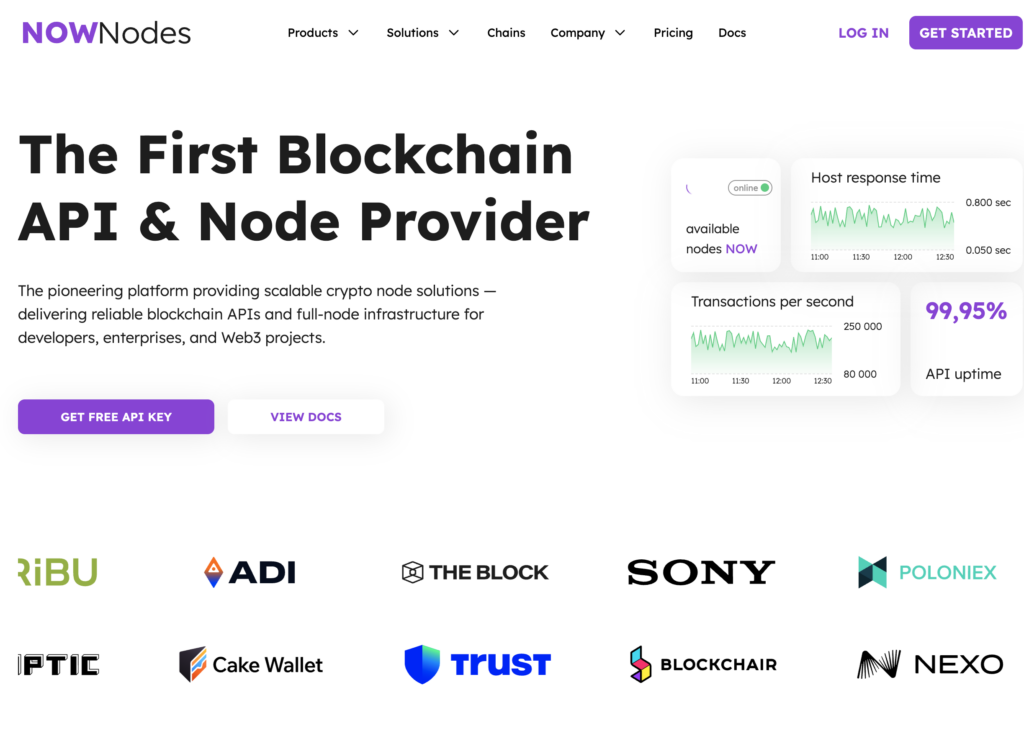
NOWNodes provides Dogecoin access over both RPC and Blockbook alongside coverage for 120-plus other blockchain networks, from Bitcoin to Ethereum to Solana. A wallet or exchange supporting several UTXO chains gets one account and one API key instead of juggling a separate service per network.
Dogecoin is also one of only two networks — alongside Bitcoin — currently covered by NOWNodes’ webhook product, which watches a configured address and sends an HTTPS callback when its balance changes, tracking up to five addresses per configuration. That’s useful for confirming incoming payments without polling, though it’s currently scoped to balance changes rather than arbitrary transaction filters, and the product is still in free beta. Paid plans carry no predefined requests-per-second cap on dedicated infrastructure, with throughput bound by allocated hardware instead.
QuickNode
QuickNode documents Dogecoin JSON-RPC access over HTTPS for both mainnet and testnet, describing the network as built for “fast, low-cost transactions.” Its docs point developers to Bitcoin Core’s RPC reference for method-level detail, since Dogecoin’s API mirrors it closely — a fit for teams already running other chains through QuickNode who want DOGE on the same dashboard.
GetBlock
GetBlock publishes a dedicated JSON-RPC reference for Dogecoin, documenting individual methods like gettransaction and signrawtransaction with method-specific pages rather than pointing back to Bitcoin’s docs. That granularity suits a developer who wants to look up one call at a time, though production teams handling real payment volume should confirm current rate limits and history depth before committing.
Chainstack
Chainstack positions Dogecoin as an enterprise-grade dedicated-node offering, describing it as “a Litecoin-derived proof-of-work coin famous for its meme origin,” where “merged-mining with LTC and enormous social reach keep it in the top-cap league.” Its dedicated Dogecoin nodes carry a 99.9% uptime SLA and a real-time monitoring dashboard, with pricing starting around $0.50 an hour and a free tier covering 3 million calls a month — a structure that suits steady, predictable traffic more than a small side project.
dRPC
dRPC lists Dogecoin mainnet endpoints among its supported chains, using the same multichain load-balancing model it applies across its broader network list. Free and paid tiers are both available, fitting a project already spreading traffic across many chains more than one that only ever needs DOGE.
Shared vs. Dedicated: Which Setup Does Dogecoin Need?
Most services above split Dogecoin access into shared and dedicated tiers, and the choice affects both cost and how much traffic you can push before hitting a ceiling. A shared node runs on infrastructure used by multiple customers, governed by request quotas and plan-based rate limits, while a dedicated node is isolated to one customer with throughput bound by allocated hardware instead.
That distinction matters more for Dogecoin than its low per-transaction value might suggest. A payment processor confirming thousands of small deposits can generate request patterns that look nothing like a wallet’s occasional balance check, even though the dollar amounts involved stay modest. Shared plans fit development and moderate traffic; dedicated ones fit high-volume exchanges and payment processors that have already hit that ceiling.
Picking the Right Option: A Quick Checklist
Work through these questions in order rather than starting from a pricing page:
- Map your actual calls. List the methods your app depends on, such as
getbalance,gettransaction, orsendrawtransaction, since indexed history queries load a service more than simple broadcasts. - Decide if you need indexed history. A Blockbook-backed plan is overkill if you only check current balances, but close to essential for reconciling deposits or building an explorer.
- Check multi-chain needs, weighing a generalist’s simpler stack against a Dogecoin-focused reference’s deeper method-level documentation.
- Test webhook or polling behavior under your own load, not just advertised uptime — a payment flow that misses a balance change is a worse failure than one that’s simply slow.
Risks and Limitations to Watch For
Relying on a single provider is a dependency, and dependencies fail. If your application only points at one endpoint, an outage or rate-limit spike there becomes your outage, regardless of how reliable the Dogecoin network itself is. The common mitigation is running a second service as failover, switching automatically when error rates or latency cross a threshold — engineering overhead worth it for anything moving real funds.
Dogecoin’s uncapped, inflationary supply deserves a separate mention. Never treat supply or price figures as investment advice — token economics sit outside what any API call can tell you, and a decision to hold or transact DOGE should rest on your own research, not on the fact that a balance lookup returned a number.
Conclusion
There’s no single best way to connect to Dogecoin, only the option that matches your traffic pattern, history requirements, and appetite for managing infrastructure yourself. A multi-chain wallet or exchange gets the most value from a service like NOWNodes that bundles DOGE alongside 120-plus other networks under one account, while a steady, high-volume payment processor may prefer Chainstack’s dedicated infrastructure and SLA.
What matters more than the brand name is verifying the specifics before you build on them: whether the service indexes full transaction history, what its uptime looks like under real load, and what happens to your application the moment that provider has a bad day.
FAQ
Is Dogecoin’s RPC interface the same as Bitcoin’s?
Nearly. Dogecoin Core is derived from the Bitcoin Core and Namecoin codebases, so most JSON-RPC methods share the same names and parameters. A few Dogecoin-specific values, like block reward and network parameters, differ, but the call structure itself carries over almost directly.
Does Dogecoin have a maximum supply?
No. Dogecoin’s protocol has no supply cap, and the network currently adds roughly 5 billion new DOGE a year through a fixed 10,000 DOGE block reward. That’s a deliberate design choice, not a bug, aimed at keeping transaction fees low rather than replicating Bitcoin’s scarcity model.
What is merged mining, in simple terms?
Merged mining lets Litecoin miners secure the Dogecoin network with the same Scrypt proof-of-work they’re already doing for Litecoin, without splitting hash power between the two chains. It’s the reason Dogecoin’s security tracks Litecoin’s much larger miner base rather than standing alone.
Do I need a full-history node for a basic Dogecoin wallet integration?
Usually not. A wallet that only checks current balances and broadcasts transactions works fine against a standard node with recent chain data. Indexed or full-history access mostly matters for exchanges reconciling deposits or analytics tools querying old transactions.
How fast does a Dogecoin transaction confirm?
Dogecoin targets a one-minute block time, so a single confirmation typically lands within about 60 seconds under normal network conditions. Payment processors often wait for a small number of additional confirmations before treating a deposit as final, the same practice used on other proof-of-work chains.