
A Monero RPC provider gives your wallet, exchange, or backend hosted access to the Monero network, so it can check balances and broadcast transactions without you running monerod yourself. The list of companies that actually support it is short: NOWNodes and GetBlock cover Monero directly, alongside a handful of smaller shared-node operators and the network’s own list of free public nodes. That’s a noticeably thinner field than Ethereum or Solana get, and the reason is Monero’s privacy design itself.
Monero isn’t like an EVM chain or even Bitcoin at the node-access layer. Its daemon exposes JSON-RPC methods such as get_info and get_block, and a separate monero-wallet-rpc process handles balances and transfers using your view key — a structure most multi-chain node platforms never had to build support for. That split, plus the compliance pressure privacy coins face, explains why picking a Monero node provider takes more homework than picking a Bitcoin one. Here’s what that access layer actually does, why it matters more for Monero than most chains, and which providers still support it in 2026.
How Does RPC Access to a Monero Node Work?
A live instance of monerod, Monero’s daemon software, exposes the chain over JSON-RPC so an application can query it instead of syncing the blockchain itself. RPC, or Remote Procedure Call, is the general pattern of asking a remote server to run a function and return the result — on Monero, that means calling methods like get_block_count, get_transactions, or on_get_block_hash against a live daemon, per the official daemon RPC documentation.
Monero splits this into two separate services, and the distinction matters. monerod handles blockchain data — blocks, transactions, network state — while a second process called monero-wallet-rpc handles wallet operations: checking a balance, building a transaction, broadcasting it. The wallet RPC doesn’t join the peer-to-peer network on its own; it depends on a monerod instance, local or remote, to scan outputs and relay signed transactions, according to the monero-wallet-rpc reference.
That two-service structure is unusual next to Ethereum’s single eth_getBalance call, and it’s one of several ways Monero’s node architecture departs from the transparent chains most node platforms were built for first. A team building on Monero typically needs both endpoints working together: the daemon RPC for chain state, and the wallet RPC for anything involving keys.
Why Do You Need a Hosted Monero Node?
You need one mainly because running monerod yourself is a heavier commitment than it looks. A full Monero node currently takes roughly 230 GiB of disk space to sync from genesis, as of July 2025, according to Monero’s own technical specification — and that number only grows as the chain does.
Sync time is the second cost. Monero mines on RandomX, an algorithm designed to run efficiently on ordinary CPUs rather than specialized ASIC hardware, which keeps mining decentralized but doesn’t make the initial blockchain download any faster. For a wallet, exchange, or bot that just needs to check a balance or submit a transaction, waiting days to sync a node before doing anything useful isn’t a realistic option.
Here’s the catch that’s specific to Monero: using someone else’s node isn’t privacy-neutral the way it is on a transparent chain. Monero’s own documentation is direct about it — a public remote node “can be risky,” since “node operators can link transactions to IP addresses,” and the project’s stated position is that “the Monero community suggests to always run your own node to obtain the maximum privacy possible,” per the Moneropedia entry on remote nodes. An RPC provider doesn’t remove that trade-off; it just makes the operational side manageable while you decide how much of it you’re willing to accept.
Who Actually Uses a Monero Node Provider?
A handful of distinct groups rely on hosted Monero node endpoints, and each one is optimizing for something slightly different.
- Wallets need fast
get_balanceandtransfercalls through wallet-rpc, plus a synced daemon behind it to scan incoming outputs, typically through a hosted Monero node rather than one they run and patch themselves. - OTC desks and non-custodial exchanges monitor deposit addresses and broadcast transactions, since most licensed centralized exchanges have stopped listing Monero entirely.
- Privacy-focused merchants and payment processors use RPC access to accept XMR without holding funds on a platform that could delist the asset overnight.
- Researchers and explorers query daemon methods like
get_blockandget_transactionsto study network activity, mining distribution, or fee markets.
A retail wallet checking one balance and an OTC desk reconciling daily withdrawals both count as “using a Monero node provider,” but they need very different reliability guarantees and, often, different providers entirely.
How Monero’s Privacy Design Affects RPC Requests
Monero doesn’t have an optional privacy mode — every transaction runs through the same cryptography, all the time, unlike other privacy coins that let users choose a transparent option. That’s the single biggest thing separating its RPC layer from Bitcoin’s or Ethereum’s, where a request is a simple lookup against a transparent ledger.
Ring Signatures and the Current Ring Size
Every Monero transaction is signed as part of a ring, currently fixed at 16 members: your real output plus 15 decoys pulled from the blockchain, per Monero’s technical specification. An outside observer, including whichever node processed the request, sees 16 plausible signers and can’t determine which one actually spent the funds.
That has a direct RPC consequence: a daemon or provider serving your transaction only ever sees an ambiguous set, never a confirmed sender. RingCT, active on Monero since 2017, layers on top of that to hide the transaction amount as well, so neither the daemon nor anyone querying it can read how much moved.
Stealth Addresses and View Keys
A stealth address is a one-time destination address generated for every incoming payment, so the same wallet never visibly receives two transactions at the same address on-chain. Scanning for incoming funds requires a view key — a separate credential from your spend key — which is exactly why monero-wallet-rpc exists as its own service rather than folding into the daemon.
That architecture is why a hosted Monero node can’t casually add “explorer-style” balance lookups the way a Bitcoin API might. Reading a Monero balance requires the wallet’s view key scanning the chain output by output, not a simple address-to-balance index.
What to Compare Between Monero Node Providers
Once a provider confirms it supports Monero at all, the real differences come down to a short list of specifics.
| Feature | What It Does | Who Needs It |
|---|---|---|
Daemon RPC (monerod) | Serves blocks, transactions, chain state | Explorers, analytics, general integrations |
| Wallet RPC support | Hosts or proxies monero-wallet-rpc for balance/transfer calls | Wallets, payment processors |
| Dedicated nodes | Isolated infrastructure, no shared rate limits | OTC desks, exchanges with steady volume |
| Multi-chain coverage | One account across Monero and other networks | Wallets and exchanges supporting several assets |
Rate limits deserve a closer look on Monero, since scanning a wallet’s full output history through monero-wallet-rpc is heavier than a single balance check on a transparent chain. A plan that looks generous for typical RPC traffic can still bottleneck a service doing that kind of scan repeatedly.
Top Monero Node Providers to Consider
The field here is smaller than for Ethereum or Solana, and treating that as noise rather than a red flag matters: it reflects the compliance overhead of supporting a privacy coin, not a lack of demand.
| Provider | Best For | Standout Feature |
|---|---|---|
| NOWNodes | Multi-chain products that include Monero | 120+ networks under one API key |
| GetBlock | Teams wanting dedicated XMR infrastructure | Documented method-by-method JSON-RPC reference |
| Public community nodes | Prototyping and light personal use | Free, no signup, listed at monero.fail |
NOWNodes
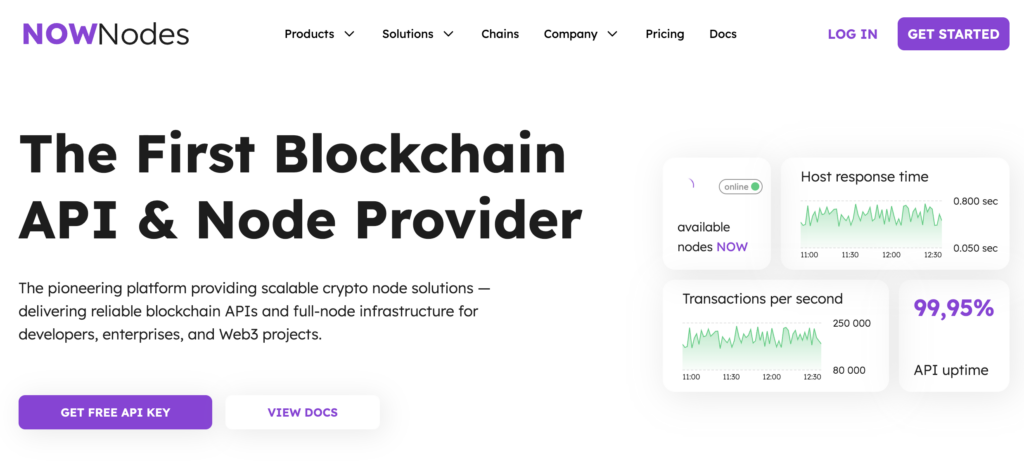
NOWNodes provides Monero node access alongside 120-plus other blockchain networks, from Bitcoin to Ethereum to Solana, through shared and dedicated node tiers. For a wallet or payment processor that already supports several assets, that means one account instead of a separate Monero-only vendor bolted onto the rest of the stack.
Paid plans carry no predefined requests-per-second cap, with throughput scaled to cluster capacity instead, and the shared Start plan currently includes 100,000 free requests to test an integration before committing to a paid tier. An XMR-only shop that never touches another chain may still get more specialized tooling from a Monero-focused specialist.
GetBlock
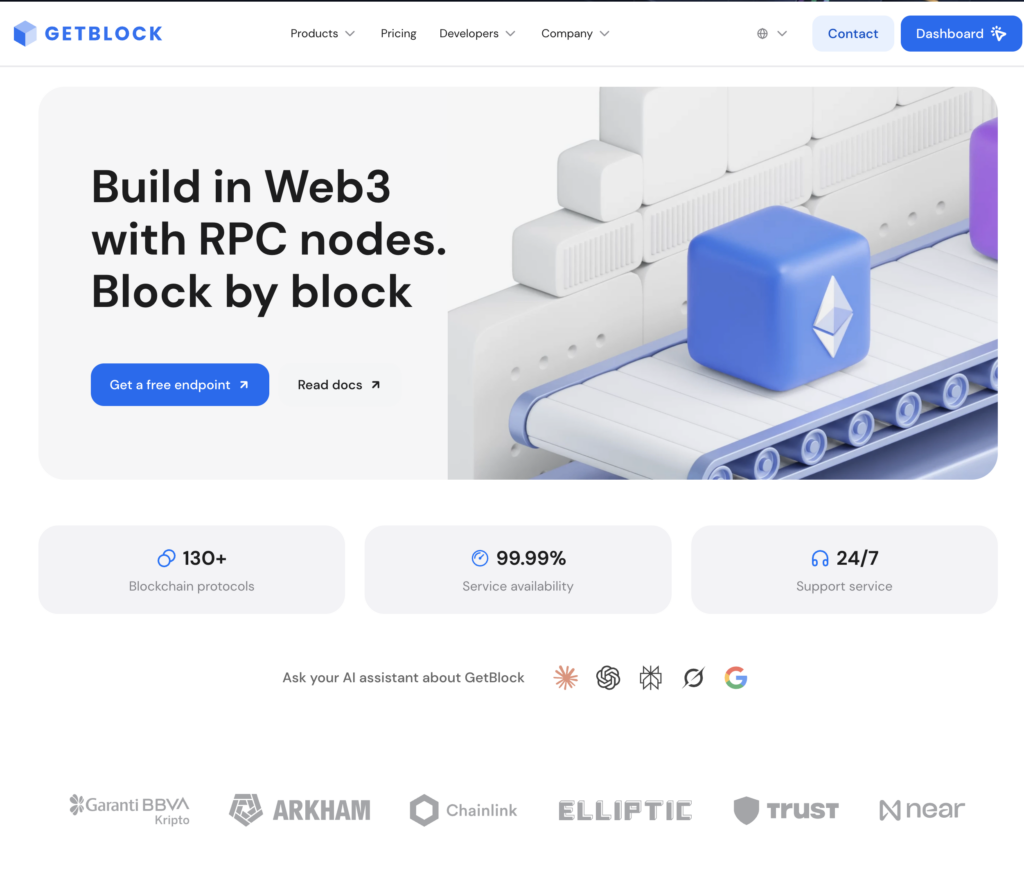
GetBlock runs dedicated, method-by-method documentation for Monero’s JSON-RPC interface, covering calls like get_block, get_output_distribution, and submit_block individually. That level of detail makes it a reasonable starting point for a developer building directly against monerod rather than a higher-level SDK.
Its dedicated-node tier starts at roughly $1,000 a month for a private server with no rate limit, which positions it for teams with sustained, predictable Monero traffic rather than early-stage testing. Lighter integrations may find the shared plan’s compute-unit pricing model takes some getting used to compared to a flat requests-per-second cap.
Public Community Nodes
Monero’s own community maintains free, open remote nodes, tracked at sites like monero.fail, that anyone can point a wallet at without an API key or signup. These work fine for casual use — checking a balance occasionally, testing a wallet configuration — but they carry the exact privacy trade-off described earlier: the operator can see your IP address alongside your requests, and uptime isn’t contractually guaranteed the way a paid provider’s is.
Running Your Own Node vs. Using a Remote Node
This decision matters more on Monero than on almost any other chain, precisely because the privacy model assumes you’re the one doing the scanning. Justin Ehrenhofer, organizer of the Monero Community Workgroup, frames the underlying stakes plainly: “Privacy is a basic human right, and we should not lose this right when moving to a digital system,” he said in an interview with Blokt.
Running your own monerod and monero-wallet-rpc means nobody outside your own machine sees which outputs you’re scanning or which IP address your requests come from. The cost is the 230 GiB sync and the ongoing maintenance of keeping a node online and updated, which is real operational work for a small team or a solo developer.
A remote node or hosted RPC provider trades some of that privacy for convenience, and the honest framing is that it’s a spectrum, not a binary choice. A paid provider under a clear terms-of-service agreement, logging requests only as needed for billing, sits in a meaningfully different privacy position than an anonymous free public node with no stated logging policy at all.
What’s Changing: The FCMP++ Upgrade
Monero’s ring-signature model is due for its biggest overhaul yet, and it changes what an RPC provider actually verifies under the hood. FCMP++, short for Full-Chain Membership Proofs, replaces the current 16-member ring with a zero-knowledge proof that a spent output belongs somewhere in the entire eligible set of outputs on the chain — well over 100 million, up from 16, according to reporting on the upgrade’s stressnet phase.
As of this writing, FCMP++ runs on a public beta stressnet rather than mainnet, and Monero’s development team has stated no mainnet activation date is set. Once it does activate, a node’s software will need to support the new proof format from the fork block onward or stop syncing correctly — a meaningful shift for anyone building infrastructure around Monero, even though the RPC methods themselves aren’t expected to change.
Risks and Limitations to Watch For
The compliance picture around Monero is the elephant in the room for anyone choosing infrastructure. More than 70 exchanges have delisted the asset since Binance dropped it in February 2024, and the EU’s Anti-Money Laundering Regulation is set to bar regulated platforms from supporting it entirely by July 2027, according to Invezz’s coverage of the delisting trend. That pressure hits exchanges harder than RPC providers, but it’s part of why the provider list for Monero stays short in the first place.
A single RPC provider is also a single point of failure regardless of which chain it serves. If your application only points at one endpoint, that provider’s outage becomes your outage — a real concern for anything moving customer funds, and one reason some teams keep a self-hosted node as a fallback even while using a paid provider day to day.
Conclusion
There’s no single best Monero node provider, only the one that matches how much privacy you’re willing to trade for convenience and how much traffic your application generates. A multi-chain wallet gets the most value from a provider like NOWNodes that covers Monero alongside 120-plus other networks under one account, while a team building directly against monerod‘s method set may prefer GetBlock’s granular documentation, and a solo developer testing something small can start on a free public node.
What matters more than the brand name is being honest about the trade-off underneath all of them: every option that isn’t your own synced node hands some visibility to whoever operates it. Weigh that against the 230 GiB and ongoing maintenance of running Monero yourself, and pick the point on that spectrum that fits what you’re actually building.
FAQ
Can I use MetaMask or a standard Ethereum wallet with Monero?
No. Monero isn’t EVM-compatible and doesn’t share Ethereum’s eth_* method set or account format. Monero wallets connect through monero-wallet-rpc and typically use the official Monero GUI/CLI or third-party wallets built specifically for XMR’s stealth-address model.
Is it legal to run a Monero node or use a hosted node provider?
Yes, in nearly every country, including the US and EU. Regulation has targeted licensed exchanges listing Monero, not the underlying network, self-hosted nodes, or RPC infrastructure connecting to it.
How long does a Monero transaction take to confirm?
A Monero block lands roughly every 2 minutes, and most wallets treat 10 confirmations as final for larger amounts, which puts typical settlement around 20 minutes. That’s slower than XRP Ledger’s 3-to-5-second finality but in line with Bitcoin’s confirmation expectations.
Does using an RPC provider instead of my own node break Monero’s privacy guarantees?
Not entirely, but it changes the trust model. The cryptography — ring signatures, RingCT, stealth addresses — still hides your transaction from the public blockchain regardless of whose node processes it; what a remote node operator can potentially see is your IP address alongside the request, which is why Monero’s own documentation recommends running your own node when maximum privacy matters.