
For most people the answer is short: Magic Eden if you want the easiest route in, Tensor if you trade actively, Exchange Art if you collect or sell 1-of-1 artwork. Those three cover almost every reason someone opens a Solana NFT marketplace in the first place.
But the “best” platform depends entirely on what you’re doing there, and 2026 has been a year of real change — Magic Eden abandoned every chain except Solana, and Tensor’s marketplace passed to an independent foundation. This guide starts with what a marketplace actually is, then works up to fee schedules, royalty enforcement and the plumbing that keeps these platforms running.
What Is a Solana NFT Marketplace?
Let’s define the thing before comparing versions of it. A marketplace is a web app plus an on-chain program that lets you list, bid on, buy and sell NFTs without trusting a counterparty to hold your assets.
NFT marketplace: a platform where non-fungible tokens are listed, bid on and traded. Settlement happens on-chain through the marketplace’s smart contract, so custody transfers only when payment clears.
The Solana version differs from Ethereum mostly in cost and speed. A trade confirms in under a second and costs a fraction of a cent in network fees, which makes behaviour that’s uneconomical elsewhere — sweeping twenty listings at once, relisting hourly, bidding across a whole collection — perfectly normal here.
How a Trade Actually Settles
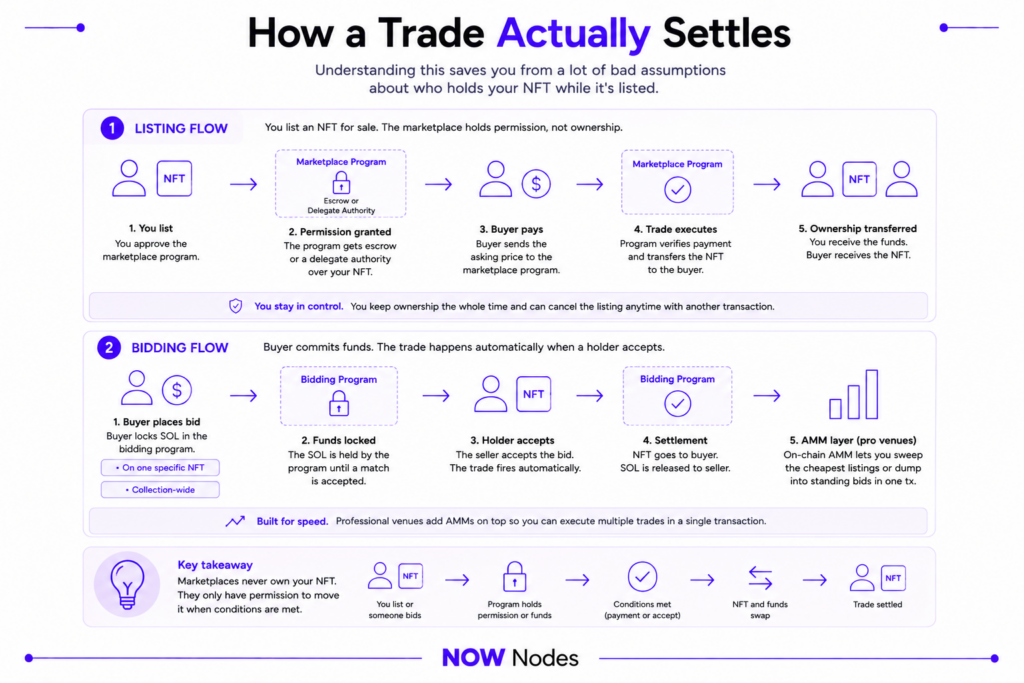
Understanding this saves you from a lot of bad assumptions about who holds your NFT while it’s listed.
When you list, the marketplace program takes either escrow or a delegate authority over the token. It can move that NFT only when a buyer pays your asking price. You keep ownership the whole time and can cancel with another transaction whenever you like.
Bids work in reverse. A buyer commits SOL to the bidding program — either on one specific NFT or collection-wide — and the trade fires automatically the moment a holder accepts. Professional venues layer an on-chain AMM on top, so you can sweep the cheapest listings or dump into standing bids in a single transaction.
Why Solana Became the Default Chain for NFTs
Cheap minting is the honest answer. The Metaplex Core standard stores an entire asset in one account at roughly 0.0029 SOL per mint, against about 0.022 SOL under the older Token Metadata standard — a cut of more than 80%.
Compression pushes that further. Using Metaplex Bubblegum, assets live in a Merkle tree instead of individual accounts, and the documented cost works out to 5 SOL for one million NFTs — about 0.000005 SOL each. Bubblegum v2 has already been used to create over a billion assets.
Here’s why that matters for marketplaces specifically. When a mint costs a rounding error, projects stop rationing supply, and the platforms have to index millions of assets rather than thousands. Every serious Solana NFT marketplace now supports compressed NFTs natively, because refusing to would cut off entire categories — game items, loyalty passes, ticketing.
The network underneath got faster too. Firedancer, the second independent validator client, reached mainnet in December 2025 and was running on more than 20% of active validators by Q2 2026. The Alpenglow consensus upgrade, targeting roughly 150ms finality, is expected to activate later in 2026.
Top Solana NFT Marketplaces in 2026
Four platforms genuinely trade Solana NFTs today. Two others get mentioned constantly and shouldn’t be.
| Marketplace | Best for | Taker fee | Royalties | Aggregates listings | Token |
|---|---|---|---|---|---|
| Magic Eden | Mainstream buyers, new mints | 2% (0% to list) | Optional | Yes | ME |
| Tensor | Active and algorithmic traders | 2% taker / 0% maker | Hybrid | Yes | TNSR |
| Exchange Art | 1-of-1 fine art | ~2.5% | Enforced | No | — |
| SolSea | License-embedded NFTs | 2% → 0% with staking | Optional | No | AART |
Fee schedules change. Check each platform’s own documentation before a large trade.
1. Magic Eden — The Default Starting Point
Magic Eden launched in 2021 and has been the retail face of Solana NFTs ever since. Listing is free, the taker fee is 2%, and its Launchpad remains the most-used distribution channel for new collections.
The interface is the reason beginners land here. Wallet connection, collection verification badges, bulk listing and a clean mobile experience remove most of the friction that makes a first NFT purchase intimidating. According to the Magic Eden help centre, that 2% is deducted from the sale price, separate from any creator royalty.
One caveat worth knowing up front: royalties here are buyer-optional. At checkout a buyer can select full, half or zero unless the collection enforces payment through its metadata standard.
2. Tensor — Built for People Who Trade Daily
Tensor took the opposite approach: assume the user already knows what they’re doing. It charges 2% taker and 0% maker, runs an on-chain NFT AMM, and aggregates listings from other Solana venues so you see the real floor rather than its own.
The feature that keeps traders there is speed of information. Real-time floor movement, bid depth, collection sweeps and portfolio tracking sit in one dashboard, and orders route through liquidity pools rather than one-off listings. If you’re buying five NFTs a week, the tooling difference against Magic Eden is significant.
Tensor also handles royalties more strictly than its rival — enforced on MIP-1 collections, optional elsewhere. That hybrid stance is a deliberate middle ground between creator income and trader volume.
3. Exchange Art — Where the Artists Are
Exchange Art has never competed on volume. It’s Solana’s curated fine-art venue, focused on single-edition work, provenance and the strongest royalty enforcement on the chain. The taker fee sits around 2.5% — higher than the trading platforms, and priced for a different customer.
The numbers give a sense of scale. At the time of its acquisition the platform counted more than 9,000 active creators and 15,000 collectors, had sold over 110,000 NFTs since October 2021, and had paid artists upward of $1.2 million in royalties.
In March 2025 the marketplace was acquired by BONK, the Solana memecoin project, which added BONK and USDC as settlement currencies. Pricing art in a stable unit rather than SOL solves a genuine problem for creators: your listing shouldn’t lose a fifth of its value because the market moved overnight.
4. SolSea — The Licensing Niche
SolSea was one of the original Solana marketplaces and is still online, though activity has been thin since 2022. Its distinguishing feature is embedded on-chain licences — the NFT carries explicit commercial-use terms rather than leaving them to a project’s website. Staking AART drops the 2% fee toward zero.
What About OpenSea and Rarible?
Neither is a Solana NFT marketplace in any practical sense. OpenSea dropped Solana NFT support in 2022 and re-added Solana token trading in 2025, with NFTs still not live. Rarible’s current app is EVM-focused — Ethereum, Base and RARI Chain — with Solana absent from its chain list. If a comparison article lists them as Solana options, it hasn’t been updated.
What Changed in 2026
Two events reshaped the top Solana NFT marketplaces within a few months of each other, and both are worth understanding before you commit to a platform.
On 27 February 2026, Magic Eden CEO Jack Lu announced the company would shut its Bitcoin Ordinals, Runes and EVM marketplaces entirely and sunset its multi-chain wallet. Trading on non-Solana assets ended 9 March; the wallet went offline 1 April. The logic was blunt — Solana accounted for over 85% of platform volume, while the multi-chain products consumed the bulk of the cost base.
“It is clear we’re entering a new era where finance and entertainment merge.” — Jack Lu, co-founder and CEO, Magic Eden, 27 February 2026
Magic Eden redirected those resources into Dicey, an iGaming platform that had processed over $15 million in wagers during a two-month closed beta. That tells you something honest about the state of the market: the largest NFT marketplace on Solana now treats NFTs as one line of business rather than the whole company.
Tensor went through its own restructuring. Coinbase agreed to acquire Vector.fun, the social trading app built by Tensor Labs, with Vector’s apps being wound down. The Tensor NFT marketplace and the TNSR token moved to the Tensor Foundation and remain independent of Coinbase.
Tensor co-founder and CEO Ilja Moisejevs has been candid about where he thinks this ends up:
“I think NFTs are gonna come back, but not in the form factor that they existed before.” — Ilja Moisejevs, co-founder and CEO, Tensor, on the Lightspeed podcast
His argument is that NFTs become infrastructure — ubiquitous but unremarkable, the way nobody announces they’ve built a website anymore. Ticketing, game inventories and ownership records don’t need to be labelled NFTs to run on the same rails.
Royalties: The Real Difference Between Platforms
This is the one comparison point that changes actual outcomes, and it confuses almost everyone.
Creator royalties are written into an NFT’s Metaplex metadata, but Solana does not enforce them at the protocol level. Whether a creator gets paid is a decision each marketplace makes on its own.
- Exchange Art — enforced. Strongest protection on Solana.
- Tensor — hybrid. Enforced on MIP-1 collections, optional otherwise.
- Magic Eden — optional. Buyer picks full, half or zero at checkout.
- SolSea — optional unless the collection enforces it.
If you’re a creator choosing where to launch, this matters more than the taker fee. A 2% platform that lets buyers zero out your 5% royalty costs you more than a 2.5% platform that guarantees it.
How to Choose the Best Solana NFT Marketplace for You
Match the platform to the job, not to the leaderboard.
| If you are… | Use | Why |
|---|---|---|
| Buying your first NFT | Magic Eden | Cleanest onboarding, verification badges, free listing |
| Trading several times a week | Tensor | AMM, sweeps, aggregated floors, 0% maker fee |
| Minting a new collection | Magic Eden Launchpad | Widest distribution and audience reach |
| Selling original artwork | Exchange Art | Enforced royalties, curation, BONK/USDC pricing |
| Licensing commercial rights | SolSea | On-chain licence terms attached to the asset |
One practical habit regardless of platform: check the verification badge before you buy. Copycat collections are the most common way people lose money on any SOL marketplace, and the badge is a two-second check.
Running a Marketplace: The Part Users Never See
Every action described above — loading a collection page, submitting a bid, confirming a sweep — is an API call against Solana. A marketplace makes thousands of them per second at peak, and the quality of that connection decides whether a transaction lands or fails.
This is critical: during a hyped mint, latency is the difference between filling an order and showing a user an error. Slow data means stale floor prices. Failed submissions mean abandoned carts. Poor indexing means compressed NFTs simply don’t appear.
NOWNodes provides Solana API access without the operational burden of maintaining your own infrastructure. The free START tier covers 100,000 requests per month at 15 RPS, which is enough to prototype a marketplace, a portfolio tracker or a floor-price bot. Paid plans start at €20/month for 1 million requests, and the catalogue spans 120+ networks if your project isn’t Solana-only.
For teams building anything that reads or writes Solana NFT data — a marketplace, an analytics dashboard, a minting tool — that’s the layer to get right before worrying about the front end.
Conclusion
The Solana NFT marketplace landscape in 2026 is narrower and more honest than it was two years ago. Four platforms do real volume, each aimed at a clearly different user, and the marketing gloss has mostly worn off — Magic Eden openly diversified into iGaming, Tensor handed its marketplace to a foundation, and Exchange Art sits inside a memecoin ecosystem.
That’s not decline so much as maturity. Pick by fee structure and royalty policy rather than brand recognition, verify the collection before you click buy, and if you’re building rather than trading, get your data layer sorted first. Everything else on this list is downstream of that.
FAQ
Which is the best Solana NFT marketplace overall?
Magic Eden for general use and new mints, Tensor for active trading. They’re the two co-leaders and together account for the large majority of Solana NFT volume. Exchange Art is the answer for 1-of-1 artwork.
What does it cost to sell an NFT on Solana?
Expect a 2% taker fee on Magic Eden or Tensor, roughly 2.5% on Exchange Art, plus any creator royalty and a network fee of a fraction of a cent. Listing itself is free on Magic Eden and Tensor.
Is Magic Eden still multi-chain?
No. As of 2026 it is Solana-only. Bitcoin and EVM trading ended in March 2026 and the multi-chain wallet shut down on 1 April 2026.
Can I buy Solana NFTs on OpenSea?
Not currently. OpenSea supports Solana token trading but has not relaunched Solana NFT support since dropping it in 2022.
Do I need a specific wallet?
Any major Solana wallet works — Phantom, Solflare and Backpack all connect to the top Solana NFT marketplaces. Backpack renders compressed NFTs with full metadata, which some older wallets handle poorly.
Are creator royalties guaranteed?
No. Solana doesn’t enforce royalties at the protocol level, so it depends on the marketplace and the collection’s metadata standard. Exchange Art enforces them; Magic Eden makes them buyer-optional.
What’s the cheapest way to mint a large collection?
Compressed NFTs via Metaplex Bubblegum, at roughly 5 SOL per million assets. For standard collections, Metaplex Core costs about 0.0029 SOL per mint.