
A Web3 development platform is the managed infrastructure and set of APIs that let you connect an app to a blockchain without building and running the backend yourself. Instead of maintaining your own servers to read balances, send transactions, and track events, you sign up, grab an API key, and start shipping. The six platforms covered here — NOWNodes, Infura, Alchemy, Moralis, QuickNode, and Supanode — are the ones most teams reach for in 2026, and each fits a slightly different kind of project. Here’s the short version: pick by the chains you need, the reliability you can’t compromise on, and the developer tools that match how you build.
What Is a Web3 Dev Platform?
Let’s start with the plain idea before going deeper. A Web3 development platform gives you a ready-made connection to one or more blockchains, along with the tools to build on top of that connection — data APIs, SDKs, webhooks, and monitoring.
Web3 development platform is a hosted service that provides API access to blockchain networks, plus developer tooling (SDKs, data endpoints, streams, analytics), so teams can build decentralized applications without operating their own backend infrastructure.
The term Web3 itself comes from Gavin Wood, the Ethereum co-founder who coined it in 2014. He described it as “a re-imagination of the sorts of things that we already use the Web for, but with a fundamentally different model for the interactions between parties.” In practice, that model means apps talk directly to a public ledger — and a development platform is what makes that conversation fast and dependable.
Why does this matter? Every wallet check, token transfer, or NFT mint your app performs is a request to a chain. A platform handles those requests at scale so you don’t have to. Ethereum’s own documentation frames Web3 as applications built on decentralized networks, and those applications still need a reliable way in.
What a Platform Actually Gives You
Under the marketing, most Web3 platforms bundle the same core pieces. Knowing them helps you compare providers on substance rather than slogans.
- API access — a stable endpoint to read chain state and broadcast transactions, usually over standard JSON-RPC.
- Data APIs — pre-indexed queries for balances, tokens, NFTs, and transaction history, so you skip building an indexer.
- SDKs and libraries — drop-in code for JavaScript, Python, and popular frameworks that cut integration time.
- Streams and webhooks — real-time push of on-chain events, instead of polling the network yourself.
The best Web3 platforms wrap these into one dashboard with keys, usage metrics, and support. That consolidation is the point: one account instead of a dozen moving parts.
Why Developers Use Web3 Platforms
Running your own infrastructure sounds appealing until you price it out. A single archive server can take days to sync, needs terabytes of fast storage, and has to stay online around the clock or your app breaks. Multiply that across several chains and you’ve hired a DevOps problem instead of building a product.
That’s the gap Web3 platforms fill. They absorb the operational weight — syncing, scaling, failover, upgrades — and hand you a stable endpoint in return. You trade a predictable monthly cost for the freedom to focus on your application.
Who Actually Uses Them
The audience is broad, but the common threads are clear. Different teams reach for a platform for different reasons:
- DeFi teams need real-time price and balance data with zero downtime during volatile markets. DeFi alone holds tens of billions of dollars across protocols, tracked live on DeFiLlama.
- NFT platforms and marketplaces rely on fast metadata reads and transfer tracking.
- Wallets and payment systems send and read transactions constantly, so latency is felt by every user.
- Enterprises want compliance, support, and predictable scaling without staffing a dedicated blockchain team.
The thread tying them together is uptime. When your product’s core action is an on-chain request, the reliability of your platform quietly becomes the reliability of your app.
What Powers the Best Web3 Apps
Look at the best Web3 apps in use today — decentralized exchanges like Uniswap, lending protocols like Aave, marketplaces like OpenSea — and you’ll notice they share something invisible to users: infrastructure that rarely fails. The interface is what people see; the platform underneath is what keeps it responsive.
This is worth dwelling on. Two teams can ship the same feature set, but the one on faster, more reliable infrastructure delivers a smoother product every time. Users don’t wait for balances to load or watch a transaction hang for thirty seconds. The best Web3 apps aren’t only well-designed — they’re well-connected.
So when you evaluate where to build, you aren’t just choosing a data source. You’re choosing the performance ceiling of everything you’ll ship on top of it.
How to Choose the Right Platform
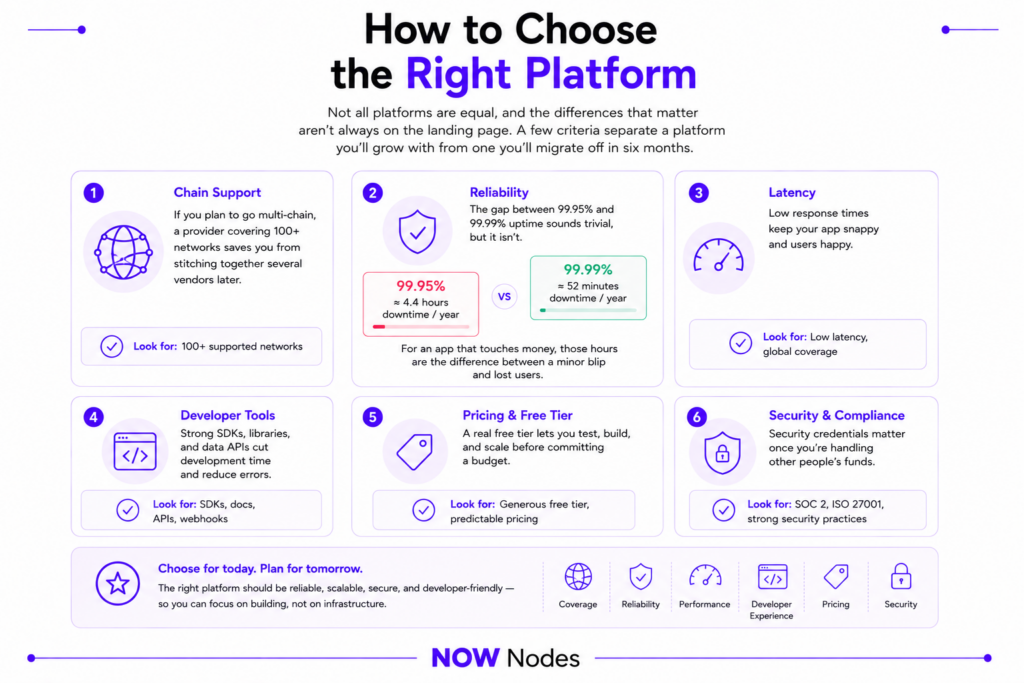
Not all platforms are equal, and the differences that matter aren’t always on the landing page. A few criteria separate a platform you’ll grow with from one you’ll migrate off in six months.
Chain support comes first. If you plan to go multi-chain, a provider covering 100+ networks saves you from stitching together several vendors later.
Reliability is the one number worth reading closely. The gap between 99.95% and 99.99% uptime sounds trivial, but it isn’t: 99.95% allows roughly 4.4 hours of downtime a year, while 99.99% trims that to about 52 minutes. For an app that touches money, those hours are the difference between a minor blip and lost users.
Latency, developer tools, and pricing round out the list. Low response times keep an app snappy, strong SDKs and data APIs cut build time, and a real free tier lets you test before committing a budget. Security credentials — think SOC 2 or ISO 27001 — matter too once you’re handling other people’s funds.
Here’s the practical takeaway: match the platform to your stage. A weekend prototype and a production DeFi protocol have very different needs, and the best Web3 development platform for crypto projects is the one that fits both where you are now and where you’re heading.
The Best Web3 Platform for Devs in 2026
The table below sums up the six, then each profile goes deeper. Details — especially pricing — change often, so confirm current terms on each provider’s site before committing real budget.
| Platform | Key Strengths | Supported Chains | Free Tier | Best For |
|---|---|---|---|---|
| NOWNodes | 120+ chains, 99.95% uptime, minimal setup | Bitcoin, Ethereum, Solana, BNB Chain, Polygon, and more | 100k requests/mo | Multi-chain apps, enterprises |
| Infura | Ethereum-first, IPFS, strong docs | Ethereum, Linea, Polygon, major L2s | Yes, tiered | Ethereum dApps, DeFi |
| Alchemy | Enhanced APIs, analytics, smart wallets | Ethereum, Base, Arbitrum, Solana, and more | Yes, compute-based | Apps needing deep tooling |
| Moralis | Cross-chain data APIs, auth, streams | Major EVM chains, Solana | Yes | NFT projects, dashboards |
| QuickNode | Low latency, global network, add-ons | 60+ chains | Trial | High-traffic, performance-critical apps |
| Supanode | Real-time streaming, transaction landing, indexers, dedicated nodes | Solana, Hyperliquid, Monad, BNB Chain; Polymarket data; additional EVM/SVM networks on request | Up to 24h trial on most products | Trading, DeFi, analytics, latency-sensitive apps |
NOWNodes
NOWNodes is our top pick for multi-chain projects, and the reason is coverage without complexity. It offers instant API access to 125+ blockchains from a single account, holds a 99.95% uptime record, and takes minutes to set up rather than days.
Strengths: the widest chain list here, flexible pay-as-you-go and subscription pricing, plus full node and block explorer API access.
Best for: teams building Web3 websites, NFT marketplaces, payment systems, and enterprise apps that span several chains.
Free tier: the START plan includes 100,000 requests per month — enough to build and test a real project before you pay anything.
What makes it stand out in a crowded field is breadth. If your roadmap touches Bitcoin, Ethereum, Solana, and a handful of others, covering all of them through one provider is a real simplification. NOWNodes handles the backend so your team ships features instead of babysitting servers.
Infura
Infura is the veteran of Ethereum infrastructure and, now part of Consensys, remains a default for Ethereum-first teams. It’s tightly integrated with the wider Consensys stack, including MetaMask and the Linea Layer 2 network.
Strengths: rock-solid Ethereum support, IPFS for decentralized storage, and some of the clearest documentation in the space.
Best for: DeFi and NFT projects anchored to Ethereum and its Layer 2s.
Trade-off: its chain coverage is narrower than the multi-chain specialists, so a broadly cross-chain app can outgrow it.
Alchemy
Alchemy built its reputation on developer experience — the dashboards, debugging, and enhanced data APIs that make building less painful. It leans less on raw chain count and more on the depth of tooling around each network it supports.
Strengths: Enhanced and NFT APIs, detailed analytics, and smart-wallet and account-abstraction tooling for smoother user onboarding.
Best for: teams that want visibility into performance and user activity, not just an endpoint.
Notable: its free tier is metered by compute units, which is generous for testing but worth modeling before you scale.
Moralis
Moralis focuses on the data and identity layer of Web3 apps. Rather than only relaying requests, it hands you cross-chain APIs for wallets, tokens, and NFTs, plus real-time streams and authentication out of the box.
Strengths: unified cross-chain data, Web3 authentication, and event streams that push on-chain activity straight to your app.
Best for: NFT projects, portfolio dashboards, and any app that needs rich data without heavy backend work.
Notable: it covers major EVM chains and Solana, which fits most consumer-facing builds.
QuickNode
QuickNode competes on speed. Its globally distributed network is tuned for low latency and high throughput, which is why performance-sensitive teams — including trading and high-traffic apps — gravitate to it.
Strengths: fast response times, 60+ supported chains, and a marketplace of add-ons like streams and webhooks. It’s also SOC 2 Type II certified and ISO 27001 compliant, which reassures enterprise buyers.
Best for: apps where every millisecond counts.
Trade-off: the performance focus comes at a price point that can climb quickly as usage grows.
Supanode
Supanode is a performance-focused RPC and data infrastructure platform built for trading, DeFi, indexing, and analytics workloads. Its deepest stack is on Solana, with JSON-RPC, Yellowstone-compatible gRPC streaming, ShredStream, transaction landing, indexing, and dedicated nodes. It also provides infrastructure for Hyperliquid, Monad, BNB Chain, and Polymarket, with dedicated nodes available for additional EVM and SVM networks on request.
Strengths: real-time blockchain data streaming, transaction landing, ClickHouse indexers, and single-tenant dedicated infrastructure.
Best for: teams where low-latency data access, trading infrastructure, analytics, or dedicated node capacity matter more than having the widest possible chain catalog.
Trial: up to 24 hours on most shared products, while dedicated nodes are provisioned and priced per deployment.
Where Web3 Platforms Are Heading
A few shifts are worth knowing before you commit for the long term. Account abstraction is going mainstream, letting apps sponsor gas and onboard users without seed-phrase friction — and platforms increasingly ship the tooling to support it. Chain abstraction is close behind, hiding the “which network am I on?” question from users entirely.
The newest wrinkle is AI. Autonomous agents are starting to read and transact on-chain, which means the platforms feeding them need to be both fast and machine-friendly. This is critical for anyone building now: the provider you pick should be keeping pace with these changes, not standing still on last year’s feature set.
How to Connect Your App With NOWNodes
If NOWNodes fits your project, getting started is quick. There’s no server to provision — you sign up, generate a key, and point your app at an endpoint.
- Sign up at nownodes.io and choose a plan; the free START tier is fine to begin.
- Create an API key from your dashboard.
- Copy your endpoint — it follows the format
https://<chain>.nownodes.io/<your_api_key>. - Wire it into your app using standard libraries like web3.js or ethers.js, or add it to a wallet as a custom network.
Because the endpoints speak standard JSON-RPC, the usual methods work without modification — you’re mostly swapping in a URL. The free 100,000 monthly requests cover testing and smaller production loads comfortably, and you can scale up when traffic does.
Final Thoughts
Choosing the best Web3 development platform in 2026 comes down to four questions: which chains you need, how much downtime you can tolerate, which developer tools save you time, and what you’ll pay as you scale. Each of the six here answers those differently — Infura for Ethereum depth, Alchemy for tooling, Moralis for data, QuickNode for speed, and Supanode for performance-focused RPC, streaming, indexing, and dedicated infrastructure.
For teams that want the widest chain coverage with minimal setup and a free tier that actually lets you build, NOWNodes is the standout. Whether you’re shipping a simple Web3 website or the next widely used decentralized app, the infrastructure you choose sets the ceiling on how well your project performs.
FAQ
Are Web3 platforms free?
Web3 development platform usually offers a free tier that’s enough to build and test. NOWNodes’ START plan includes 100,000 requests per month, and Infura, Alchemy, and Moralis all provide free entry points before their paid plans begin.
What are the best Web3 apps, and what do they run on?
Widely used apps like Uniswap, Aave, and OpenSea pair strong design with reliable infrastructure underneath. The best Web3 apps depend on fast, stable platform connections as much as they depend on good code.
How many blockchains should a platform support?
If you’re single-chain, coverage barely matters. If you plan to expand, a Web3 development platform with 100+ networks — like NOWNodes — saves you from onboarding a new vendor every time you add a chain.