
A blockchain application is any piece of software that stores its data or runs its logic on a distributed ledger instead of a single company’s server. Rather than one database controlled by one party, the record is copied across many independent computers, called nodes, that all have to agree before anything changes. That single design choice — shared, hard-to-alter records — is why blockchain applications now show up in banking, shipping, healthcare, and gaming, not just cryptocurrency trading.
This guide starts with the plain-language basics and works up to the trade-offs an engineer or founder actually has to weigh before building one.
What Is a Blockchain Application, Exactly?
Blockchain application: software (often called a dApp, or decentralized application) whose core data and rules live on a distributed ledger, verified by a network of nodes rather than a single central server.
Every transaction is bundled into a block, linked cryptographically to the block before it, and confirmed by network consensus. Once confirmed, changing that record would require rewriting every later block across every node — which is what makes the ledger practically immutable.
Most blockchain applications share the same rough stack:
- Consensus layer — the protocol nodes use to agree on the current state (proof of stake, practical Byzantine fault tolerance, and similar mechanisms).
- Smart contract layer — self-executing code that runs automatically once its conditions are met.
- Data layer — the transaction history and account state itself.
- API and middleware layer — the connection between the chain and outside systems, including node providers and RPC endpoints.
- Interface layer — the web or mobile app a person actually touches.
Why Do Businesses Build Blockchain Applications?
Because trust between organizations is expensive. Every bank, notary, clearinghouse, or verification agency in a transaction adds a fee, a delay, and a chance of error. A blockchain application replaces that layer of intermediaries with a shared record everyone can check directly.
That trade shows up as three concrete benefits:
- Programmability. Smart contracts encode business logic directly into the protocol, so a payment releases or a compliance check runs automatically once conditions are met — no manual sign-off required.
- Shared visibility. Every authorized participant sees the same version of events in real time, which cuts the reconciliation work that eats up back-office teams.
- Tamper resistance. Because altering history requires rewriting the whole chain, records are far harder to quietly manipulate than entries in a private database.
Who Actually Uses Blockchain Applications?
Adoption has moved well past pilots. Analyst firm Gartner projects that roughly 25% of Global 2000 companies will run blockchain in production by the end of 2026, up from just 11% in 2024 — concentrated mostly in financial services and supply chain, according to enterprise blockchain research.
A few groups make up most of that activity:
- Banks and payment providers — settlement, custody, and cross-border transfers. JPMorgan’s Kinexys platform (formerly Onyx) has processed over $300 billion in institutional transactions.
- Asset managers — tokenized funds such as BlackRock’s BUIDL, a tokenized U.S. Treasury fund that has grown to roughly $2.4 billion in assets across nine blockchain networks.
- Manufacturers and retailers — provenance tracking, recall management, and counterfeit reduction across multi-party supply chains.
- Healthcare organizations — secure sharing of patient records between providers without a central custodian.
- Game studios and NFT platforms — verifiable ownership of in-game or digital assets.
- Developers and Web3 startups — building on public chains directly, without an enterprise procurement layer in the way.
What Are the Main Categories of Blockchain Applications in 2026?
| Category | What it does | Example use |
|---|---|---|
| DeFi (decentralized finance) | Lending, trading, and yield without a bank as intermediary | Stablecoin payments, on-chain lending markets |
| Real-world asset tokenization | Splits ownership of physical or financial assets into tradable tokens | Tokenized Treasury funds, fractional real estate |
| Supply chain traceability | Records every step a product takes from origin to shelf | Food safety verification, anti-counterfeiting |
| Digital identity | Lets a person hold and share verifiable credentials without a central database | Self-sovereign ID, reusable KYC checks |
| Cross-border payments | Settles transfers between institutions without correspondent banking chains | Stablecoin and CBDC-based transfers |
| Gaming and NFTs | Establishes verifiable ownership of digital or in-game assets | Item marketplaces, collectible provenance |
Stablecoins are the clearest example of how far this has moved from speculation into infrastructure: the global stablecoin market has grown past $300 billion in 2026, driven partly by clearer U.S. regulation for dollar-pegged tokens.
Public vs. Permissioned: Which Kind of Blockchain Application Fits?
Not every application needs an open, anyone-can-join network. The right model depends on who needs to see the data and who needs to control it.
| Public blockchain | Permissioned blockchain | |
|---|---|---|
| Who can participate | Anyone | Approved members only |
| Governance | Decentralized, protocol-driven | Controlled by a consortium or operator |
| Typical use | DeFi, NFTs, open payments | Enterprise supply chain, interbank settlement |
| Examples | Ethereum, Solana | Hyperledger Fabric, R3 Corda |
| Trade-off | Maximum transparency, less control | Faster and more compliant, less open |
Hyperledger Fabric alone reportedly powers around 80% of permissioned enterprise deployments, while Ethereum accounts for roughly three-quarters of public dApp activity — a rough but useful signal of how the two models have split by use case.
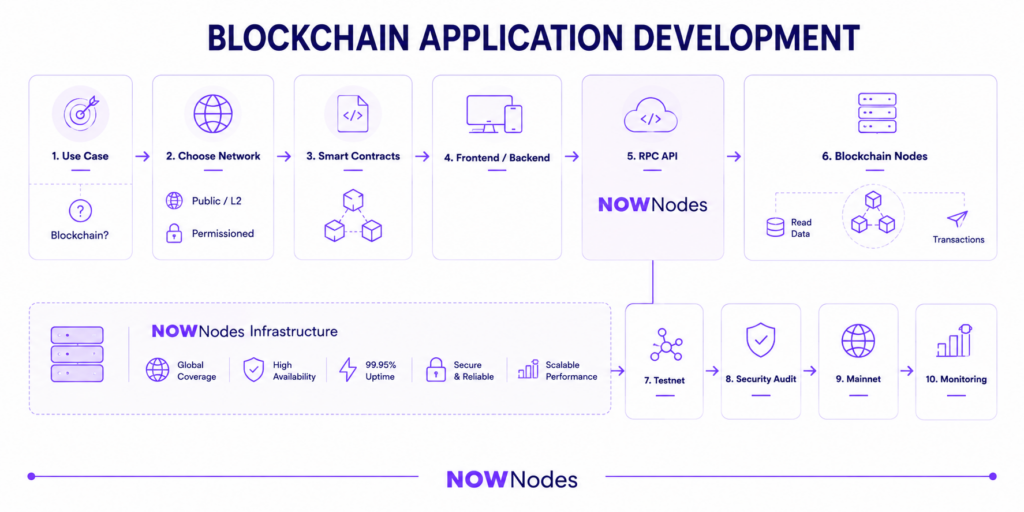
What Infrastructure Does a Blockchain Application Need to Run?
Behind every blockchain application sits something less visible: node infrastructure. A node is a computer that stores a copy of the ledger and validates new transactions, and an application needs to query nodes constantly to read balances, submit transactions, or check contract state.
Running your own node for every chain you support is possible, but it means syncing gigabytes to terabytes of data, keeping it patched, and monitoring uptime around the clock. That’s the gap infrastructure providers fill. NOWNodes, for instance, offers hosted RPC endpoints and full-node access across more than 120 networks, so a development team can query mainnet and testnet data — including archive data, WebSocket feeds, and Blockbook explorers — without operating the underlying servers themselves.
That kind of access matters most at two points in an application’s life: development, when a team needs to fork and replay chain state to test logic safely, and production, when read and write requests need to stay fast and available under real traffic. Providers in this space are typically judged on uptime, response time, and how many requests per second they can sustain without throttling — figures worth checking directly against a provider’s published service levels before committing to one.
How Much Does It Cost to Build a Blockchain Application?
Cost scales with complexity far more than with calendar time, and it varies by what kind of application you’re building.
| Project type | Typical cost | Notes |
|---|---|---|
| Simple token or basic dApp | $10,000–$40,000 | Standard token standard, minimal custom logic |
| Mid-size DeFi or supply chain app | $50,000–$150,000 | Custom smart contracts, multi-party workflows |
| Complex cross-chain or tokenization platform | $150,000–$500,000+ | Bridges, compliance layers, institutional integrations |
Two costs are easy to underbudget for: a pre-launch smart contract audit — often $5,000 to $150,000 depending on scope — and the ongoing infrastructure spend for node access, monitoring, and support once the application is live.
What Are the Risks and Limits of Blockchain Applications?
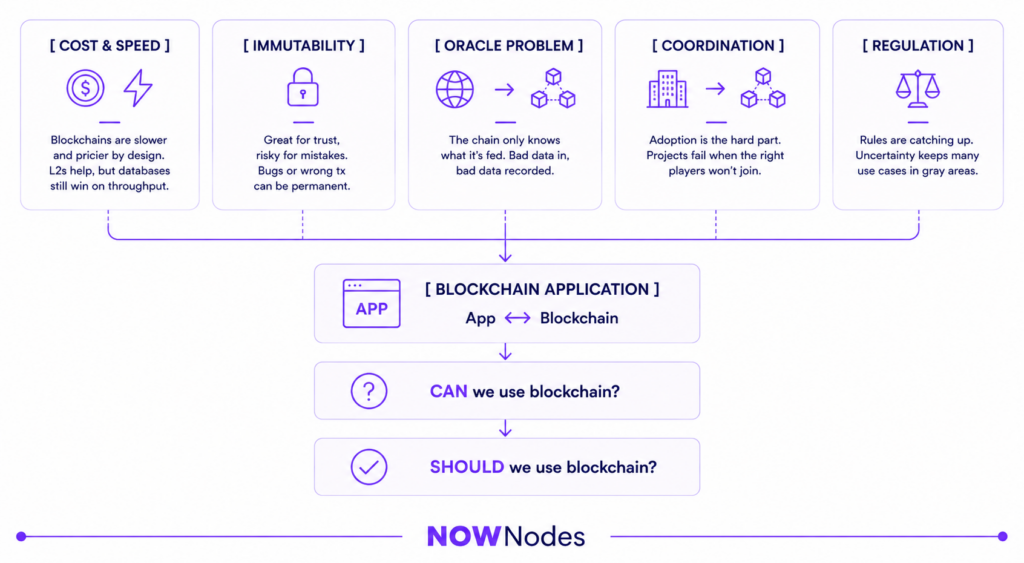
Blockchain solves a specific problem — shared, tamper-resistant record-keeping — and it solves that problem well. It doesn’t automatically solve everything adjacent to it, and treating it as a universal upgrade is how projects overspend and underdeliver.
Martha Bennett, an analyst at Forrester Research, put the last decade of blockchain hype plainly: the technology “never went away,” even after it failed to deliver the miracles early adopters expected. That’s a fair summary of where things stand — real, narrower, and more useful than the 2017–2018 hype cycle suggested.
A few concrete limits worth planning around:
- Legacy integration is the real bottleneck. ERPs, core banking systems, and CRMs weren’t built to talk to a distributed ledger, so custom middleware is almost always needed and rarely shows up in the first project estimate.
- Security depends on more than the chain. Wallet drainers, phishing, and smart contract bugs remain common attack paths; the ledger being tamper-resistant doesn’t protect a user who signs a malicious transaction.
- Scalability still has a ceiling on some chains. Layer-2 rollups and modular architectures have narrowed this gap considerably, but throughput and fees still vary widely by network.
- Talent is scarce. Teams that understand both blockchain engineering and the compliance rules of their industry are still hard to hire, which slows real deployments more than the technology itself does.
How Should You Choose an Approach for Your Project?
Match the blockchain model to the problem, not the other way around. A few questions tend to sort most projects quickly:
- Does the data need to be publicly verifiable, or only shared among known partners? Public chains suit the former; permissioned networks usually suit the latter.
- How much transaction volume do you expect? High-frequency use cases need a chain (or a Layer-2) built for throughput, not just security guarantees.
- What compliance obligations apply? Regulated industries generally lean toward permissioned or hybrid models that keep participation and data access controllable.
- Who is responsible for the infrastructure? Decide early whether your team will run nodes directly or rely on a hosted provider, since that choice affects both cost and time to launch.
- What happens after launch? Budget for a security audit, ongoing monitoring, and a plan for reclaiming or managing on-chain assets your own wallets accumulate over time — a step teams cleaning up test or treasury wallets handle with dedicated tools rather than manual account closures.
FAQ
Is a blockchain application the same thing as a cryptocurrency?
No. Cryptocurrency is one application built on blockchain technology, but the same underlying ledger can run supply chain tracking, identity systems, or tokenized funds that have nothing to do with trading a coin.
Do blockchain applications always need their own token?
No. Many enterprise and permissioned blockchain applications run without any tradable token at all; the ledger is used purely for shared record-keeping between known participants.
Can a blockchain application be changed after it’s deployed?
Deployed smart contracts are generally immutable, so teams that need flexibility build in upgradeability through proxy patterns from the start. Any change still needs its own review, since the original audit only covers the version that was actually examined.
How fast can a blockchain application process transactions?
It depends entirely on the network and architecture — base-layer chains vary widely in throughput, and Layer-2 rollups exist specifically to push that ceiling higher. Node and API performance also matters in practice, since an application is only as responsive as the infrastructure feeding it data.
Does using a permissioned blockchain mean giving up transparency?
Not entirely. Permissioned networks restrict who can join, but participants still see a shared, tamper-resistant record — the trade-off is closed membership in exchange for compliance control, not the loss of a shared source of truth.