
A blockchain oracle is a service that feeds outside information — asset prices, real-world events, API responses, sensor readings — into a blockchain so that smart contracts can act on it. Blockchains are sealed off from the internet by design, so on their own, smart contracts only ever see data already stored on their own chain. Oracles are the connection that lets on-chain code react to off-chain reality, and they can send data and instructions back out too. This guide starts with the plain definition, then builds up to how they work, who relies on them, and where they fail.
What is an oracle in blockchain, exactly?
An oracle is a piece of middleware that fetches data from the outside world, checks it, and delivers it on-chain in a format a smart contract can read. It sits between two environments that can’t talk to each other directly: the deterministic, closed world of the blockchain and the messy, open world of web APIs, exchanges, banks, and physical sensors.
Blockchain oracle is a service or network that retrieves off-chain data (or triggers off-chain actions), verifies it, and submits it to a blockchain so smart contracts can use it as an input for on-chain logic.
The direction of travel goes both ways. Inbound oracles bring external data onto the chain — say, the current ETH/USD price. Outbound oracles do the reverse, letting a smart contract signal an off-chain system, such as releasing a payment through a traditional bank rail once an on-chain condition is met.
Here’s the part that decides whether any of this is useful: the smart contract trusts whatever the oracle tells it. If the input is wrong, the output is wrong, and on a blockchain that output is automatic and hard to reverse. Old rule, still true — garbage in, garbage out.
Why do blockchains need oracles? The oracle problem
Blockchains can’t reach external data because they’re built to be isolated. Every node has to reach the same result when it re-runs a transaction, so the network can only rely on data that already lives on-chain. Pull in a live web value and different nodes might see different numbers, breaking consensus.
That isolation is a feature. It’s what gives blockchains their tamper resistance and uptime. But it also means a smart contract can’t natively check a stock price, a match result, or the weather — and most useful applications need exactly that kind of input. This gap is known as the blockchain oracle problem: connecting contracts to the outside world without giving up the security that made them worth using.
A simple example makes it concrete. Two people bet on a football match and lock $40 in a smart contract. When the game ends, the contract has no way to know who won — that result lives off-chain. An oracle fetches the final score from a sports feed and delivers it, and only then does the contract pay out. Lending, insurance, derivatives, and stablecoins hit the same wall, which is why oracles became core infrastructure.
Who uses crypto oracles?
Decentralized finance is the biggest consumer of crypto oracles by far, but the list runs well beyond it. Anywhere a contract needs to know a price, an outcome, or a fact from outside its chain, an oracle is doing the work.
The main users break down like this:
- DeFi lending and trading — protocols like Aave and Compound use price oracles to value collateral and decide when a loan is undercollateralized. Perpetuals venues like GMX and Jupiter pull low-latency price data to open and close positions.
- Stablecoins and tokenized real-world assets (RWAs) — oracles supply the reference prices and reserve data that keep tokens pegged and backed.
- Insurance — parametric policies pay out automatically when an oracle confirms a triggering event, such as a flight delay or a drought reading.
- Gaming and NFTs — verifiable randomness picks fair winners in mints and games, and dynamic NFTs change based on outside events.
- Institutions and payments — oracle networks connect banks and settlement systems to on-chain assets.
The numbers show how central this has become. Chainlink, the largest provider, reports it has enabled more than $27.6 trillion in cumulative transaction value and secures over 70% of DeFi, per its own education hub. Adopters include Swift (11,500+ institutions), the DTCC, and J.P. Morgan.
How do oracles work? Push vs. pull
Most follow the same basic sequence, whether they serve one contract or thousands. The reliability comes from repeating each step across many independent participants rather than trusting a single source.
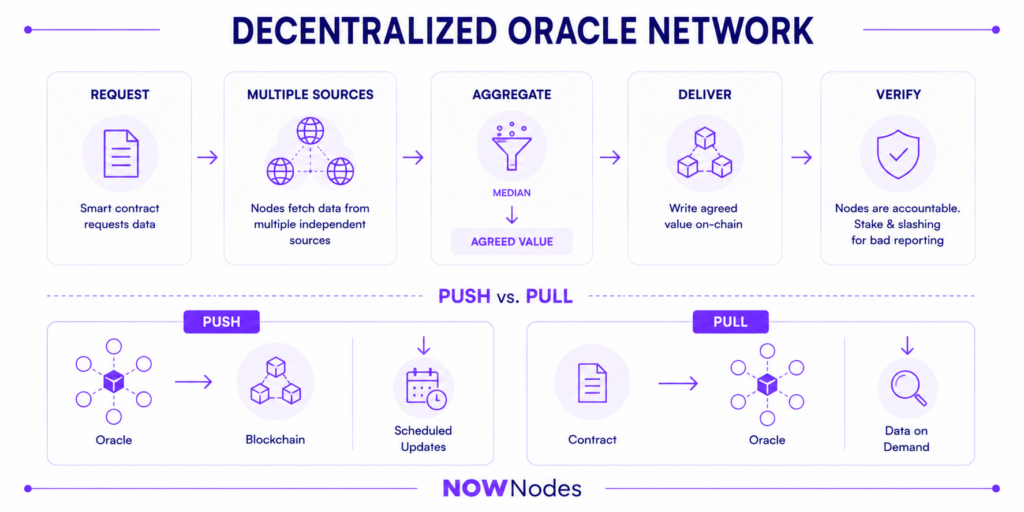
Here’s the flow a decentralized oracle network runs:
- Request — a smart contract asks for a specific piece of data, or the network publishes it on a set schedule.
- Source — multiple independent nodes fetch the value from multiple independent data providers, not one.
- Aggregate — the network combines those responses (for example, taking the median) to filter out bad or outlier data.
- Deliver — the agreed value is written on-chain, where the contract reads it and executes.
- Verify — node operators are cryptographically accountable, and many stake collateral that can be slashed for bad reporting.
That aggregation step is the whole point of a decentralized oracle network (DON). One oracle is a single point of failure; if it goes offline or gets corrupted, the contract acts on stale or false data. Spreading the job across many nodes and sources removes that weak link.
They also differ in when they deliver data. The two dominant models — push and pull — split on cost and speed.
| Model | How it works | Best for | Example |
|---|---|---|---|
| Push | Data is posted on-chain automatically on a schedule or when it moves past a set threshold | Lending markets that need a value always available on-chain | Chainlink Data Feeds |
| Pull | Data is kept off-chain and updated frequently; the user pulls it on-chain only when needed | High-frequency trading, perps, and options where low latency and low cost matter | Chainlink Data Streams, Pyth |
Neither model is strictly better. Push feeds keep a fresh value on-chain for anyone to read; pull feeds cut costs and update faster by only touching the chain at the moment of use. Chainlink’s push vs. pull explainer breaks down the trade-off.
What types of blockchain oracles are there?
Beyond push and pull, oracles in blockchain systems are grouped by what they do and how they’re run. Most real setups combine several of these categories at once.
| Type | What it does |
|---|---|
| Data (inbound/outbound) | Moves information between a chain and external systems — APIs, bank rails, enterprise backends |
| Cross-chain | Passes data, messages, and value between different blockchains |
| Compute | Runs verifiable computation off-chain — randomness, automation, compliance checks — that’s too costly to do on-chain |
| Centralized vs. decentralized | Run by a single operator, or by a network of independent nodes |
| Software vs. hardware | Pulls from digital sources (web data) or physical ones (IoT sensors, barcode scanners) |
| Human | A trusted person verifies and submits information manually |
Compute oracles stretch what a contract can do. Chainlink’s Verifiable Random Function (VRF), for instance, gives games and NFT drops randomness that’s provably fair rather than something the operator could rig. Cross-chain oracles move value between networks — Coinbase picked Chainlink’s Cross-Chain Interoperability Protocol (CCIP) as its exclusive bridging infrastructure for wrapped assets.
Which oracle providers matter in 2026?
Chainlink is still the default, but it’s no longer the only serious option. Each major provider makes a different trade-off between decentralization, speed, and how data gets sourced.
| Provider | Model | Notable trait | Reach |
|---|---|---|---|
| Chainlink | Push + pull | Industry standard; widest service range (feeds, CCIP, VRF, Proof of Reserve) | 900+ integrations across 27+ chains |
| Pyth Network | Pull | First-party data straight from exchanges and trading firms | 2,800+ feeds across 100+ chains |
| RedStone | Push + pull | Modular design; fastest-growing challenger | $6B+ secured across 70+ chains |
| API3 | Push | First-party oracles run by the data providers themselves | Multi-chain |
| Band Protocol | Push | Cross-chain data via its own chain | Multi-chain |
Pyth is the clearest example of the pull model. It sources prices directly from 120+ first-party providers — including firms like Jane Street and Cboe — and by late 2025 secured around $6 billion in value, per Messari. RedStone has grown fast by offering both push and pull delivery from one modular stack.
For an independent view of who secures what, DeFiLlama tracks the total value secured (TVS) by each provider in real time, with Chainlink sitting well ahead of the field.
What can go wrong? Oracle security and trade-offs
The oracle is the point where a secure contract meets unverified reality, which makes it a favorite target. When the data feeding a contract is wrong, the contract still executes — flawlessly, and in the attacker’s favor.
Price manipulation is the classic attack. In October 2022, a trader drained roughly $110 million from Solana-based Mango Markets by using his own trades to inflate the oracle-reported price of the MNGO token, then borrowing against the temporarily bloated collateral. He was later charged by the SEC, CFTC, and DOJ. It wasn’t a one-off: Chainalysis found DeFi protocols lost $403.2 million across 41 separate oracle manipulation attacks in 2022 alone.
Most of these attacks share a root cause: a contract relying on a thin or centralized price source that’s cheap to move. It’s why serious protocols insist on decentralized feeds with many sources and aggregation. As Chainlink co-founder Sergey Nazarov put it to Cointelegraph after a 2024 NYSE pricing glitch, “Decentralized oracle networks… can mitigate these risks by providing accurate, tamper-proof data.”
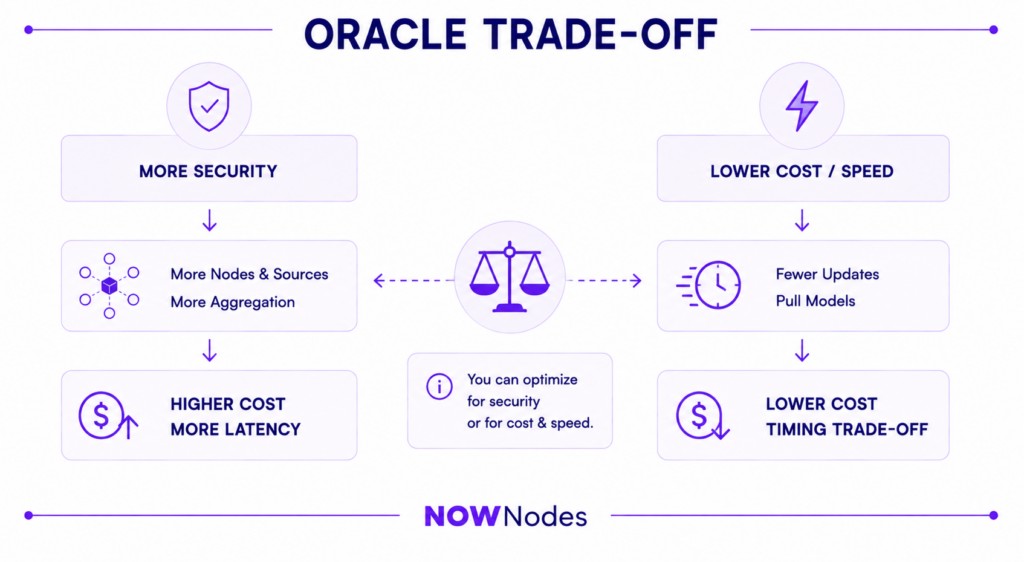
The trade-offs are real. More decentralization means more nodes and sources, which adds cost and latency. Pull models cut costs but shift update timing onto the user. Choosing an oracle setup balances how much security a use case needs against the speed and cost it can spare.
Where do Bitcoin and AI oracles fit in?
Two search-heavy corners of this topic — Bitcoin oracles and AI oracles — apply the same idea in newer directions. Both extend what an oracle delivers, rather than changing what it fundamentally is.
Bitcoin was built with limited scripting and no native smart-contract layer like Ethereum’s, so oracle support historically lagged. As Bitcoin-linked applications and layer-2 networks have grown, oracle providers have added price feeds and data services aimed at that ecosystem, letting BTC-denominated contracts reference the same kind of external data other chains take for granted.
AI oracles push the idea further. Instead of passing a raw value on-chain, an AI oracle can process data with a machine-learning model first, then deliver a result — a volatility forecast, a fraud-probability score, or a sentiment read rather than just a price. Oracle networks are also being used the other way around: aggregating answers from multiple large language models to reduce hallucinations, and providing verifiable compute so a smart contract can confirm an AI agent ran exactly as programmed.
This is early and moving fast. A 2025 academic paper, “Can Artificial Intelligence solve the blockchain oracle problem?”, argues AI can sharpen data validation but can’t remove the need to trust the source — so it’s a complement to decentralized oracles, not a replacement. Treat “Bitcoin oracle AI” tools as an emerging category worth watching, not settled infrastructure.
One practical note on infrastructure. An oracle only helps if the applications reading its data can also reach the blockchain reliably — the endpoints that let a dApp query on-chain state and broadcast transactions. That connectivity layer is separate from the oracle itself; providers such as NOWNodes supply it across many networks, including Bitcoin and Ethereum.
Conclusion
A blockchain oracle solves one specific problem: blockchains can’t see past their own ledger, and almost every useful application needs outside data to work. Oracles supply that data — prices, events, randomness, cross-chain messages — and increasingly run computation the chain can’t handle itself.
The lesson from every major exploit is the same. An oracle is only as trustworthy as its sources and its decentralization, and a contract built on a weak feed is a contract waiting to be drained. As on-chain finance scales into trillions of dollars of tokenized assets, oracles have shifted from a technical footnote to the layer holding much of it together.
FAQ
Is a blockchain oracle the same as the Oracle software company?
No. They share a name and nothing else. Oracle Corporation is a traditional database and enterprise-software company. A blockchain oracle is a service that feeds external data into smart contracts. If someone in crypto says “oracle,” they mean the data bridge, not the company.
What’s the difference between an oracle and a regular API?
An API delivers data; an oracle delivers data and makes it trustworthy enough for a blockchain to act on automatically. A single API is one source that can go down, get hacked, or return a bad value with no recourse. A decentralized oracle pulls from many sources, aggregates them, and holds node operators accountable, because the contract consuming the data can’t afford to be wrong.
Can a smart contract work without an oracle?
Yes, but only for logic that uses on-chain data alone — moving tokens between wallets, for example. The moment a contract needs an external input like a market price, a real-world event, or randomness, it needs an oracle. That covers most of DeFi, insurance, and tokenized assets.
Do blockchain oracles have their own tokens?
Many do. Chainlink (LINK), Pyth (PYTH), Band (BAND), and API3 all use tokens to pay node operators, secure the network through staking, or govern the protocol. The token is part of the incentive design that keeps operators reporting honest data, though not every oracle is token-based.
Which blockchains can use oracles?
Effectively all major smart-contract platforms — Ethereum, Solana, BNB Chain, Avalanche, and dozens of others — have oracle support, and providers keep adding networks. Even Bitcoin-linked applications and layer-2s now have access to oracle feeds, despite Bitcoin’s more limited native scripting.