
Throughput and latency sound like the same idea, but they measure two different things. Throughput is how many transactions a network settles per second. Latency is how long your single transaction waits before it’s final. A chain can be strong on one and weak on the other, which is exactly why “fast” is a word worth unpacking.
This matters the moment a network gets busy. When demand climbs past what a block can hold, transactions queue, fees rise, and confirmations drag. Below is a plain walk through throughput, latency, and the congestion that pushes both in the wrong direction.
What Is Blockchain Throughput?
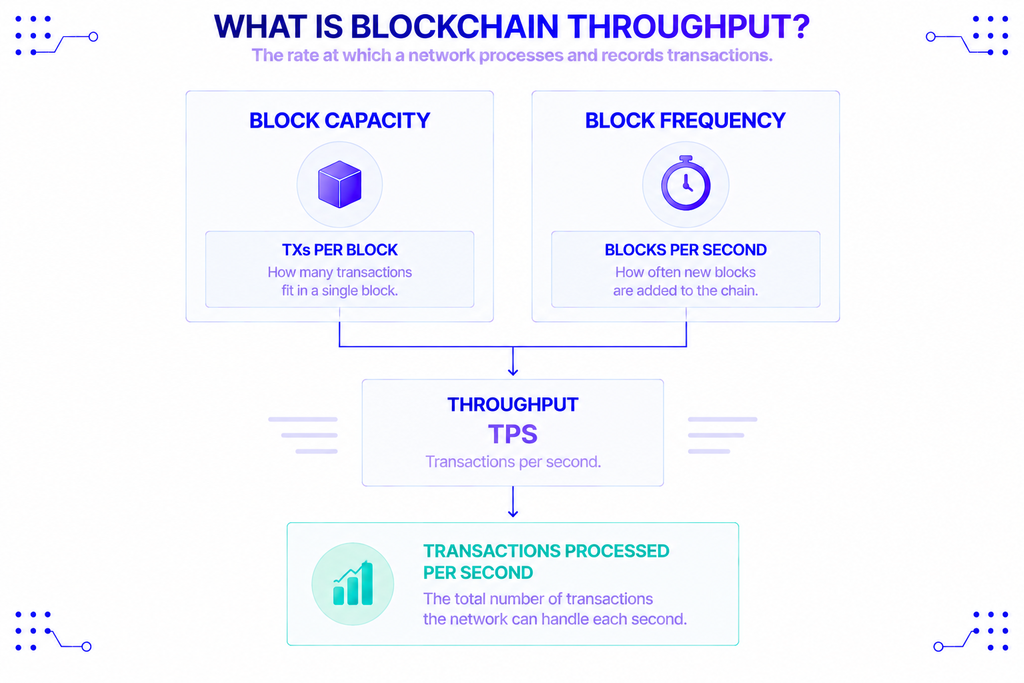
Throughput is the rate at which a network processes and records valid transactions, usually quoted in transactions per second (TPS). It’s a measure of volume, not speed. A high-TPS chain can clear a large crowd at once, the same way a wide road moves more cars than a narrow one.
The number has a hard ceiling set by design. Each block holds a limited amount of data, and new blocks arrive on a fixed schedule. Multiply the two and you get the theoretical maximum.
How Is Throughput Measured?
Divide the transactions that fit in a block by the time between blocks. Bitcoin produces a block roughly every 10 minutes, and each one carries about 2,000 to 4,000 transactions, which caps it near 7 transactions per second at maximum. Ethereum’s base layer settles around 15 TPS with a new block every 12 seconds.
Two warnings about TPS. Theoretical peaks rarely match real-world load, so a “65,000 TPS” headline usually describes lab conditions. And raw TPS ignores how long any one transaction takes to become permanent, which is a separate metric entirely.
What Is Latency, and How Does It Differ From Finality?
Latency is the delay between sending a transaction and seeing it settle. If throughput is how many cars cross the bridge, latency is how long your car takes to reach the far side. It’s the number users actually feel.
Latency isn’t one clean value. It stacks up from several stages:
- Mempool wait: how long the transaction sits in the queue before it’s picked for a block.
- Block production time: how often the network produces a new block.
- Propagation time: how long a new block takes to spread across the network’s participants.
- Finality time: how many more blocks or epochs must pass before the transaction can’t be reversed.
Finality is the last and most important piece. Time to finality measures the duration from when a transaction is submitted to the moment it becomes an irreversible part of the ledger. A transaction can look confirmed in seconds yet take far longer to become truly unchangeable. Bitcoin uses probabilistic finality, where confidence grows with each new block. Ethereum reaches economic finality in roughly 15 minutes today, with shorter windows planned in future upgrades.
The finality model is the biggest reason latency differs so much from chain to chain. A network that waits several blocks for safety will always feel slower than one with near-instant settlement, even at identical TPS.
Why the Two Metrics Aren’t the Same
The core point is that these two numbers move independently. A chain can post high throughput and high latency at once, clearing thousands of transactions per second while each one still takes minutes to finalize. The reverse also happens: a network that settles few transactions per second but finalizes each one almost instantly.
An easy way to picture it is a highway. Throughput is the number of lanes, which decides how many cars pass in a given stretch of time, while latency is the drive time from your on-ramp to your exit. More lanes don’t shorten your trip, and a short trip doesn’t mean the road carries more traffic.
Different chains land in very different spots on this map, mostly because of their consensus and finality designs. Here’s a rough comparison.
| Network | Throughput (real-world TPS) | Block time | Time to finality |
|---|---|---|---|
| Bitcoin | ~7 | ~10 min | ~60 min (6 blocks) |
| Ethereum (L1) | ~15 | 12 sec | ~15 min |
| Solana | ~3,000–5,000 | ~400 ms | a few seconds |
| Avalanche | high, subnet-dependent | sub-second | under 1 second |
Figures are approximate and shift with network conditions and upgrades.
The metric that matters depends on the job. A payment app cares about latency, because a buyer at a till won’t wait minutes. A data-heavy settlement layer may accept slower finality in exchange for security and volume.
What Causes Blockchain Congestion?
Congestion happens when more transactions arrive than a block can hold. The surplus doesn’t vanish. It waits in the mempool, the holding area for transactions that have been broadcast but not yet included in a block. As that queue grows, latency climbs for everyone, and the price of fast confirmation goes up.
Because block space is fixed, users bid for it. Blocks fill with the transactions offering the highest fees, so anyone in a hurry pays more to jump the line. Low-fee transactions can sit for hours or, during heavy load, days.
How Do Fee Markets Respond to Congestion?
Each major network handles the bidding differently. Bitcoin runs a straightforward auction: transactions are prioritized by fee per byte, and during spikes the clearing rate rises sharply. When Ordinals-related activity peaked after the April 2024 Runes launch, priority transactions reached 2,750 sat/vB, the highest fees in Bitcoin’s history.
Ethereum changed its model with EIP-1559. Instead of a blind auction, each block carries a base fee that adjusts up or down based on how full the previous block was. Rather than chaotic spikes where gas prices could jump from 20 to 200 gwei in minutes, fees now move gradually, block by block. The result is smoother, more predictable pricing, though a genuinely busy network still gets expensive.
The common thread: congestion turns into a fee problem before it turns into a “chain is down” problem. The network keeps running; it just gets costly and slow until demand eases.
Why Do Blockchains Slow Down?
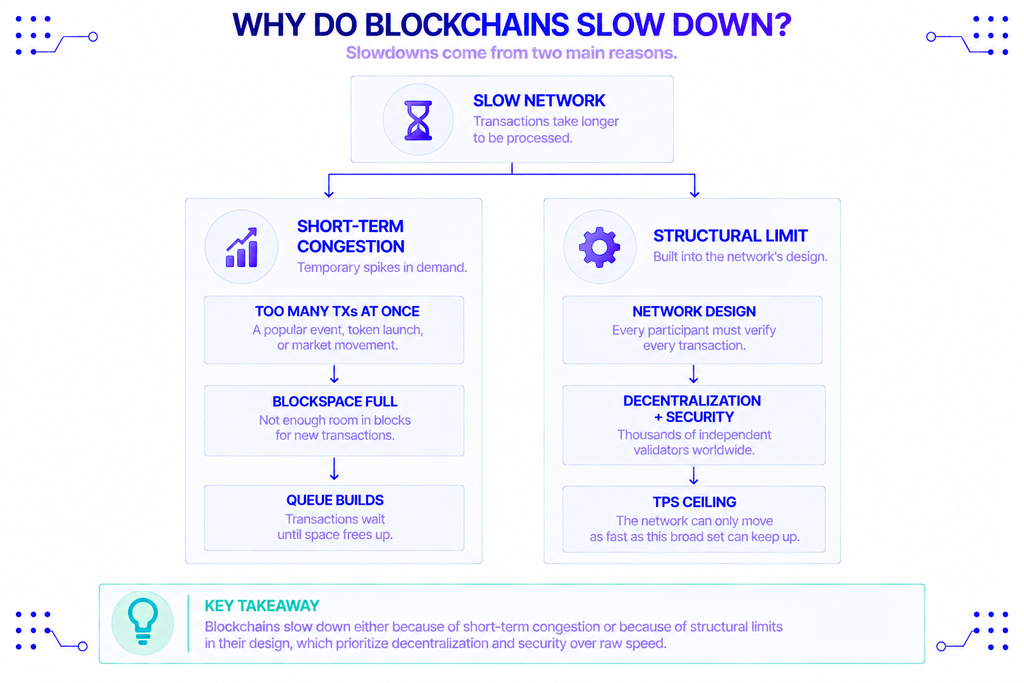
Slowdowns come from two places. Short-term, it’s congestion: a popular token launch, a market crash, or an airdrop sends a wave of transactions that overwhelms available block space. These pass once demand drops.
The deeper reason is structural, and it has a name. The scalability trilemma, a concept popularized by Ethereum co-founder Vitalik Buterin, describes the difficulty of achieving scalability, security, and decentralization all at the same time. Push hard on one and you tend to give up ground on another.
Decentralization is the usual constraint on raw speed. If every participant must verify every transaction, and you want thousands of independent machines spread worldwide, the network can only move as fast as that broad set can keep up. Bitcoin and Ethereum deliberately cap base-layer throughput to keep participation open to as many people as possible. That’s a design choice, not a defect, but it’s also why their base layers feel slow next to high-performance chains that lean on fewer, heavier-duty validators.
So a chain “slowing down” often isn’t a malfunction. It’s the visible cost of a design that put security and decentralization first.
Who Needs to Track These Metrics?
Throughput and latency stop being abstract as soon as you build or transact on-chain.
- Traders and DeFi users feel latency directly. A swap that lands a few blocks late can mean a worse price or a failed transaction during volatile moments.
- Payment and point-of-sale apps live or die on fast finality. Nobody waits ten minutes at a checkout.
- Developers choose a chain partly on this trade-off, then design around it, batching transactions, adding retry logic, or moving activity to a faster layer.
- Infrastructure teams watch mempool depth and confirmation times to catch congestion before users start complaining.
For that last group, reliable access to live network data is the whole job. Services like NOWNodes provide API access to blockchain data across 120+ networks, so teams can monitor mempool depth through real-time streams, track confirmations, and broadcast transactions without running and syncing separate infrastructure for every chain they touch.
How Are Networks Improving Performance?
The dominant answer is to move work off the base layer rather than force it to do more. Layer-2 rollups process transactions on a faster secondary layer, then post compressed proofs back to the main chain for security. Ethereum’s aggregate Layer-2 throughput has climbed past 300 TPS, scaling the base layer by roughly 20x while keeping settlement anchored to Ethereum.
Protocol upgrades push in the same direction. Ethereum’s Fusaka upgrade activated on mainnet on December 3, 2025, introducing PeerDAS to ease the data bottleneck that limits how much rollups can post. Follow-up adjustments have raised blob capacity in steps, and the roadmap targets much higher combined throughput over the next few years. On the high-performance side, Solana’s Firedancer client aims to lift real-world TPS well into five figures.
None of this erases the trilemma. It just widens the room to maneuver inside it, mostly by separating execution from settlement so each can be tuned on its own. For builders, the practical upshot is more choice: a fast layer for user-facing activity, a secure base layer for final settlement, and infrastructure providers that expose both through one API.
Conclusion
Throughput and latency answer different questions. One tells you how much a network can carry; the other tells you how long your transaction waits. Congestion is what happens when demand outruns block space, and the fee market is how networks ration what’s left. Blockchains slow down partly from that short-term pressure and partly from a deliberate design choice to protect decentralization and security.
Read the two numbers together, not in isolation. A chain’s headline TPS means little if finality drags, and fast finality means little if the network can’t handle a crowd. Knowing which metric your use case depends on is the difference between a system that holds up under load and one that stalls when it matters.
FAQ
Is high TPS the same as a fast blockchain?
No. TPS measures throughput, or how many transactions the network handles per second. “Fast” from a user’s view is closer to latency, the time your single transaction takes to finalize. A chain can have high TPS and still feel slow if finality is delayed.
What is the mempool’s role in congestion?
The mempool is the queue of broadcast transactions waiting to be added to a block. When transactions arrive faster than blocks can clear them, the mempool grows, and that wait becomes the largest part of latency during busy periods.
Why do transaction fees spike when a network is congested?
Block space is limited, so users compete for it by raising fees. Blocks fill with the highest-paying transactions first, pushing the market rate up until demand cools. Low-fee transactions wait until the backlog clears.
Can a blockchain have both high throughput and low latency?
It’s difficult because of the scalability trilemma. Maximizing speed and volume usually pressures decentralization or security. Modern designs chase both by splitting execution onto fast layers while settling on a secure base layer.
Does Layer 2 fix blockchain congestion?
Layer-2 rollups relieve pressure by handling transactions off the main chain, which lowers fees and latency for users. The base layer still settles the final proofs, so its throughput and finality remain the backstop for security.