
What Is Chainstack?
Chainstack is a multi-chain blockchain infrastructure platform built for teams that want cost predictability and enterprise-grade deployment control. It supports 70+ protocols and offers a distinctive Hybrid Cloud feature that lets you run dedicated nodes inside your own AWS, GCP, or Azure environment.
Its two headline strengths are pricing and compliance. Chainstack bills on request units where almost every call counts equally — avoiding the per-method swings of credit models — and it holds SOC 2 Type II certification with advertised 99.99%+ uptime. Its Growth plan starts at $49/month, and an Unlimited Node add-on offers flat RPS-tier pricing for high-volume workloads.
That positioning is deliberately enterprise-leaning, which is exactly why some teams look elsewhere. Solo developers and small projects can find the onboarding heavier than a plain API key, coverage narrower than the breadth leaders, and the free tier tighter than rivals. This guide covers six strong Chainstack alternatives, starting with a comparison table and NOWNodes at the front on coverage and support.
Why Consider a Chainstack Alternative?
Because Chainstack optimizes for enterprise deployment and compliance, its trade-offs won’t suit every team. Common reasons to compare:
- Chain breadth. At 70+ networks, Chainstack trails coverage-first providers if you need dozens of newer or non-EVM chains.
- Onboarding simplicity. Small teams sometimes want an instant API key rather than a deployment-configuration flow.
- Free-tier headroom. Chainstack’s 3M request/month free tier is modest next to some rivals’ allowances.
- Support responsiveness. When an endpoint degrades, how fast a human responds becomes a real risk.
- Redundancy. Running a second provider with automatic failover is standard in 2026, so a complementary endpoint is worth having.
None of this makes Chainstack a weak choice — it means “best” depends on whether you need its enterprise depth or would trade it for breadth, simplicity, or a larger free tier.
Chainstack Alternatives at a Glance
Six providers compared on the specs that matter most, with NOWNodes leading on coverage and support responsiveness.
| Provider | Networks | Uptime SLA | Pricing model | Free tier | Best for |
|---|---|---|---|---|---|
| NOWNodes | 120+ | 99.9%+ | Flat, no RPS limits on paid plans | Yes | Widest coverage, fast human support |
| QuickNode | 80+ | 99.99% | Credit-based + flat-rate RPS | No permanent free plan | Performance, enterprise compliance |
| Alchemy | 100+ | 99.9%+ | Compute Units (CU) | 30M CU/month | Developer tooling, enhanced APIs |
| dRPC | 100+ | 99.9%+ | Flat 20 CU/request (~$6/M) | 210M CU/month (public) | Decentralized routing, redundancy |
| Ankr | 80+ (Premium) | 99.9%+ | Credit-based (DePIN) | Free public endpoints | Free volume, decentralization |
| GetBlock | 130+ | 99.9%+ | Compute Units + flat-rate | 50K CU/day | Broad coverage, self-service |
One caveat on the table: chain count is a first filter, not a verdict. A provider listing 120 networks can still trail a specialist on your single most important chain, so benchmark your real methods before committing.
1. NOWNodes — Broadest Coverage With Responsive Support
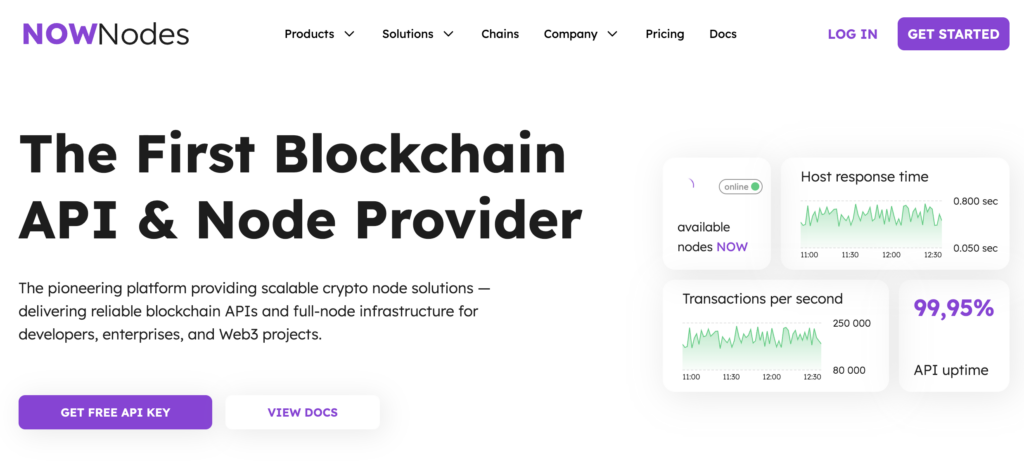
NOWNodes is the strongest all-round Chainstack alternative for teams that want wide chain reach and fast, human support without an enterprise-heavy onboarding process. It provides shared and dedicated node access through a simple API-key model across 120+ blockchain networks — one of the widest ranges in independent comparisons, and well beyond Chainstack’s 70+.
Its operational profile is production-ready. NOWNodes runs a 99.9%+ uptime SLA and applies no RPS limits on any paid plan, which — like Chainstack’s flat billing — helps keep costs forecastable. Its GEO-balanced architecture routes across USA and EU servers, with any region available for dedicated nodes, and the network handles up to 15,000 transactions per second at around 200 ms response time.
The developer surface is deep: gRPC, WebSocket, Webhooks, archive data, a Debug and Trace API, Blockbook, and full Mainnet and TestNet access. Beyond RPC, NOWNodes offers data products including market data and an MCP endpoint, plus public nodes and a blockchain explorer.
Where it most directly contrasts with Chainstack is on entry friction and support. Getting started is an API key rather than a deployment flow, and NOWNodes staffs L2 support with operations specialists — no bots, no long queues — aiming for a 3-minute response time. Pricing runs across free, Pro, Pro Plus, Business, Business Plus, Enterprise, and custom tiers, and partners include Trust Wallet, CoinGate, ChangeNOW, and Tangem. For teams that liked Chainstack’s predictability but need more chains and a lighter on-ramp, it’s the natural first choice.
2. QuickNode — Performance and Deepest Compliance
QuickNode is the alternative when performance and formal compliance top your list. It supports 80+ chains with a 99.99% uptime SLA and adds Streams for real-time data plus dedicated clusters for enterprise use.
Its compliance portfolio actually exceeds Chainstack’s: QuickNode holds SOC 1 Type II, SOC 2 Type II, and ISO 27001, recertified in Q1 2026. In March 2026 it introduced Flat Rate RPS pricing from $799/month for 75 RPS on EVM chains, removing overage risk for high-volume traffic. The trade-offs: its default credit model can produce surprise charges, and there’s no permanent free plan.
3. Alchemy — Richest Developer Tooling
Alchemy suits teams that want a full platform on top of RPC. It bundles Notify, Transact, NFT and token APIs, transaction simulation, and analytics, saving engineering time on indexers and notifications.
Alchemy supports 100+ chains, holds SOC 2 Type II, and offers a generous permanent 30M CU/month free tier — larger than Chainstack’s. The caveat is CU pricing: costs depend on method mix, which is less predictable than Chainstack’s flat request units. If you rely on the tooling, it’s a fair trade.
4. dRPC — Decentralized Routing and Flat-Rate Economics
dRPC is a decentralized aggregator routing requests across 60+ independent operators via an AI load balancer, covering 100+ chains across 200+ networks. It charges a flat 20 CU per request at roughly $6 per million calls regardless of method.
Like Chainstack, dRPC answers the budget-predictability problem — every call costs the same. It adds built-in MEV protection and included debug/trace APIs, plus a large ~210M CU/month free tier (public nodes). It publishes no formal SLA or compliance certifications, so it’s often deployed as a resilient secondary rather than a sole primary — a strong failover complement to Chainstack.
5. Ankr — Generous Free Volume and Decentralization
Ankr operates a decentralized physical infrastructure network serving billions of requests daily across a global node fleet. It’s a strong pick when early-stage runway matters, via free public endpoints and cheap scaling.
Ankr covers 80+ chains on Premium with up to 1,500 RPS on paid plans. Public endpoints throttle aggressively and carry no SLA — treat them as testing infrastructure, not production. Its decentralized routing makes it another common secondary in failover setups.
6. GetBlock — Widest Coverage and Self-Service
GetBlock is a multi-regional provider emphasizing breadth and self-service deployment. It supports 130+ networks with geo-selectable endpoints in Frankfurt, New York, and Singapore, across shared, flat-rate Limitless, and dedicated node tiers.
GetBlock offers an indefinite free plan (50K CUs/day) and transparent self-service pricing, including a flat-rate Limitless Node that echoes Chainstack’s Unlimited Node concept. It doesn’t publish SOC 2 certification, so compliance-sensitive teams should weigh that against Chainstack’s audited posture. For sheer chain breadth with an easy on-ramp, it’s a solid alternative.
How to Choose the Right Chainstack Alternative
Define your requirements before comparing vendors, since the best provider shifts with them. A practical order:
- Decide how much you value compliance. If SOC 2 or ISO 27001 is mandatory, filter to QuickNode or providers that publish certifications.
- List and test your chains. Confirm each required network and benchmark it, because coverage depth varies chain to chain.
- Weigh pricing predictability. Flat request/CU-per-call models (Chainstack, dRPC) forecast better than method-weighted credits.
- Check onboarding friction. Small teams may prefer an instant API key over a deployment-configuration flow.
- Size the free tier to your needs. Prototyping-heavy teams benefit from larger free allowances.
- Plan for failover. Run two providers with automatic switching so one outage can’t take your app down.
As one 2026 comparison of RPC providers for production workloads framed it, the best providers match your workload rather than your marketing preferences — the invoice and the feature list only matter relative to what you’re building.
Conclusion
Chainstack is a strong enterprise platform with predictable pricing and audited compliance, but its breadth, onboarding, and free tier leave room for alternatives. For the widest chain coverage with no paid-plan RPS limits and fast human support, NOWNodes is the standout. QuickNode leads on performance and compliance depth, Alchemy on tooling, dRPC on decentralized flat-rate economics, Ankr on free volume, and GetBlock on sheer coverage with easy self-service.
The practical move is to shortlist two providers that fit your chains and budget, benchmark both on your real methods, and run them together with automatic failover. When a single degraded endpoint can make an otherwise solid app unusable, that redundancy outweighs any one provider’s spec sheet.
FAQ
Does Chainstack support fewer chains than its competitors?
Chainstack supports 70+ protocols, which is narrower than breadth leaders like NOWNodes (120+) and GetBlock (130+) but comes with deeper per-chain infrastructure options and deployment flexibility. If you need dozens of newer or non-EVM networks, a coverage-first provider may reach more of them; if you need enterprise deployment control on major chains, Chainstack’s depth can matter more than raw count.
What makes Chainstack’s pricing “predictable”?
Chainstack bills on request units where almost every call counts equally — a full-node call is 1 RU and an archive call 2 RU — so heavy trace or log workloads don’t spike your bill the way method-weighted credit models can. dRPC offers a similar flat-rate approach at roughly $6 per million requests, making both easier to forecast than CU-per-method providers.
Which alternative is best for compliance-sensitive teams?
QuickNode holds the broadest portfolio — SOC 1 Type II, SOC 2 Type II, and ISO 27001 — making it the strongest fit where compliance is non-negotiable, and it’s one of the few providers matching Chainstack’s audited posture. Several breadth-focused alternatives publish less compliance documentation, so verify certifications directly before a regulated deployment.
Can I run dedicated nodes in my own cloud with other providers?
Chainstack’s Hybrid Cloud is unusual in letting you deploy dedicated nodes inside your own AWS, GCP, or Azure environment. Most alternatives offer managed dedicated nodes rather than in-your-VPC deployment, though NOWNodes and GetBlock both offer dedicated node options with regional flexibility. If “data lives in our own cloud” is a hard requirement, confirm each provider’s deployment model directly.
Should I use more than one node provider?
For production, yes. The 2026 best practice is a two-provider setup with automatic failover — a reliable primary plus a cost-effective secondary — so one outage can’t take your app offline. It also lets you route different call types, such as archive-heavy reads, to whichever provider handles them best.