
A decentralized stablecoin is a cryptocurrency built to hold a steady value, usually $1, without a company custodying the reserves behind it. Instead of a bank account and a corporate issuer, the backing sits in smart contracts anyone can inspect on-chain, and minting, redeeming, and governance run on code and community votes rather than a boardroom decision. That’s the stablecoin definition once you add “decentralized” to the front of it. People search for the stablecoin meaning or the stable coin meaning expecting one universal answer, but centralized and decentralized versions work in genuinely different ways underneath that shared dollar target.
DAI, USDS, GHO, and crvUSD are the clearest working examples — together backing more than $16 billion without a single custodian holding the keys, according to DeFiLlama. This guide starts with the plain-language basics, then works through why the model exists, who actually relies on it, and where it still breaks down.
What Separates This From a Centralized Stablecoin?
The short answer: no single company or bank account backs it. A decentralized stablecoin is minted against collateral locked in a public smart contract, and the rules for how much collateral is required, how liquidations work, and how the protocol changes over time are set by on-chain governance instead of an executive team.
Decentralized stablecoin: a cryptocurrency that targets a stable value, typically pegged to a fiat currency like the US dollar, using on-chain collateral and smart contracts rather than a centralized issuer holding reserves in a bank. See CoinGecko’s overview of the category.
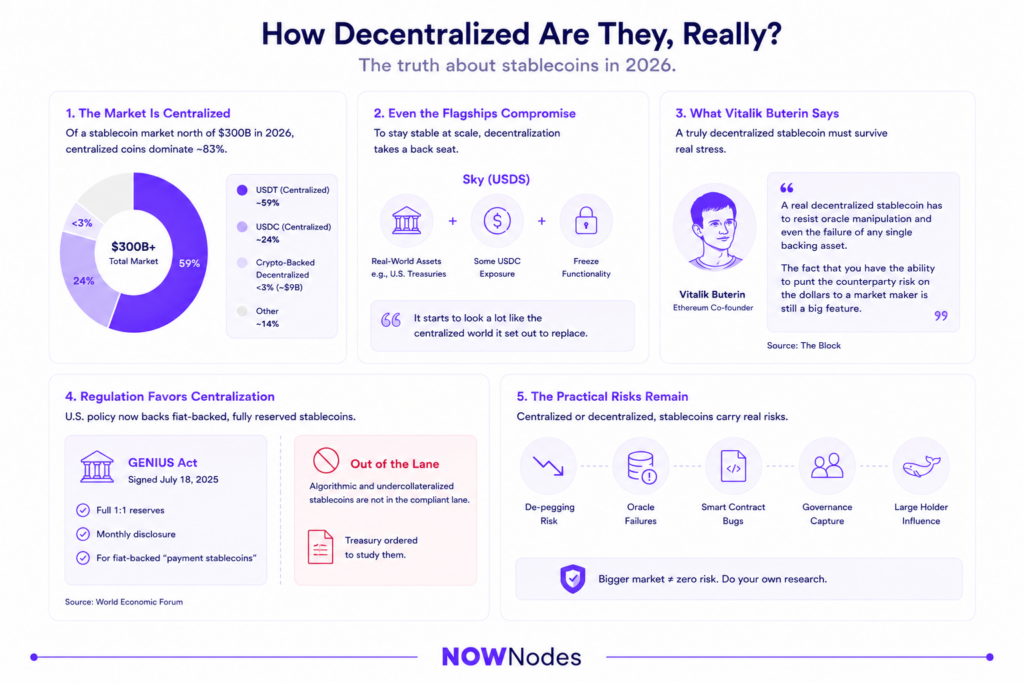
Compare that to USDT or USDC: both are IOUs issued by a company — Tether and Circle, respectively — that says it holds equivalent reserves off-chain and will redeem tokens for dollars on request. That model works, and it’s why USDT alone makes up roughly 60% of the entire stablecoin market on its own, per DeFiLlama, with USDC accounting for most of the rest held by centralized issuers. But it also means trusting one company’s balance sheet, audits, and decisions about who gets to use the token at all.
A decentralized stablecoin swaps that trust for a different set of trade-offs: transparent collateral anyone can verify in real time, but exposure to smart contract bugs, governance votes, and the volatility of whatever crypto backs it. Neither model is strictly safer — they’re safer against different failure modes, which is the theme running through the rest of this guide.
Why Do These Tokens Exist in the First Place?
Here’s the problem a decentralized stablecoin is actually built to solve: a centralized issuer can freeze your funds, and it isn’t a hypothetical. In August 2022, Circle blacklisted every USDC address associated with Tornado Cash after the US Treasury sanctioned the mixing protocol, freezing funds instantly and without a court order against the individual holders, as Forkast reported at the time.
That single event is the clearest real-world argument for the entire category. A stablecoin backed by on-chain collateral and enforced by a smart contract doesn’t have a company positioned to pause it — there’s no customer support line to call and revoke your balance, because no one holds that switch. The trade-off is that nobody’s coming to bail you out if the code itself has a bug, either.
Transparency is the second reason, and it matters even without a freeze ever happening. Centralized issuers publish periodic attestations of their reserves; a decentralized protocol’s collateral is visible on-chain at any moment, to anyone, without waiting for a monthly report.
Who Actually Holds and Uses Them?
DeFi users and protocols are the core audience, and it’s not close. Decentralized stablecoins are the default collateral and settlement asset across lending markets and decentralized exchanges — Curve’s biggest pools are built specifically around stablecoin pairs, and Aave’s GHO exists mainly to be borrowed and redeployed inside DeFi itself.
DAOs and protocol treasuries are a related group, holding decentralized stablecoins specifically because the balance is auditable by every token holder, not just reported to them after the fact. That transparency lines up with how DAOs govern shared funds in general — a public, code-enforced balance fits a public, code-enforced organization.
Automated systems are the newest and fastest-growing category — trading bots, DeFi strategies, and increasingly AI agents that need to verify what’s actually backing a token before transacting with it, not just read a company’s claim. Sky Protocol founder Rune Christensen put it plainly in February 2025:
“For AI systems, transparency is key. They need to know in real time what the backing of a stablecoin is.” — Rune Christensen, Sky Protocol founder, The Block, February 2025
Worth being honest about scale here: decentralized stablecoins remain a small slice of the market. DAI, USDS, GHO, and crvUSD combined come to roughly 5.5% of total stablecoin supply, with USDT and USDC dominating everyday payments and exchange trading pairs, per DeFiLlama’s live breakdown. The category’s usage is concentrated in DeFi, not retail spending — at least for now.
How Do They Actually Hold a $1 Peg?
There’s no single mechanism behind that peg. Three distinct models cover almost everything in the category, and they carry very different risk profiles depending on what’s actually backing the token.
Overcollateralized Vaults: DAI, USDS, GHO, and crvUSD
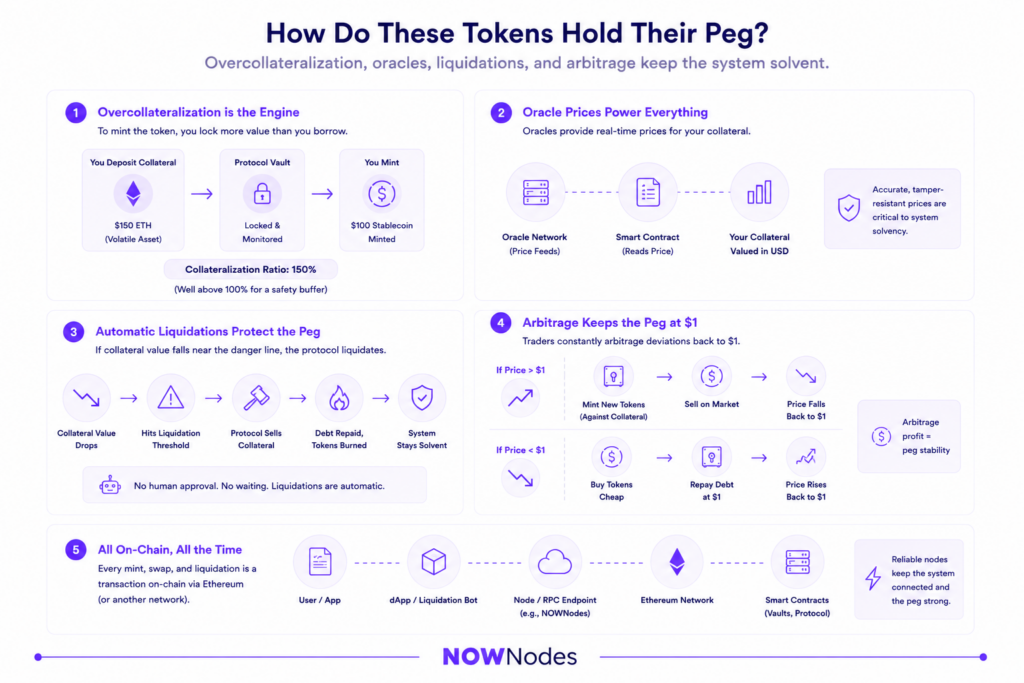
This is the dominant, and most battle-tested, approach. A user locks crypto collateral — ETH, staked ETH, BTC, or increasingly tokenized real-world assets — into a smart contract worth more than the stablecoin they mint against it, commonly 150% or higher.
That extra buffer is what absorbs price swings. If the collateral’s value drops too close to the debt it backs, the protocol liquidates it automatically to keep the stablecoin fully backed, without waiting for the borrower’s permission — the same loan-to-value mechanic that governs any crypto-backed loan applies here, just running through a DAO-governed protocol instead of a company.
DAI and its newer counterpart USDS — both from Sky Protocol, the project formerly known as MakerDAO — pioneered this model and still lead it, with a combined supply above $11 billion as of this writing, per DeFiLlama. Curve’s crvUSD and Aave’s GHO use the same core idea with their own liquidation mechanics layered on top.
Algorithmic Models — and Why Most Failed
A purely algorithmic stablecoin skips collateral almost entirely, relying instead on a second, floating-price token that expands or contracts supply to defend the peg through arbitrage incentives. TerraUSD (UST) was the largest example of this model, and its collapse in May 2022 is the reason “algorithmic” is now a word most protocols avoid using about themselves.
UST lost its dollar peg in a matter of days as its sister token LUNA hyperinflated in a death spiral, wiping out more than $40 billion in value across the Terra ecosystem, according to Futurum Group’s analysis. Frax Finance, which ran a hybrid “fractional-algorithmic” model, drew its own lesson from the fallout: in February 2023, its community voted to move to full collateralization rather than continue relying on an algorithmic backstop, as CoinDesk reported.
Delta-Neutral Synthetic Dollars: The Ethena Model
Ethena’s USDe takes a third approach that’s neither fully collateralized in the DAI sense nor algorithmic in the Terra sense. It holds staked ETH or BTC as collateral, then opens an equal-sized short position on that same asset through perpetual futures — a hedge designed to keep the position’s dollar value flat no matter which way the market moves.
The yield comes from staking rewards plus the funding rate paid on that short position, not from a central bank or a company’s balance sheet. USDe has grown to roughly $4.1 billion in supply, per DeFiLlama, making it the third-largest token in this category — though it depends partly on centralized exchanges for the futures leg, which is its own trade-off against the “decentralized” label.
| Model | Examples | Backing | Main risk |
|---|---|---|---|
| Overcollateralized vault | DAI, USDS, GHO, crvUSD | Crypto + some real-world assets, 150%+ | Liquidation cascades, oracle failure |
| Algorithmic / fractional-algorithmic | UST (defunct), old FRAX | Little to no hard collateral | Death spiral if confidence breaks |
| Delta-neutral synthetic | USDe (Ethena) | Staked crypto + short futures hedge | Funding-rate reversal, exchange counterparty risk |
What Happens When the Peg Breaks?
Terra is the extreme case, but smaller depegs happen more often than the marketing suggests. Even overcollateralized models depend entirely on accurate, timely price data — if the oracle feeding a protocol’s collateral prices lags or gets manipulated, vaults can get liquidated incorrectly, or not liquidated when they should be.
That data has to come from somewhere: liquidation bots and price oracles read blockchain state constantly. That’s exactly the kind of real-time RPC access a provider like NOWNodes supplies across 120-plus networks, instead of every protocol running its own infrastructure for every chain it supports.
Decentralization itself is also a spectrum, not a switch. Sky’s collateral for DAI and USDS now includes tokenized US Treasuries and other real-world assets alongside crypto, a shift Ark Invest’s analysis tracks in detail. That collateral is still verifiable on-chain, but it reintroduces a dependency on traditional financial institutions and legal structures the original crypto-only model didn’t have.
This is critical to weigh honestly: a decentralized stablecoin removes one company’s ability to freeze your funds, but it doesn’t remove risk altogether. It trades custodial risk for smart contract risk, oracle risk, and — increasingly — a partial reliance on the same real-world financial system it was built to route around.
Are They Actually Regulated?
Mostly not, and that’s a real gap rather than an oversight. The US GENIUS Act, signed into law on July 18, 2025, requires payment stablecoin issuers to back tokens one-to-one with dollars or similarly low-risk assets — but it was written around companies like Circle, and it doesn’t clearly address decentralized or algorithmically-managed tokens that have no single issuer to regulate in the first place.
The EU’s MiCA framework has the same structural gap. It requires issuers of asset-referenced and e-money tokens to hold formal authorization and maintain regulated reserves, but that requirement is built around an identifiable legal entity — something a DAO-governed protocol like Sky doesn’t cleanly map onto, per the European Banking Authority’s own framework documentation.
Practically, this means decentralized stablecoins currently operate in a gray zone: not banned, not explicitly exempted, and not yet the direct subject of rules written with them in mind. That’s likely to change as the category grows, so treat any specific compliance claim about a given protocol as something to verify against its current legal disclosures, not something to assume.
Conclusion
A decentralized stablecoin trades a company’s promise for a smart contract’s math — transparent collateral and no single custodian who can freeze your balance, in exchange for exposure to liquidations, oracle failures, and governance votes instead of a customer service line. DAI and USDS proved the overcollateralized model works at scale, Terra proved the purely algorithmic version doesn’t, and Ethena’s USDe shows there’s still room for new designs in between.
None of that makes one model universally better than the other — it makes them different tools for different risk tolerances. If censorship resistance and on-chain transparency matter more to you than a familiar brand name, this is the category built around exactly that trade-off.
FAQ
Can One of These Protocols Be Shut Down?
Not the way a company can be — there’s no office to raid or executive to arrest that stops the smart contract from running. Governance token holders can vote to change or freeze specific functions, though, so “decentralized” doesn’t mean no one can ever alter it.
Do You Need KYC to Use One?
The protocols themselves generally don’t — minting DAI or USDS against your own collateral doesn’t require identity verification. Getting crypto onto a wallet in the first place, through a centralized exchange, usually does.
Are These Tokens Backed 1:1 Like USDC?
Not exactly — most are backed at 150% or more of their value in collateral, not a flat 1:1 ratio, specifically to absorb price volatility that a dollar-for-dollar reserve couldn’t handle. USDe is the exception, using a hedged position rather than simple overcollateralization.
Which of These Protocols Is the Largest?
USDS and DAI, Sky Protocol’s two tokens, lead the category with a combined supply above $11 billion, followed by Ethena’s USDe at roughly $4.1 billion, per DeFiLlama. Figures shift daily, so treat any snapshot as a moment in time rather than a fixed ranking.
Can You Lose Money Holding One?
Yes, if it depegs — UST’s collapse is the clearest example of that risk becoming real. Overcollateralized models like DAI have held their peg through multiple market crashes since 2017, but overcollateralization reduces that risk rather than eliminating it.