
GetBlock is a Web3 infrastructure provider that gives developers hosted access to blockchain nodes through RPC, REST, and WebSocket connections. Instead of running Bitcoin, Ethereum, or Solana clients yourself, you send API requests to GetBlock’s servers and get blockchain data back — balances, transactions, block data, contract state — without maintaining the underlying infrastructure.
Founded in 2019, GetBlock now lists support for 130+ blockchain networks and says it serves over 1,000 active companies, according to GetBlock’s own leadership announcement. This guide covers what GetBlock actually does, who it’s built for, and where it fits against alternatives — including cases where a multi-chain provider like NOWNodes is the more practical choice.
What Is GetBlock?
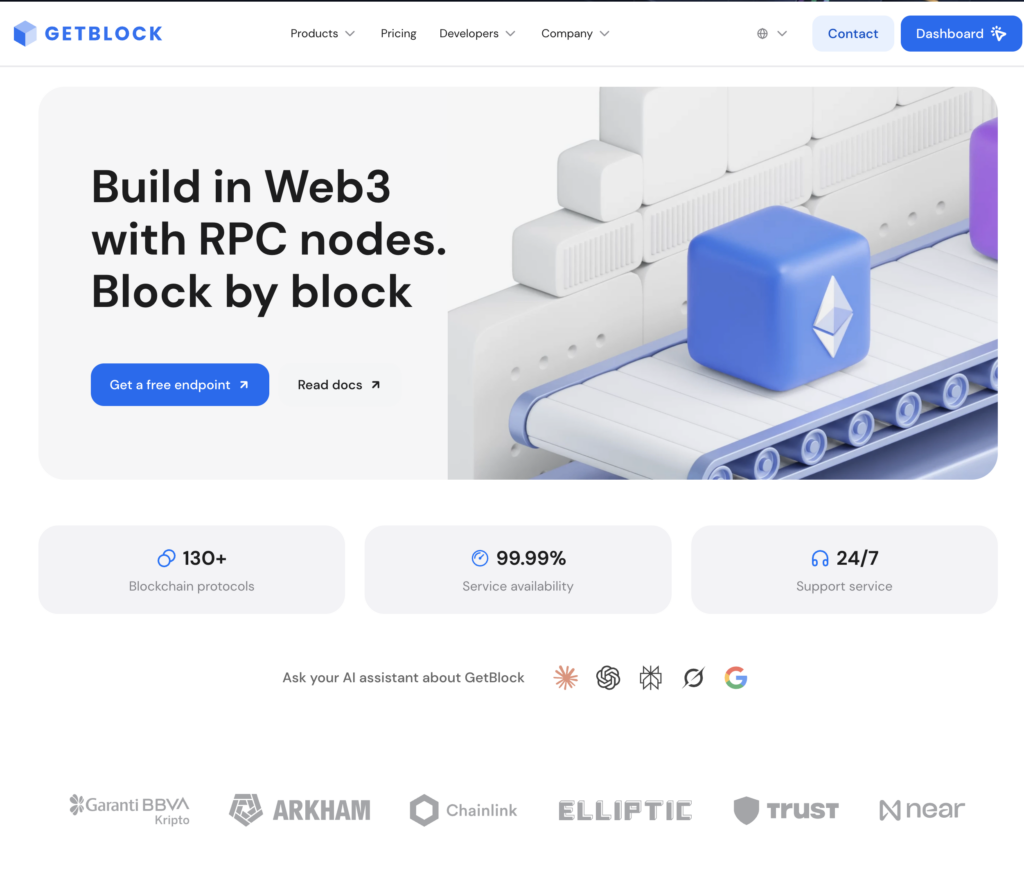
GetBlock is a node-as-a-service platform. It runs the blockchain infrastructure — the servers, the sync process, the client software — and exposes it through an API, so your application can read on-chain data or broadcast a transaction with a single HTTPS or WebSocket call.
Node-as-a-service: a hosted infrastructure model where a provider operates blockchain nodes on a customer’s behalf and exposes them through an API, removing the need to run and sync a node locally. See Ethereum’s own explanation of what a node does.
The company operates geo-distributed clusters across regions including the US, EU, and Asia, and it holds SOC 2 Type II attestation, a security-controls audit that some enterprise customers require before signing a vendor contract. GetBlock also publishes CoinGecko’s ranking placing it among the top five RPC node providers globally, a claim worth noting as GetBlock’s own citation rather than an independently verified metric.
That framing — infrastructure as the product, not the application built on top of it — is the right lens for understanding what GetBlock actually sells: access, not a finished tool.
Why Do Developers Need a Provider Like GetBlock?
Running your own blockchain node is a real infrastructure commitment, not a quick setup. A full Ethereum node alone needs several hundred gigabytes of storage and has to stay synced through every protocol upgrade, and an archive node — one that keeps complete historical state, one of the several distinct types of blockchain nodes — can run into multiple terabytes depending on the client.
That’s before accounting for uptime. A node that goes offline during a deposit check or a failed transaction broadcast becomes your outage, not a background inconvenience. GetBlock, like other RPC providers, absorbs that operational burden: it handles syncing, scaling, and failover so a team can focus on application logic instead of server maintenance.
This is the same trade-off covered in more depth in what RPC nodes and endpoints actually do — the provider takes on the infrastructure job so the client only has to manage an API key.
Who Uses GetBlock?
GetBlock’s stated customer base spans several categories of Web3 products, each stressing a different part of the infrastructure:
- Wallets need balance lookups and transaction broadcasting that stay responsive under real user traffic.
- DeFi protocols and dApp frontends call smart contracts repeatedly for reads and need consistent state across requests.
- NFT platforms and marketplaces query metadata and ownership records across multiple chains at once.
- Analytics and compliance tools rely on GetBlock’s separate risk-and-compliance products, including wallet risk checks and smart-contract screening.
- Trading and monitoring applications use WebSocket subscriptions instead of repeatedly polling for updates.
A wallet checking one balance and an analytics dashboard scanning years of transaction history are both “using GetBlock,” but they lean on completely different parts of the platform — which is exactly why the pricing model below is structured around usage rather than a flat per-seat fee.
How GetBlock’s Node Access Works
GetBlock splits its infrastructure into three tiers, and picking the right one depends almost entirely on request volume and how predictable that volume is.
Shared Nodes and Compute Units
Shared Nodes are GetBlock’s entry-level product: infrastructure used by multiple customers at once, billed through Compute Units (CUs) rather than flat request counts. A simple call like checking a balance costs fewer CUs than a heavier one like scanning event logs, so two accounts making the same number of requests can burn through very different budgets.
The free tier runs indefinitely at 50,000 CUs per day across any supported chain — enough for prototyping, not for production traffic. The paid Pro plan starts at $399 a month billed yearly, with configurable CU tiers, 800 requests per second, and access to roughly 150 API endpoints.
Dedicated and Limitless Nodes
Dedicated Nodes remove the shared-infrastructure ceiling entirely. GetBlock advertises unlimited RPS with no CU cap, starting around $1,000 a month, backed by a 99.99% uptime SLA and sub-5-minute engineer-led support response times.
Limitless Node sits between the two: a flat-rate plan built around a guaranteed RPS ceiling instead of a CU budget, aimed at teams that want predictable billing without the cost of fully dedicated hardware. Here’s the practical difference — Shared Nodes suit unpredictable or low-volume traffic, while Dedicated and Limitless plans suit teams that already know their throughput needs and want to stop tracking CU consumption.
GetBlock Pricing in 2026
Pricing is one of the more time-sensitive parts of any RPC provider comparison, so treat the figures below as a snapshot to verify on GetBlock’s own pricing page before committing.
| Plan | Starting Price | Requests / Limits | Best For |
|---|---|---|---|
| Free | $0 | 50,000 CUs/day | Prototyping and testing |
| Pro (Shared) | $399/month (billed yearly) | Configurable CU tiers, 800 RPS | Production apps with moderate, variable traffic |
| Limitless Node | Custom, flat-rate | Guaranteed RPS, no CU tracking | Predictable, high-volume workloads |
| Dedicated Node | From $1,000/month | Unlimited RPS, hardware-bound | High-throughput or latency-sensitive production |
That jump from a $399 shared plan to a $1,000-plus dedicated node is steep for a team that’s simply outgrown the free tier — which is exactly the gap where a lot of teams start comparing alternatives.
GetBlock vs NOWNodes: How the Two Compare
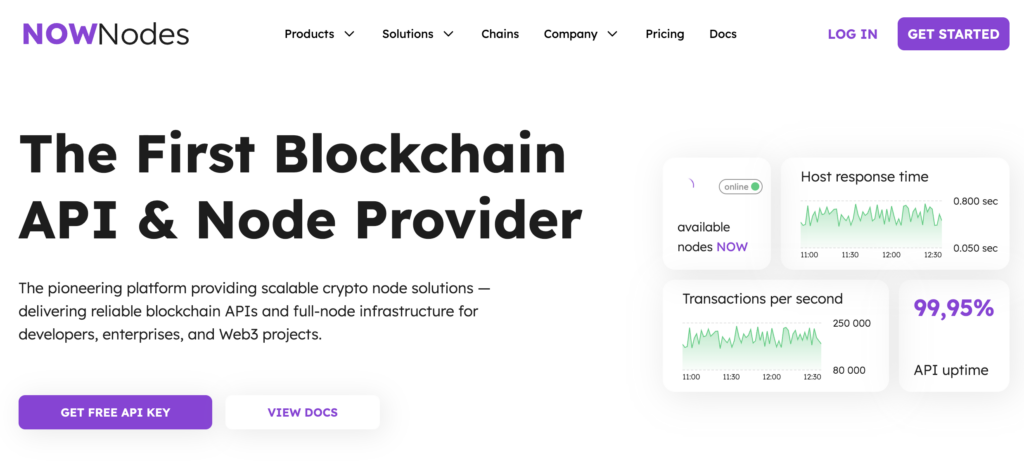
Both platforms solve the same core problem — API access to blockchain nodes without self-hosting — but they diverge on network breadth, product scope, and how the free and entry tiers are structured.
| Feature | GetBlock | NOWNodes |
|---|---|---|
| Network coverage | 130+ blockchains | 120+ blockchains |
| Free tier | 50,000 CUs/day, indefinite | 100,000 requests on the Start plan |
| Entry paid plan | $399/month (Pro, Shared) | €20/month (Pro, 1,000,000 requests) |
| Dedicated node RPS | Unlimited, from $1,000/month | No predefined RPS cap; bound by hardware |
| Additional products | Market data, wallet risk checks, AML tools | WebSockets, Blockbook, gRPC streaming, Market Data API, MCP Server for AI coding tools |
| Compliance | SOC 2 Type II | — |
Pricing and limits on both platforms change often — verify the current figures on GetBlock’s pricing page and NOWNodes’ pricing page before building a cost model.
When GetBlock Makes Sense
GetBlock is a reasonable fit for a team that wants a straightforward node API, values GetBlock’s compliance and risk-screening add-ons, or is already deep into its CU-based billing model and doesn’t want to migrate. Its per-method documentation, covering individual JSON-RPC calls chain by chain, is genuinely useful for a developer looking up one method at a time — a similar breakdown of chain-by-chain options runs through this comparison of Ethereum RPC providers.
When NOWNodes Is the Better Fit
The gap shows up clearest in the entry-level pricing. GetBlock’s paid tier starts at $399 a month for 800 RPS, while NOWNodes’ Pro plan runs €20 a month for a million monthly requests — a meaningfully lower cost of entry for a team past the prototyping stage but not yet at enterprise volume.
NOWNodes also bundles a broader interface set under one account: RPC, WebSocket, and Blockbook access, gRPC streaming, a Market Data API covering 9,000-plus cryptocurrencies, and an MCP Server that connects AI coding assistants like Claude Code and Cursor directly to documented API methods. A multi-chain wallet or exchange that wants node access, market data, and streaming updates from a single vendor gets that without stitching together separate GetBlock products for compliance and market data.
NOWNodes’ dedicated node infrastructure follows the same “no predefined RPS cap” model as GetBlock’s dedicated tier, but without a $1,000 price floor attached to the announcement — a detail worth confirming directly with sales, since dedicated pricing on both platforms is typically quoted per configuration rather than published as a flat rate.
Limitations to Consider Before Committing
No RPC provider is free of trade-offs, and GetBlock is no exception. Its CU-based billing means the effective cost per request varies by method, so a workload leaning on expensive calls can burn through a budget faster than the headline price suggests — the same caution applies to any compute-unit-billed provider, GetBlock included.
The jump from the Pro shared plan to a dedicated node is also large relative to competitors, which can leave a fast-growing team facing an awkward pricing cliff right when traffic starts to spike. And relying on a single RPC provider of any kind — GetBlock or otherwise — creates a dependency: if that provider has an outage, your application inherits it. Running a second provider as failover is the standard mitigation for anything handling real user funds.
Conclusion
GetBlock is a capable, compliance-focused RPC provider with broad network coverage and a genuinely useful set of risk and market-data add-ons. For teams already inside its ecosystem, or ones that specifically need its AML and wallet-screening tools, it’s a defensible choice.
For most multi-chain products, though, the practical starting point is cost and scope: a lower entry price, a wider bundled feature set, and one account covering RPC, streaming, and market data tend to matter more than an extra ten blockchain networks on a coverage list. That’s the case where NOWNodes is worth evaluating side by side with GetBlock before you commit to either one.
FAQ
What Blockchains Does GetBlock Support?
GetBlock states support for 130+ blockchain networks, spanning EVM chains, non-EVM chains like Solana and Bitcoin, and several enterprise-focused ecosystems. Exact interface support — RPC, REST, WebSocket, or GraphQL — varies by network, so it’s worth checking the specific chain and interface combination before building on it.
Is GetBlock Free to Use?
Yes, GetBlock offers a free plan usable indefinitely, currently capped at 50,000 Compute Units per day across any supported chain. That’s workable for development and testing but not sized for production traffic.
Is GetBlock Reliable for Production Applications?
GetBlock advertises 99.99% uptime on its dedicated node tier and states it processes dozens of billions of requests monthly. As with any provider, that SLA applies to the specific product tier it’s attached to — verify which guarantee covers the plan you’re actually paying for.
How Does GetBlock’s Dedicated Node Differ From NOWNodes’ Dedicated Node?
Both remove the shared-infrastructure request ceiling and price by allocated hardware rather than a fixed quota. GetBlock publishes a starting price around $1,000 a month; NOWNodes’ dedicated nodes are quoted per configuration, so the two are worth comparing directly against your specific network, region, and throughput requirements.