

You access the Ethereum mempool through WebSocket subscription to newPendingTransactions, or a specialized mempool API — the right choice depends on whether you need full transaction details, just a live stream of hashes, or data aggregated across many nodes at once. Each node keeps its own local copy of pending transactions, so “the mempool” isn’t one shared database you can simply query from anywhere.
That distinction matters more than it sounds. Get it wrong and you’ll spend an afternoon debugging why your txpool_content call returns nothing on a public endpoint that never exposed the method in the first place. This guide walks through what the mempool actually is, why developers and traders need to see inside it, and the specific methods that work — starting simple and ending with the private-pool setups serious trading operations use.
What Is the Ethereum Mempool?
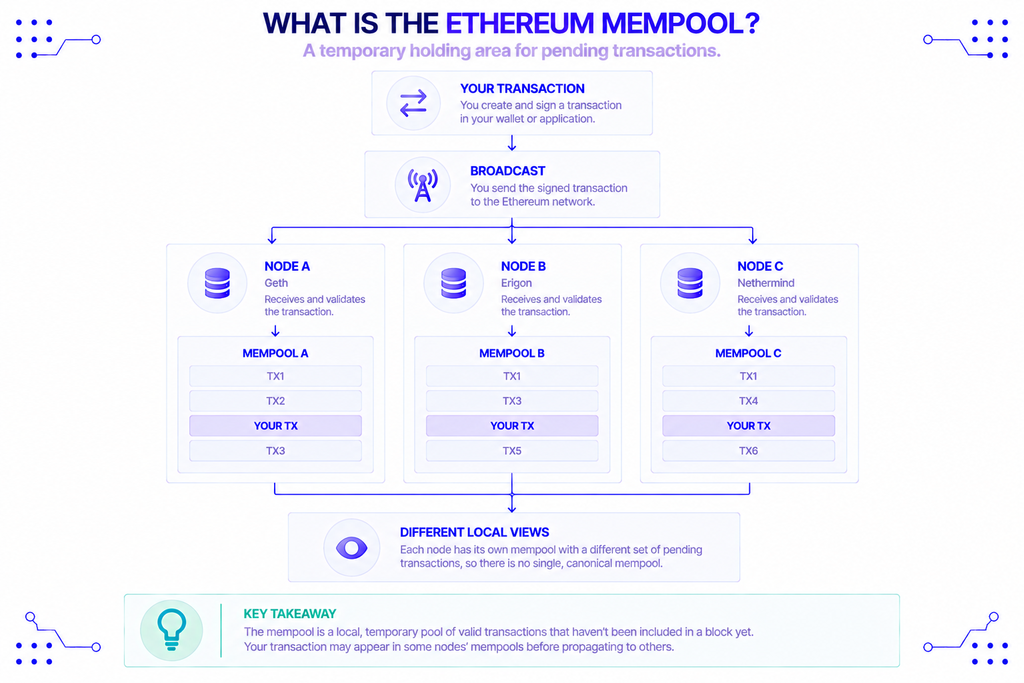
The mempool is the holding area where a transaction sits after you broadcast it and before a validator includes it in a block. Every Ethereum node — Geth, Erigon, Nethermind, or any other client — maintains its own version of this pool locally.
Mempool (memory pool): the set of transactions a node has received and validated but not yet included in a block, held in memory rather than on disk, and visible to that node until the transaction is mined, dropped, or replaced. See ethereum.org’s JSON-RPC documentation for where mempool-related methods sit in the broader API.
Here’s the part that trips people up: there is no single, canonical mempool. Your transaction might sit in one node’s pool for a few seconds before propagating to others, and a node with stricter fee or size settings might reject a transaction that another node happily queues. What you can query is always a mempool view, not the mempool.
Geth’s txpool namespace defaults to holding 4,096 pending and 1,024 queued transactions per account limit before older, unprofitable ones get evicted, according to the official Geth documentation. Operators can raise that ceiling with the –txpool.globalslots flag, but a bigger pool means a heavier RPC payload every time someone queries it.
Why Would You Need Mempool Access?
The most immediate reason is your own transaction. If a transfer or swap is taking longer than expected to confirm, checking the mempool tells you whether it’s still pending, been dropped for underpricing, or replaced by a competing transaction with the same nonce.
Fee estimation is the second reason, and it’s less obvious. Wallets and gas-fee tools look at what’s currently sitting in the mempool to guess the priority fee needed to get included in the next block or two, rather than relying only on the last mined block’s numbers.
Security monitoring is the third. A team watching its own contract’s mempool activity can spot an attack forming — a suspicious call encoding, an unusual sender, a transaction targeting a known vulnerability — in the seconds before it lands, not after.
Who Actually Reads the Mempool?
A handful of distinct groups query pending transactions for very different reasons, and the tooling they reach for differs accordingly.
- Wallets and dApps poll or subscribe to pending transactions to show users “pending” status and to calculate suggested gas fees in real time.
- MEV searchers and arbitrage bots scan every pending transaction for profitable opportunities, which is the exact behavior covered in more depth in what MEV is and how MEV protection works.
- Block explorers and analytics platforms surface pending transaction counts and gas trends as a public service, the way Etherscan’s pending-transactions chart does.
- Security researchers and protocol teams watch for exploit attempts against specific contracts before they’re confirmed, sometimes racing to submit a defensive transaction first.
- Exchanges and payment processors track incoming deposits the moment they’re broadcast, so a user isn’t left waiting for the first confirmation to see a balance update.
How to Access the Ethereum Mempool With RPC Methods
The most direct route is Geth’s txpool namespace, a set of JSON-RPC methods purpose-built for looking inside the pool. They return live, node-local data rather than a historical record.
| Method | What it returns | Typical use |
| txpool_content | Full transaction objects, grouped by sender and nonce, split into pending and queued | Building a complete mempool snapshot |
| txpool_contentFrom | Pending and queued transactions for one specific address | Checking your own wallet’s outstanding transactions |
| txpool_inspect | A compact text summary instead of full transaction objects | Quick manual debugging without a heavy payload |
| txpool_status | Just the pending and queued counts | Lightweight monitoring of pool size over time |
Here’s a minimal request for a full snapshot, sent as a standard JSON-RPC call:
json
{
  "jsonrpc": "2.0",
  "method": "txpool_content",
  "params": [],
  "id": 1
}
This is critical to know before you build anything around it: most public endpoints disable the txpool namespace by default, partly for privacy and partly to protect node resources from being drained by expensive full-pool queries. You’ll generally need a node that exposes it explicitly, which in practice means running your own Geth or Erigon instance, or using a dedicated node configured with method access beyond the standard read-only set.
Watching the Mempool in Real Time With WebSockets
For most practical use cases — a wallet showing pending status, a bot scanning for opportunities — you don’t need the full txpool_content payload. You need a live stream of transaction hashes as they arrive, which is what a WebSocket subscription is built for.
The eth_subscribe method with a newPendingTransactions parameter pushes a new transaction hash to your client the instant a connected node sees it. That’s the same mechanism libraries like ethers.js wrap with provider.on(“pending”, …), and it’s supported over a persistent connection rather than repeated polling.
A subscription request looks like this:
json
{
  "jsonrpc": "2.0",
  "id": 1,
  "method": "eth_subscribe",
  "params": ["newPendingTransactions"]
}
The response is just a hash — you still need a follow-up eth_getTransactionByHash call if you want the full transaction details. That two-step pattern keeps the stream lightweight even during busy periods when thousands of transactions hit the pool per minute.
NOWNodes’ WebSocket API provides this kind of persistent connection on supported networks, including Ethereum, so an application can subscribe to pending activity without maintaining its own always-on node just to keep a socket open. It’s the same underlying pattern as the txpool methods above, just delivered as a stream instead of a one-time query.
Do You Need Your Own Node, or Will a Provider Do?
This is the practical decision most developers actually face, and the honest answer depends on what you’re building.
| Approach | What you get | Best fit |
| Self-hosted Geth/Erigon node | Full txpool namespace, total control over pool settings | Teams running heavy custom MEV or monitoring infrastructure |
| Dedicated node from a provider | Same method access as self-hosted, without the maintenance | Teams that want txpool access but not the operational overhead |
| Standard RPC/WebSocket endpoint | eth_subscribe pending-transaction streams, no full-pool queries | Wallets, dApps, and bots that just need to see incoming transactions |
| Third-party mempool API | Aggregated, often multi-node visibility with added filtering | Applications wanting broader mempool coverage than one node provides |
An Ethereum RPC endpoint with WebSocket support covers the majority of use cases — checking your own pending transactions, estimating fees, or watching for activity on a specific contract. Reaching for the full txpool namespace only makes sense once you specifically need every field of every pending transaction, not just the ones relevant to your address or contract.
Why the Mempool Is Also a Risk, Not Just a Data Source
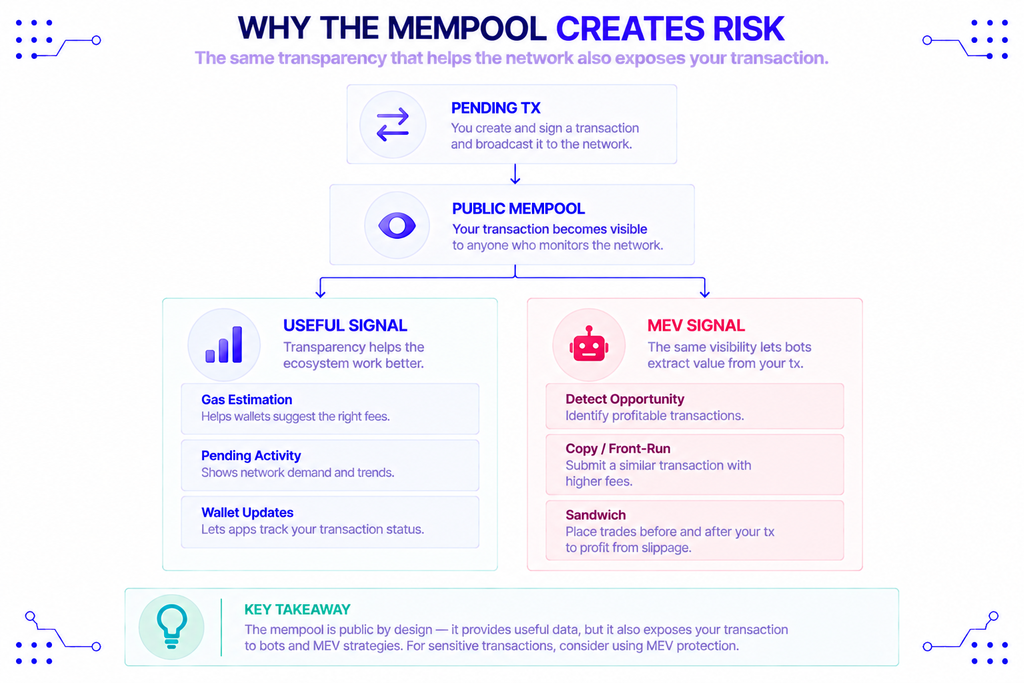
Visibility cuts both ways. The same openness that lets a wallet estimate gas fees lets a bot see your swap before it confirms and race to profit from it.
Paradigm researchers Dan Robinson and Georgios Konstantopoulos captured this starkly in a widely cited 2020 essay: “If the chain itself is a battleground, the mempool is something worse: a dark forest,” they wrote, describing an environment where any visible, profitable transaction risks getting front-run or copied the moment it’s public. That framing still holds — the mempool being observable by design is precisely what makes MEV extraction possible in the first place, a mechanic covered in full in what MEV is and how MEV protection works.
Before broadcasting anything sensitive — a large swap, a liquidation, a time-locked claim — it’s worth checking how to simulate a transaction on Ethereum first. A simulation won’t hide your transaction, but it flags a bad outcome before you’ve exposed anything to the public pool at all.
Private Mempools: Keeping a Transaction Out of Public View
If exposure itself is the problem, the fix some traders reach for is skipping the public mempool entirely. Services like Flashbots Protect and MEV-Blocker accept a signed transaction directly and route it to block builders through a private channel, so it never appears in any node’s public txpool until it’s already confirmed.
The trade-off is real, not cosmetic. A transaction sent privately can’t be seen by the searchers who’d otherwise sandwich it, but it also can’t be inspected by the wallets, explorers, and monitoring tools that rely on public mempool visibility to do their jobs. Most private-relay users accept that trade for exactly the transactions worth protecting, while routing everyday transfers through the normal public pool.
Conclusion
Getting mempool data down to the method you actually need saves real engineering time. A wallet or dApp usually needs nothing more than an eth_subscribe WebSocket stream; a security team or MEV operation building on full transaction detail needs the txpool namespace, which means a self-hosted or dedicated node rather than a standard public endpoint.
Whichever route fits, the underlying requirement stays the same: reliable, low-latency access to Ethereum, whether that comes from your own client or a provider handling the node layer. Match the tool to what you’re actually trying to see, and keep in mind that the same visibility making the mempool useful is what makes an unprotected transaction there worth protecting.
FAQ
Is the mempool data the same on every Ethereum node?
No. Each node maintains its own local view based on which transactions it has received and its own fee and size thresholds, so two nodes can show slightly different pending transactions at the same moment.
Can a transaction disappear from the mempool without being confirmed?
Yes. A node drops a transaction from its pool if it sits too long without being included, gets replaced by a new transaction using the same nonce and a higher fee, or falls below the pool’s minimum fee threshold during a busy period.
Is watching the Ethereum mempool illegal?
No. Mempool data is public information broadcast to any node willing to receive it, and reading it isn’t restricted — what you do with that information, such as certain trading strategies, is a separate question regulators are still working through.
Does every blockchain have a mempool?
Most account for pending transactions in some form, though the mechanics vary. Solana, for instance, routes transactions differently and doesn’t rely on a traditional public mempool the way Ethereum does, which changes how MEV shows up there.
What should I do if my transaction is stuck in the mempool?
Check its status with txpool_contentFrom or a block explorer, then either wait if network congestion is temporary, or resubmit the same nonce with a higher priority fee to replace it.