
A copy trading bot is a program that watches one wallet and automatically mirrors its trades into your own account. You pick a trader who is good at something, and the bot copies what they do in close to real time, so you are not stuck watching a screen. A Polymarket copy trading bot and a BNB Chain memecoin copy bot share that same loop — watch, detect, copy — but the plumbing underneath each one is different, and that is where most of the actual work lives.
This guide walks through both. First the core idea and the mechanics that apply everywhere, then two concrete builds: one for Polymarket, the on-chain prediction market on Polygon, and one for memecoins trading on BNB Chain. The code here is illustrative, not production-ready, so treat it as a starting point and test with tiny amounts before anything real.
What Copy Trading Is
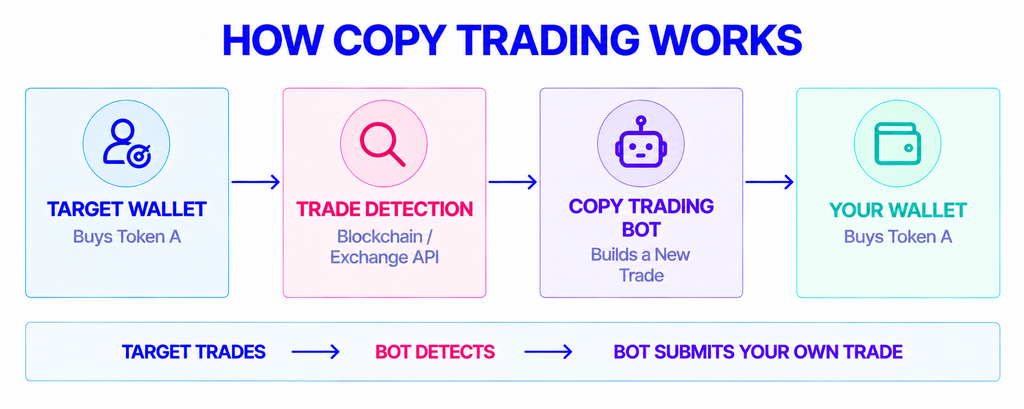
Copy trading means mirroring another trader’s positions automatically, instead of deciding every trade yourself. When the target wallet buys, your bot buys the same thing; when it sells, your bot can sell too. The appeal is simple: you borrow someone else’s timing and research without doing the research.
It is worth separating two things that often get blurred. A signal service tells you what to do and leaves you to click the buttons. A copy bot removes the clicking — it reads the chain or an exchange API, spots the trade, and submits its own order with no human in the loop.
On-chain markets make this possible because wallets are public. Every trade a target makes is visible, either through a market’s API or directly on the blockchain, so a bot can follow a wallet it has never met and react within seconds.
Why Traders Copy Another Wallet
The honest reason most people copy trade is that finding good trades is hard and finding them fast is harder. Copying a wallet that already does both is a shortcut. It does not make you a better analyst; it makes you faster at acting on someone else’s edge.
Who this suits depends on the market. On Polymarket, people copy sharp forecasters — wallets with a track record of being right about elections, sports, or macro events. On BNB Chain, people copy “smart money” wallets that reliably catch memecoin launches early, before a token runs.
The reason both are worth building bots for now is liquidity. Polymarket has moved from a niche DeFi experiment toward the financial mainstream: the NYSE’s parent company, Intercontinental Exchange, completed a roughly $2 billion investment in the platform by March 2026, and Polymarket relaunched in the US after acquiring a CFTC-licensed exchange (The Block). CEO Shayne Coplan called the ICE deal “a major step in bringing prediction markets into the financial mainstream.” More volume means more wallets worth copying. On the memecoin side, launchpads like four.meme turn out new BNB Chain tokens constantly, so there is always a fresh stream of trades to follow.
How a Copy Bot Works Under the Hood
Strip away the venue and almost every copy bot runs the same four steps. The interface changes, the chain changes, but the loop does not.
- Monitor — the bot tracks one or more target wallets, either by polling an API or by subscribing to on-chain events.
- Detect — when the target makes a new trade, the bot reads the details: which market or token, buy or sell, and how big.
- Size — the bot scales the trade to your budget, usually with a fixed multiplier (copy 10% of every position, say) and hard caps so one trade can’t blow up your account.
- Execute — the bot submits its own order on the same venue and records the fill so it can track exposure.
One thing to accept up front: your copy is never identical to the original. You see the trade after it happens, the price has already moved a little, and you are behind the leader by at least the time it took to detect and submit. The goal is a close follow, not a perfect clone.
Building a Copy Bot for Polymarket
Polymarket runs on Polygon (chain ID 137). Markets are binary outcome shares — you buy “Yes” or “No” on an event, priced between 0 and 1 — and trades clear through a central limit order book, or CLOB, while settlement stays non-custodial on-chain. A copy bot here watches a target wallet, detects its trades through Polymarket’s data layer, and places matching orders through the CLOB.
What Changed With Polymarket’s CLOB V2 Upgrade
If you follow an older tutorial, it will probably break. Polymarket shipped CLOB V2 on April 28, 2026, a coordinated upgrade with new exchange contracts, a rewritten order-book backend, and a new collateral token (Polymarket’s V2 migration guide).
Two changes matter most for a bot. First, the wallet-facing collateral moved from bridged USDC.e to pUSD (Polymarket USD), a standard ERC-20 on Polygon backed 1:1 by USDC. Second, the old client libraries were retired — V1-signed orders no longer work against production. You now install py-clob-client-v2 (Python) or @polymarket/clob-client-v2 (TypeScript). Any code still funding orders with USDC.e or importing the legacy py-clob-client will fail silently or get rejected.
Which Polymarket APIs Does the Bot Use?
Polymarket is not one API but three, each with a job. A copy bot usually touches all three.
| API | Base URL | Auth | What it does |
|---|---|---|---|
| Gamma | gamma-api.polymarket.com | None | Find markets and events, get outcome-token IDs |
| CLOB | clob.polymarket.com | Wallet | Read the order book, place and cancel orders |
| Data | data-api.polymarket.com | None | Read a wallet’s trades, positions, and activity |
The Data API is your discovery layer: it tells you what the target wallet did. The CLOB is your execution layer: it is where your own copy order goes. Full details are in the Polymarket developer docs.
How Does the Bot Detect the Target’s Trades?
The simplest approach is to poll the Data API for the target wallet’s recent trades on a short interval.
python
import requests

def recent_trades(wallet, since_ts):
    r = requests.get(
        "https://data-api.polymarket.com/activity",
        params={
            "user": wallet.lower(),
            "type": "TRADE",
            "limit": 100,
            "sortBy": "TIMESTAMP",
            "sortDirection": "DESC",
            "start": since_ts,
        },
    )
    return r.json()
Polling every couple of seconds is fine to start. For faster updates, Polymarket also exposes a WebSocket feed (wss://ws-subscriptions-clob.polymarket.com) with a market channel for order-book updates and an authenticated user channel. A common pattern is to poll the Data API to discover new trades, then subscribe to the specific markets involved for live pricing.
Placing the Copy Order
Once you detect a trade, size it and submit your own. You initialize the CLOB client, derive API credentials from your private key, apply your multiplier and risk caps, then post the order.
python
# conceptual — method names vary by client version, so check your installed py-clob-client-v2
from py_clob_client.client import ClobClient

client = ClobClient("https://clob.polymarket.com", chain_id=137, key=PRIVATE_KEY)
client.set_api_creds(client.create_or_derive_api_creds())

copy_notional = original_size * 0.10          # copy 10% of the target's size
if copy_notional > MAX_TRADE_SIZE:            # hard cap per trade
    copy_notional = MAX_TRADE_SIZE

# build and post a Fill-Or-Kill order for the same outcome token...
A few practical notes. Fund the trading wallet with pUSD for collateral and a little POL for Polygon gas. A sensible demo guardrail is to copy only BUY orders and skip SELLs at first, since exiting someone else’s position correctly is harder than entering it. And keep sizes small while you test — the first live run of any bot is where the surprises happen.
Building a Copy Bot for BNB Chain Memecoins
BNB Chain (chain ID 56) has no order book to call and no tidy trade API for a wallet. Memecoins there trade on decentralized exchanges, so a copy bot has to read the blockchain directly: watch the target wallet, decode its swaps, and fire its own swap through the same DEX.
Where BNB Chain Memecoins Trade
Most new BNB Chain memecoins start on a launchpad. four.meme is the dominant one — a no-code platform where anyone creates a BEP-20 token on a bonding curve, and once the curve fills (commonly around 24 BNB), liquidity migrates automatically to PancakeSwap, BNB Chain’s largest DEX. From that point the token trades like any other PancakeSwap pair.
That split matters for your bot. A token still on the four.meme curve and one that has graduated to PancakeSwap are traded through different contracts, so a copy bot has to know where the target actually bought. For most setups, watching PancakeSwap swaps covers the bulk of real volume; its router and pool mechanics are documented in the PancakeSwap docs.
Watching the Wallet’s Swaps in Real Time
Because there is no REST feed of a wallet’s trades, you subscribe to the chain over WebSocket. Two common approaches: watch the target wallet’s outgoing transactions and decode any that hit a DEX router, or subscribe to Swap events on the specific pairs you care about and filter for your target’s address.
python
# conceptual sketch with web3.py over a BSC WebSocket endpoint
from web3 import Web3

w3 = Web3(Web3.LegacyWebSocketProvider("wss://YOUR_BSC_WSS_ENDPOINT"))

# subscribe to PancakeSwap Swap events, then decode token in/out and amounts,
# and act only when the 'sender' or recipient matches your target wallet
Reading confirmed blocks is the safe default. You can go a step faster by watching the mempool for the target’s pending transaction, but that pulls you into front-running territory and exposes you to MEV, where bots compete to reorder transactions. For copying — as opposed to sniping a launch — confirmed swaps are usually enough.
Executing the Copy Swap
To copy a buy, your bot sends its own swap through the PancakeSwap router with your amount, a slippage tolerance, and a deadline, paying BNB for gas. The mechanics are the standard swapExactTokensForTokens-style call; the hard part is not the swap but trusting the token.
Before copying into any new token, your bot should run basic safety checks: is liquidity locked, can you actually sell it back, and does the contract apply a hidden transfer tax. Honeypot tokens let you buy and then block the sale, and no amount of copy speed protects you from one.
Polymarket vs BNB Chain Memecoin Copy Bots
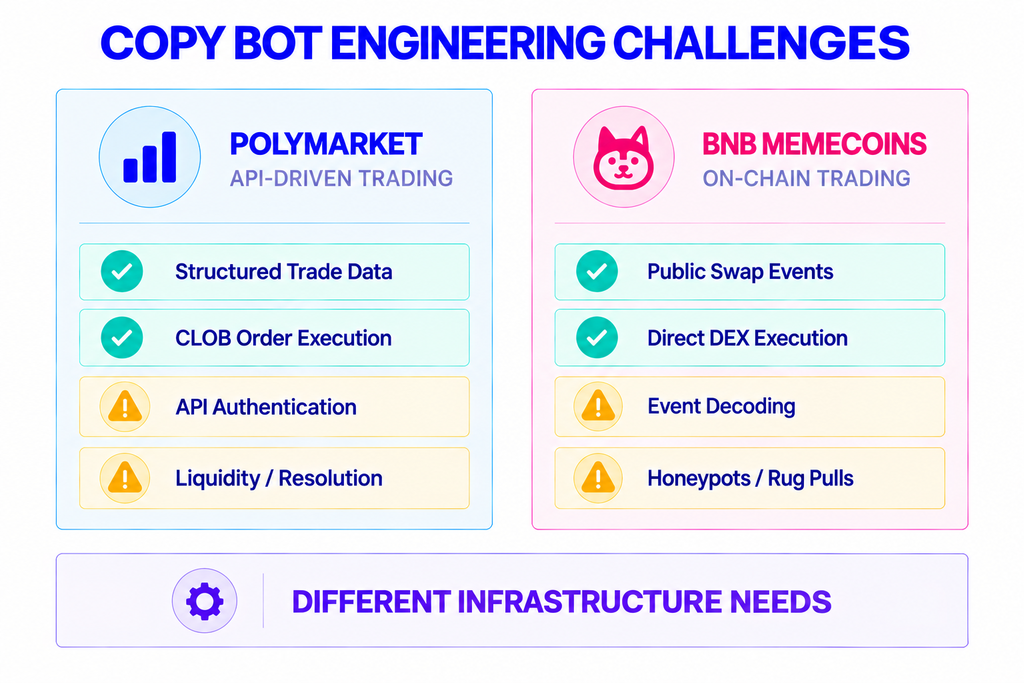
The same four-step loop, but the engineering diverges at almost every step. This table lines up the differences that actually change your code.
| Polymarket copy bot | BNB memecoin copy bot | |
|---|---|---|
| Where you read trades | Official Data API | Raw on-chain events (DEX swaps) |
| Auth to read a wallet | None | None |
| Auth to trade | Wallet credentials (CLOB) | Your own signed transactions |
| What you hold | pUSD outcome positions | BEP-20 tokens |
| Execution | CLOB order (e.g. FOK) | DEX swap via router |
| Biggest risk | Market resolution, thin liquidity | Rug pulls, honeypots, MEV |
| Speed sensitivity | Seconds are fine | Milliseconds matter more |
Neither is strictly easier. Polymarket gives you clean APIs but a stricter, authenticated trading flow and a recent V2 migration to respect. Memecoins give you no gatekeeper and no auth to read, but you take on event decoding, token safety, and a far more hostile market.
Risks You Can’t Code Away
A copy bot improves your timing, not your judgment. These risks sit outside anything you can fix in software:
- You are always behind the leader. You trade after they do, at a worse price, and you may miss their exit entirely.
- The leader can be wrong. A wallet with a hot streak is not a guarantee. Copying also copies their bad trades.
- Memecoins are mostly traps. Rug pulls, honeypots, and tax tokens are routine on BNB Chain. Verify a token’s contract before trusting it.
- Transactions fail. Reverted swaps and failed orders during congestion still cost gas, and they stack up on an active bot.
Two habits reduce the damage. Use a dedicated burner wallet funded with only what you can lose, never your main holdings. And never give a bot, script, or “service” your seed phrase or private key beyond the single wallet it needs — anything asking for more is trying to drain you. None of this is financial advice; automated trading of new tokens and event contracts is high-risk by nature.
The Infrastructure a Copy Bot Runs On
A copy bot is only as responsive as its connection to the chain. Polling the Data API and watching PancakeSwap swaps both run through an RPC endpoint, and the real-time paths depend on a stable WebSocket connection. A dropped connection during a busy launch is a missed trade.
Running your own Polygon and BSC nodes to get that connection is a lot of overhead — sync time, storage, and uptime you now own. A provider such as NOWNodes supplies RPC and WebSocket access for BNB Smart Chain, Polygon, and other networks, so you can point your bot at an endpoint and spend your time on the copy logic instead of the servers. For a Polymarket bot you need a Polygon endpoint plus the platform’s own CLOB WebSocket; for a BNB memecoin bot you need a BSC endpoint and a WebSocket to stream swaps.
Conclusion
Building a copy trading bot comes down to one loop — watch a wallet, detect its trade, size it, copy it — wrapped around whatever the target market actually requires. For Polymarket, that means the Gamma, CLOB, and Data APIs, and respecting the 2026 move to CLOB V2 and pUSD collateral. For BNB Chain memecoins, it means reading swaps straight off the chain and executing through PancakeSwap, with token safety checks doing as much work as the trading code.
Start with one target wallet, copy only buys, cap your sizes, and run it on a burner. A copy bot gives you someone else’s speed and someone else’s picks; it does not give you their judgment or shield you from a bad token. Get the plumbing right first — reliable chain access, careful sizing, honest risk limits — and the bot itself is the easy part.
FAQ
Is copy trading on Polymarket legal? It depends where you are. Polymarket relaunched in the US in 2026 after acquiring a CFTC-licensed exchange, but availability and rules vary by jurisdiction, and some regions remain restricted. Check your local law before trading; this is not legal advice.
How much money do I need to start? Enough collateral to place the smallest copied order plus gas — pUSD and a little POL on Polygon for Polymarket, or BNB on BNB Chain for memecoins. Start with an amount you are fully prepared to lose while you test the bot.
Can one bot copy several wallets at once? Yes. A bot can track multiple target addresses and act on each one’s trades, but your total exposure adds up fast. Set a per-wallet cap and an overall session cap so several leaders trading at once can’t overextend you.
Do I need to run my own node? No. A shared RPC and WebSocket endpoint is enough to build and run a copy bot. Dedicated infrastructure mainly helps once you are trading at scale or chasing lower latency, where a private endpoint and closer routing make a measurable difference.
What’s the difference between a copy trading bot and a signal group? A signal group sends you alerts and you place the trades manually. A copy bot does the placing itself — it reads the target’s activity and submits your order automatically, which is faster but also means a bad call gets copied before you can second-guess it.