
There are two main ways to stake SOL: native staking, where you delegate directly to a validator, and liquid staking, where you deposit SOL and get a token back that you can keep using. Both pay you a share of Solana’s network rewards. The difference is what you give up in exchange.
This guide walks through how each method works, what you’ll actually earn in 2026, how long your SOL stays locked, and the risks worth knowing before you commit. We’ll start with the basics and move into validator selection, liquid staking tokens, and the trade-offs between them.
What Is Solana Staking?
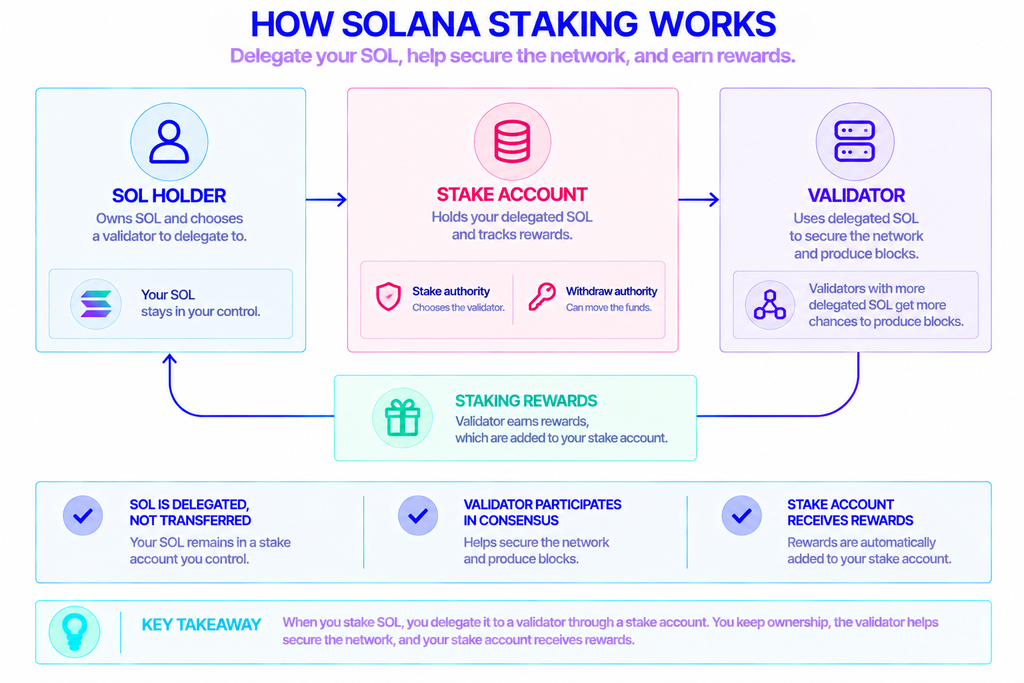
Solana staking is the process of delegating your SOL to a validator so it can help secure the network, in return for a cut of the rewards. Solana runs on proof of stake, so validators that hold more delegated SOL get more chances to produce blocks. When you stake, you keep ownership of your coins the whole time — your SOL sits in a stake account that only you control.
Native staking uses two permissions on that account: a stake authority that chooses the validator, and a withdraw authority that can move the funds. You delegate to a validator’s vote account, and that’s it — you never hand over your private keys. Solana’s official staking page covers the mechanics in detail.
How Do Staking Rewards Actually Work?
Rewards come mostly from inflation: Solana mints new SOL every epoch (roughly every two days) and pays it to validators and their delegators. As of mid-2026, the inflation rate sits near 3.8% and falls a little each year toward a long-term floor of 1.5%.
That decline just got faster. On August 28, 2026, Solana stakers voted to double the annual disinflation rate from 15% to 30%, pulling the 1.5% target forward from around 2032 to roughly 2029. The vote was close enough to make headlines.
“After 500 calls in the past few hours we got all the votes in the last seconds and passed the disinflation proposal by a literal hair.” — Mert Mumtaz, CEO of Helius, August 28, 2026
What does this mean for you? Rewards are shrinking over time. The nominal staking rate has already dropped from about 6.76% to 5.35% over the past year, and it will keep grinding down as issuance falls. Live native yields currently run in the 5–7% range depending on the validator, before commission. Rewards compound automatically each epoch, so you don’t have to claim anything.
Why Stake SOL in the First Place?
The straightforward reason: idle SOL earns nothing, and staked SOL earns a yield that generally beats holding. If you plan to hold SOL anyway, staking puts it to work while you wait.
There’s a network reason too. More staked SOL spread across more validators makes Solana harder to attack and harder to censor. Your delegation is a small vote for whichever validator you back.
The catch is liquidity. Native staking locks your SOL — you can’t trade or spend it without unstaking first and waiting out a cooldown. That single drawback is the entire reason liquid staking exists, and it shapes most of the decisions below.
Native vs Liquid Staking: Which Should You Pick?
For most people holding SOL long-term, native staking is the simplest and lowest-risk choice. If you want your staked value to stay usable across DeFi, liquid staking is the better fit — at the cost of extra smart-contract exposure. Exchange staking is the easiest path but means giving up custody.
Here’s how the three compare:
| Native staking | Liquid staking | Exchange staking | |
|---|---|---|---|
| You keep custody | Yes | Yes | No |
| Stays liquid | No (locked) | Yes (tradable token) | No |
| Typical yield | ~5–7% | ~5–8% (MEV edge) | Often lower (fees) |
| Usable in DeFi | No | Yes | No |
| Unstake time | ~2–3 days | Instant via pools, or redeem | Varies by platform |
| Main extra risk | Opportunity cost | Smart contract, depeg | Counterparty |
| Best for | Long-term holders | DeFi users | Beginners |
How to Stake SOL Natively
Native staking takes a few minutes inside most Solana wallets. You pick a validator, delegate your SOL, and start earning from the next epoch. There’s no minimum to stake, though it’s smart to leave a little SOL unstaked — around 0.05 — to cover transaction fees.
A typical flow in Phantom, Solflare, or Backpack looks like this:
- Open your wallet and go to the SOL asset, then find “Stake” or “Earn.” (Backpack lets you delegate natively from a minimum of 0.01 SOL.)
- Browse the validator list and check each one’s commission and performance.
- Choose a validator and enter the amount you want to stake.
- Approve the transaction. Your wallet creates a stake account you control.
- Wait one epoch for the stake to activate. Rewards begin after that and compound automatically.
How Do You Choose a Good Validator?
Look at three things: commission, reliability, and decentralization. Commission is the cut the validator keeps — many charge 5–10%, and a 0% fee isn’t always a good sign if performance is poor. Reliability means consistent uptime, since a validator that misses its slots earns you fewer rewards.
Decentralization is the one people skip. More than 90% of Solana’s stake runs the Jito validator client, and a lot of stake concentrates in a handful of large operators. Delegating to a smaller, well-run validator helps spread that out, and most wallets let you compare validators before you commit.
How Long Does It Take to Unstake SOL?
Unstaking native SOL takes about two to three days — one Solana epoch. When you deactivate your stake account, it keeps earning until the current epoch ends, then becomes withdrawable. Deactivate early in an epoch and you wait most of it; deactivate near the boundary and the wait is shorter.
If you need out faster, instant-unstake liquidity pools (such as Sanctum’s) will swap your stake account for SOL immediately for a small fee, skipping the cooldown entirely. Never sell a stake account to a random buyer, though — the safe routes are to wait the epoch, deposit into a liquid staking pool, or use a recognized instant-unstake tool.
How Liquid Staking Tokens Work
Liquid staking solves the lock-up problem. You deposit SOL into a protocol and receive a liquid staking token (LST) in return. That token represents your staked SOL plus accruing rewards, and you can trade it, lend it, or use it as collateral while it quietly earns yield in the background.
The value accrues into the token’s price rather than arriving as separate payouts. One JitoSOL is worth slightly more SOL each epoch, so the token appreciates against SOL over time. When you want your SOL back, you redeem the token through the protocol or swap it on a DEX.
Which Are the Main Solana Liquid Staking Tokens?
The market has reshaped over the past year. As of August 2026, Sanctum held the top spot by total value locked with about 18 million SOL, underwriting a wide range of tokens including INF and JupSOL. JitoSOL, the long-time leader, settled around 9.86 million SOL after yield compression trimmed its share. You can track live figures on DeFiLlama’s liquid staking dashboard.
The tokens worth knowing:
- JitoSOL (Jito) — the first Solana LST to pass through MEV rewards, which gives it a small yield edge and deep DeFi liquidity.
- mSOL and Marinade Native (Marinade) — mSOL is the classic pooled LST; Marinade Native lets you keep direct validator ownership without smart-contract custody while using the same delegation strategy.
- INF and JupSOL (Sanctum) — INF is Sanctum’s multi-LST pool, often near the top on headline APY; JupSOL benefits from Jupiter’s large user base.
- bSOL (BlazeStake) — a smaller issuer focused on decentralized validator selection.
Marinade tends to lag slightly on yield but leads on decentralization, while Jito and Sanctum compete on raw APY and liquidity. Yields rotate weekly with validator performance and MEV activity, so check a live dashboard before you pick one.
Staking SOL Through an Exchange
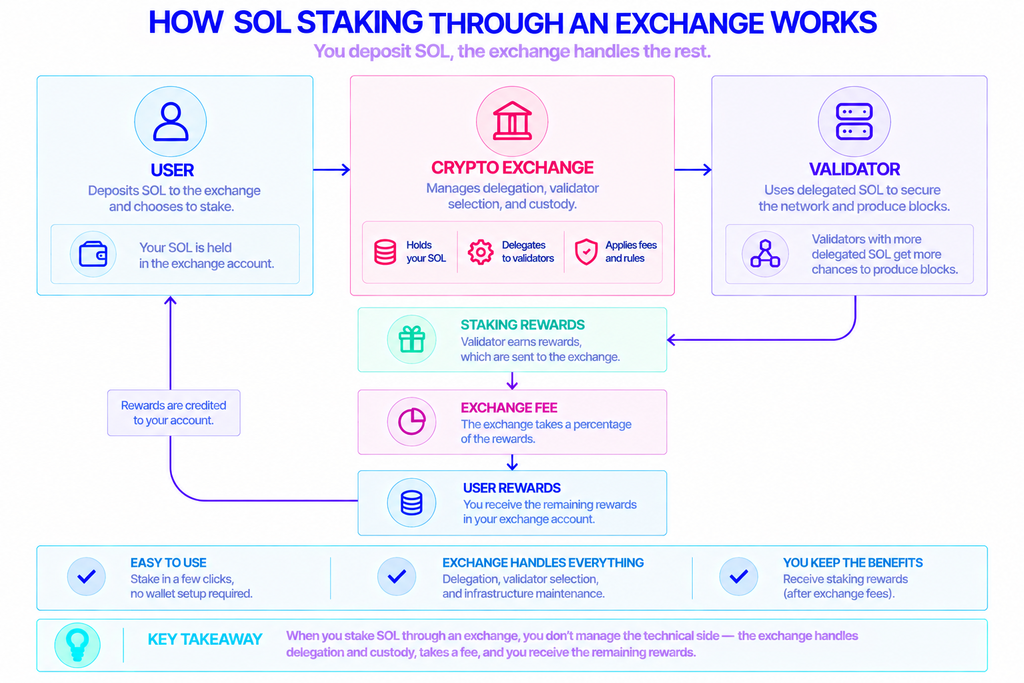
If you’d rather not touch a wallet at all, exchanges like Coinbase, Binance, and Kraken offer SOL staking in a couple of clicks. You navigate to their staking section, choose an amount, and the platform handles delegation for you.
The trade-off is custody. The exchange holds your keys, takes a cut of rewards, and sets its own unstaking rules. It’s the most beginner-friendly option and the one that gives you the least control — fine for small amounts, less ideal if self-custody matters to you.
What Are the Risks of Staking SOL?
Staking SOL is relatively low-risk, but it isn’t risk-free. The biggest downside for native stakers is opportunity cost — your SOL is locked during the cooldown and can’t react to the market.
The main risks to weigh:
- No principal slashing, but weak validators cost you. Solana does not currently confiscate delegators’ principal through automatic protocol slashing the way some networks do. A poorly run validator mostly costs you rewards through downtime, not your stake. Choosing reliable validators still matters.
- Price volatility. Rewards are paid in SOL, so a 6% yield means little if SOL’s price falls further than that. Staking doesn’t hedge price.
- Smart-contract risk (liquid staking). LSTs run on code that could have bugs. Established protocols have strong track records, but the risk is real.
- Depeg risk (liquid staking). An LST can briefly trade below the value of its underlying SOL. Small depegs of 1–3% have appeared during Solana congestion events, though none has caused a major holder loss to date.
- Declining yields. With the disinflation rate now doubled, inflation-funded rewards will fall faster than before. Factor that into long-term expectations.
Building on Solana Staking Data
If you’re building rather than just staking — a staking dashboard, a validator monitoring tool, or anything that reads stake accounts and reward history programmatically — you need steady access to Solana’s data. Querying validator performance, epoch rewards, and account states at scale takes reliable infrastructure.
NOWNodes provides Solana API access and endpoints across 120+ networks, so you can pull on-chain staking data without running your own infrastructure. For a staking app that needs accurate, real-time validator and reward information, that connection is the foundation everything else sits on.
Conclusion
Staking SOL comes down to one choice: keep it simple and locked with native delegation, or keep it liquid and composable with an LST. Native staking suits long-term holders who want the lowest-risk yield; liquid staking suits anyone who wants their SOL working in DeFi at the same time. Exchange staking covers beginners who value convenience over custody.
Whichever you choose, pick a reliable validator or a well-established protocol, keep a little SOL free for fees, and remember that rewards are drifting down as Solana’s issuance shrinks. Check live yields before you commit — the numbers move.
FAQ
Do You Keep Custody of Your SOL When You Stake It?
With native and liquid staking, yes — your SOL stays in a stake account or protocol tied to your own wallet, and you never share your private keys. Only exchange staking takes custody, since the platform holds the keys on your behalf.
Can You Stake SOL on a Ledger Hardware Wallet?
Yes. You can connect a Ledger to a wallet like Solflare or Phantom and delegate SOL natively while your keys stay on the device. This gives you hardware-level security with full staking functionality — a common setup for larger holdings.
Are SOL Staking Rewards Taxable?
In many jurisdictions, staking rewards are treated as income when you receive them, and again for any gain when you sell. Rules vary widely by country, and this isn’t tax advice — check your local regulations or a qualified professional before filing.
What Happens If Your Validator Goes Offline?
You don’t lose your staked SOL — it stays in your account. You simply earn fewer rewards for the time the validator is down or missing slots. If a validator is consistently unreliable, you can deactivate and redelegate to a better one after the cooldown.
Is Native or Liquid Staking Better for Beginners?
Native staking is usually the better starting point: it’s lower-risk, requires no understanding of DeFi, and works directly inside your wallet. Liquid staking makes sense once you want to use your staked SOL elsewhere and are comfortable with the extra smart-contract and depeg risk that comes with it.