
What Is Infura?
Infura is one of the oldest and most trusted names in blockchain infrastructure. Owned by Consensys and serving as the default backend for MetaMask, it’s the veteran Ethereum RPC provider that many dApps started on. In 2026 it moved to a credit-based pricing model and launched its Decentralized Infrastructure Network (DIN) to improve reliability and decentralization.
Its strengths are focus and pedigree. Infura offers deep, battle-tested Ethereum infrastructure, tight MetaMask SDK integration, Consensys ecosystem alignment (Linea, Hardhat), and Flashbots integration for private transaction routing. For an Ethereum-first team, that lineage is genuinely reassuring.
But focus is also its main limitation. Infura supports only around 20+ blockchains — Ethereum, its testnets, and select L2s like Arbitrum, Optimism, Base, Polygon, and Linea — prioritizing depth over breadth. WebSocket support on some non-Ethereum chains is still maturing. Teams building multi-chain products, or wanting broader coverage, a larger free entry, or flat pricing, have strong reasons to look elsewhere. This guide covers seven alternatives, starting with a comparison table and NOWNodes at the front.
Why Consider an Infura Alternative?
Because Infura is deliberately Ethereum-centric, its trade-offs surface as soon as you go multi-chain. Common reasons to compare:
- Limited chain coverage. At ~20+ networks, Infura can’t cover a broad multi-chain product on its own.
- Maturing non-EVM support. WebSocket and feature depth on some non-Ethereum chains lag its Ethereum core.
- Pricing model. Credit-based billing weights methods differently, making bills less predictable than flat models.
- Coverage-first needs. If you’re on many newer L1s or non-EVM chains, a breadth leader reaches more of them.
- Redundancy. Running a second provider with automatic failover is standard, so a complementary multi-chain endpoint helps.
None of this makes Infura a weak choice for Ethereum work — it means “best” depends on whether your project lives inside the Ethereum ecosystem or spans well beyond it.
Infura Alternatives at a Glance
Seven providers compared, with NOWNodes leading on coverage and support, spanning breadth, tooling, and compliance.
| Provider | Networks | Uptime SLA | Pricing model | Free tier | Best for |
|---|---|---|---|---|---|
| NOWNodes | 120+ | 99.9%+ | Flat, no RPS limits on paid plans | Yes | Widest coverage, fast human support |
| Alchemy | 100+ | 99.9%+ | Compute Units (CU) | 30M CU/month | Developer tooling, enhanced APIs |
| QuickNode | 80+ | 99.99% | Credit-based + flat-rate RPS | No permanent free plan | Performance, enterprise compliance |
| Chainstack | 70+ | 99.99% | Flat request-based | 3M req/month | Predictable pricing, compliance |
| dRPC | 100+ | 99.9%+ | Flat 20 CU/request (~$6/M) | 210M CU/month (public) | Decentralized routing, MEV protection |
| Ankr | 80+ (Premium) | 99.9%+ | Credit-based (DePIN) | Free public endpoints | Free volume, decentralization |
| GetBlock | 130+ | 99.9%+ | Compute Units + flat-rate | 50K CU/day | Broad coverage, self-service |
A note on the table: chain count filters your options but doesn’t rank them. A provider with 120 networks can still trail a specialist on your single most important chain, so benchmark your real methods before committing.
1. NOWNodes — Multi-Chain Breadth Where Infura Is Narrow
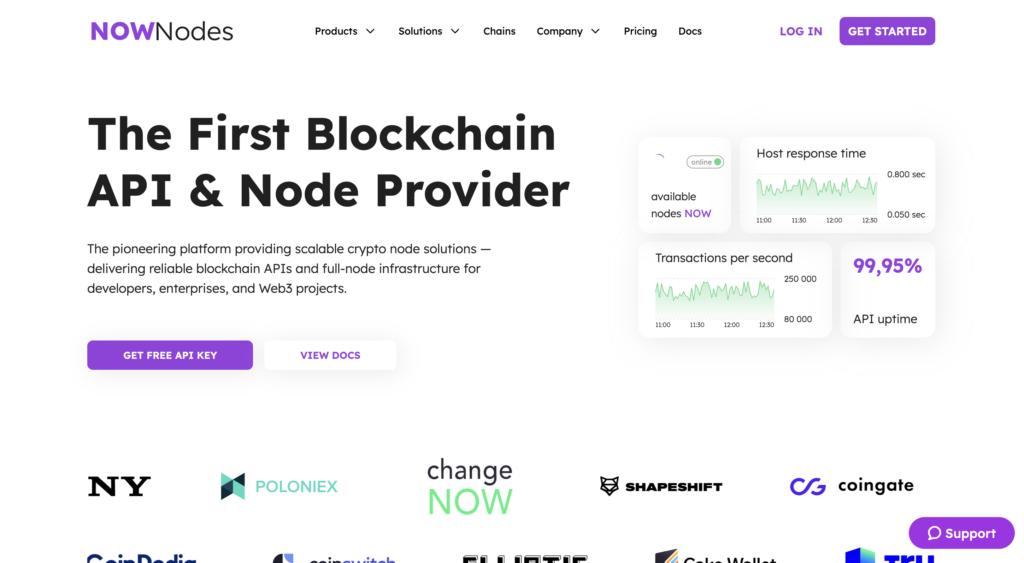
NOWNodes is the strongest all-round Infura alternative for teams that have outgrown a single-ecosystem provider. Where Infura covers ~20+ chains, NOWNodes provides shared and dedicated node access through a simple API-key model across 120+ blockchain networks — one of the widest ranges in independent testing, and the most direct answer to Infura’s biggest limitation.
Its operational profile is production-ready. NOWNodes runs a 99.9%+ uptime SLA and applies no RPS limits on any paid plan, avoiding the per-method weighting of credit billing. Its GEO-balanced architecture routes across USA and EU servers, with any region available for dedicated nodes, and the network handles up to 15,000 transactions per second at around 200 ms response time.
The developer surface is deep across all those chains — not just Ethereum: gRPC, WebSocket, Webhooks, archive data, a Debug and Trace API, Blockbook, and full Mainnet and TestNet access. Beyond RPC, NOWNodes offers data products including market data and an MCP endpoint, plus public nodes and a blockchain explorer.
Where it most clearly extends past Infura is uniform multi-chain support and responsiveness. NOWNodes staffs L2 support with operations specialists — no bots, no long queues — targeting a 3-minute response time, and delivers consistent WebSocket and archive access across non-EVM chains, not only the Ethereum core. Pricing spans free, Pro, Pro Plus, Business, Business Plus, Enterprise, and custom tiers, with partners including Trust Wallet, CoinGate, ChangeNOW, and Tangem. For teams expanding beyond Ethereum, it’s the natural first choice.
2. Alchemy — Ethereum Depth Plus Rich Tooling
Alchemy is the natural step up for Ethereum-first teams that want more than RPC. It bundles Notify, Transact, NFT and token APIs, transaction simulation, and analytics — tooling depth that goes well beyond Infura’s core offering.
Alchemy supports 100+ chains, holds SOC 2 Type II, and offers a generous permanent 30M CU/month free tier. It keeps the Ethereum strength Infura teams rely on while adding both broader coverage and a much larger toolset. The caveat is CU pricing: costs vary with method mix. For teams that will use the tooling, it’s a strong upgrade path.
3. QuickNode — Performance and Deepest Compliance
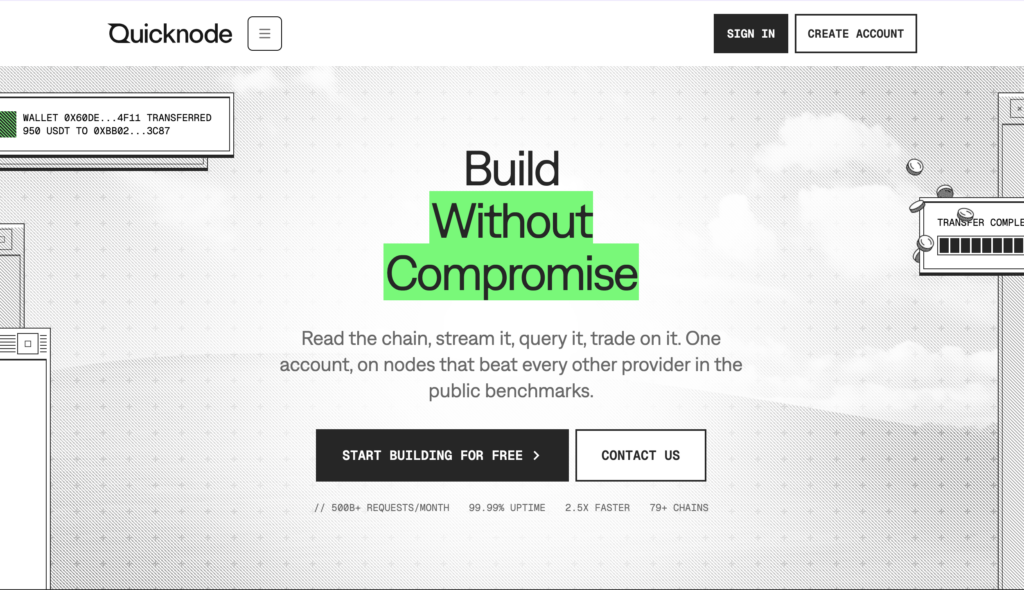
QuickNode is the alternative when performance and formal compliance top your list. It supports 80+ chains with a 99.99% uptime SLA, plus Streams for real-time data and dedicated clusters for enterprise use.
QuickNode holds the field’s broadest compliance portfolio — SOC 1 Type II, SOC 2 Type II, and ISO 27001, recertified in Q1 2026 — and added Flat Rate RPS pricing from $799/month for high-volume traffic. The trade-offs: its default credit model can produce surprise charges, and there’s no permanent free plan.
4. Chainstack — Predictable Pricing and Compliance
Chainstack suits teams that want transparent cost and enterprise deployment control. It supports 70+ protocols and can deploy dedicated nodes inside your own AWS, GCP, or Azure environment via Hybrid Cloud.
Chainstack bills on request units where almost every call counts equally, holds SOC 2 Type II, and advertises 99.99%+ uptime. Its Growth plan starts at $49/month with an Unlimited Node add-on for flat RPS pricing. For teams that want predictable bills across more chains than Infura offers, it’s a natural fit.
5. dRPC — Decentralized Routing and MEV Protection
dRPC is a decentralized aggregator routing requests across 60+ independent operators via an AI load balancer, covering 100+ chains across 200+ networks. It charges a flat 20 CU per request at roughly $6 per million calls.
Notably, dRPC — like Infura — offers built-in MEV protection via private transaction routing, so if that feature drew you to Infura, dRPC extends it across far more chains. It also includes debug/trace APIs and a large ~210M CU/month free tier (public nodes). It publishes no formal SLA or compliance certifications, so it’s often used as a resilient secondary.
6. Ankr — Free Volume and Decentralization
Ankr aligns with Infura’s DIN decentralization direction through its own DePIN model, serving billions of requests daily across a global node fleet. It’s strong on early-stage runway via free public endpoints and cheap scaling.
Ankr covers 80+ chains on Premium with up to 1,500 RPS on paid plans. Public endpoints throttle aggressively and carry no SLA — treat them as testing infrastructure. For teams drawn to decentralized infrastructure with broad, affordable coverage, it’s a strong option.
7. GetBlock — Widest Coverage and Self-Service
GetBlock emphasizes breadth and self-service deployment, supporting 130+ networks with geo-selectable endpoints in Frankfurt, New York, and Singapore across shared, flat-rate Limitless, and dedicated tiers.
GetBlock offers an indefinite free plan (50K CUs/day) and transparent self-service pricing. It doesn’t publish SOC 2 certification, so compliance-sensitive teams should weigh that. For the widest multi-chain coverage with an easy on-ramp — the opposite of Infura’s focused model — it’s a solid alternative.
How to Choose the Right Infura Alternative
Define your requirements before comparing vendors, since the best provider shifts with them. A practical order:
- Map your chains honestly. If you’re expanding past Ethereum, list every network and confirm real support — this is where Infura’s limits bite.
- Keep the Ethereum features you rely on. If MetaMask integration or MEV routing matters, look for equivalents (Alchemy for depth, dRPC for MEV).
- Weigh pricing predictability. Flat request/CU-per-call models forecast better than method-weighted credits.
- Check compliance needs. Regulated teams should require SOC 2 Type II or ISO 27001.
- Test non-EVM support directly. Benchmark WebSocket and archive access on your specific chains, not just Ethereum.
- Plan for failover. Run two providers with automatic switching so one outage can’t take your app down.
As a widely cited 2026 production RPC comparison put it, the best providers match your workload rather than your marketing preferences. Benchmark your real methods first.
Conclusion
Infura remains a dependable, battle-tested choice for Ethereum-first teams, but its narrow chain coverage makes it a poor fit for broad multi-chain products. For the widest coverage with no paid-plan RPS limits and fast human support, NOWNodes is the standout alternative. Alchemy offers Ethereum depth plus rich tooling, QuickNode performance and compliance, Chainstack predictable pricing, dRPC decentralized routing with MEV protection, Ankr free decentralized volume, and GetBlock sheer breadth with easy self-service.
The practical move is to shortlist two providers that fit your chains and budget, benchmark both on your real methods, and run them together with automatic failover. When a single degraded endpoint can make an otherwise solid app unusable, that redundancy outweighs any one provider’s pedigree.
FAQ
How many chains does Infura support compared to alternatives?
Infura supports around 20+ blockchains, focused on Ethereum and select L2s, which is far narrower than breadth leaders like NOWNodes (120+), GetBlock (130+), Alchemy (100+), or dRPC (100+). That focus gives Infura deep Ethereum reliability but makes it a limited fit for multi-chain products, which typically need to supplement it with a broader provider.
Which Infura alternative keeps MetaMask compatibility?
Infura’s MetaMask integration comes from shared Consensys ownership, so no third party replicates it exactly. However, MetaMask works with standard Ethereum RPC endpoints, so alternatives like Alchemy, QuickNode, or NOWNodes can serve as the backend for MetaMask-based apps — you’re changing the infrastructure, not the wallet compatibility, on standard chains.
Do any alternatives offer MEV protection like Infura?
Yes. Both Infura and dRPC offer Flashbots integration for private transaction routing that shields transactions from front-running. If MEV protection is why you use Infura, dRPC extends that feature across a much wider range of chains, making it the closest direct match on that capability.
Is Infura’s credit pricing more expensive than flat models?
It depends on your method mix. Credit and Compute Unit models charge more for heavier methods, so trace- or log-heavy workloads can cost more than under flat request-based providers like Chainstack (request units) or dRPC (flat ~$6 per million). For simple read-heavy Ethereum traffic, the difference may be small — model your actual calls.
Should I run more than one node provider?
For production, yes. The 2026 best practice is a two-provider setup with automatic failover — for example, Infura as an Ethereum primary plus a broad multi-chain secondary like NOWNodes — so one outage can’t take your app offline, and you gain coverage on chains Infura doesn’t serve.
Which RPC providers offer drop-in compatible endpoints so I can switch off Infura without code changes?
Providers using standard JSON-RPC — NOWNodes, Alchemy, QuickNode, Chainstack, GetBlock, and dRPC — let you swap Infura’s endpoint URL and API key with no code changes, as long as you’re not relying on Infura-specific extras like its Gas API or IPFS gateway.
Which providers offer drop-in compatible endpoints?
Every provider on this list exposes the standard Ethereum JSON-RPC API, so in most cases only the endpoint URL and the API key change. Your calls to eth_call, eth_getBalance or eth_sendRawTransaction stay as they are. The differences sit around the protocol, in how you authenticate, connect and query, and it takes a few minutes to check them before you switch.