
NOWNodes and Infura solve the same basic problem — connecting an application to a blockchain without you running the node yourself — but they start from different scopes. NOWNodes gives one account access to 120+ networks, from Ethereum and Bitcoin to Solana and Monero, under a flat request quota. Infura focuses almost entirely on Ethereum and its rollups, billed through a credit system that charges more for heavier calls. Which one fits depends on how many chains your project actually touches and how predictable you need your monthly bill to be.
What Are NOWNodes and Infura, Exactly?
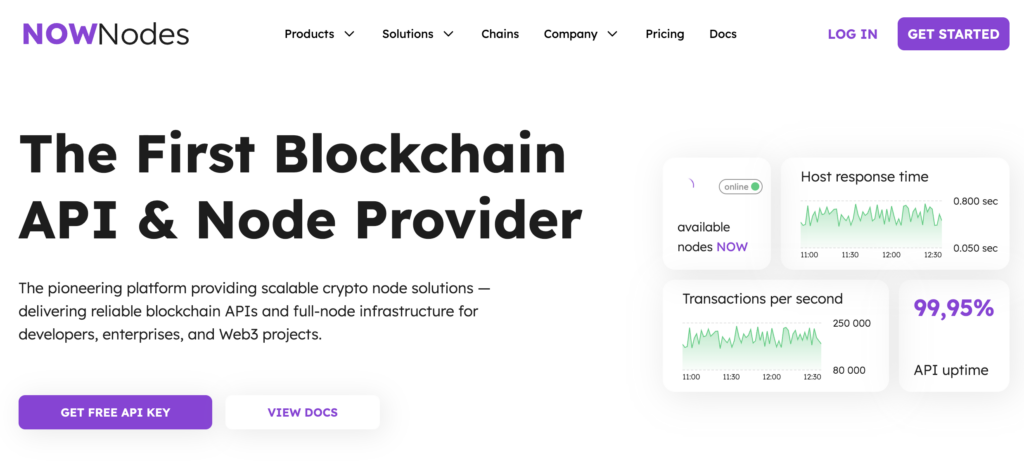
NOWNodes is a blockchain infrastructure provider that gives developers API-based access to shared and dedicated nodes across 120+ networks. You get an endpoint and an API key, and NOWNodes runs and maintains the underlying node — whether that’s Bitcoin, Ethereum, BNB Smart Chain, or a privacy coin like Monero.
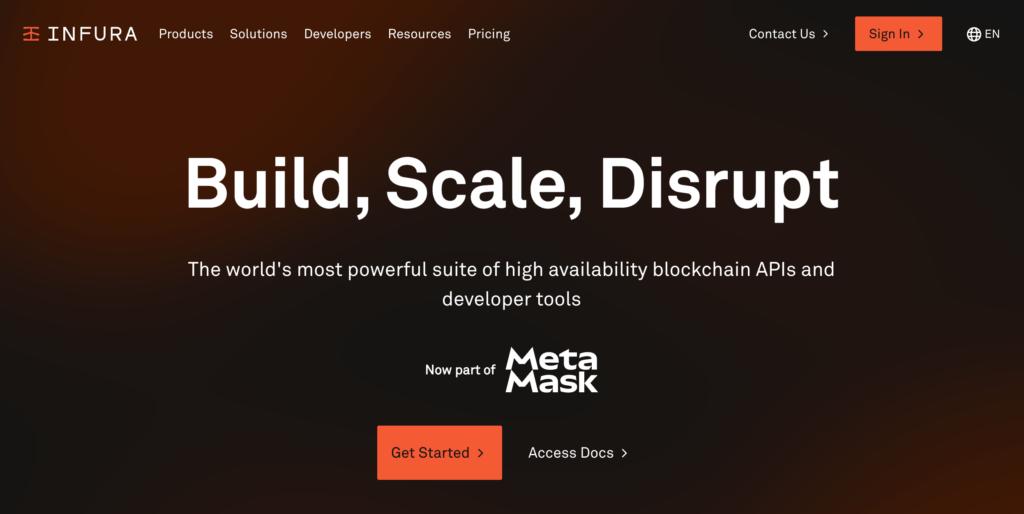
Infura is a Consensys product that has powered Ethereum infrastructure since 2016, best known as the default RPC connection built into MetaMask. It’s now bundled into “MetaMask Developer,” pairing node access with MetaMask’s own SDK under one dashboard.
Both companies expose JSON-RPC, a standardized API format where a call like eth_getBalance asks a remote server to run a function and return the result — the same thing any Ethereum client, from Geth to Erigon, would answer locally. Ethereum.org’s developer documentation covers the full method set this protocol supports. That shared standard is exactly why an app built on one provider can usually point at another with little more than a URL change.
Why Do You Need an RPC Provider Like NOWNodes or Infura?
Running your own node is a real operational job, not a side task. A synced Ethereum full node currently needs roughly 650–700 GB of disk space and keeps growing, and it has to be patched and resynced through every protocol upgrade the network ships.
A provider takes that maintenance off your plate. You get an authenticated endpoint, the provider keeps the client software current and the hardware scaled, and your team spends its time on application logic instead of server operations. This holds whether you’re on NOWNodes’ flat-rate shared plans or Infura’s credit-weighted ones — the underlying trade-off is identical.
Here’s why that distinction matters day to day: a payment backend doesn’t need to know how Erigon prunes state. It needs eth_getBalance to return the correct number, on every call, without an engineer babysitting a server at 2 a.m.
Who Actually Uses NOWNodes vs. Infura?
NOWNodes tends to attract teams whose product spans more than one blockchain family — wallets, exchanges, and payment platforms that need Bitcoin, Ethereum, and a dozen other chains under a single account instead of a separate vendor per network. Trading tools and monitoring systems that lean on WebSocket or gRPC streaming fit the same profile.
Infura’s biggest user is MetaMask itself, which ships with Infura configured as its default Ethereum connection across millions of installs. That pulls in wallet and dApp developers who want an endpoint already proven at MetaMask’s scale, plus teams already using Consensys tooling such as Truffle or Linea.
Zhen Yong, co-founder of Web3Auth, explained the appeal in a testimonial featured on Infura’s own site: “We chose it for the reliability, speed, and transparency of the technology.” That kind of ecosystem trust is Infura’s real pitch — less a unique feature, more the infrastructure MetaMask itself runs on.
| Use case | Better fit with NOWNodes | Better fit with Infura |
|---|---|---|
| Multi-chain wallet or exchange (BTC + ETH + others) | Yes — one account, one API key | Needs a second provider for non-EVM chains |
| Product built entirely on Ethereum + MetaMask ecosystem | Works fine | Yes — tightest ecosystem fit |
| Trading bot or monitoring system needing predictable cost | Yes — flat request quota | Depends on method mix and daily credits |
| Backend needing Bitcoin, Solana, or privacy-coin data | Yes — covered under one account | Not supported |
| Team already using Linea, Truffle, or MetaMask SDK | Possible | Yes — one dashboard for everything |
Pricing: Flat Request Quotas vs. Credit-Weighted Billing
This is where the two providers diverge the most. NOWNodes’ shared plans bill on a flat request-quota model: pick a monthly tier, get a fixed number of requests, and every call — light or heavy — counts the same against that number.
Infura instead uses a credit system that assigns a weighted cost to each RPC method based on server-side effort. A simple balance check costs less than a heavier call like eth_getLogs, and the allowance resets every 24 hours regardless of how the previous day’s traffic was spent, according to Infura’s own pricing documentation.
| Plan tier | NOWNodes (shared, flat quota) | Infura (credit-weighted) |
|---|---|---|
| Free | 100,000 requests/month, 1 API key | 3,000,000 daily credits, 500 credits/sec, 1 key |
| Entry paid | ~€20/month, 1,000,000 requests, 3 API keys | $50/month, 15,000,000 daily credits, 5 keys |
| Mid tier | ~€200/month, 30,000,000 requests, 25 API keys | $225/month, 75,000,000 daily credits, unlimited keys |
| Enterprise | ~€500/month, 100,000,000 requests, 100 API keys | Custom |
Both companies change pricing and tier structure often, so treat this table as a snapshot to verify against NOWNodes’ current pricing page and Infura’s pricing page before budgeting. The practical difference stays the same either way: a flat quota means 1 million balance checks cost the same as 1 million log scans, while a credit bill shifts with whichever methods your app happens to call most that month.
Network and Feature Coverage
NOWNodes advertises support for 120+ blockchain networks, including non-EVM chains such as Bitcoin, Dogecoin, Litecoin, and Monero alongside Ethereum, Solana, and other EVM chains. Infura’s coverage adds a little over a dozen networks on top of Ethereum mainnet — mostly EVM-compatible Layer 2s tied to the Consensys ecosystem, including Linea, Polygon, Arbitrum, Optimism, Avalanche C-Chain, Starknet, zkSync, and Blast.
That gap matters more or less depending on what you’re building. An Ethereum-only dApp won’t notice much difference. A wallet or exchange that also needs Bitcoin or a non-EVM chain will find those simply aren’t part of Infura’s lineup and would need a second provider to fill the gap — something NOWNodes’ node directory covers under one account instead.
Feature-for-feature, both cover the RPC and WebSocket basics on their major networks, and both gate archive data and Debug/Trace methods to specific plans. NOWNodes adds a few products Infura doesn’t offer in the same form: a Market Data API covering 9,000+ cryptocurrencies, gRPC streaming across 25+ chains, and free public endpoints capped at 5 requests per second for prototyping. Infura’s own extras run the other way — a Gas API for fee estimation and an IPFS gateway, though the IPFS product is currently limited to pre-qualified accounts rather than open to everyone.
How Reliable Is Each Provider?
Uptime claims are easy to publish and harder to verify, so track record matters more than a marketing number. Infura’s most cited incident happened on November 11, 2020, when Ethereum client developers shipped a quiet consensus-bug fix without wide announcement.
Infura’s Geth nodes were running an outdated client version, split from the rest of the network at block 11,234,873, and the resulting outage knocked out MetaMask and forced Binance and Coinbase Wallet to briefly suspend Ethereum withdrawals, according to Decrypt’s coverage of the incident. Infura has since joined the Decentralized Infrastructure Network, a multi-provider failover system built with Microsoft, Chainstack, and more than a dozen other infrastructure companies — a real mitigation, though it doesn’t erase how much of Ethereum’s default traffic still routes through Infura’s own infrastructure first.
NOWNodes’ current product pages advertise 99.95% API uptime on shared infrastructure and 99.99% on dedicated nodes, with GEO-balanced infrastructure keeping latency under 200 milliseconds for key regions in the US and Europe. Those are current published figures, not a universal guarantee — actual performance still depends on the specific network, product, and plan.
Switching Costs: How Locked In Are You?
Because JSON-RPC is standardized, moving core RPC traffic between providers is usually a configuration change, not a rewrite. An app built purely against eth_getBalance and eth_sendRawTransaction can point at a new endpoint with a URL and key swap.
The friction shows up with provider-specific extras. Infura’s Gas API calls and IPFS gateway don’t have direct equivalents elsewhere, so a team leaning on those has real migration work if it ever needs to leave. NOWNodes’ core RPC access carries the same portability as any standards-based endpoint, and its broader chain list means a team that starts there rarely needs to migrate away just to reach a network Infura doesn’t support.
That’s worth weighing before committing rather than after six months in production. A team that expects to stay Ethereum-only and wants deep MetaMask-ecosystem integration accepts Infura’s narrower scope deliberately. A team that wants to keep its options open — or already knows it needs Bitcoin, Solana, or another non-EVM chain — has less to untangle later by starting on a broader, standards-first provider like NOWNodes.
Which One Should You Choose?
Is NOWNodes better than Infura for a multi-chain product? Generally, yes. One account covering 120+ networks under a flat, predictable request quota is a simpler setup than running Infura plus a second provider to fill in every chain outside the Ethereum-and-rollups list.
Is Infura better than NOWNodes for a MetaMask-centric app? For that specific case, Infura’s ecosystem depth is real — its Ethereum mainnet endpoint is proven at MetaMask’s scale, and teams already using Linea or Consensys tooling get one dashboard for everything.
The honest framing is that NOWNodes bets on breadth and pricing predictability outweighing a narrower, single-ecosystem integration. For most teams building beyond pure Ethereum, or ones that would rather know their bill before the month starts than after a heavy eth_getLogs day, that bet tends to pay off — NOWNodes’ Ethereum endpoint alone offers shared and dedicated nodes, full archive access back to genesis, and Trace/Debug methods that Infura reserves for its paid tiers.
Conclusion
Infura and NOWNodes both give an application API access to blockchain data instead of requiring a self-managed node, but they’re built around different bets. Infura goes deep on one ecosystem — Ethereum plus its closest rollups, tied tightly to MetaMask and Consensys tooling. NOWNodes goes broad, covering 120+ networks including Bitcoin, Solana, and privacy coins under one flat-quota account.
For a team that already knows its product will touch more than Ethereum, or simply wants a bill it can forecast before the month starts, NOWNodes is the more straightforward starting point. Since standard JSON-RPC calls migrate between providers with little more than a URL change, testing both against real traffic for a week answers the question faster than any pricing page.
FAQ
Is NOWNodes cheaper than Infura?
It depends on your method mix. NOWNodes’ flat request quotas cost the same regardless of which methods you call, while Infura’s credit system can be cheaper for light workloads but climbs quickly for calls like eth_getLogs or debug_traceTransaction.
Does Infura support Bitcoin or Solana?
No. Infura’s coverage centers on Ethereum and its EVM-compatible Layer 2s; it doesn’t include Bitcoin, Solana, or privacy coins such as Monero the way a broader multi-chain provider like NOWNodes does.
Can I use NOWNodes and Infura at the same time?
Yes. Running two providers side by side — one primary, one failover, or split by chain — is a common production pattern that limits how much a single provider’s rate-limit spike or outage can affect an app.
Is Infura the same thing as MetaMask?
No. MetaMask is a wallet application; Infura is the infrastructure company, owned by the same parent, Consensys, that MetaMask uses as its default RPC connection. You can run MetaMask against a different provider, and you can use Infura without touching MetaMask at all.
How hard is it to migrate from Infura to NOWNodes?
Standard RPC calls migrate easily since JSON-RPC is a shared protocol. The work comes from Infura-specific features — the Gas API or IPFS gateway — which need a different approach on any provider that doesn’t offer a direct equivalent.