
Short answer: all three let you launch your own Ethereum-secured chain from open-source code, and the right pick depends on three things — how your chain proves its state, which ecosystem you want to plug into, and how much you want to customize.
OP Stack is the most widely adopted optimistic framework and the default for a general-purpose chain. Arbitrum Orbit gives you a sovereign chain with multi-language smart contracts and flexible settlement. ZK Stack builds validity-proof chains that join a shared, bridge-free network. The rest of this guide explains what that means in practice and who each one suits.
What Is a Rollup Framework?
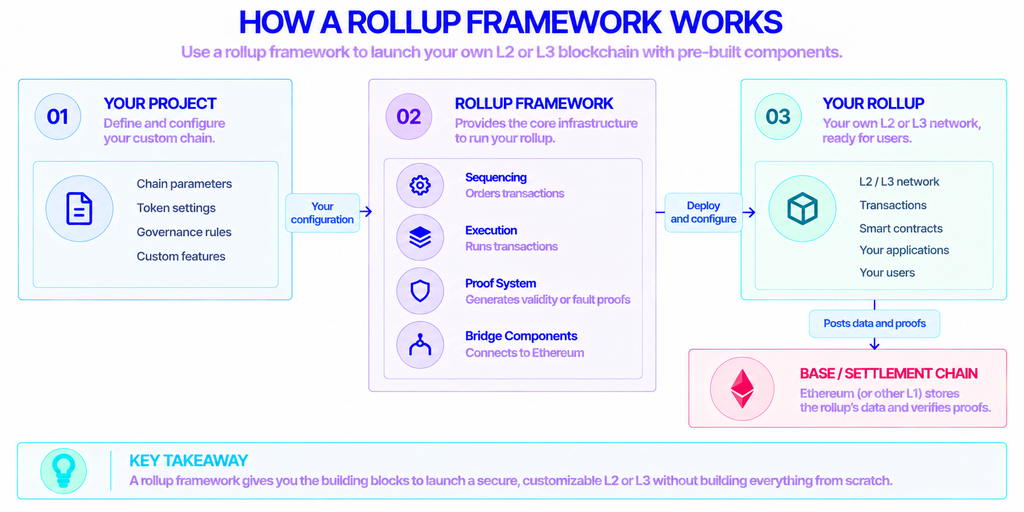
A rollup framework is an open-source toolkit for launching your own Layer 2 or Layer 3 blockchain. Instead of writing sequencing, proof, and bridge logic from scratch, you deploy a tested stack and configure it.
A rollup, the thing these frameworks produce, is a chain that executes transactions off Ethereum and posts compressed data and a proof back to it. That lets the rollup run fast and cheap while still inheriting Ethereum’s security for settlement. Ethereum’s own L2 overview covers the base concept in depth.
The three frameworks here cover the two main rollup designs. OP Stack and Arbitrum Orbit are optimistic: they assume transactions are valid and allow a challenge window in which anyone can dispute an incorrect state with a fault proof. ZK Stack is a validity-proof (zero-knowledge) design: every batch ships with a cryptographic proof that it is correct, so there is nothing to dispute after the fact.
That single split drives most of the differences you’ll run into, from how long withdrawals take to how the chains talk to each other.
Why Use a Framework Instead of Building From Scratch?
Because almost none of a rollup is app-specific. Sequencing, batch posting, the canonical bridge, the proof system, upgrade machinery — every chain needs the same plumbing, and getting any of it wrong is a security incident waiting to happen.
Frameworks hand you that plumbing as audited, production-run code. You inherit upgrades, documentation, wallet and explorer support, and a community that has already hit the bugs you would otherwise discover in production. You also inherit an interoperability story: OP Stack chains share the Superchain, Orbit chains settle into the Arbitrum ecosystem, and ZK Stack chains connect through the Elastic Network.
There’s a practical layer on top, too. Rollup-as-a-service providers like Conduit, Caldera, and Gelato will run the stack for you, so “launch a chain” can mean a configuration form rather than a dedicated infrastructure team. That changes the decision from “can we build this?” to “which ecosystem do we want to live in?”
Who Builds on These Stacks?
Teams that want the economics or control of their own chain rather than a contract on a shared L2. In 2026 that’s a broad group.
Consumer and DeFi apps launch app-chains to capture sequencer revenue and tune fees. Exchanges build flagship chains — Coinbase’s Base is an OP Stack chain and one of the largest L2s by value locked. Gaming projects pick stacks that let them customize gas tokens and throughput. Institutions and real-world-asset platforms increasingly lean toward zero-knowledge chains for faster finality and privacy options; Robinhood, for example, has built on the Arbitrum stack for a tokenized-equities effort.
The common thread: these builders don’t want to maintain low-level chain internals. They want a framework plus reliable access to the networks involved, and then they want to ship their product.
OP Stack: The Superchain Default
OP Stack is Optimism’s open-source framework and the software behind the Superchain — a federation of chains that share a bridge, governance standards, and a common security model. It’s MIT-licensed, which makes it the most permissive of the three to fork and modify.
Technically it’s an optimistic rollup. Chains post state to Ethereum, and a roughly seven-day challenge window lets anyone submit a fault proof against an invalid state using the Cannon dispute system (with a newer Rust-based proof program, Kona, in the pipeline). Permissionless fault proofs are live on OP Mainnet and Base — the milestone that moves an optimistic chain past the “trust the operator” phase. You can check any chain’s current classification on L2BEAT’s scaling summary, since stages shift as chains upgrade.
Adoption is the headline here. The OP Stack powers more than 40 production chains, including Base, World Chain, Unichain, Zora, and Mode, and it has the deepest rollup-as-a-service support of the three. The in-progress Superchain interop standard aims to let these chains pass messages in close to a single block without external bridges, so the whole set behaves more like one chain over time.
Pick OP Stack when you want a general-purpose EVM chain, the biggest ecosystem, and a shared interoperability roadmap you don’t have to build yourself.
Arbitrum Orbit: Sovereign Chains With Stylus
Arbitrum Orbit lets you spin up a chain on Offchain Labs’ battle-tested Nitro stack. Its signature trait is flexibility on where your chain settles: an Orbit chain can settle to Ethereum as a Layer 2, or to Arbitrum One or Nova as a Layer 3 that rides on top of an existing L2 for cheaper onboarding.
Licensing is where Orbit gets specific. Nitro uses a Business Source License, but an Additional Use Grant lets you deploy an Orbit chain permissionlessly if it settles to Arbitrum One or Nova — no custom license, no revenue share. Settle to a different parent chain and the Arbitrum Expansion Program applies, routing 8% of net chain revenue to the Arbitrum DAO and 2% to a developer guild.
Two features define the developer experience. Stylus adds a second virtual machine alongside the EVM, so you can write contracts in Rust, C, or C++ and run them at WASM speed next to Solidity. BoLD (Bounded Liquidity Delay) enables permissionless validation, which is what pushed Arbitrum One to L2BEAT Stage 1 — anyone can submit a fraud proof without being whitelisted. Orbit chains you govern yourself can even adopt these features ahead of a DAO vote.
As Offchain Labs CEO Steven Goldfeder put it to Blockworks, builders can “take an Arbitrum Orbit chain which you govern yourself” and move faster than the public, DAO-governed chains. That sovereignty is the pitch: over a hundred Orbit chains are live, including enterprise deployments, and each one can modify gas tokens, data availability, and sequencing.
Pick Orbit when you want self-governed control, Rust/C++ contracts via Stylus, or a cheap L3 settling into the Arbitrum ecosystem.
ZK Stack: Validity Proofs and the Elastic Network
ZK Stack is Matter Labs’ open-source framework for building zero-knowledge chains, with ZKsync Era as its reference chain and hub. Rather than a challenge window, every batch is proven correct with a validity proof, so funds can exit as soon as Ethereum verifies the proof — no seven-day wait.
The differentiator is the Elastic Network (renamed from Hyperchains after a trademark clash). Chains built with ZK Stack connect through it and share liquidity and security via recursive proofs instead of trusted bridges. A component called the ZK Gateway batches proofs from many chains and settles them to Ethereum together, which keeps per-chain costs down and lets the network aim to feel like a single chain to users. The ecosystem includes rollups plus data-availability variants like validiums and volitions, and had grown past 19 connected ZK chains by 2025.
Proving has moved fast here. Airbender, a RISC-V zero-knowledge virtual machine, is becoming the default prover for new ZKsync chains and generates validity proofs on commodity hardware. Matter Labs has also leaned into regulated finance with Prividium, a privacy-focused configuration aimed at institutions.
Two honest caveats. Rollup-as-a-service support is thinner than OP Stack’s, and ZKsync Era currently sits at Stage 0 on L2BEAT, with an emergency board able to bypass upgrade delays — common for ZK chains, but worth knowing before you build.
Pick ZK Stack when you need fast finality, native shared liquidity without bridges, or privacy and compliance features for institutional use.
OP Stack vs Arbitrum Orbit vs ZK Stack: How Do They Compare?
The table lines up the decisions that actually separate them.
| Factor | OP Stack | Arbitrum Orbit | ZK Stack |
|---|---|---|---|
| Proof type | Optimistic (fault proofs) | Optimistic (fault proofs) | Validity / zero-knowledge |
| Withdrawal finality | ~7-day challenge window | ~7-day challenge window | After proof is verified (fast) |
| Smart contracts | EVM (Solidity) | EVM + Stylus (Rust, C, C++) | zkEVM (Solidity) |
| Shared interop | Superchain + interop standard | Settles into Arbitrum ecosystem | Elastic Network (no bridges) |
| License | MIT (most permissive) | BUSL + Additional Use Grant / AEP | Open source |
| Revenue share | None required | None if settling to Arbitrum One/Nova; 8% + 2% otherwise | None required |
| Decentralization (L2BEAT) | Permissionless fault proofs live (OP Mainnet, Base) | Arbitrum One at Stage 1 (BoLD) | ZKsync Era at Stage 0 |
| Ecosystem size | Largest (40+ chains) | Large (100+ Orbit chains) | Growing (19+ ZK chains) |
| RaaS support | Broadest | Broad | Narrower |
| Best for | General-purpose EVM + big ecosystem | Sovereign chains, multi-language, L3s | Fast finality, privacy, institutions |
Which One Should You Choose?
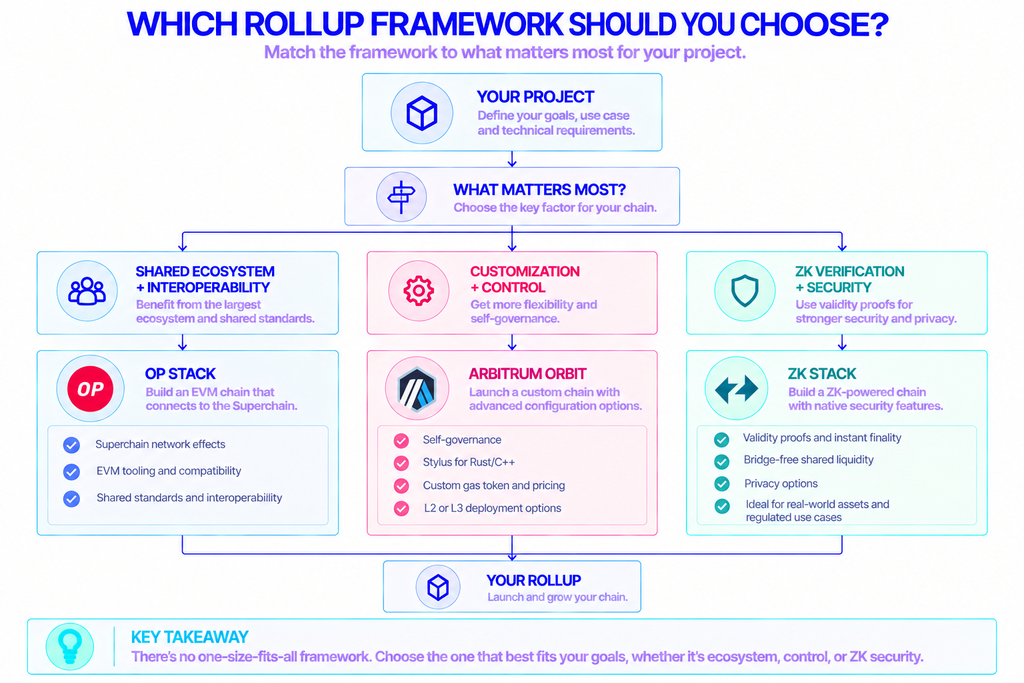
Match the framework to what matters most for your chain:
- Biggest ecosystem and shared interoperability — OP Stack. A general-purpose EVM chain that benefits from Superchain network effects.
- Control and customization — Arbitrum Orbit. Self-governance, Stylus for Rust/C++, and a low-cost path to launch an L3 on Arbitrum.
- Instant finality and ZK security — ZK Stack. Validity proofs, bridge-free shared liquidity, and privacy options suited to real-world assets and regulated use.
Whichever you land on, your chain and its users still need steady access to the parent network and to the rollup itself — for settlement, indexing, and the dashboards your app depends on. Infrastructure providers like NOWNodes offer endpoints across 120+ networks, including Ethereum, Arbitrum, Base, and ZKsync Era, so you can connect without standing up that layer yourself.
Making the Call
There’s no single best framework — there’s the one that fits your proof requirements, your ecosystem bet, and your appetite for customization. If you want reach and simplicity, OP Stack is the safe default. If you want to own every layer and write contracts in Rust, Orbit gives you the keys. If finality speed and privacy drive the project, ZK Stack’s validity proofs are hard to match.
The good news is that none of these choices lock you out of Ethereum’s security or its liquidity. They’re different routes to the same destination: a fast, cheap chain that settles to Ethereum. Pick the route that matches your team and your users, and you can be shipping on testnet in days rather than quarters.
FAQ
What’s the difference between a Layer 2 and a Layer 3?
A Layer 2 settles directly to Ethereum. A Layer 3 settles to a Layer 2 instead — for example, an Arbitrum Orbit chain that posts to Arbitrum One. L3s can cut onboarding and transaction costs further, at the cost of adding another layer between your chain and Ethereum.
Can you migrate a chain from one framework to another?
It’s possible but not trivial. Moving stacks means changing the proof system, bridge contracts, and settlement setup, and usually migrating state and liquidity. Rollup-as-a-service providers can help, but the realistic advice is to choose carefully up front, since a switch is closer to a re-launch than a config change.
Do you need a native token to launch a rollup?
No. All three frameworks let you run a chain that pays gas in ETH or a token of your choice, and a native governance or fee token is optional. Some ecosystems use their token for shared settlement — ZKsync’s ZK token for the Gateway, for instance — but your own chain doesn’t require issuing one.
What about Polygon CDK as a fourth option?
Polygon’s Chain Development Kit is another zero-knowledge framework, with chains connecting through its AggLayer for shared liquidity. It’s a reasonable alternative to ZK Stack, though note that Polygon’s standalone public zkEVM chain is a separate product being wound down — a change that doesn’t affect CDK chains you build yourself.
How fast can users withdraw funds from each type?
On optimistic chains (OP Stack, Arbitrum Orbit), native withdrawals wait out a roughly seven-day challenge window, though third-party bridges offer faster exits for a fee. On a ZK Stack chain, withdrawals finalize once the validity proof is verified on Ethereum, which is far quicker — one of the main reasons teams choose a zero-knowledge framework.