
A Solana faucet is a free service that sends test SOL to your wallet so you can pay transaction fees on Solana’s development networks without spending real money. You paste in a wallet address, pass a light anti-bot check, and the tokens arrive within seconds. The fastest route is the official Solana Foundation devnet faucet page, which allows two requests every eight hours.
This guide explains what a sol faucet does, why developers depend on it, and who uses it. It then walks through three ways to claim tokens, compares the main providers, and covers why claims fail. Limits below were checked against each provider’s page in September 2026, and they change without notice.
What Is a Faucet on Solana, and What Does It Give You?
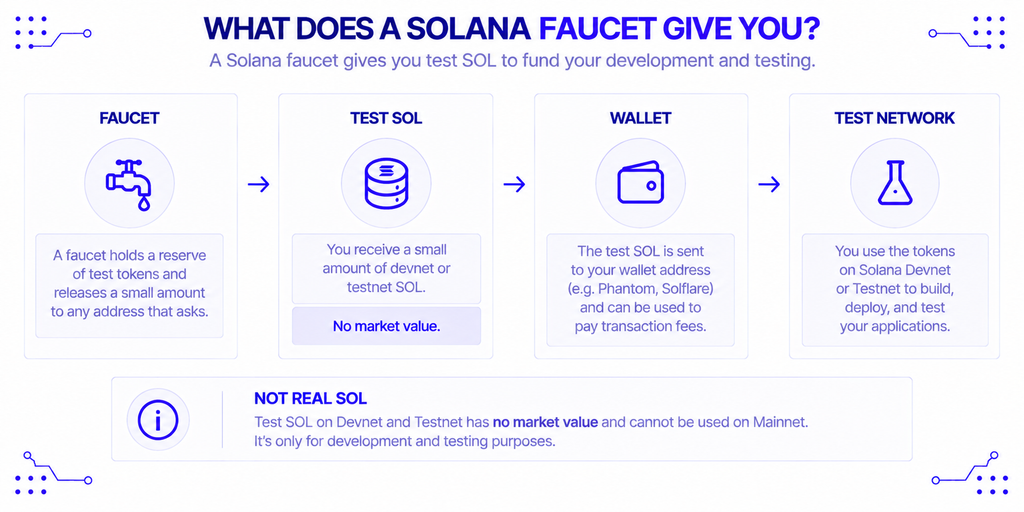
A Solana faucet is a dispenser: it holds a reserve of test tokens and releases a small portion to any address that asks. On Solana, those tokens are devnet SOL or testnet SOL, and they have no market value. According to the Solana clusters documentation, both networks carry “not real” tokens, while mainnet uses real SOL and has no faucet at all.
Here’s the mechanical part. Every Solana transaction costs a fee, and the base fee is 5,000 lamports per signature, split evenly between burning and the validator. One SOL equals 1,000,000,000 lamports. A single 2 SOL claim from a faucet solana developers use therefore covers roughly 400,000 simple transfers in base fees alone.
The token is only half the story. The wallet you fund also needs a connection to the network, and that connection is an endpoint, a URL your tools send requests to. Public devnet and testnet endpoints exist, which is why the same dispenser flow works in the CLI, in a browser wallet, and in scripts.
Why Do Developers Need Free Test SOL?
Because every action on a blockchain costs gas, and on mainnet that gas is real money. Deploying a program, creating a token account, or sending a test transaction all need a funded wallet. Mistakes are also permanent there, so nobody should debug on mainnet.
A test network removes the risk. You can deploy the same program ten times in an afternoon, break it deliberately, and lose nothing. The trade-off is that you need a steady supply of test SOL, and that supply is exactly what a faucet solana devnet developers rely on provides.
Deployment is the heavy spender. Publishing a program reserves SOL to store its data on-chain, which drains a balance far faster than plain transfers. The Solana cookbook even calls closing old buffer accounts and reusing that SOL “the most sustainable way” to save it.
Who Claims Free Test SOL, and for What?
Anyone who needs to sign a transaction on a test network needs a balance first. The people who claim most often:
- Program developers deploying Rust programs with Anchor and testing instructions on devnet.
- dApp and wallet teams checking that connection, signing and transfer flows work before launch.
- Bot and trading-tool builders dry-running strategies without risking capital.
- QA and CI pipelines that send real transactions on every commit.
- Students and hackathon teams learning how wallets, signatures and confirmations fit together.
Node operators are a smaller but real group. Validator teams who test upgrades on solana testnet need funds for vote accounts and stake, which is a different job from app development.
What Is the Difference Between Devnet, Testnet and Mainnet?
Devnet is the network for app builders, testnet is for core contributors stress-testing the protocol, and mainnet is production. Solana’s own documentation describes devnet as a “playground for anyone who wants to take Solana for a test drive.” Choosing the wrong one is the most common beginner mistake.
| Network | Purpose | Tokens | Faucet available | Resets possible |
|---|---|---|---|---|
| Devnet | App and program development | Test SOL, no value | Yes | Yes |
| Testnet | Validator and protocol testing | Test SOL, no value | Yes | Yes |
| Mainnet | Live applications | Real SOL | No | No |
Some tutorials say only a solana devnet faucet exists. That was true of some providers, but the official Solana Foundation page currently serves both networks, so it works as a solana testnet faucet too. For everyday app work, stay on devnet.
Note the reset column. Solana says devnet and solana testnet “may be subject to ledger resets,” which wipes balances and deployed programs. Never keep anything you can’t recreate there.
How to Get Free SOL on Devnet Step by Step
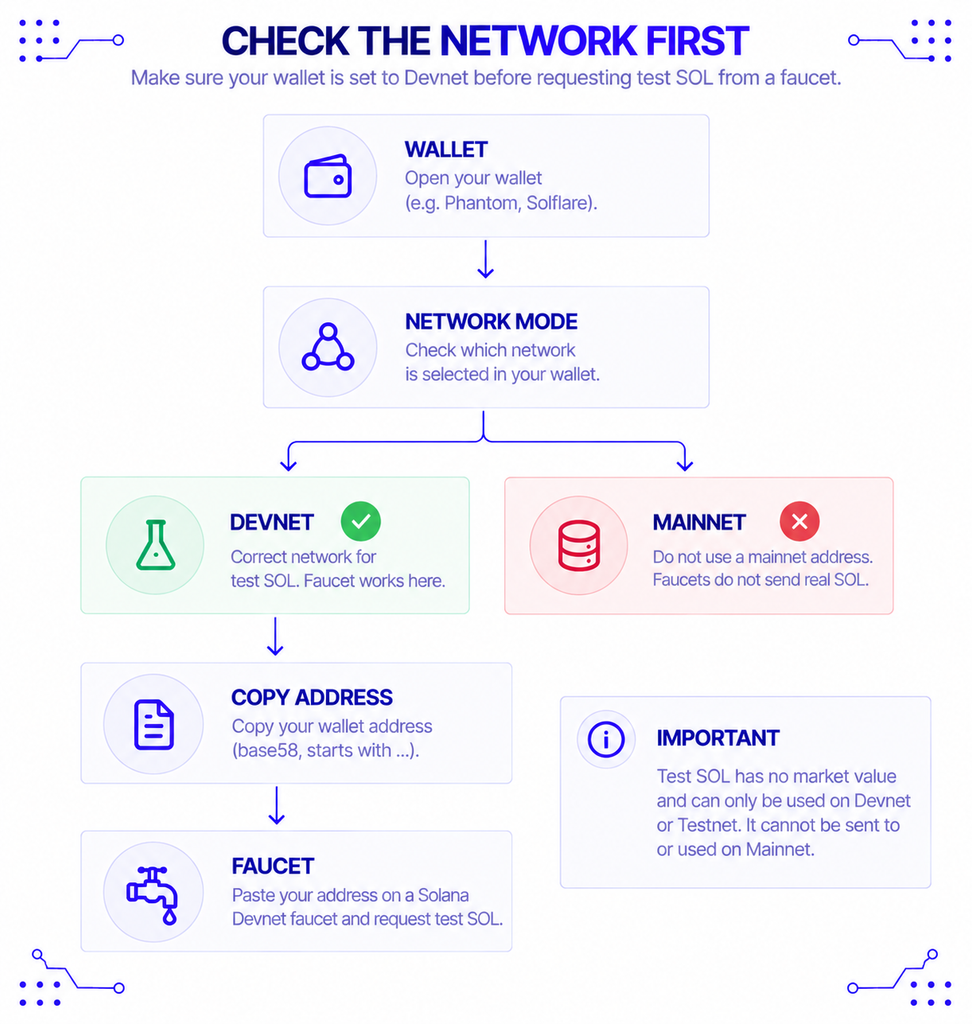
Claiming takes about three minutes. Pick one of the three methods below; the first suits most people.
- Create or open a wallet such as Phantom or Solflare and switch it to Devnet in the network settings.
- Copy your public address, the long base58 string.
- Open a dispenser from the comparison table in the next section.
- Paste the address, choose an amount, and complete the verification.
- Check the balance in the wallet or on a devnet explorer.
Claim From the Official Web Page
This faucet Solana developers reach first, the Solana Foundation page, needs no login for standard use and allows a maximum of two requests every eight hours. Signing in with GitHub unlocks higher limits, although the page warns that “some accounts may not pass verification.” It also asks AI agents not to use it, pointing to the CLI, a proof-of-work faucet or a local validator instead.
Airdrop Through the Solana CLI
If you already have the Solana CLI installed, three commands do the job:
bash
solana config set --url devnet
solana address
solana airdrop 2
The last line requests 2 SOL, which makes the CLI the quickest faucet solana devnet route for anyone working in a terminal. Then run solana balance to confirm. Metaplex’s devnet guide lists 2 SOL as the usual per-request ceiling, and the cookbook warns airdrops can be throttled when demand is high.
Request an Airdrop From Code
Scripts and tests can call the same airdrop method directly. This is handy when a CI job needs a fresh wallet on every run:
js
import { Connection, Keypair, LAMPORTS_PER_SOL } from "@solana/web3.js";

const connection = new Connection("https://api.devnet.solana.com", "confirmed");
const wallet = Keypair.generate();
const sig = await connection.requestAirdrop(wallet.publicKey, LAMPORTS_PER_SOL);
await connection.confirmTransaction(sig, "confirmed");
The public devnet URL is shared, so heavy loops hit its limits quickly. The clusters documentation caps each IP at 100 requests per 10 seconds, with 40 per 10 seconds for a single method.
Which Dispensers Work Best in 2026?
No single faucet solana provider wins for everyone. The right pick depends on whether you have mainnet SOL, want to avoid accounts, or need a bigger amount. Rules below come from each provider’s own pages and can change.
| Provider | Amount and frequency | Requirements | Best for |
|---|---|---|---|
| Solana Foundation | Up to 2 requests per 8 hours | No login; GitHub sign-in raises limits | Default choice, devnet and testnet |
| QuickNode | Amount shown after entering an address; once per 12 hours | No account, X post or mainnet balance | Brand-new wallets |
| Chainstack | 1 SOL per 24 hours, top-up model | Chainstack API key and a small mainnet SOL balance | Teams already on Chainstack |
| Helius | 1 SOL per 24 hours | Paid Helius plan | Existing Helius customers |
Local validator (solana-test-validator) | Unlimited, no network | Local machine only | Offline tests and CI |
The pattern is familiar. Providers that ask for accounts or mainnet balances pay predictably, while the no-login options cap what you can take. Sharing a post on X with your address and the QuickNode URL doubles its drip, which is a good example of trading a little friction for volume.
Chainstack’s model deserves a note. If your devnet wallet already holds close to the daily cap, its faucet may send a reduced amount or nothing, because it tops up rather than dropping a fixed sum.
Why Did Your Airdrop Fail?
A failed claim on any sol faucet usually comes from one of five causes, and they are quick to check.
- Rate limit hit. The official page allows two requests per eight hours, and busy periods throttle the CLI too. Wait, or switch provider.
- Wrong network. A wallet set to mainnet will show zero after a devnet drop. Match the wallet, the CLI (
solana config get) and the dispenser. - Amount too large. Try a smaller request. Metaplex suggests 0.5 SOL when 2 SOL fails.
- Mainnet balance rule. Some providers, Chainstack included, want a small real SOL balance at the address.
- Ledger reset. After a reset, the balance is gone even though the transaction once existed. Claim again.
If everything is throttled, run solana-test-validator. It starts a local cluster with effectively unlimited SOL and no shared limits.
Why Do Faucets Limit Claims?
Bots. Automated scripts drain free tokens faster than people can use them, and honest developers end up with empty queues. Ana Levidze, writing for Chainstack, put the frustration bluntly: “Solana faucets and dev airdrops have always been scattered, rate-limited, or throttled when you need them most.”
The mainnet-balance rule is a lighter answer to the same problem. A few cents of real SOL is trivial for a developer and costly for someone farming a thousand wallets. The catch is that genuine newcomers get blocked as well, which is when a no-requirement option like QuickNode earns its place.
How to Spot a Fake Dispenser
A real Solana faucet never asks for a seed phrase, a private key or a payment. Test SOL has no price, so anyone selling it is running a scam. A page that asks you to approve a token spend instead of just entering an address should be closed immediately.
Look-alike solana faucet sites also collect search traffic. Start from the links in Solana’s own documentation, not an ad or a social post, and use a separate wallet for testing so a mistake can’t reach your real holdings.
What to Do After the Test SOL Arrives
Once the solana faucet drop lands and the wallet shows a balance, confirm it from code before building on it. A balance check is one JSON-RPC call, and the result comes back in lamports:
bash
curl https://api.devnet.solana.com -X POST \
  -H "Content-Type: application/json" \
  -d '{"jsonrpc":"2.0","id":1,"method":"getBalance","params":["YOUR_WALLET_ADDRESS"]}'
A fresh 2 SOL claim appears as 2000000000 in the value field. Public URLs like this one are shared and rate-limited, so they suit a first check but not a busy test suite.
NOWNodes is a blockchain infrastructure provider that gives API access to Solana over RPC and WebSocket, so an application can read state and send transactions without running its own validator setup. The Start plan is free with 100,000 requests, and the public endpoints page lists keyless access at 5 requests per second for a selection of networks. Coverage differs by network and interface, so check the documentation for the exact Solana endpoints before you wire them in. Our guide to blockchain test networks covers the wider testing workflow.
Conclusion
Getting free SOL from a solana faucet takes a wallet set to devnet, an address, and one dispenser that fits your situation. The official faucet sol page from the Solana Foundation is the default, QuickNode suits fresh wallets, and a local validator is the fallback when every shared option is throttled.
Treat the tokens as disposable, watch for ledger resets, and never hand a seed phrase to anything that promises more. Test SOL is free because it is worthless outside the test network, which is exactly why it is safe to break things with.
FAQ
Can I Sell or Swap Test SOL for Real SOL?
No. Test tokens have no market value and no bridge to mainnet. Anyone offering to buy or sell them is running a scam.
Does My Wallet Address Change Between Devnet and Mainnet?
No. Solana uses the same address format on every cluster, so one address can hold balances on all three. Only the network selected in your wallet or CLI changes.
How Much Test SOL Do I Need to Deploy a Program?
It depends on program size, since deployment reserves SOL to store the program data. A single 2 SOL claim is enough for many small programs, and closing old buffer accounts recovers what earlier deployments locked.
Can AI Agents or Bots Use the Official Dispenser?
The Solana Foundation page asks AI agents not to use it and suggests the CLI, a proof-of-work faucet or a local validator instead. Automated pipelines should use one of those routes.
What Is Proof-of-Work Faucet Mining?
It is a faucet model where your machine solves small puzzles before receiving devnet SOL, which makes bulk farming inefficient. Solana’s cookbook points to the devnet-pow tool maintained by Ellipsis Labs for this.