Solana enters mid-2026 as a network in the middle of a rebuild. It now runs on two competing validator clients, its consensus engine is being replaced from the ground up, and its finality is on track to fall from 12.8 seconds to roughly 150 milliseconds. This Solana technical analysis for 2026 looks past the price chart and evaluates the blockchain on what actually keeps it running: raw technical performance and scalability.
We’ll go from simple to complex. First, what Solana is and who relies on it. Then the real performance numbers, the upgrades reshaping the network this year, and the trade-offs that any honest assessment has to include.
What Solana Is, and Why Its Technical Design Matters
Solana is a Layer 1 blockchain built for one goal above all others: process a very high volume of transactions at very low cost. Where many networks add speed through secondary “Layer 2” chains, Solana pushes everything through a single high-throughput base layer. That design choice is the root of both its strengths and its recurring engineering challenges.
Two ideas make this possible. The first is Proof of History, a cryptographic clock that timestamps transactions before consensus, so validators don’t have to negotiate the order of events from scratch. The second is parallel execution: Solana’s Sealevel runtime processes non-overlapping transactions at the same time, rather than one after another. Combined, they let the network target throughput that most chains reach only in theory.
Here’s why this matters for a technical analysis. Solana isn’t optimizing for the same thing as Bitcoin or Ethereum. Its roadmap treats latency and bandwidth as the headline metrics, which means you evaluate the blockchain company Solana on technical performance and scalability first, and everything else second.
Who Uses Solana
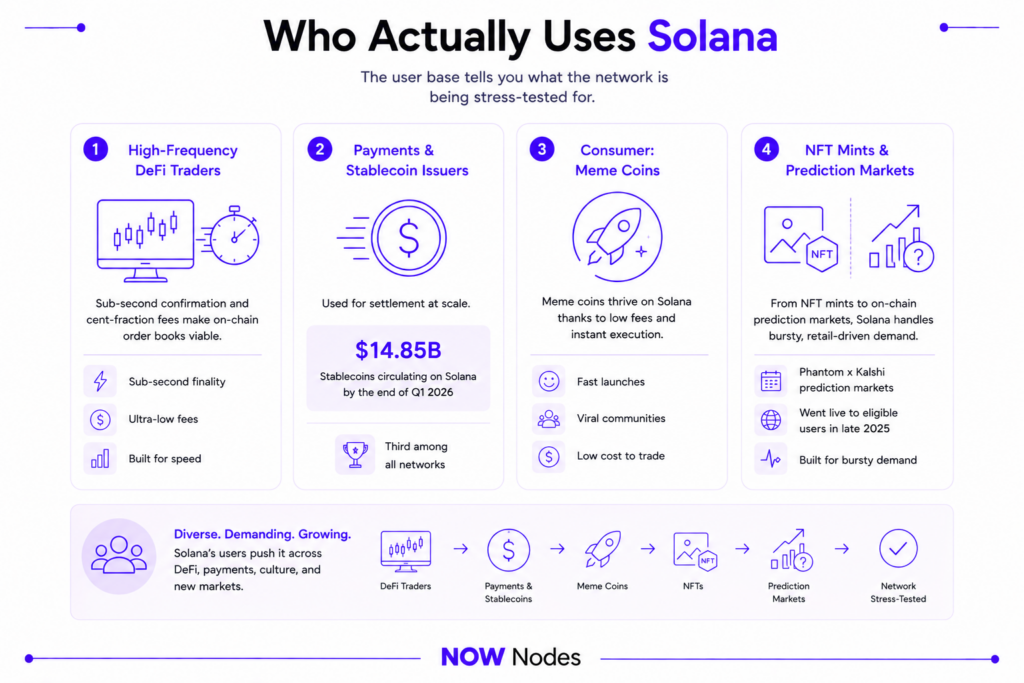
The user base tells you what the network is being stress-tested for. High-frequency DeFi traders use Solana because sub-second confirmation and cent-fraction fees make on-chain order books viable. Payment and stablecoin issuers use it for settlement, with roughly $14.85 billion in stablecoins circulating on the chain by the close of Q1 2026, third among all networks.
Then there’s the consumer layer: meme coins, NFT mints, and a new wave of prediction markets. Phantom’s Kalshi-powered prediction markets went live to eligible users in late 2025, and that kind of bursty, retail-driven demand is exactly what pushes a high-throughput chain to its limits.
Solana Network Performance in 2026
Let’s be precise, because this is where old articles get lazy. Solana’s theoretical ceiling sits around 65,000 transactions per second (TPS), but that figure is close to meaningless for day-to-day use. The number that matters is real, non-vote throughput, which measures genuine user activity rather than the internal votes validators cast to keep the chain in sync.
By mid-2026, Solana’s real non-vote throughput averaged between roughly 1,600 and 3,800 TPS depending on demand, with “true TPS” readings surpassing 2,500 and spikes climbing past 6,000 during busy periods (see live data at Chainspect). Over the first quarter of 2026 alone, the network settled about 25.3 billion transactions. That gap between 65,000 and reality isn’t a scandal; it’s the difference between a lab benchmark and a live market.
The table below sums up where the network stands technically as of this writing.
| Metric | Figure (mid-2026) |
|---|---|
| Theoretical max throughput | ~65,000 TPS |
| Real non-vote throughput | ~1,600–3,800 TPS |
| Observed spikes | 6,000+ TPS |
| Block time | ~400 ms |
| Finality (pre-Alpenglow) | ~12.8 s |
| Target finality (Alpenglow) | 100–150 ms |
| Median transaction fee | under $0.01 |
| Uptime since Feb 2024 | ~22 months, no major outage |
That last row is the quiet success story of the past two years. After a history of well-publicized halts, Solana has now gone roughly 22 months without a major confirmed outage, its longest stable streak ever. Reliability, not peak speed, is what changed the institutional conversation.
How to Analyze Solana Today
A quick clarification, because search intent splits here. When people look up “Solana technical analysis today,” some want candlestick chart patterns and price targets. This is not that. A network-level Solana technical analysis short term or long term measures the machine itself: throughput, finality, fee stability, validator health, and client performance.
The distinction is critical. Price technical analysis tells you what traders are feeling this week; network technical analysis tells you whether the infrastructure can carry the next wave of users. For a Solana technical analysis today that holds up over time, watch four signals: sustained non-vote TPS, median priority fees during congestion, validator client distribution, and finality times as Alpenglow rolls out.
If you only track one of these on a short-term basis, make it fee behavior during demand spikes. Fees are where scalability problems show up first, long before they reach the headlines.
The 2026 Upgrades Driving Solana’s Scalability
This is the part that makes 2026 genuinely different from 2025. Three overlapping efforts are rebuilding how Solana produces, propagates, and finalizes blocks.
Alpenglow: A New Consensus Engine
Alpenglow is the largest protocol change in Solana’s history, and that’s not marketing language. In the words of the Anza research team that authored it, “Alpenglow is not only a new consensus protocol, but the biggest change to Solana’s core protocol since, well, ever.” It replaces the old TowerBFT voting system with a component called Votor and swaps the Turbine block-propagation layer for one called Rotor.
The performance implication is dramatic. Alpenglow finalizes transactions in roughly 100–150 milliseconds, down from about 12.8 seconds, and it moves validator voting off-chain. That single change frees up close to three-quarters of block space for actual user transactions, which is a scalability gain on top of the finality gain.
Governance already ratified it. In September 2025, SIMD-0326 passed with 98.27% of participating stake voting yes, and the upgrade went live on a community test cluster in May 2026. Mainnet activation is targeted for the second half of 2026 through the Agave 4.1 client, though the exact date depends on testnet results and validator coordination.
Firedancer and the Race for Client Diversity
For most of its life, Solana ran on a single validator client, which meant a single point of software failure. Firedancer, a clean-room reimplementation written in C by Jump Crypto, changes that. It began producing mainnet blocks in May 2026 after roughly three years of development.
Adoption moved fast. By mid-2026, about 14% of staked SOL runs on Firedancer, with another 26% on Frankendancer, a hybrid that pairs Firedancer’s networking stack with Agave’s execution layer. In live mainnet tests, Frankendancer has demonstrated 600,000+ TPS bursts, while the full Firedancer client targets 1 million+ in lab conditions. Multicoin Capital’s Kyle Samani has framed this throughput headroom as the foundation for Solana’s “internet capital markets” ambitions.
The point isn’t the million-TPS bumper sticker. Real demand rarely exceeds a few thousand TPS. The point is redundancy: two independent codebases mean a bug in one no longer threatens the whole network. You can read the engineering details in the Firedancer documentation.
| Client | Team | Language | Status (mid-2026) |
|---|---|---|---|
| Agave | Anza | Rust | Reference client |
| Firedancer | Jump Crypto | C | Live on mainnet (~14% stake) |
| Frankendancer | Jump Crypto | C + Rust hybrid | Live on mainnet (~26% stake) |
| Jito-Solana | Jito | Rust | MEV-optimized fork |
IBRL: Bandwidth, Fees, and Fairer Execution
Underneath the marquee upgrades sits a broader program the ecosystem calls IBRL, short for “Increase Bandwidth, Reduce Latency.” It groups scheduler refinements, fee-market tuning, and execution-fairness work aimed at keeping confirmation times predictable when markets get loud. Part of this effort targets MEV (maximal extractable value), the profit validators can capture by reordering pending transactions, through encrypted transaction handling and clearer separation between block builders and proposers.
For anyone evaluating scalability, IBRL is the connective tissue. It’s the difference between a network that’s fast on a quiet Tuesday and one that stays fast during a launch stampede.
Scalability vs. Decentralization: The Trade-off to Watch
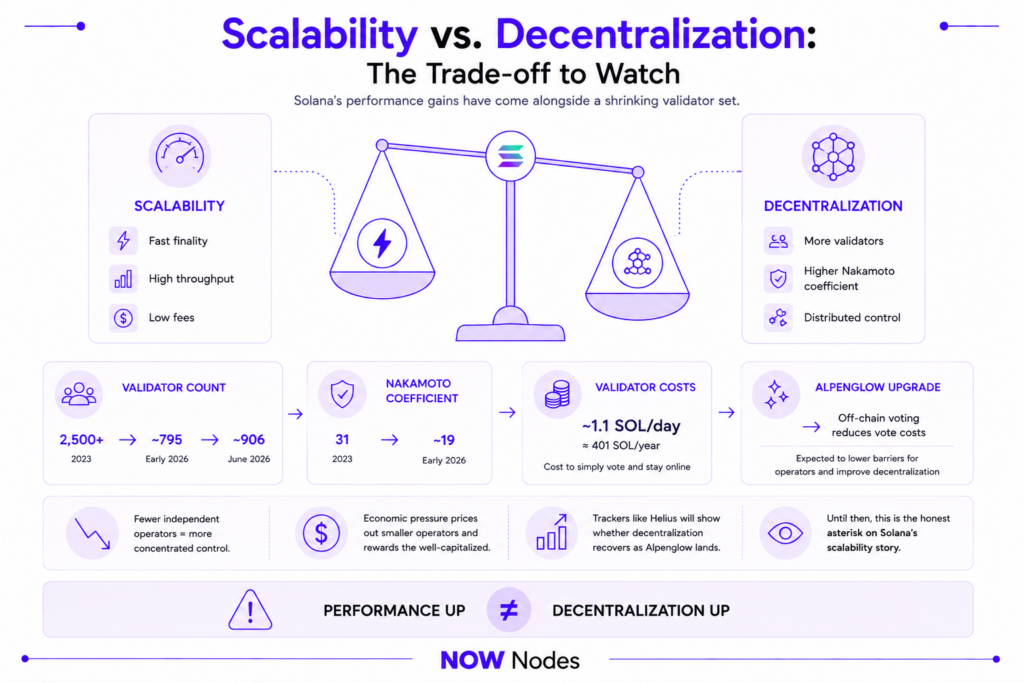
No credible technical analysis ends on a victory lap, so here’s the tension. Solana’s performance gains have come alongside a shrinking validator set, and that’s a real cost.
The active validator count fell from over 2,500 in 2023 to around 795 in early 2026, recovering to roughly 906 by June. Its Nakamoto coefficient, the minimum number of entities that could collude to halt the chain, slipped from 31 to about 19 over the same window. Fewer independent operators means more concentrated control, and that runs counter to the whole premise of a public blockchain.
The cause is largely economic. Simply voting to stay online can cost a validator up to about 1.1 SOL per day, roughly 401 SOL a year, which prices out smaller operators and rewards well-capitalized ones. Alpenglow’s off-chain voting is expected to ease this pressure by cutting vote costs, and independent trackers like Helius are worth following to see whether decentralization recovers as the upgrade lands. Until then, this is the honest asterisk on Solana’s scalability story.
Ecosystem and Market Context
Technical strength doesn’t exist in a vacuum, so a brief look at adoption. Solana’s DeFi total value locked (TVL) sits near $4.77 billion, down sharply from its August 2025 peak above $11.5 billion, yet the amount of SOL deposited in DeFi crossed 80 million tokens, an all-time high. In plain terms: dollar value fell with the market, but on-chain conviction rose. You can verify current figures on DeFiLlama.
The forward narrative leans institutional. Tokenized real-world assets, expanding stablecoin issuance, and prediction markets are the growth stories analysts point to for 2026, with Solana co-founder Anatoly Yakovenko predicting the broader stablecoin sector could reach $1 trillion. On price, SOL trades near $78 as of July 2026 for a market cap around $45 billion, well below its January 2025 record of $294.85. That’s a reminder that network performance and token price move on different clocks.
What Solana’s Technical Outlook Means Short Term
Pulling it together, the short-term technical picture is upgrade-driven. The two developments to watch over the coming quarters are Alpenglow’s mainnet activation and Firedancer’s rising share of stake. If both land cleanly, Solana will pair sub-200-millisecond finality with genuine client diversity, a combination no major high-throughput chain currently offers.
The risks are equally clear: a delayed or bumpy Alpenglow rollout, and a validator set that stays concentrated. For a Solana technical analysis short term, those two variables matter more than any price prediction. Watch the testnet reports and the validator distribution charts, and you’ll understand the network’s trajectory better than the candlesticks will tell you.
Conclusion
Solana in 2026 is best understood as an engineering project in mid-flight. The performance is real, the reliability is proven, and the upgrades landing this year, Alpenglow and Firedancer chief among them, address the exact weaknesses critics have pointed to for years. The open question is whether scalability gains can coexist with a healthier, more decentralized validator set.
For builders and analysts, the takeaway is to judge Solana on its measurable technical performance and scalability rather than its price swings. Track finality, throughput, fees, and client diversity through the second half of the year, and the network’s real story will be clear well before it reaches the mainstream feeds.
This analysis reflects publicly available network data as of July 2026. Blockchain performance metrics change continuously; verify current figures against primary sources before making decisions.
FAQ
Is Solana still one of the fastest blockchains in 2026?
Yes. Solana consistently processes more real user transactions than any other Layer 1, with non-vote throughput in the low thousands of TPS and sub-second block times. Firedancer and Alpenglow are set to widen that lead on both speed and finality.
What is Solana’s real TPS?
Its theoretical maximum is around 65,000 TPS, but real non-vote throughput averages roughly 1,600–3,800 TPS, with spikes above 6,000. Vote transactions inflate raw TPS figures, so non-vote TPS is the honest measure of activity.
What is Alpenglow, and when will it reach mainnet?
Alpenglow is Solana’s new consensus protocol, replacing TowerBFT with Votor and Turbine with Rotor. It cuts finality from about 12.8 seconds to 100–150 milliseconds and is targeted for mainnet in the second half of 2026 after passing governance with 98.27% approval.
Is Solana decentralized?
Partially, and it’s a live debate. The network has around 900 active validators and a Nakamoto coefficient near 19, both down from earlier highs, so control has grown more concentrated even as performance improved.
How reliable has Solana been recently?
As of mid-2026, the network has run roughly 22 months without a major confirmed outage, its longest stable streak, after a rougher history of halts in 2021–2024.
What’s the difference between technical analysis and price analysis?
Price technical analysis reads charts to forecast SOL’s value, while a network technical analysis measures the blockchain’s performance and scalability, throughput, finality, fees, and validator health. This article covers the second kind.