
Crypto prediction markets turn forecasts into prices. Instead of reading another analyst’s crypto market predictions, users trade positions tied to future outcomes: whether Bitcoin will cross a certain price, a protocol will launch a token, an election candidate will win, or the Fed will change rates.
That makes a crypto prediction market different from a conventional crypto price prediction website. It does not simply publish a model’s forecast. It lets participants put capital behind competing views, producing probabilities that change as new information reaches the market.
The category has expanded well beyond cryptocurrency predictions. Today’s platforms cover politics, sports, macroeconomics, technology, culture, and short-term crypto predictions, while the underlying infrastructure ranges from fully on-chain protocols to regulated event-contract exchanges.
What Are Event-Based Forecasting Markets?
A prediction market lets participants buy and sell positions representing possible outcomes of a future event. In a simple binary market, a YES share trading at $0.63 can be read as the market collectively pricing the event at roughly a 63% probability.
If the event occurs, the winning share generally settles at $1 and the losing position at $0. Prices can move before settlement, so traders do not necessarily need to wait for the final result: they can sell when their view changes or when the market moves in their favor.
A crypto prediction adds blockchain infrastructure to some or all of that process. Depending on the platform, wallets can hold positions, stablecoins can provide collateral, smart contracts can handle settlement, and public ledgers can make trades independently inspectable.
This distinction matters when searching for the most accurate crypto predictions. A market price is not an oracle from the future. It is a continuously changing estimate produced by traders with different information, incentives, and levels of conviction.
Why Do People Use Market-Based Forecasts?
The main attraction is information aggregation. Polls ask people what they think; prediction markets ask them to attach a financial consequence to that opinion.
That mechanism can combine news, research, private models, macro data, and trader judgment into one number. A crypto market forecast might therefore change within minutes of an ETF filing, protocol exploit, regulatory announcement, or unexpected economic release rather than waiting for an analyst to publish an updated cryptocurrency forecast.
There is another use case beyond speculation: hedging. An institution exposed to a specific event can take the opposite position in an event market, while analysts can use market probabilities as another input alongside surveys, derivatives, and conventional models.
Crypto traders use the same logic for crypto predictions today and crypto predictions this week. Short-duration markets can express views on BTC, ETH, or SOL prices, while longer markets cover adoption, regulation, token launches, market capitalization, and other crypto future predictions.
Who Actually Uses Them?
Retail traders are the most visible group. They use markets to express a view directly, compare their cryptocurrency prediction with the crowd, or trade around breaking news without taking a conventional leveraged futures position.
Researchers and journalists can use prices without trading at all. A liquid market effectively becomes a live probability feed, making it useful for tracking how expectations change after new information arrives.
Professional traders add another layer. They look for inconsistent prices between venues, hedge related positions, provide liquidity, or build automated systems that react faster than a human refreshing several pages.
Developers increasingly matter too. On-chain markets expose smart contracts, APIs, order books, oracle data, and transaction history that can feed dashboards, trading bots, aggregators, and AI agents. This is where prediction markets stop being just websites and start looking like programmable financial infrastructure.
10 Platforms Worth Knowing in 2026
There is no universal best crypto prediction site. Liquidity, geographic availability, market type, custody, settlement rules, and blockchain architecture matter more than a generic ranking.
| Platform | Main focus | Infrastructure | Best suited to |
|---|---|---|---|
| Polymarket | Broad event trading | Polygon | Deep event-market activity |
| Kalshi | Regulated event contracts | Centralized regulated exchange | U.S.-focused regulated access |
| Limitless | Finance, crypto, sports | Base | On-chain trading on Base |
| Predict.fun | Crypto, sports, events | BNB Chain | BNB ecosystem users |
| Myriad | Crypto, culture, politics, sports | Multichain | Broad Web3 forecasting |
| SX Bet | Sports and crypto | On-chain protocol | Peer-to-peer sports markets |
| Azuro | Prediction infrastructure | EVM networks | Builders and liquidity providers |
| PRDT Finance | Short-term price direction | Solana + EVM | Short-duration price markets |
| Seer | General and complex markets | Gnosis/Ethereum ecosystem | Market creation and futarchy |
| Hedgehog Markets | User-created markets | Solana | Solana-native experimentation |
Polymarket
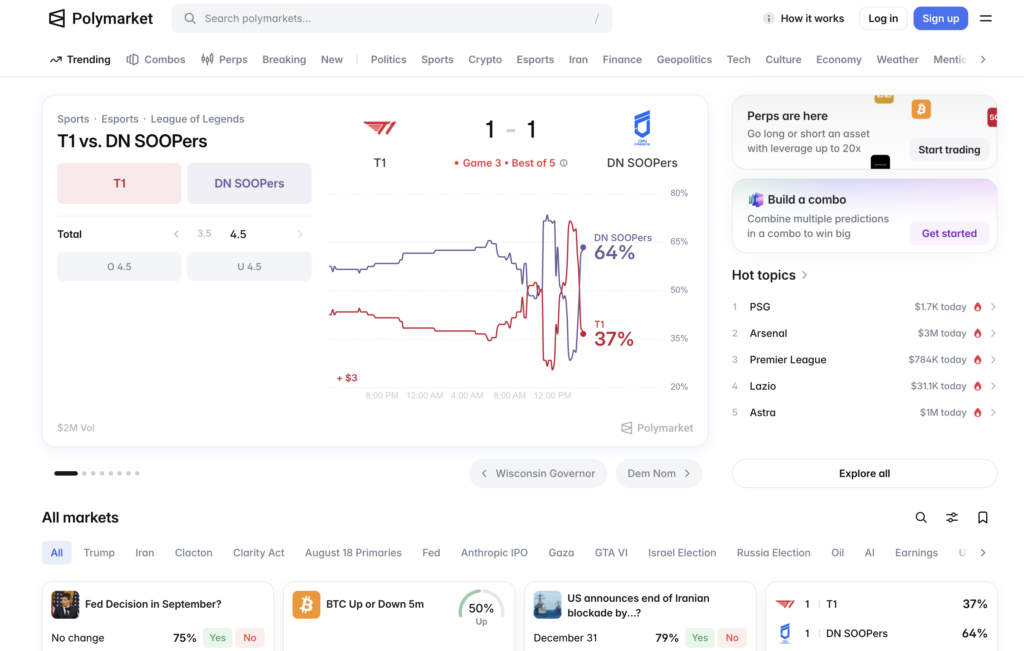
Polymarket is the obvious starting point for broad event markets. It runs on Polygon and supports markets spanning crypto, politics, macroeconomics, sports, technology, and world events.
Its basic mechanism is easy to read: outcome shares represent probabilities and winning positions settle at $1. The platform also uses predefined resolution rules and an optimistic-oracle process for settling outcomes, which makes oracle design part of the trading risk rather than invisible plumbing.
For someone looking beyond a static crypto predictor, its value is liquidity and breadth. It is also useful simply as a live sentiment source; you can watch probabilities without placing a trade.
Kalshi
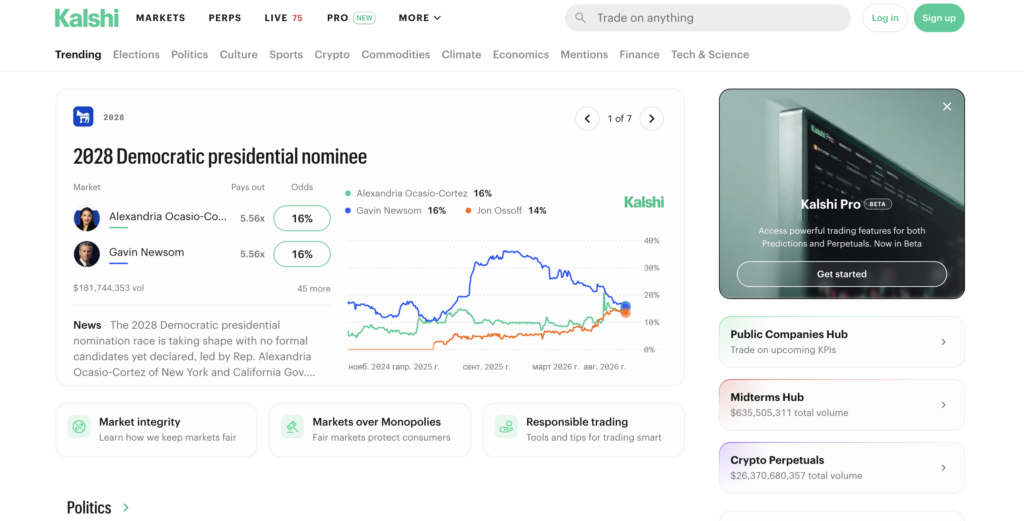
Kalshi takes a different route. It operates a CFTC-designated contract market and offers event contracts across economics, politics, financial markets, commodities, sports, and other real-world outcomes.
That regulated structure makes it particularly relevant to institutions. Kalshi explicitly positions event contracts for hedging, price discovery, trading, market making, arbitrage, and probability data.
It is therefore not a decentralized crypto betting market in the same sense as an on-chain protocol. Its inclusion matters because the prediction economy now spans both blockchain-native markets and regulated venues, and users should understand the difference before comparing them.
Limitless
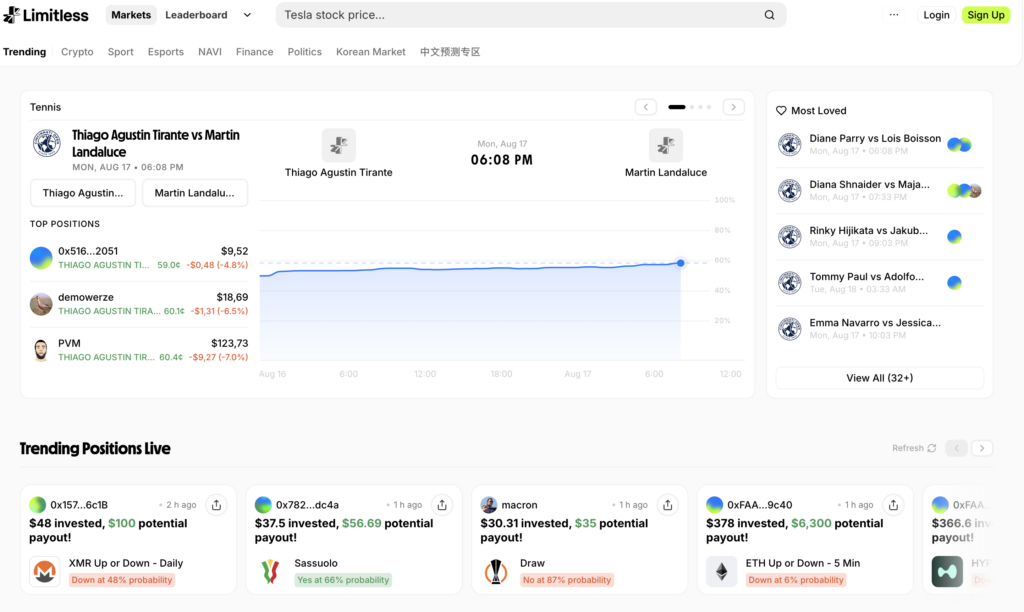
Limitless is built on Base and focuses heavily on financial outcomes, including crypto, stocks, commodities, sports, and other events. Shares generally settle at $1 or $0, while trading determines the implied probability.
The platform is especially relevant for users interested in cryptocurrency market predictions rather than only elections or sports. Its team reports more than $5 billion in processed trading volume, although, naturally, platform-reported figures should be read as such.
Predict.fun
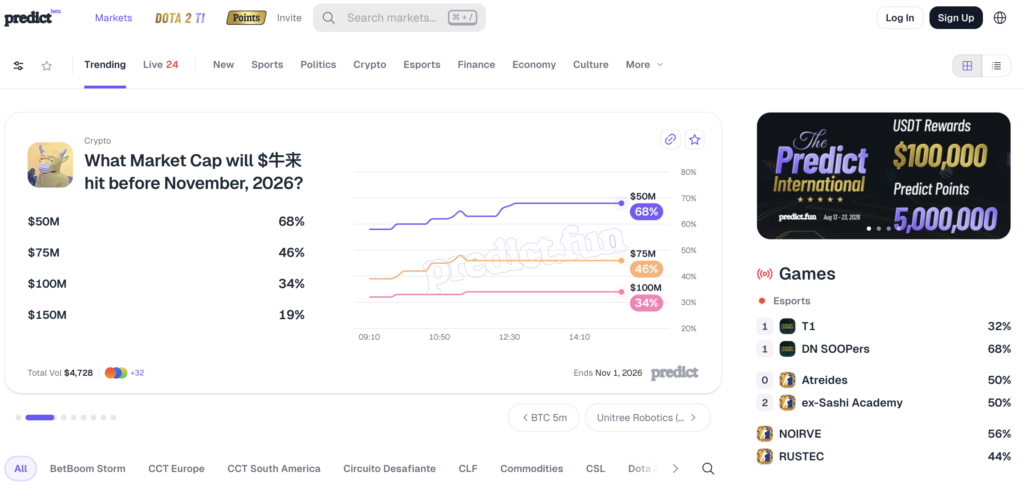
Predict.fun is a BNB Chain-native venue with markets covering crypto, elections, sports, and special events. Its interface also features very short crypto markets, including five- and fifteen-minute BTC directional markets.
That makes it closer to the crypto short-term prediction end of the spectrum. The project reported $1.5 billion in cumulative volume after launching in December 2025 and has also been integrated into Binance Wallet’s prediction product.
Myriad
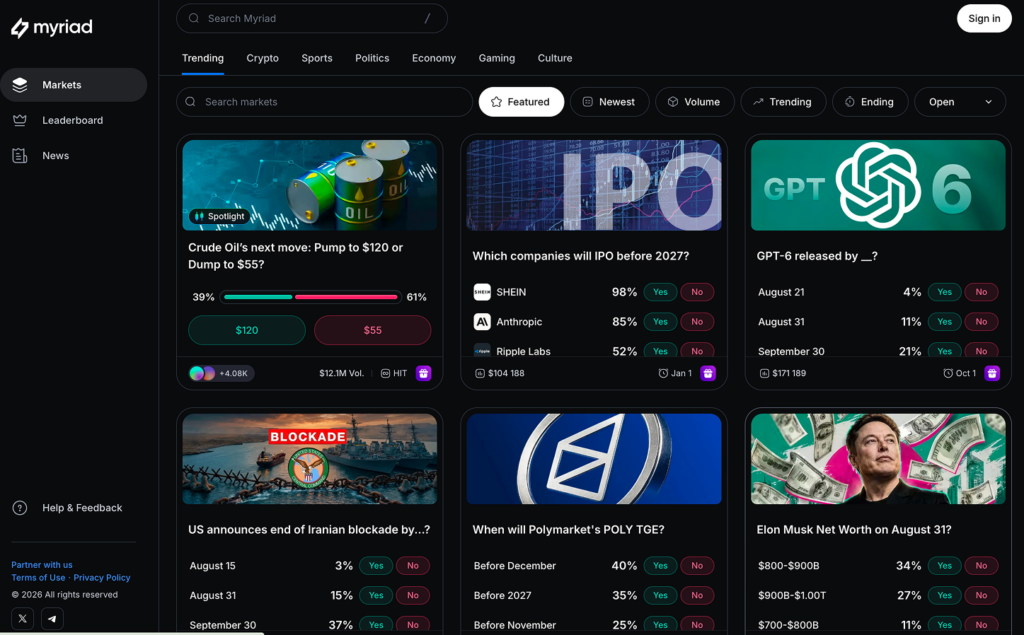
Myriad combines crypto, politics, economics, sports, gaming, and culture markets. Prices move as users buy and sell outcome shares, with winning shares settling at $1 and losing shares at $0.
One useful distinction is distribution. Its documentation supports integrations and automated trading by bots and AI agents, while the platform itself offers both points-based and real-money markets depending on location. That makes it interesting for developers as well as traders.
SX Bet
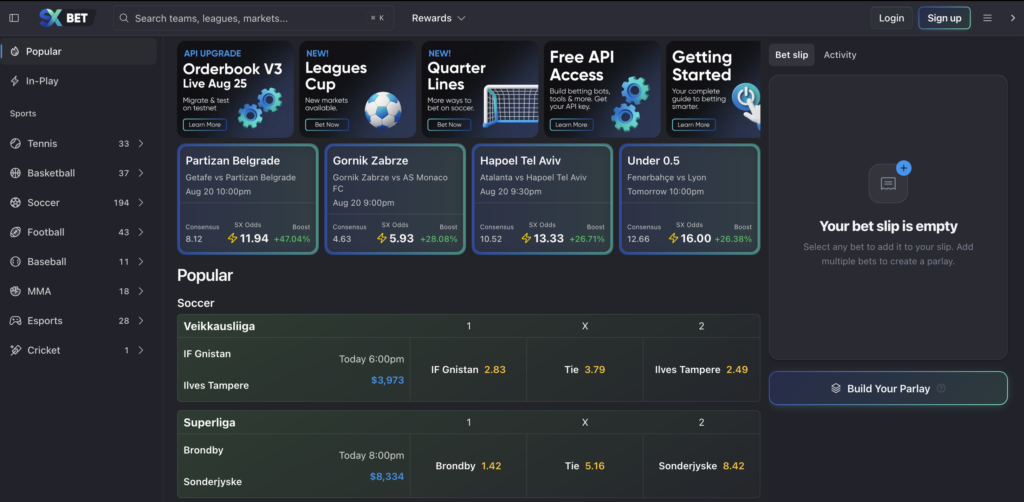
SX Bet specializes in sports and crypto rather than trying to cover every possible news event. It uses a peer-to-peer model in which participants trade against one another instead of accepting odds dictated by a centralized bookmaker.
Its open-source smart contracts process and settle bets on-chain. For users primarily interested in sports markets with Web3 settlement, that specialization can be more useful than a larger general-purpose venue.
Azuro
Azuro is the odd one out, usefully so. It is less a single prediction website than infrastructure that developers use to build prediction applications.
Instead of relying on a traditional order book, Azuro uses an AMM-oriented liquidity architecture and provides smart contracts, SDKs, data infrastructure, and oracle tooling. The protocol reports powering more than 40 live applications and over $530 million in volume.
For developers studying how crypto prediction markets work underneath the interface, Azuro is arguably more instructive than another consumer frontend.
PRDT Finance
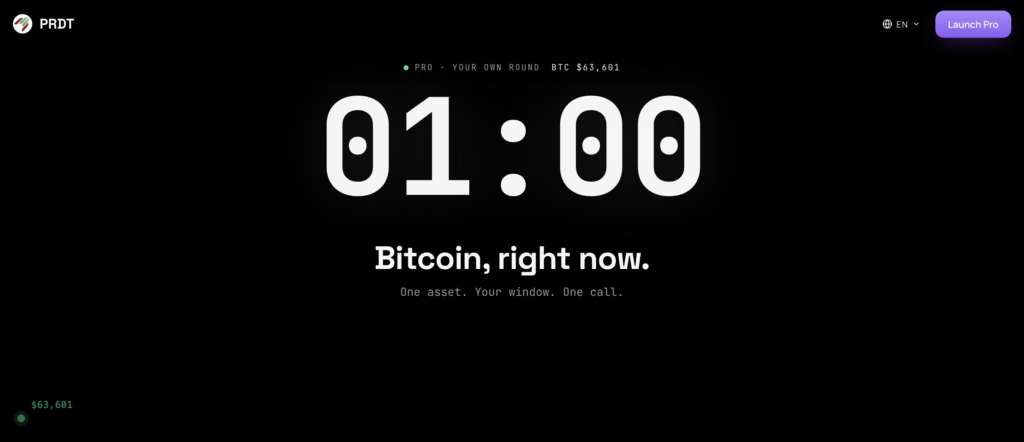
PRDT Finance focuses directly on crypto price prediction. Users take UP or DOWN positions on assets such as BTC, ETH, and SOL over short windows rather than predicting broad political or economic events.
Its Pro mode supports user-selected windows from one to thirty minutes, while Classic uses shared five-minute rounds. That makes it one of the more specialized options for traders searching for a crypto price prediction tool built around immediate market direction rather than long-range cryptocurrency future predictions.
Seer

Seer supports user-created categorical, multi-categorical, scalar, and multi-scalar markets. It uses conditional outcome tokens and can escalate disputed answers through Kleros.
The interesting part is what happens beyond ordinary betting. Seer also supports futarchy-style markets designed to help communities evaluate decisions by trading on their expected consequences, pushing prediction infrastructure toward governance and collective decision-making.
Hedgehog Markets
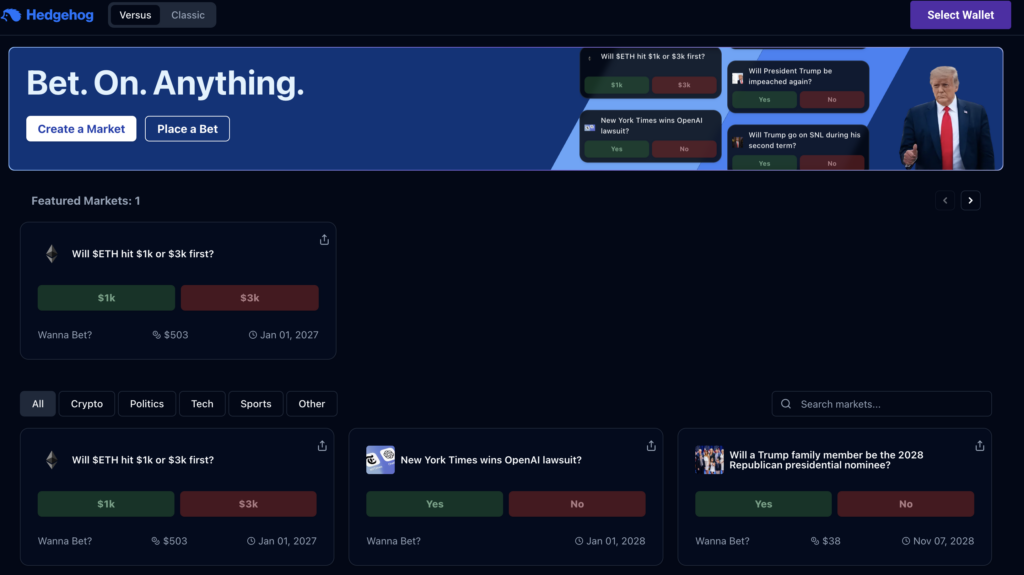
Hedgehog Markets is a Solana-based venue built around user-driven markets. Its current interfaces include pooled predictions, parlays, and markets where participants can choose or create positions and odds.
Its significance is less about competing for the largest general-purpose liquidity pool and more about experimentation on Solana. Low-cost execution makes the chain suitable for smaller and more frequent interactions, although users should still inspect liquidity and resolution sources market by market.
What Should You Compare Before Choosing One?
Start with liquidity. A beautifully designed market with nobody on the other side is not especially useful; thin liquidity creates wider spreads, worse execution, and probabilities that can be moved by relatively small trades.
Then examine resolution. Every contract eventually needs an answer, and the method matters: official sources, centralized adjudication, optimistic oracles, decentralized arbitration, and other mechanisms introduce different failure modes.
Custody comes next. Some Web3 venues let users retain control through wallets and smart contracts; Polymarket, for example, describes its architecture as non-custodial. A regulated exchange such as Kalshi follows a very different account and compliance model.
Finally, check fees, chain costs, market rules, geographic restrictions, and legal status. Prediction markets sit at an awkward intersection of derivatives, forecasting, betting, and crypto regulation, and access can change by jurisdiction. Recent CFTC enforcement guidance also makes clear that fraud and misuse of nonpublic information remain enforcement concerns even in regulated event markets.
How Does Blockchain Infrastructure Fit In?
On-chain markets ultimately depend on blockchain data. A frontend needs to read contracts and balances, track transactions, follow market state, and sometimes broadcast user-signed transactions quickly enough that the displayed probability has not already moved.
For on-chain prediction markets, RPC infrastructure is simply the connection between the application and the blockchain. Developers can run their own nodes or use infrastructure providers such as NOWNodes to read contract state, follow transactions, and send requests to the networks their applications depend on.
Where Can These Markets Go Wrong?
Prediction markets are useful, but “market price” and “truth” are not synonyms. A thin market can be distorted by one large participant, while a badly worded question can create disagreement even when everyone knows what happened.
Oracle and settlement risk are especially important on-chain. If the resolution source fails, produces ambiguous data, or is manipulated, the smart contract can faithfully execute the wrong answer. Automation does not rescue bad inputs; it merely makes the mistake impressively efficient.
There is also smart-contract, wallet, liquidity, stablecoin, and network risk. Add jurisdiction-specific regulation and the result is considerably more complicated than choosing the most accurate crypto prediction site from a leaderboard.
For that reason, the best crypto prediction app depends on the job. Broad information discovery favors liquid general markets; short-term crypto predictions favor specialized price venues; institutions may prioritize regulated contracts; developers may care more about open contracts, APIs, and reliable resolution infrastructure.
FAQ
Are market probabilities the same as a cryptocurrency forecast?
No. A cryptocurrency forecast is usually produced by an analyst or model, while a market probability emerges from participants buying and selling competing outcomes. It is better understood as a live consensus estimate than a guaranteed prediction.
Can I use these markets only for research?
Yes. You can follow crypto market predictions and changing probabilities without taking a position. This can be useful for research dashboards, news monitoring, sentiment analysis, and comparing market expectations with your own crypto projections.
Is there a most accurate crypto price prediction platform?
Not consistently. Accuracy changes with liquidity, time horizon, market design, participant quality, and the information available. Comparing several independent signals is more defensible than assuming one crypto prediction website will always outperform the rest.
Can developers build tools around market data?
Yes. Many platforms expose public blockchain activity, APIs, SDKs, or smart contracts that can feed aggregators, alerting systems, trading interfaces, and AI agents. On-chain applications also need dependable RPC access to retrieve state and follow transactions.
Are these markets legal everywhere?
No. Availability and legal treatment differ by country and, in some cases, by state or region. Users should check the platform’s current eligibility rules and their local laws rather than assuming that blockchain access automatically makes participation permitted.