
A blockchain API is a web interface that lets an application read blockchain data or send transactions without running its own node. You send a request, the service talks to the network, and you get structured data back, usually JSON. That is the whole idea, and most of the confusion around the topic comes from the fact that “blockchain APIs” cover four quite different things.
Some give you raw node access. Others return pre-indexed history, explorer-style lookups, or market prices. Picking the wrong type costs more time than picking the wrong vendor, so this guide starts with the basics, then moves to real requests, current limits of the main services, and the trade-offs that show up in production.
What Is a Web3 API?
A web3 API is a standard way for software to ask a blockchain a question. “What is this address’s balance?” “Which transactions are in block 900,000?” “Broadcast this signed transaction.” Each of those is a request to an endpoint, and each returns a response your code can parse.
The underlying protocol depends on the chain. Ethereum-style networks use JSON-RPC, which ethereum.org describes as a stateless, lightweight remote procedure call protocol that gives every client “a uniform set of methods.” Bitcoin and other UTXO chains expose different methods, and many services add REST endpoints on top so developers don’t have to learn each chain’s native calls.
Why Do Developers Need One?
Because reading a blockchain directly is expensive. A node has to download, verify and store the whole chain, then stay in sync forever. Erigon’s archive mode, for example, needs around 2 TB of disk for Ethereum alone, and that is one network out of the hundreds a wallet or exchange may support.
A blockchain API removes that layer. Your team writes product code, and someone else keeps the node running, patched and indexed. Here’s the catch, though: you now depend on that service’s uptime, limits and data quality, which is why the choice matters.
There is a second reason that is easy to miss. Nikil Viswanathan, CEO of Alchemy, put it this way in a CoinDesk interview in April 2026: “You can write code to manage a crypto wallet. You can’t write code to manage a bank account in the same way.” Programmability is the point, and a good api crypto teams can call from ordinary software is what makes it usable.
Who Uses These Interfaces, and for What?
Wallets are the most obvious case for a blockchain API. They need balances, transaction history and a way to broadcast signed transactions, often across dozens of chains at once. Exchanges and payment processors watch deposit addresses and confirmation counts through the same blockchain APIs.
The other groups look like this:
- dApp teams read contract state and subscribe to events instead of polling.
- Analytics and tax tools pull historical transactions and token transfers in bulk.
- Explorers index blocks and addresses so users can search them.
- Trading bots need low-latency streams of new blocks and pending transactions.
- AI coding agents now call blockchain APIs too, usually through an MCP server that supplies documentation and request templates.
If you’re building in the last category, this comparison of AI tools for blockchain development covers the tooling in more detail.
What Types of Chain Interfaces Exist?
There are four kinds of blockchain API, and most products end up using two of them. The table shows how they differ.
| Type | What it returns | Typical use | Example |
|---|---|---|---|
| Node access | Live chain state via JSON-RPC, WebSocket or gRPC; broadcasting transactions | dApps, wallets, bots | Alchemy, Infura, NOWNodes |
| Indexed data | Pre-indexed balances, address history, token transfers | Wallets, analytics | Blockbook, Blockchair |
| Explorer | Block, transaction and address lookups, charts | Quick lookups, monitoring | Blockchain.com, Etherscan |
| Market data | Prices, volume, market cap, exchange rates | Portfolio trackers, dashboards | Aggregated price APIs |
A blockchain data API is the indexed kind, and it is the one most teams underestimate. The node itself is good at answering “what is the state right now” but slow at “give me every transaction this address ever made,” because that requires scanning history. An indexer builds that database once and serves it quickly.
That is why the Bitcoin family relies on it. A Bitcoin API built directly on a node can’t list an address’s history efficiently, since Bitcoin tracks unspent outputs, not account balances (the UTXO model explains why). Blockbook, the indexer NOWNodes runs on 30+ networks, fills that gap with ready-made balance and history queries, which is why a serious bitcoin API setup usually includes an indexer.
What Does a Real Request Look Like?
Here is a working blockchain API example. It asks an Ethereum endpoint for the latest block number using the same eth_blockNumber method shown in the ethereum.org documentation:
bash
curl -X POST 'https://eth.nownodes.io/YOUR_API_KEY' \
  -H 'Content-Type: application/json' \
  --data '{"jsonrpc":"2.0","method":"eth_blockNumber","params":[],"id":1}'
The response comes back as {"jsonrpc":"2.0","id":1,"result":"0x..."}, where the result is the block height in hexadecimal. Convert it and you have the current block. Authentication differs between services, so check whether yours expects the key in the URL, in a header, or as a query parameter.
Getting to that point takes four steps, and the second one is where the blockchain API key comes in:
- Create an account with the service and pick a plan.
- Generate an API key in the dashboard.
- Copy the endpoint for the chain and interface you need.
- Send one simple request, such as a block number, to confirm the connection.
Treat the blockchain API key like a password. Keep it in an environment variable or secrets manager, never in front-end code or a public repository, because anyone who finds it can burn through your quota.
Which Services Are Worth Comparing in 2026?
The list below covers the names developers ask about most when they compare, whatever api blockchain services advertise. Numbers come from each service’s own pages, so re-check them before you commit, since plans change often.
| Service | Type | Chains | Free access |
|---|---|---|---|
| Blockchain.com Explorer API | Explorer | Bitcoin, Ethereum, Solana, Bitcoin Cash | Free public endpoints; optional key |
| Blockchair | Explorer / indexed | Multi-chain | 1,000 calls per day without a key |
| Etherscan API V2 | Explorer | 60+ EVM chains | One key for all chains |
| Alchemy | Node access + enhanced APIs | 100+ | 30M compute units per month |
| Infura | Node access | 40+ networks | 3M credits per day |
| NOWNodes | Node access, Blockbook, WebSocket, gRPC, market data | 120+ | Start plan: 100,000 requests |
Explorer Endpoints: the Old and the New
Searches for the blockchain.com API, the blockchain.info API and the blockchain info API all point to the same company. The older blockchain.info domain still answers: a call to blockchain.info/latestblock returns JSON with the block hash, height, time and transaction indexes.
The current product is the Explorer Gateway API, which covers Bitcoin, Bitcoin Cash, Ethereum and Solana. Its /public/* endpoints are free, an optional key goes in the X-Explorer-Auth-Key header, and separate paid endpoints use the x402 payment protocol with a fixed price per call. The Blockchain.com API is a solid choice for address lookups and charts, but it isn’t built to serve as the only backend for a multi-chain wallet.
Blockchair, Etherscan and the Explorer Tier
Blockchair is the pick when you need to filter and sort across chains, not just fetch one record. Its free testing plan allows 1,000 calls per day without a key, which is enough to prototype and not much more.
Etherscan’s V2 API uses a single key across 60+ EVM chains, selected with a chainid parameter. That makes it convenient for token and contract history on EVM networks, and irrelevant for Bitcoin or Solana.
Alchemy, Infura and NOWNodes
These three sit in the node-access tier, and the differences are mostly about breadth and billing. Alchemy’s free plan includes 30 million compute units a month on 100+ chains, then $0.525 per million units on pay-as-you-go. Infura’s free tier gives 3 million credits per day across 40+ networks, and its Developer plan at $50 a month adds trace and debug methods.
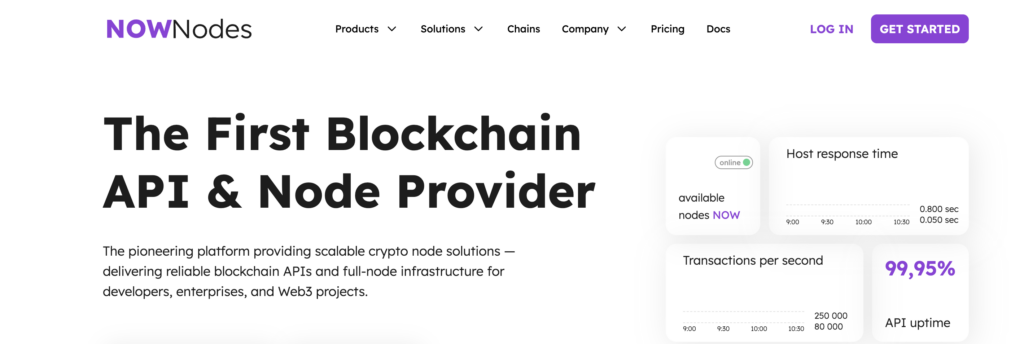
NOWNodes takes the wide-coverage route: 120+ networks behind one account, with Blockbook indexing, WebSockets and gRPC streaming alongside plain JSON-RPC. That breadth matters most for teams that support Bitcoin-family coins next to EVM chains, since most Ethereum-first services skip them. The free Start plan includes 100,000 requests, while heavier workloads can move to shared plans or a dedicated node with no predefined RPS cap. A team that only ever touches Ethereum may still get more from a specialist’s higher-level tooling.
How Do You Choose the Right One?
Start with the chains, not the brand, whichever blockchain API you shortlist. If your product touches only Ethereum and EVM networks, nearly every service above works. Add Bitcoin, Monero or a smaller chain and the field narrows quickly.
Then check these four things:
- Interface coverage. Does the chain you need offer WebSocket, indexed history or archive data, or only basic calls? Coverage differs by network, so verify the exact chain and feature pair.
- Billing model. Flat request quotas are easy to forecast. Compute units or credits weight each method differently, so a heavy call can cost many times a light one.
- Rate limits. A free plan’s requests-per-second cap decides whether a load test passes, not the monthly total.
- Failure behavior. Look at how the service reports errors and what happens at the limit. Some block your IP, others throttle.
Real-time apps deserve a separate look at connections, since streaming blockchain APIs behave differently from request-response ones. Persistent streams drop silently more often than teams expect, and WebSocket best practices for production covers reconnection and heartbeat handling in detail.
What Are the Risks and Limits?
Vendor dependence is the main one. If your only data source goes down or changes its pricing, your product stalls, so production systems usually add a second source as a fallback.
Data lag is the second. An indexer can trail the chain tip by seconds or minutes, so a confirmed transaction may look pending in one service and settled in another. For payments, check confirmations against a node directly.
Third, a blockchain API cannot change how the chain behaves. It doesn’t control gas fees, block times or finality, and it can’t guarantee a transaction confirms. It only delivers what the network produces.
Conclusion
Blockchain APIs save you from running nodes, but only if the type matches the job. Use node access for live state and transactions, a blockchain data API for history, an explorer interface for lookups, and market data for prices. Then compare services on chain coverage, billing model and rate limits, in that order.
For a first project, pick one service, generate a key, and run the block-number request above. Once it works, you will know quickly whether the limits and response times suit your product.
FAQ
Are there free ways to query Bitcoin data?
Yes. The Blockchain.com Explorer API offers free public endpoints, Blockchair allows 1,000 calls per day without a key, and several node-access services include a free plan. Free tiers suit prototypes, not production traffic, whichever bitcoin API you pick.
Do I always need a key?
No. Some explorer endpoints work without one, but keys unlock higher limits and let the service identify your traffic. Node-access services generally require a key.
What is the difference between JSON-RPC and REST?
JSON-RPC sends every call to one URL with a method name in the request body, and it is the native format for Ethereum-style nodes. REST uses separate URLs per resource, such as /address/{id}, and is common in indexed and explorer services.
Can one service cover several blockchains?
Partly. Many services cover dozens of networks under one account, but methods and available features still differ by chain. A Bitcoin call and an Ethereum call will not look the same.
How much does this kind of access cost?
It ranges from free to thousands of dollars a month. Free tiers typically offer between 100,000 requests and tens of millions of compute units, and paid plans scale by request count, credits or dedicated hardware.