
Enterprise blockchain solutions are shared-ledger systems that companies, banks and market operators run for business use, with controlled membership, private data and compliance built in. The term spans two layers that often get confused: the platform that runs the ledger (Hyperledger Fabric, R3 Corda, Hyperledger Besu, Canton) and the infrastructure beneath it — the nodes, hosting and connectivity that keep it online and reachable.
Most guides stop at the platform. This one covers both, then names the providers you would actually shortlist. It starts with what enterprise blockchain is and who runs it in 2026, works through the platforms that matter, and ends with the top infrastructure providers and how to pick between them.
What Is an Enterprise Blockchain?
An enterprise blockchain is a ledger that several known organizations share and update together, without any single one of them holding the master copy. Access is usually permissioned: an administrator or a consortium decides who can join, write and read. That is the opposite of Bitcoin or Ethereum, where anyone can run a node and see every transaction.
The practical consequence is control. Because participants are vetted rather than anonymous, the network can run under a governance model built on whatever trust already exists between members, and it does not need a native cryptocurrency to pay for security (Hyperledger Fabric docs). Data can stay private between the parties to a deal instead of being broadcast to the whole network.
Enterprise blockchain solutions have two parts, and conflating them is the most common planning mistake. The platform layer is the ledger software and its rules. The infrastructure layer is everything that keeps nodes synced, patched and reachable — and it is where outages actually happen.
Why Do Businesses Use Permissioned Blockchains?
They remove a step that costs real money: reconciliation. Two companies that trade with each other normally keep separate records and square them up later, by hand or through an intermediary. A shared ledger lets both sides see the same record at the same moment, and settlement can run around the clock instead of on banking hours.
The catch is rarely the technology. Adoption fails for organizational reasons far more often than technical ones. Maersk and IBM shut down TradeLens, their blockchain shipping platform, in 2022; Maersk’s Rotem Hershko said “the need for full global industry collaboration has not been achieved”. The software worked. Not enough competitors joined. Before you choose a platform, confirm the partners you need are actually committed to the network.
Who Is Actually Using Enterprise Blockchain in 2026?
Finance leads, and 2026 has the clearest production examples so far:
- Payment networks. In July 2026, Swift opened its blockchain-based shared ledger for initial use, with 17 banks across six continents — including HSBC, Citi, BNY, UBS and Wells Fargo — lined up to pilot 24/7 cross-border payments in tokenized deposits.
- Banks. J.P. Morgan’s Kinexys network has now processed more than $4 trillion in cumulative transactions and averages over $7 billion a day across eight currencies, by the bank’s own figures.
- Market infrastructure. DTCC ran its first live tokenized trades in July 2026 and is launching its full Tokenization Service — covering tokenized Treasuries, money-market funds and equities — in October 2026.
- Institutional assets. R3 reports more than $17 billion in tokenized real-world assets across 200-plus banks running on Corda networks.
The pattern underneath these examples: regulated institutions want shared records and instant settlement, but only among vetted participants. That is exactly what a permissioned design gives them.
Which Enterprise Blockchain Platforms Matter in 2026?
Four platform families cover most serious projects, and one former favorite has dropped out. Each one answers a different question about who should see the data.
Hyperledger Fabric
Fabric is a modular, permissioned platform under the Linux Foundation’s LF Decentralized Trust. Organizations join channels, and only the members of a channel can see the data on it — useful when a consortium needs tight, selective privacy. It runs without a native token, because participants are known rather than anonymous.
The 3.x line added SmartBFT, a Byzantine fault tolerant consensus option that keeps a network running even if some nodes are compromised or act maliciously. The latest release is v3.1.5 (June 2026), while the 2.5 line stays the long-term-support branch for teams that prefer stability over new features (Fabric releases). Fabric suits consortiums that want fine-grained control over who sees what.
R3 Corda
Corda deliberately skips the shared global ledger. Each node sees only its own transactions and those it has been given, not everything on the network (R3 docs). That fits regulated finance, where broadcasting trade terms to every participant is a non-starter under rules like MiFID II.
R3 is now bridging the private-public divide. Corda Enterprise 4.14 ships with a Solana notary, letting permissioned Corda networks settle against the public Solana chain without wrapped tokens or external bridges (Genfinity). Separately, the R3 Foundation launched Corda Protocol, a Solana-native product for curated real-world-asset yield — a distinct offering from the enterprise ledger software.
Hyperledger Besu
Besu is an open-source Ethereum client written in Java and licensed under Apache 2.0, and it is a graduated LF Decentralized Trust project. It runs on Ethereum mainnet and also powers private networks using QBFT or IBFT 2.0 consensus, which makes it the natural pick for teams that want Ethereum tooling with a path between private and public chains.
Its enterprise credibility is not theoretical. DTCC chose Besu for the private side of its tokenization work, running July 2026 trades across its own Besu network and the public Canton network (DTCC). Besu is also where most former Quorum users landed after J.P. Morgan handed Quorum to Consensys, which no longer provides ongoing support (Kaleido).
Canton Network
Canton is a public, permissioned network built for institutions issuing and trading tokenized assets such as bonds, funds and Treasuries. “Public permissioned” means it is open to a broad set of approved participants, while each party still controls who sees its own data. It reports more than 700 ecosystem participants and backing from firms including BlackRock and a16z crypto.
Canton is the newest of the four and its adoption is moving fastest. DTCC’s October 2026 Tokenization Service runs on Canton alongside Besu, and tokenized Treasury settlement went live on the network earlier in the year. If your use case is institutional tokenization rather than a closed supply-chain ledger, Canton belongs on the list.
What Dropped Off the List
Two names from older guides no longer belong in a 2026 shortlist. IBM ended support for its IBM Blockchain Platform software in 2023 and pointed customers to its managed Hyperledger Fabric support. Quorum lost its active maintainer, as noted above. Both are reasons this list looks different from one written two years ago.
The private-versus-public split is also blurring. J.P. Morgan issues its JPMD deposit token on Base, a public Ethereum layer-2, while running Kinexys on its own infrastructure — a permissioned bank operating directly on a public chain.
Why Does Infrastructure Make or Break the Project?
Because a platform is only as reliable as the nodes behind it. Every bank, exchange or logistics firm that reads from or writes to a chain needs a node that is synced, patched and reachable. Run it yourself and you own the hardware, the upgrades and the 3 a.m. resyncs. Buy it as a service and you own a vendor relationship instead.
Most teams end up mixing both models, and the deciding factor is usually isolation. Shared infrastructure is cheaper and quick to start. Dedicated infrastructure gives one customer a private node on its own hardware, so other customers’ traffic cannot slow it down and access can be restricted by IP address. Teams that also touch public chains — for tokenized assets or stablecoin flows — need dependable access to those networks too, which is where multi-chain node providers come in.
Who Are the Top Providers of Enterprise Blockchain Infrastructure?
The five below cover node access, dedicated hosting and managed networks. They were compared on chain coverage, isolation options, published compliance evidence, and how much of the stack each one handles. NOWNodes is our own product and sits first because multi-chain access and dedicated nodes carry the most weight here; put audited compliance certifications first and the order would change.
| Provider | Best for | Coverage | Compliance shown on its site |
|---|---|---|---|
| NOWNodes | Multi-chain access, dedicated nodes | 120+ networks, one API key | None listed on the dedicated-nodes page |
| Blockdaemon | Institutional nodes and staking | Institutional focus, 70+ points of presence | SOC 2 Type II, ISO 27001 |
| Chainstack | Managed nodes with enterprise support | 70+ chains | ISO/IEC 27001; SOC 2 Type 2 data centers |
| Kaleido | Launching permissioned networks | Public and private chains | SOC 2 Type 2, ISO 27001/27017/27018 |
| Alchemy | Single-tenant clusters | 100+ chains | SOC 2 Type II |
NOWNodes
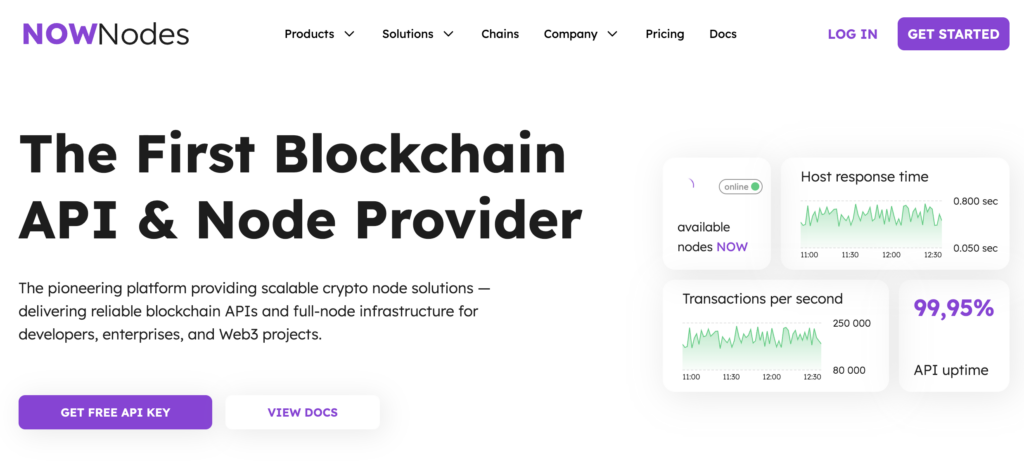
NOWNodes gives teams API access to nodes on 120+ blockchains through a single key, so one integration covers Bitcoin, Ethereum, Solana and the long tail of other networks. Its main website advertises 99.95% API uptime and geo-balanced servers in the US and Europe, and pricing runs from a free Start tier to an Enterprise plan with 100 million monthly requests.
For enterprise workloads the dedicated-node product is the more relevant one. Each node is deployed for one customer and one chain, in a region you choose, with a client such as Geth or Erigon, Blockbook, or custom indexing. Dedicated nodes carry no predefined request-per-second limit and no monthly call quota — throughput is bounded by the hardware you are allocated — and support private IP whitelisting plus advanced Trace and Debug access. Shared plans, by contrast, run on request quotas and plan-based limits.
Two caveats worth stating plainly. NOWNodes connects your systems to chains; it does not run Fabric or Corda networks for you. And the dedicated-nodes page does not list SOC 2 or ISO reports, so ask for audit documentation if procurement requires it.
Blockdaemon
Blockdaemon targets institutions that want node infrastructure and staking from one vendor. Its security page cites SOC 2 Type II and ISO 27001 certification and describes slashing-risk coverage arranged with the insurance broker Marsh. The trade-off is scope: it is built around institutional staking and node hosting, not around launching a consortium ledger.
Chainstack
Chainstack offers managed nodes across 70+ chains, and its security page states ISO/IEC 27001 certification with hosting in SOC 2 Type 2 data centers. It suits teams that want documented security practices alongside managed and dedicated deployments. Coverage is narrower than NOWNodes or Alchemy, so check that your specific chain is on the list.
Kaleido
Kaleido is the closest thing here to a full enterprise blockchain platform. It lets organizations stand up permissioned networks and reach public chains including Ethereum, Base and Canton, and it maintains open-source projects such as Besu, Hyperledger FireFly and Paladin. It reports SOC 2 Type 2 and ISO 27001, 27017 and 27018 compliance. Pick it when you need to launch a consortium network, not only connect to existing ones.
Alchemy
Alchemy’s Dedicated Clusters are single-tenant, fully managed node infrastructure, described as SOC 2 Type II compliant and available across 100+ blockchains. Its uptime and throughput figures are vendor claims, so test them against your own workload. Its named customers skew toward applications on public networks, so it fits that profile better than a permissioned consortium.
How to Choose a Platform and Infrastructure Provider
Work through these in order, because each answer narrows the next.
- Decide who must see the data. If competitors share the ledger, you need permissioned access. If the public should be able to verify it, look at public or hybrid networks.
- Check the collaboration risk first. TradeLens had working software and still failed. Confirm your required partners are committed before you commit to a platform.
- Match the platform to the job. Fabric for controlled consortiums, Corda for regulated bilateral data, Besu for Ethereum compatibility, Canton for tokenized institutional assets.
- Choose shared or dedicated infrastructure. Start shared to prototype, then move to dedicated nodes when limits, isolation or downtime cost more than a fixed monthly bill.
- Ask for the audit reports. A written SOC 2 or ISO document counts for more than an uptime figure on a landing page.
- Pilot with real load. Run your actual traffic against a trial tier and compare latency and error rates before you sign.
Conclusion
Enterprise blockchain has moved from pilots to production in finance, and the stack now has clear layers. Choose the platform for what your data and partners require, then choose infrastructure for the reliability and isolation your workload needs.
The most expensive mistake is treating those as one decision. A well-chosen platform on weak infrastructure still goes down, and strong infrastructure cannot rescue a network that partners refuse to join. For the multi-chain and dedicated-node side of a build, it is cheap to test a shared plan before committing to anything larger.
FAQ
Do enterprise blockchains need their own cryptocurrency?
Usually not. Permissioned platforms like Hyperledger Fabric run without a native token because participants are vetted rather than anonymous, so there is no mining or staking to incentivize. A token only becomes relevant when the network settles value against a public chain.
How much does an enterprise blockchain cost to run?
The platform software is often open-source and free to download, so the real cost sits elsewhere: development and integration, node infrastructure, and ongoing operations. Expect to pay for engineering time, a development or hosting partner, and either self-run nodes or a provider subscription, which can range from a free tier to enterprise contracts.
Which blockchain is best for a bank launching its own chain?
It depends on the data model. A bank that needs strict bilateral privacy often starts with R3 Corda; one that wants Ethereum tooling and a public-chain path tends toward Hyperledger Besu; and institutions focused on tokenized securities are increasingly building on Canton. There is no single winner — the right answer follows your regulatory and settlement requirements.
What does an enterprise blockchain development company do?
It helps a business design, build and run a permissioned network end to end: choosing a platform, writing the smart-contract logic, integrating existing systems, and often hosting the nodes. Managed providers such as Kaleido fold much of this into a single service, while platform maintainers and infrastructure providers each cover one layer of the stack.