
A blockchain programming language is any language developers use to write code that runs directly on a blockchain — smart contracts, protocol-level logic, or both. Some, like Solidity and Move, were built from scratch for this job. Others, like Rust and Go, were general-purpose languages that blockchains adopted because they already solved problems chains care about: memory safety, speed, and predictable behavior.
There’s no single best programming language for blockchain development — only a best language for the chain and problem you’re solving. Here’s the short version: Solidity runs most of Ethereum and BNB Smart Chain, Rust powers Solana and Polkadot, Move secures Aptos and Sui, and Go builds the enterprise chains most users never see. This guide covers why each one exists, who uses it, and how to choose.
What Makes a Coding Language Work on a Blockchain?
It’s a language whose code compiles — or in a few cases, runs directly — on a blockchain’s virtual machine, then executes identically on every node that validates the network. Regular software runs on one machine at a time, and a bug usually costs you a bad deploy. Blockchain code runs on thousands of independent computers at once, and once it’s deployed, it’s often impossible to patch.
That difference is why an entire category of languages — Solidity, Vyper, Move, Clarity, Cairo — exists purely to write this kind of code safely. Some only handle smart contracts: self-executing programs that run automatically once their conditions are met. Others, like Go and Rust, also build the blockchain’s own client software, the program that makes a computer a node in the first place.
Why Not Just Use a General-Purpose Language?
A few blockchains allow it, but most smart contract platforms restrict you to a small set of languages on purpose, for reasons normal software never faces.
Determinism is one: every node running a transaction has to reach the exact same result, every time, or the network can’t agree on a shared state. Gas metering is another — every operation costs a measurable fee, so the language needs a predictable way to price computation before it runs. Turing-completeness is the third, and it cuts both ways.
Turing-complete: describes a language expressive enough to compute anything a Turing machine could, including unbounded loops and recursion. Most general-purpose languages are Turing-complete; a handful of blockchain languages, like Clarity, deliberately are not. See the Stacks documentation on decidability for why that trade-off exists.
A Turing-complete language can, in theory, run forever, which is exactly what gas fees exist to prevent. That’s where the stakes get real: in July 2023, attackers exploited a broken reentrancy lock in three Vyper compiler versions (0.2.15, 0.2.16, 0.3.0), draining roughly $70 million from DeFi protocols on Curve Finance’s liquidity pools, per Halborn’s technical breakdown. Whitehat recovery later cut the final loss to about $52 million, according to Chainalysis.
Vyper is one of the languages built specifically to minimize this kind of risk. The bug lived in the compiler, not the language’s design goals — a reminder that the language matters, but so does everything built on top of it.
Who Actually Writes in These Languages?
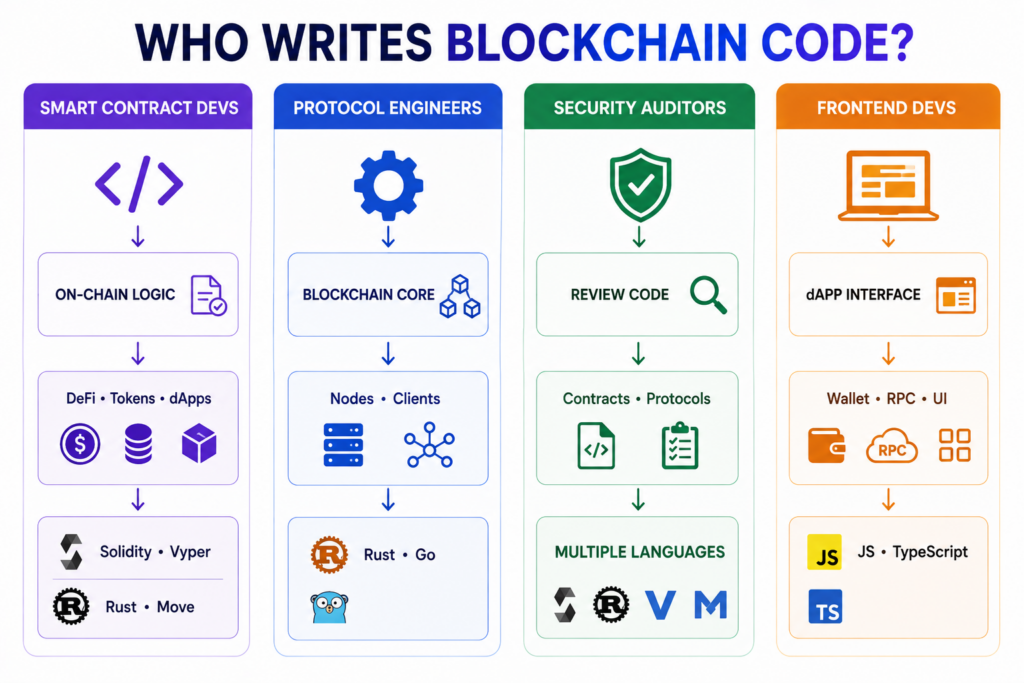
Four groups make up most blockchain coding language use, and they rarely overlap much:
- Smart contract developers write on-chain logic for DeFi protocols, token contracts, and dApps — mostly in Solidity, Vyper, Rust, or Move, depending on the chain.
- Protocol engineers build the blockchain’s own client software, which is why Go and Rust show up as often in nodes as in contracts.
- Security auditors need to read whichever language a project shipped in, part of why firms increasingly specialize by ecosystem — see smart contract auditing firms.
- Frontend developers connect a dApp’s interface to the chain, almost always in JavaScript or TypeScript, regardless of the contract language underneath.
The scale is bigger than most expect. Ethereum added roughly 16,000 new developers between January and September 2025, bringing its active base to 31,869; Solana added 11,500 for a total of 17,708 active — 29.1% year-over-year growth against Ethereum’s 5.8%, per Electric Capital data reported via Yahoo Finance. The Solana Foundation disputes the exact count, arguing it understates its real developer base.
Solidity and Vyper: Writing Contracts for Ethereum and BNB Chain
Most blockchain smart contract development still happens on EVM-compatible chains, which means most of it happens in one of two languages.
Solidity: The Default for EVM-Compatible Chains
Solidity is the closest thing this space has to a default. It’s the language behind most of Ethereum’s smart contracts, and because BNB Smart Chain, Polygon, and Arbitrum run the same Ethereum Virtual Machine, the same contract usually deploys on any of them with little change. That overlap is why BSC smart contract programming and Ethereum smart contract programming look so similar in practice.
Contrary to a claim that circulates a lot, Solidity wasn’t written by Vitalik Buterin — Ethereum co-founder Gavin Wood proposed it in August 2014, and a team led by Christian Reitwiessner built it out, according to Solidity’s own project history. It borrows its syntax from JavaScript, which is why web developers pick it up fast, but it’s statically typed underneath. The current stable release is version 0.8.36, shipped July 9, 2026, per the official Solidity blog.
Vyper: What Happens When “Simple” Still Isn’t Simple Enough
Vyper takes the opposite approach on purpose. Originally created by Vitalik Buterin, it uses Python-like syntax and deliberately leaves out features Solidity has — modifiers, inheritance, inline assembly, operator overloading — specifically so a contract is easier to audit from top to bottom.
That philosophy is why Curve Finance and other DeFi protocols chose it. It’s also, as the incident above shows, no guarantee against every bug: a compiler flaw can undercut even a language built around minimizing attack surface. The takeaway isn’t “avoid Vyper” — it’s that no crypto coding language, however disciplined, replaces a proper security audit before real money touches a contract.
Rust, Move, and Go: The Non-EVM Alternatives
Once you leave the EVM world, the language a chain chose usually tells you what its designers valued most.
Rust: Why Solana, Polkadot, and NEAR Chose It
Rust is the language for blockchains that treat performance and memory safety as non-negotiable. Its compiler catches whole categories of bugs — buffer overflows, use-after-free errors, data races — before the code runs, using an ownership model most mainstream languages don’t have. That’s why Solana, Polkadot’s Substrate framework, and NEAR Protocol all built around it.
Solana founder Anatoly Yakovenko has been blunt about why Rust specifically, framing it as a filter for who ends up building on the chain. Discussing the decision in comments reported by The New Stack, he put it this way:
“The hard part with EVM is are you gonna get, like, really smart people full-time thinking about how do I build in scale? Or are you just going to get somebody that copies something from Solidity and then slaps a token on it?”
Rust’s learning curve is real — the same strictness that prevents bugs also means more upfront friction. It’s a trade most performance-sensitive chains have decided is worth making.
Move: Treating Digital Assets as Objects, Not Numbers
Move started as an internal project at Meta, built for the now-shut-down Diem (formerly Libra) blockchain, before Aptos and Sui adopted and extended it as their smart contract language. Its core idea treats digital assets as first-class objects with their own ownership rules, rather than entries in a balance mapping the way Solidity represents them — structurally preventing whole bug categories instead of relying on developers to avoid them by convention.
Sui’s implementation lets one transaction chain together up to 1,024 Move function calls with no reentrancy risk by design, per Sui’s own documentation. Sui states that five of the ten vulnerability categories in the OWASP Smart Contract Top 10 are structurally impossible in Move — worth verifying against your own threat model, but a real sign of how differently Move treats asset safety.
Go: Powering Enterprise and App-Specific Chains
Go rarely shows up in smart contract tutorials, but it does serious work underneath the industry. Hyperledger Fabric writes its chaincode primarily in Go, and Go is also the backbone of the Cosmos SDK, the framework behind Cosmos Hub, Osmosis, and dozens of other sovereign chains linked through the IBC protocol. If Rust is for squeezing maximum performance out of one chain, Go is for building an entirely new chain quickly, with less ceremony.
What About Cairo and Clarity?
Two more languages solve exactly one problem each rather than trying to be general-purpose. Cairo, built and maintained by StarkWare, generates zero-knowledge proofs — cryptographic evidence that a computation happened correctly without re-executing it. StarkNet, the Ethereum layer-2 network it powers, runs its own virtual machine instead of the EVM to give Cairo room to do this well, at the cost of a genuinely steep learning curve.
Clarity, behind the Bitcoin-anchored Stacks blockchain, takes the opposite bet: it’s non-Turing-complete by design, with no unbounded loops or open-ended recursion, so tooling can determine exactly what a contract will do — and cost — before it runs. Stacks’ own documentation puts the trade-off directly: complexity is the enemy of security when mistakes are permanent, so the language removes a whole class of it upfront.
Where Do Python and JavaScript Fit In?
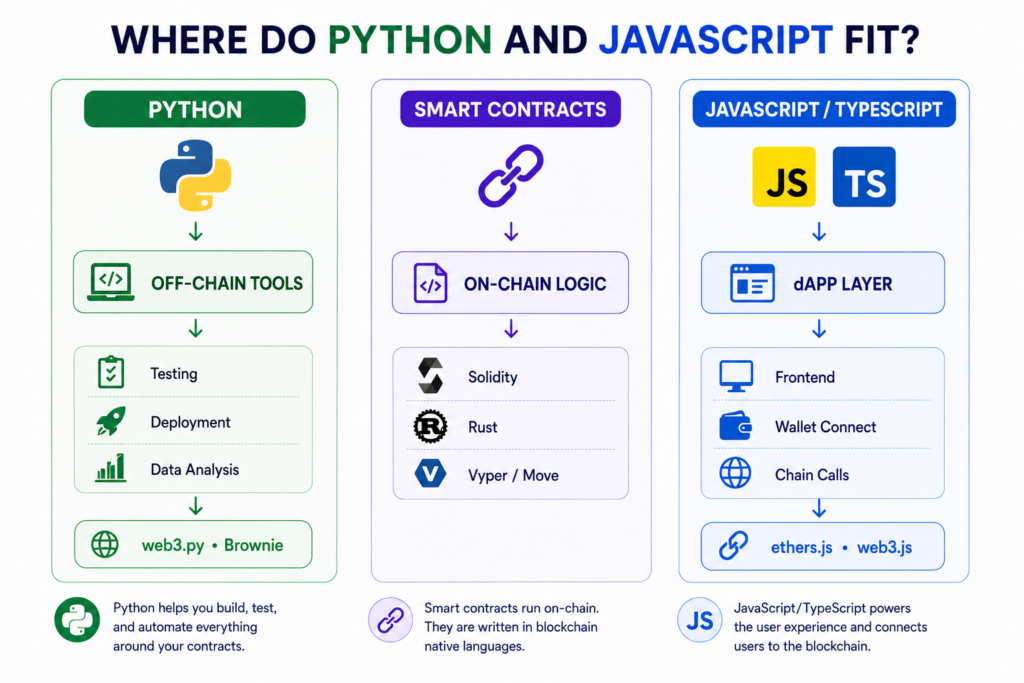
Yes — just not usually for the contract itself. Blockchain Python shows up constantly through libraries like web3.py and Brownie, for writing tests, scripting deployments, and running on-chain data analysis that doesn’t need to live on the blockchain at all. For newcomers, treating Python as a first crypto coding language is a reasonable way to start experimenting before touching a production contract.
JavaScript and TypeScript play a bigger role, since almost every dApp needs a frontend that talks to a wallet and a chain, usually through ethers.js or web3.js. NEAR Protocol goes further and lets developers write actual smart contracts in JavaScript or TypeScript directly, lowering the barrier for web developers moving into blockchain coding.
AI coding assistants now sit on top of all of this. Tools like GitHub Copilot and Claude Code work across every language here, and reaching live chain data increasingly runs through a standard interface called the Model Context Protocol instead of custom code per model and chain. That helps with boilerplate — it’s not a substitute for knowing the language well enough to catch what the assistant gets wrong.
Matching a Language to Your Blockchain Project
Which language is used in blockchain work depends on which chain your users are already on and what you’re optimizing for, not which language ranks highest on an abstract list.
| Language | Primary Ecosystems | Best For | Key Trade-off |
|---|---|---|---|
| Solidity | Ethereum, BNB Smart Chain, Polygon, Arbitrum | Widest EVM adoption, biggest talent pool | Flexible enough that mistakes are easy to write |
| Vyper | Ethereum (EVM) | Auditability-first DeFi contracts | Smaller ecosystem, fewer libraries |
| Rust | Solana, Polkadot, NEAR | Maximum performance and memory safety | Steep learning curve |
| Move | Aptos, Sui | Asset safety by structural design | Newer ecosystem, less mature tooling |
| Go | Hyperledger Fabric, Cosmos SDK chains | Enterprise and app-specific blockchains | Not used for EVM-style public contracts |
| Cairo | StarkNet | Zero-knowledge proof generation, L2 scale | A genuinely new paradigm to learn |
| Clarity | Stacks (Bitcoin) | Predictable gas costs, formal verification | Non-Turing-complete limits what you can build |
| Python / JS / TS | Cross-chain tooling; NEAR (contracts) | Testing, scripting, frontends, prototyping | Rarely used for production EVM contract logic |
If your users are already on Ethereum or BNB Smart Chain, Solidity isn’t really a choice — it’s the entry fee. If you’re building something performance-critical from scratch, Rust or Move are worth the steeper learning curve, and if you’re validating an idea first, Python and JavaScript get you a working prototype fastest.
Is One of These Languages Actually the Safest?
Not really — security depends more on how a language is used than which one you picked. Clarity and Move both remove entire bug categories by design, a genuine structural advantage over Solidity’s flexibility. But the Vyper compiler bug covered earlier proves that even a language built around minimizing risk can still fail somewhere its designers didn’t expect.
The practical rule holds across every language here: a secure smart contract language reduces how many ways you can go wrong, but it doesn’t replace testing on a real network before mainnet, and it doesn’t replace an independent audit. Verifying how a transaction will actually behave — through tools like eth_call or debug_traceCall — catches problems no language’s design can fully prevent on its own.
Conclusion
There’s no single best blockchain programming language — every answer above is really an answer to “best for what.” Solidity and Vyper still run most of what happens on Ethereum and BNB Smart Chain, Rust and Move back the chains built around performance and airtight asset handling, Go quietly runs the enterprise chains most users never see, and Cairo and Clarity each bet on one idea taken further than any general-purpose language would.
Picking one comes down to where your users already are and what you can’t afford to get wrong. Learn the language your target chain actually runs, understand what it structurally protects you from, and treat the audit — not the language choice alone — as the real security backstop.
FAQ
What Language Is the Blockchain Itself Written In?
That’s different from which language contracts are written in. Bitcoin Core, the reference client, is written mainly in C++; Ethereum has multiple independent client implementations in Go, Rust, and other languages, since running diverse client software is itself a decentralization safeguard.
Is Solidity a Good First Language to Learn?
It’s a reasonable start if you already know JavaScript, since the syntax feels familiar. It’s harder if you’re brand new to programming entirely, since you’re learning general coding concepts and blockchain-specific ones — gas, state, immutability — at the same time.
How Much Do Blockchain Developers Earn, by Language?
Solidity developers earn an average of $91,310 a year globally, with the top 10% earning $168,000 and the bottom 10% around $20,000, according to CryptoJobsList’s 2026 salary data from over 7,000 submissions. Rust and Move roles at Solana- or Aptos-native teams often command similar or higher premiums, largely because the pool of experienced developers is smaller.
Can the Same Code Work Across Different Chains?
Not directly — a Solidity contract and a Move module aren’t interchangeable, since they run on entirely different virtual machines. What’s often portable is the frontend and RPC layer: wallets and dApp interfaces built in JavaScript or TypeScript can generally support multiple chains through a shared connection layer, even when the underlying contracts are written differently.