
A Layer 2 blockchain is a separate network that runs on top of a base chain like Ethereum. It processes transactions off to the side to make them faster and cheaper, then settles the results back to the base chain so they inherit its security. A rollup is the most common kind of Layer 2.
That one-paragraph answer hides a few moving parts, and the parts are where most of the confusion lives. This guide works through them in order: what separates a Layer 1 from a Layer 2, what a rollup actually does with your transactions, the job of the sequencer that orders them, and how the two main rollup families — optimistic and zero-knowledge — make different bets on proving they told the truth.
What Is a Layer 2 Blockchain?
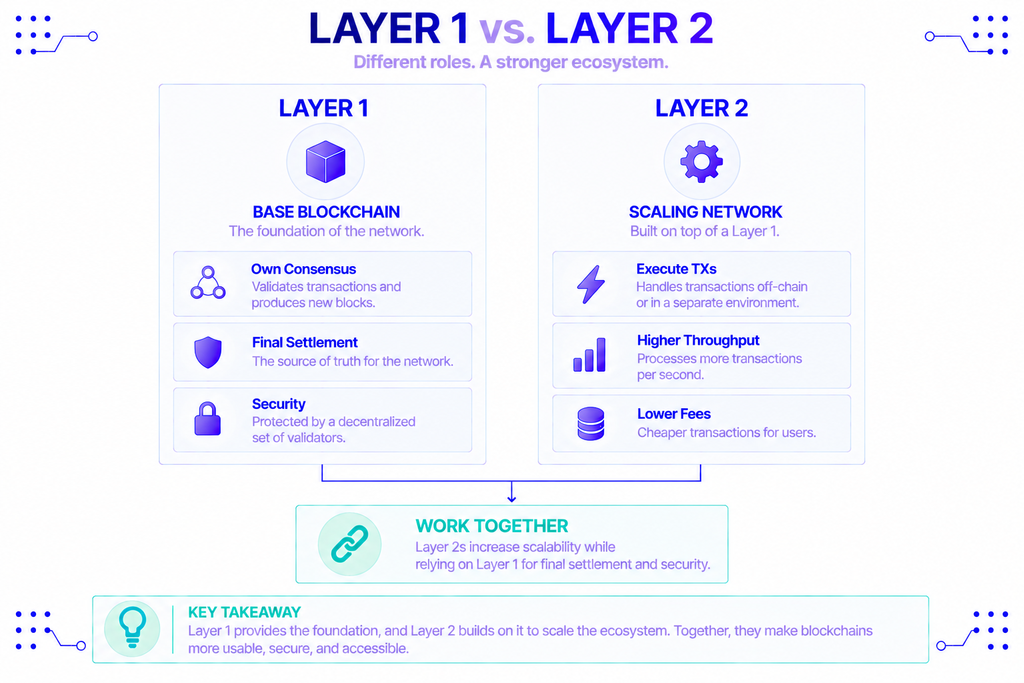
A Layer 1 is a base blockchain that runs its own consensus and keeps its own record of every account and balance. Ethereum and Bitcoin are Layer 1s. A Layer 2 is a network built on top of a Layer 1 that handles transactions itself but relies on the base chain to finalize and secure them.
The reason Layer 2s exist is throughput. Ethereum’s base layer processes only a few dozen transactions per second, and when demand spikes, fees climb with it. The obvious fix — bigger blocks — would let fewer people afford to run a node, which weakens the decentralization that makes the chain worth using. That tension between speed, security, and decentralization is the blockchain trilemma, and it’s why Ethereum chose to scale through separate networks instead of inflating its own blocks.
So a Layer 2 moves the heavy work elsewhere and reports back. The base chain stays light and keeps acting as the final source of truth, while the Layer 2 absorbs the volume. Here’s the practical result: the same transaction that might cost several dollars on Ethereum’s base layer usually costs a few cents on a Layer 2.
Layer 1 vs Layer 2: What’s the Difference?
The cleanest way to tell them apart is to ask where security comes from.
| Layer 1 (e.g. Ethereum) | Layer 2 (e.g. a rollup) | |
|---|---|---|
| Consensus | Its own validators | Borrows the Layer 1’s security |
| Main job | Final settlement and data | Executing transactions cheaply |
| Transaction cost | Higher, rises under load | A few cents |
| Example | Ethereum, Bitcoin | Arbitrum, Base, zkSync Era |
A Layer 2 doesn’t run a validator set that could rewrite Ethereum’s history. It posts its data and its results to Ethereum, and Ethereum is what everyone ultimately trusts.
What Is a Rollup?
A rollup is a Layer 2 that executes transactions off-chain, bundles hundreds or thousands of them into a single batch, and posts a compressed summary of that batch back to the base chain. The name is literal: it rolls many transactions up into one.
The savings come from sharing. Posting to Ethereum costs money, but a rollup pays that cost once per batch and spreads it across every transaction inside. Ten thousand transfers settled together each carry a tiny slice of a single settlement bill instead of paying the full price alone.
What keeps a rollup honest is that it doesn’t just post a summary — it also publishes the underlying transaction data to Ethereum, so anyone can independently reconstruct the rollup’s state and check it. Since Ethereum’s Dencun upgrade in March 2024, that data goes into “blobs,” a cheaper, temporary storage lane built specifically for rollups through EIP-4844. Blobs are the main reason Layer 2 fees fell to the single-digit-cent range.
Ethereum has kept widening that lane. The Fusaka upgrade activated in December 2025 and introduced PeerDAS, a method that lets nodes verify blob data is available by sampling pieces of it rather than each storing all of it. Two follow-up “blob parameter” forks raised the target from 3 blobs per block before Fusaka to 14 by early January 2026, with the ceiling rising from 6 to 21, according to Ethereum’s client teams. More room for blobs means more rollup data fits per block, which keeps the per-transaction cost low even as usage grows.
One distinction worth holding onto: a rollup is a type of Layer 2, not a synonym for it. Rollups are the dominant kind because their data lives on Ethereum, so they inherit its security directly. Other designs store that data elsewhere to cut costs further, trading away some of that guarantee — but rollups are what most people mean when they say Layer 2 today.
What Is a Sequencer?
A sequencer is the part of a rollup that receives your transaction, decides where it sits in line, and packs transactions into the batches that get posted to Ethereum. It’s the traffic controller: ordering first, settlement later.
The sequencer is also why a Layer 2 feels instant. When you send a transaction, the sequencer gives you a near-immediate “soft confirmation” that it’s been accepted and ordered, well before the batch reaches the base chain. That responsiveness is a big part of the Layer 2 experience, and the sequencer is what delivers it.
That power is also the catch. Whoever runs the sequencer controls transaction order, which means they can reorder transactions to extract value (MEV) or refuse to include specific ones. As of early 2026, most major rollups still run a single, centralized sequencer: Offchain Labs operates Arbitrum’s, Coinbase runs Base’s, and the Optimism Foundation runs OP Mainnet’s, per L2BEAT’s risk analysis.
The nuance that trips people up is the gap between two different guarantees. A centralized sequencer can delay or censor your transaction, but it can’t steal your funds or forge a fake balance — the rollup’s proof system blocks that regardless of who sequences. L2BEAT tracks this with a “stage” framework, and most large rollups sit at Stage 1: they have working proofs and let users exit without permission, but transaction ordering is still run by one operator. Decentralizing the sequencer is one of the open engineering problems of 2026, not a solved feature.
Optimistic vs ZK Rollups: What’s the Difference?
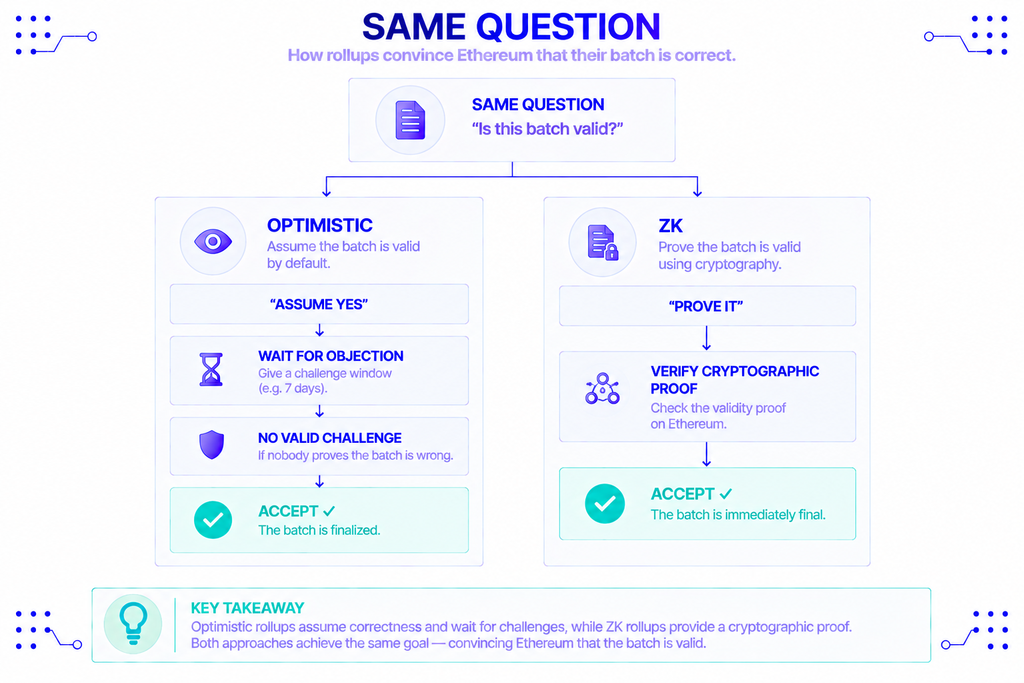
Every rollup has to convince Ethereum that its off-chain results are correct without forcing every Ethereum node to re-run the work. There are two ways to do that, and they split rollups into two camps.
Optimistic rollups assume the batch is valid and leave a window — usually around seven days — for anyone to challenge it with a fraud proof. If a challenge succeeds, the bad batch is thrown out and the submitter is penalized; if nobody objects, the batch finalizes. Arbitrum, Base, and Optimism are optimistic rollups. For a closer look at the two largest, see Arbitrum vs. Optimism.
Zero-knowledge (ZK) rollups skip the waiting. Instead of assuming correctness, they generate a cryptographic validity proof that the batch is correct and submit it alongside the data. Once Ethereum verifies the proof, the result is final — there’s nothing to dispute. zkSync Era, Starknet, and Linea use this approach.
| Factor | Optimistic rollups | ZK rollups |
|---|---|---|
| How correctness is proven | Assumed valid, challenged if wrong | Proven valid upfront |
| Typical withdrawal to Ethereum | ~7 days | Minutes to hours |
| EVM compatibility | Near-native, mature | Improving, historically harder |
| Examples | Arbitrum, Base, Optimism | zkSync Era, Starknet, Linea |
The difference you actually feel is the withdrawal time. Moving funds from an optimistic rollup back to Ethereum means waiting out the challenge window, roughly a week, unless you pay a third-party bridge to front the money sooner. A ZK rollup releases funds as soon as its proof verifies. The mechanics behind both — how a fraud proof narrows a dispute, and what a validity proof proves — are worth their own read in validity proofs vs. fraud proofs.
Which model wins long-term is still argued. Ethereum co-founder Vitalik Buterin put his bet on ZK years ago: “My opinion is that in the longer term, ZK-Rollups are eventually going to beat Optimistic Rollups because they have these fundamental advantages like you don’t need to have a seven-day withdrawal period,” he said at ETHSeoul in 2022, as reported by The Block. That bet hasn’t paid off yet — optimistic rollups still hold the most value in 2026 — but the gap in proving costs that once favored optimistic designs keeps shrinking.
Who Uses Layer 2s, and How Do You Connect to One?
Anyone who wants cheap Ethereum transactions ends up on a Layer 2. That covers DeFi traders dodging high gas fees, NFT and game projects that need thousands of low-cost actions, and payment apps moving small amounts. Because the biggest rollups are EVM-compatible, developers can deploy the same Solidity contracts they’d use on Ethereum, pointed at the Layer 2 instead.
Getting on and off a rollup runs through a bridge: you deposit funds from Ethereum to the Layer 2, transact cheaply there, and withdraw back to the base chain when you’re done. On EVM rollups you keep the same wallet and address — you’re just adding a network.
Building on a Layer 2 still needs the same infrastructure any chain does. An application has to read balances, broadcast transactions, and watch for new blocks, and on a rollup that means talking to both the Layer 2 and the Ethereum base layer it settles to. Running those nodes yourself is a real operational load, which is why many teams use a provider instead. NOWNodes, for example, offers RPC endpoints for major Layer 2 networks including Arbitrum, Optimism, and Polygon, so a team can connect through an API and skip maintaining the nodes themselves.
Conclusion
A Layer 2 is Ethereum’s answer to its own capacity limits: a network on top that handles transactions cheaply and leans on the base chain for security. Rollups are the version of that idea that caught on, because they publish their data to Ethereum and inherit its guarantees rather than inventing their own.
Underneath, three things decide how a given rollup behaves. The sequencer controls speed and, for now, sits with a single operator on most networks. The proof system — optimistic or ZK — decides how fast you can withdraw and whom you’re trusting in the meantime. And Ethereum’s blob capacity decides how cheap it all stays. Knowing which rollup makes which choice tells you more than any “best Layer 2” ranking, because the right answer depends on whether you care most about withdrawal speed, tooling maturity, or cost.
None of this is financial advice. Fees, blob limits, sequencer setups, and withdrawal windows all change as these systems mature, so check current figures before relying on them.
FAQ
Is a Layer 2 the same as a sidechain?
No. A sidechain runs its own validators and its own security, so if that validator set fails, your funds are at risk — the main chain isn’t backing it. A rollup posts its data and results to Ethereum and inherits Ethereum’s security instead. Both sit next to a main chain, but only one leans on it for safety.
Are Layer 2 transactions as secure as Ethereum?
For settlement, rollups inherit Ethereum’s security: their proofs and on-chain data mean no operator can forge balances or steal funds. The live trust gap is the sequencer, which on most networks is still a single operator that can delay or censor a transaction — but not take your money.
Do I need a different wallet to use a Layer 2?
Not on EVM-compatible rollups. The same wallet and the same address work across Ethereum and networks like Arbitrum, Base, and Optimism. You add the Layer 2 as a network and bridge funds over; the keys don’t change.
Do Layer 2s have their own cryptocurrency?
Some do, some don’t. Networks like Arbitrum and Optimism issued tokens (ARB, OP) used mainly for governance, but most rollups still charge gas in ETH. A Layer 2 having a token doesn’t mean you need it just to transact.
Is a rollup the same thing as a Layer 2?
A rollup is the most common type of Layer 2, but not the only one. The label “Layer 2” covers any network that scales a base chain while relying on it for security; rollups are the designs that do this by posting their transaction data to Ethereum. Other approaches keep that data elsewhere, which changes the security trade-off.