
A DEX’s full form — decentralized exchange — already tells you most of what you need to know: it’s a place to swap one cryptocurrency for another directly from your own wallet, with no company holding your money or approving the trade. Code executes the swap, not a support desk. Decentralized exchanges explained simply: no sign-up, no custody, no one who can freeze what’s already yours.
What is a DEX beyond that one-line pitch? This guide builds the answer from the ground up: what the term means, why the model exists, who actually uses one, and how a trade settles once you hit confirm.
What Does Decentralized Exchange Mean?
DEX explained without the marketing: a decentralized exchange is a set of smart contracts — self-executing code deployed on a blockchain — that let two strangers trade tokens without either one trusting the other, or a company, to hold the funds.
The word “exchange” is a little misleading here, and it trips up most newcomers. A DEX isn’t a business with a balance sheet — it’s software you connect a wallet to. Your wallet signs the transaction, the contract executes it, and the new tokens land back in your wallet seconds later.
Real examples make this concrete: Uniswap runs on Ethereum, PancakeSwap runs on BNB Smart Chain, Curve specializes in stablecoins, and Jupiter routes trades across Solana. That also answers what a DEX is in DeFi terms — not a standalone app, but the base layer that lending markets, yield vaults, and trading bots all plug into. With the dexes definition out of the way, the more useful question is why the model took off in the first place.
Why Do Decentralized Exchanges Exist?
DEXs solve a problem that’s cost people real money more than once: when an exchange holds your crypto, you’re trusting that company to stay solvent and keep your funds accessible. FTX collapsed in November 2022 while holding customer deposits, and a US court later ordered its estate to repay $12.7 billion to customers — money that had simply been unreachable in the meantime.
This isn’t just history, either. As recently as February 2026, Chicago-based trading firm BlockFills suspended client withdrawals, citing market conditions. A DEX removes that failure point by design — the contract can’t decide to pause withdrawals, because there’s no company account for it to freeze.
There’s a second reason: access. Anyone with a wallet and an internet connection can trade — no identity check, no approval, no region-blocking — and new tokens routinely list on a DEX first, long before a centralized platform picks them up.
The market has backed this with real volume. DEX spot trading climbed from roughly 6% of centralized exchange volume in 2021 to an all-time-high ratio of 37.4% in June 2025, and monthly DEX spot volume hit its own record of $419.76 billion that October. By January 2026, DEX spot volume stood at $231.29 billion for the month — more than double what it was two years earlier.
“If we don’t care about decentralization, and we don’t care about censorship resistance, and we don’t care about being non-custodial — then why have blockchains? What are any of us doing here?” — Hayden Adams, Uniswap founder, in a 2021 Bloomberg interview
That’s the design principle every DEX above is built around: if the platform can still freeze or reverse a trade, it hasn’t actually solved the problem.
Who Actually Trades on a decentralized exchange?
DEXs aren’t only for advanced traders, though that’s a common assumption. A few distinct groups rely on them, each for a different reason.
Active traders use decentralized exchanges to reach new tokens early — Solana sniper bots, for instance, exist specifically to buy a token the instant its liquidity pool goes live on a DEX like Raydium. DeFi users go further, plugging swaps directly into lending, staking, and yield strategies that never touch a centralized platform.
Then there are the people funding the pools rather than just trading in them. Liquidity providers deposit token pairs and earn a cut of every swap fee, effectively renting out their capital to the market. Developers and projects lean on DEXs to launch tokens and bootstrap trading without waiting on a centralized listing review.
Finally, there’s a group that’s easy to overlook: users in regions where centralized platforms are restricted, slow to onboard, or unavailable. For them, a permissionless exchange isn’t a preference — it’s the only practical way into global crypto markets.
How Does a decentralized exchange Actually Execute a Trade?
How does a DEX work once you get past the definition? Most decentralized exchanges skip order matching entirely, relying instead on one of three models: automated market makers, on-chain order books, or aggregators that route across both.
Automated Market Makers and the x·y=k Formula
The AMM model is by far the most common of the three, and it’s the one most beginners end up using without realizing it.
Automated market maker (AMM): a pricing mechanism that replaces buyer-seller matching with a liquidity pool and a math formula, letting a trade execute against pooled funds instead of another person’s order. Uniswap is widely credited with popularizing the model — see Uniswap’s own explanation.
A liquidity pool is a smart contract holding two tokens — say ETH and USDC. The most common design keeps the product of both balances constant, written as x × y = k: trade ETH into the pool and the ratio shifts, which moves the price automatically. Liquidity providers supply both sides of that pool and earn a share of every trade’s fee in return.
Order Books and Aggregators
AMMs aren’t the only model. Some DEXs — especially fast ones built for perpetual futures, like Hyperliquid — run an on-chain order book that matches bids and asks directly, closer to how a traditional exchange works. That approach needs a cheap, fast chain to be practical, since posting and canceling orders costs gas.
A third category, aggregators, doesn’t hold liquidity at all. Tools like Jupiter on Solana or 1inch on Ethereum scan multiple DEXs at once and route a trade through whichever combination of pools gives the best price — often the simplest way for a beginner to get a fair rate without checking five apps by hand.
What Happens When You Hit “Swap”
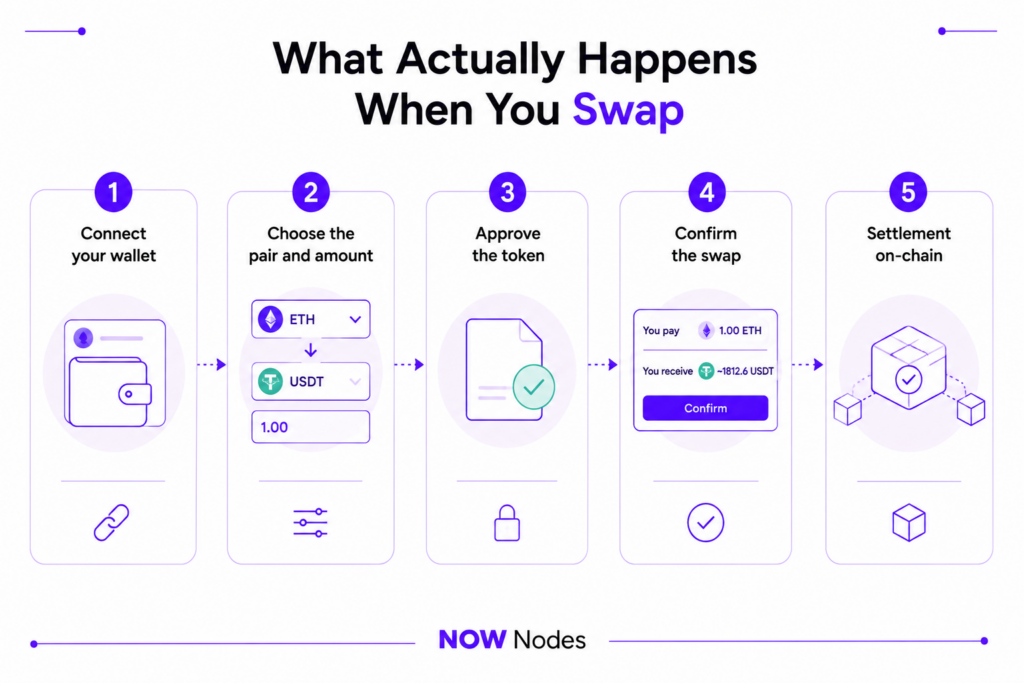
Underneath any interface, a single swap follows roughly the same sequence:
- Connect your wallet. A self-custody wallet like MetaMask links to the DEX front end — no account, just a signature request.
- Choose the pair and amount. The interface quotes a price along with estimated slippage and network fees.
- Approve the token (first time only). For a new token, you sign a one-time approval so the contract can access it.
- Confirm and sign. Your wallet signs the transaction and pays a gas fee to have it processed.
- Settlement happens on-chain. The contract executes the trade, and the new tokens appear in your wallet, publicly recorded for anyone to verify.
What Can Go Wrong on it?
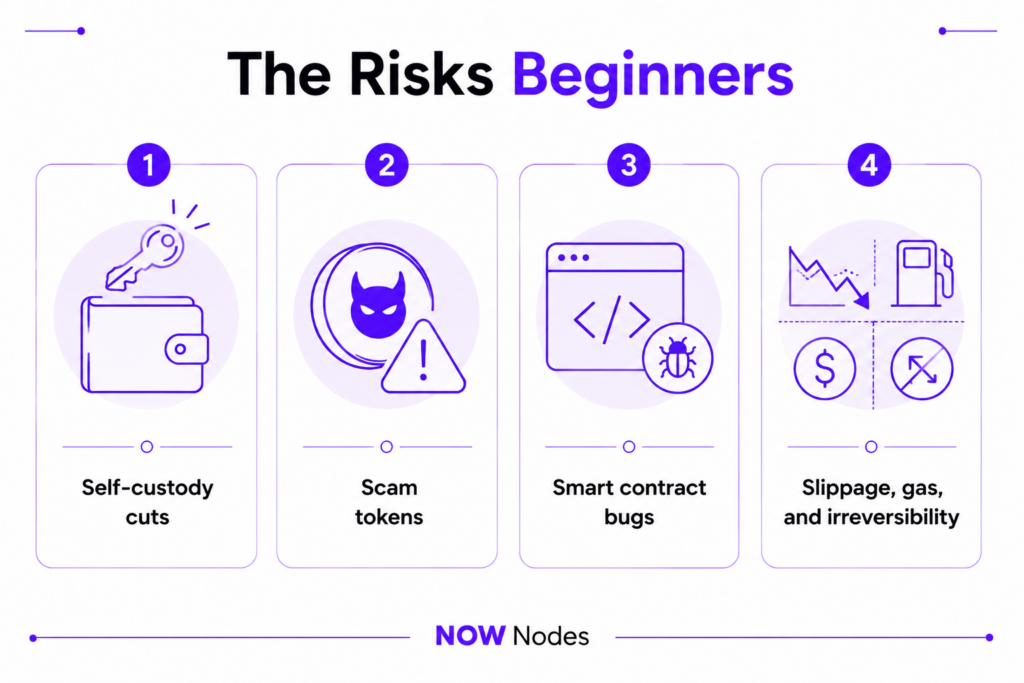
Self-custody cuts both ways, and an honest guide has to say so. Because a DEX gives you full control, it also gives you full responsibility — there’s no support line and no undo button.
- Scam tokens and rug pulls. Anyone can create a token and list it, so a coin that looks promising can be a trap whose creator drains the liquidity and disappears.
- Smart contract bugs. DeFi lost more than $1 billion to exploits in just the first four months of 2026, according to CCN’s tracking of major incidents — sticking to protocols reviewed by firms like the ones in our smart contract auditing guide meaningfully lowers this risk.
- Slippage, gas, and irreversibility. A large trade against a thin pool moves the price against you, busy networks spike gas costs, and sending tokens to the wrong address is final — there’s no chargeback on a blockchain.
- Impermanent loss. Liquidity providers can end up with less value than if they’d simply held the two tokens, since the pool automatically rebalances as prices move.
None of this should scare a careful trader off — it’s the price of being your own bank, and it’s manageable with a bit of caution.
What Infrastructure Keeps a decentralized exchange Running?
Here’s a detail most beginner guides skip: a DEX’s interface still has to talk to the blockchain constantly. Every quoted price, wallet balance, and swap has to be read from, or written to, the chain in real time, and that connection runs through blockchain infrastructure most users never see.
That infrastructure is an RPC endpoint: a server that lets an application query network data and broadcast signed transactions. A provider like NOWNodes supplies that access across 120-plus networks through a single API, which is how a DEX front end, wallet, or trading bot reads balances and submits swaps without its team running and syncing nodes for every chain it supports. Some of these same applications also pull live token prices from a market data API for the USD values shown next to a quote. The DEX is the interface; the node behind it is what keeps that interface responsive when volume spikes.
Conclusion
So what’s a DEX, once you zoom back out from the mechanics? A way to trade crypto directly from your own wallet, priced and settled by smart contracts, with no company in the middle holding your funds.
With the decentralized exchange explained from definition to infrastructure, the choice comes down to one trade-off: control versus convenience. Start with an audited, well-known protocol, keep the amount small while you learn the mechanics, and treat every approval as final before you confirm it — because on a DEX, it is.
FAQ
Are these platforms safe to use?
Established, audited DEXs are reasonably safe, but the risk sits with you rather than a company. Scam tokens, contract bugs, and irreversible mistakes are the real dangers, so verify a token’s contract and stick to reputable protocols.
Do you need an account or ID to trade on this Platform?
No. A decentralized exchange is permissionless — there’s no sign-up and no KYC. You just need a self-custody wallet, some crypto to trade, and enough of the network’s native token to cover gas.
What’s the biggest decentralized exchange right now?
By trading volume, Uniswap leads, handling roughly a quarter of all DEX activity over the past 30 days across the 47 chains it operates on, according to DefiLlama. PancakeSwap and Aerodrome follow, alongside fast-growing perpetuals platforms like Hyperliquid.
Does it charge lower fees than a centralized exchange?
Not necessarily. Most AMMs charge a swap fee around 0.3%, similar to many CEX trading fees, and you pay network gas on top — which can run higher than a CEX fee during congestion, or close to nothing on a low-cost chain.
Can a complete beginner use it safely?
Yes, especially through an aggregator that finds the best price automatically. Start with a small amount on a well-known protocol, double-check every address and approval, and treat the first few swaps as practice.