
A soulbound token is a token you cannot sell, trade, or send to anyone else. Once it lands in your wallet, it stays there. That one rule — no transfers — is what sets it apart from nearly every other token on a blockchain.
The point of locking a token in place is to make it mean something. A diploma you could resell would be worthless as proof of a degree. The same logic applies here: by removing the ability to move the token, you turn it into a credential, a membership, or a record of something you did. Below is where the idea came from, how it differs from an NFT, who is using it now, and the problems that are still unsolved.
Where Did Soulbound Crypto Come From?
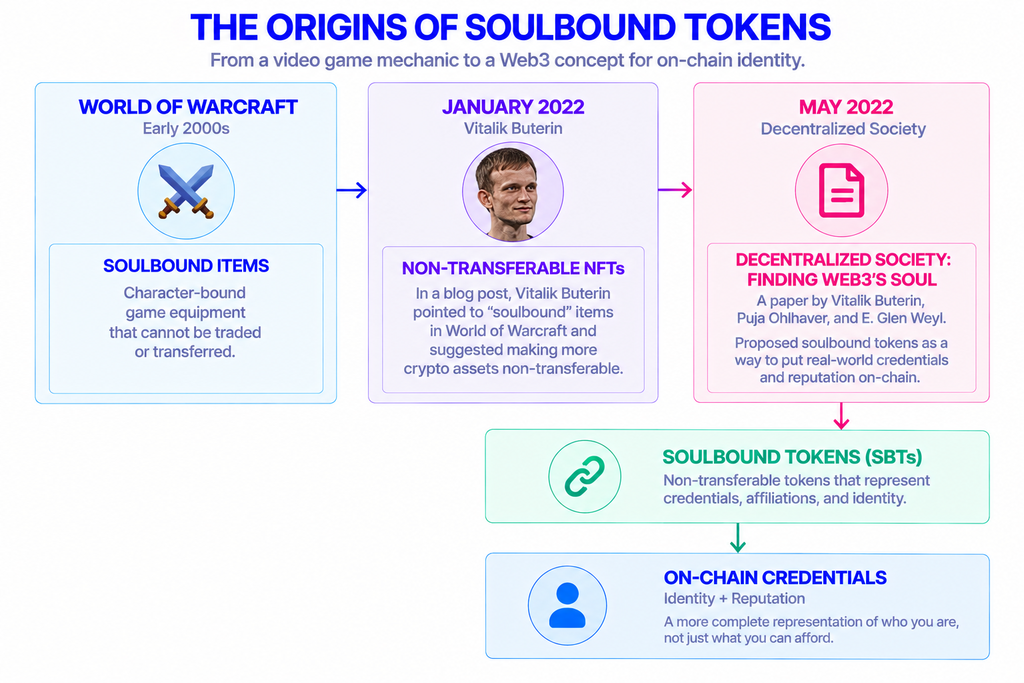
The term started as a reference to a video game. In a January 2022 blog post, Ethereum co-founder Vitalik Buterin pointed to “soulbound” items in World of Warcraft — gear that binds to a character and can never be traded. He argued that making more crypto assets behave this way could let NFTs “represent much more of who you are and not just what you can afford.”
A few months later, the concept got a full treatment. In May 2022, Buterin, lawyer Puja Ohlhaver, and economist E. Glen Weyl published a paper called “Decentralized Society: Finding Web3’s Soul.” It describes a world where non-transferable tokens record the credentials and affiliations of accounts the authors call “Souls.” The tokens held by those accounts are the soulbound tokens, often shortened to SBTs.
The paper framed a gap in crypto: most of Web3 is built around assets you can buy and sell, while trust in the real world runs on things you cannot buy — a license, a track record, a reputation. SBTs were proposed as a way to put that second category on-chain.
How Is an SBT Different From an NFT?
Both live on the same kind of smart contract, so the confusion is understandable. The difference is what happens after you receive one.
An NFT is built to move. You can list it on a marketplace, send it to a friend, or use it as collateral. Its price is the whole point for many holders. A soulbound token is built to stay. It has no resale value by design, and any attempt to transfer it is blocked by the contract.
| Feature | NFT (ERC-721) | Soulbound token (SBT) |
|---|---|---|
| Can it be transferred? | Yes — sold or sent to anyone | No — bound to the issuing wallet |
| What it represents | Ownership of an asset | Credential, membership, reputation |
| Market value | Priced and traded | No resale value by design |
| Sybil resistance | Weak — buy more to get more | Strong — tied to one identity |
| Typical example | Digital art, collectibles | A diploma, a KYC badge, event attendance |
A short way to hold the distinction: an NFT answers “what do you own?” while a soulbound token answers “who are you, and what have you done?”
Why Do Non-Transferable Tokens Matter?
Blocking transfers fixes a problem that free-moving tokens create. When anything can be bought, holding it proves only that you had the money. That breaks down in three common situations.
Reputation that can’t be purchased. Governance in many crypto projects is weighted by how many tokens you hold, so whoever spends the most has the most say. A credential that can’t be bought lets a system reward contribution instead of wealth.
Sybil resistance. A “Sybil attack” is when one person spins up hundreds of wallets to game a vote or an airdrop. If a reward is tied to a token that only a verified person can hold once, the trick stops working. One identity, one token.
Credential fraud. Degrees, certificates, and licenses get faked. A credential issued as a soulbound token can be checked against the issuer’s address in seconds, with no central database to forge or take offline.
Who Is Actually Using Soulbound Identity Today?
The idea moved past theory faster than most expected. A few live examples show the range.
Proof-of-KYC badges
The largest early deployment came from Binance. On September 8, 2022, it launched the Binance Account Bound (BAB) token on BNB Smart Chain — a non-transferable token minted by users who finished identity verification. It proves a holder passed KYC without exposing their personal details, and the holder can revoke it. Fourteen projects signed on at launch to offer rewards or Sybil protection to BAB holders.
Sybil resistance for funding and airdrops
Human Passport, previously Gitcoin Passport, grew out of the same need. It scores wallets for “proof of personhood” so grant rounds and airdrops can filter out fake accounts. The tool rebranded to Human Passport in December 2024 after the Holonym Foundation acquired it. As of March 2026, it had provided Sybil resistance for more than 120 projects and 150 campaigns, helping secure over $512M in capital flow.
Credentials, memberships, and attendance
Smaller use cases are where the concept fits most naturally. Universities and coding bootcamps can issue diplomas as SBTs. DAOs use them for voting rights that can’t be bought. Event organizers hand out attendance tokens that prove you showed up. In each case the value comes from the fact that the token stays put.
The audience, then, is broad: exchanges handling identity, protocols fighting bots, institutions issuing certificates, and communities that want influence to track participation rather than balance.
How Are SBTs Built on Ethereum?
There is no single soulbound standard. Instead, several Ethereum Improvement Proposals (EIPs) take different approaches, and most extend ERC-721 — the standard behind ordinary NFTs — so existing wallets and tools still recognize the token.
ERC-5192: Minimal Soulbound NFTs
The most widely referenced one is ERC-5192, finalized in 2022. It adds a tiny signal to an ERC-721 token that tells wallets and marketplaces the token is locked. Any transfer function on a locked token simply reverts. Because it is minimal, it is easy to bolt onto existing contracts.
EIP-4973: Account-Bound Tokens
Written by the same author who later proposed ERC-5192, EIP-4973 defines “account-bound” tokens as another way to describe a token that belongs to one address and never leaves it.
ERC-5484: Consensual Soulbound Tokens
ERC-5484 adds a detail the others leave open: who is allowed to burn the token. It bakes a burn authorization into the token when it is issued, which matters for credentials that might need to be revoked or reissued later.
The common thread is the “Soul” — the wallet address that holds the tokens. Stack several SBTs on one address, and the paper’s original vision starts to appear: a wallet that reads less like a bank balance and more like a résumé.
The Hard Parts: Privacy and Recovery
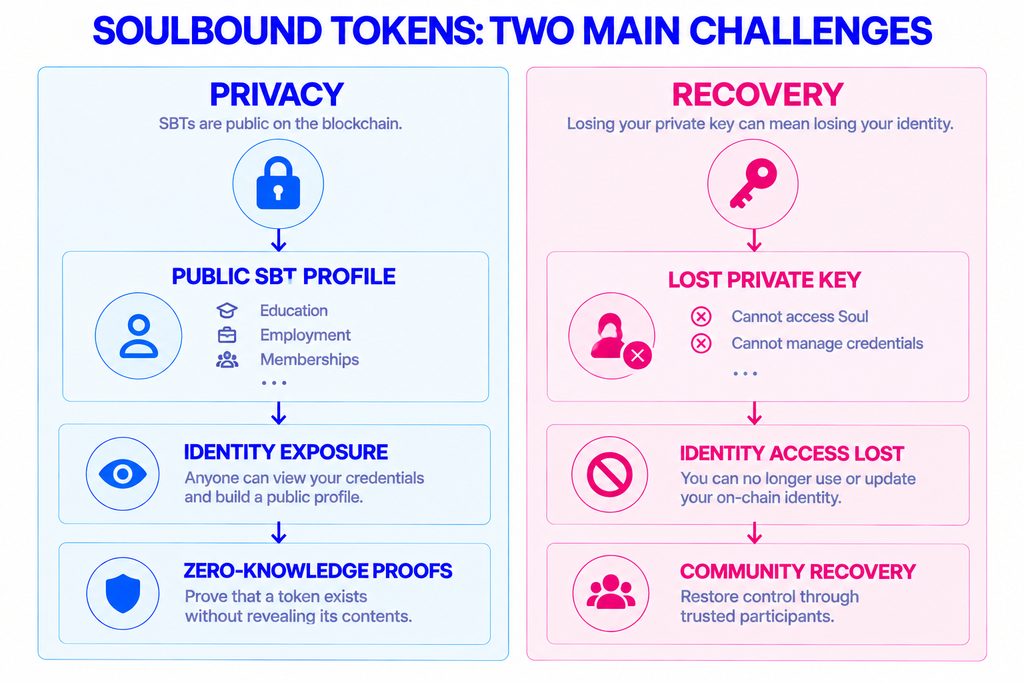
Honest coverage has to include what still doesn’t work. These are the two issues that come up in almost every serious discussion of SBTs.
Privacy. A public blockchain shows everything. If your wallet carries tokens for your employer, your degree, your medical certifications, and the events you attend, anyone can read that profile. Richie Bonilla, founder of the DAO dashboard Clarity, described a wallet full of identity tokens on an open ledger as a privacy nightmare. The proposed fix is zero-knowledge proofs — a method that lets you prove a token exists without revealing its contents — but that technology is still maturing.
Recovery. Lose the keys to a wallet holding regular tokens, and you lose money. Lose the keys to a Soul, and you lose your identity, with no way to move the tokens to a new wallet. The paper’s answer is “community recovery,” where members of your communities collectively approve restoring access. Some projects use social recovery with trusted guardians or time-locked transfers instead. None of these is a settled standard yet.
There is also a philosophical objection worth naming: a wallet address is not a person. People use many wallets, share them, or lose them, so binding identity to a single address is a rough fit for how humans actually behave online.
Working With SBTs Across Networks
Soulbound tokens are only useful if applications can read them. A dApp checking a BAB badge, a grants platform scoring wallets, or a university verifying a diploma all need to query the chain where the token lives — and SBTs today span Ethereum, BNB Smart Chain, and other EVM networks.
That is the part NOWNodes handles. We provide access to Ethereum, BNB Smart Chain, and 120+ other networks through a single connection, so teams building or verifying soulbound tokens can reach the right chain without running their own infrastructure. If you are issuing credentials on-chain or reading them inside an app, reliable network access is the groundwork everything else sits on.
Conclusion
A soulbound token is a simple idea with a wide reach: a token locked to one wallet so it can stand for something money can’t buy. The concept is only a few years old, and the clearest wins so far are credentials, proof-of-personhood, and Sybil resistance rather than the sweeping “Decentralized Society” the founding paper imagined.
Whether SBTs become everyday infrastructure depends on solving privacy and recovery in a way ordinary people can trust. The building blocks exist — finalized standards, live deployments, and real adoption numbers. What comes next is a question of whether the tooling catches up to the vision.
FAQ
What blockchains can soulbound tokens run on?
They work on Ethereum and other EVM-compatible chains, including BNB Smart Chain, where Binance issued the first large-scale SBT. Any network that supports ERC-721-style smart contracts can support soulbound tokens.
Does it cost anything to create a soulbound token?
Yes. Minting an SBT is an on-chain transaction, so it carries the usual network fee (gas) of whatever blockchain you use. The token itself has no price or resale value, but the act of issuing it costs a transaction fee like any other.
Can a soulbound token be removed or taken back?
It depends on how the contract was written. Standards like ERC-5484 let the issuer set a burn authorization when the token is created, so a credential can be revoked or destroyed later. Many SBTs, though, are permanent by design and cannot be removed once minted.
Are soulbound tokens a type of cryptocurrency?
No. A cryptocurrency is fungible and meant to be spent or traded. A soulbound token is non-fungible, non-transferable, and holds no monetary value — it is closer to a verifiable certificate than to a coin.