
A validator node is a computer that stakes cryptocurrency to check transactions, confirm new blocks, and keep a Proof-of-Stake blockchain running honestly. It does the job miners do on older networks, but instead of burning electricity to earn the right to add a block, it locks up coins as collateral and risks losing them for breaking the rules. That swap — energy for staked money — is the core of what a validator node in blockchain actually is.
Here’s the short version: a validator stores the ledger, follows the network’s rules, and votes with thousands of other machines on which blocks are valid. Do the job well and you earn rewards; cheat and the network destroys part of your stake. The more independent validators a chain has, the harder it is to attack or censor.
What Does a Validator Do on a Blockchain?
Every Proof-of-Stake blockchain is kept alive by a crowd of computers that each hold a full copy of the ledger and agree, block by block, on what happened. A validator is one of those computers that has put up a stake and earned the right to take part in that agreement.
It runs the blockchain’s client software, proposes and attests to new blocks, and carries financial responsibility for getting it right — earning rewards for honest work and losing part of its stake for negligent or malicious behavior, as the ethereum.org staking documentation describes.
Node vs. Validator: What’s the Difference?
A node is just a computer connected to the network that holds a copy of the chain and relays data. A plain node watches and passes messages along. A validator does more: it actively signs off on blocks and has money on the line. The terms “node validator” and “validator node” mean the same thing, so the word order doesn’t change anything.
From Miners to Stakers
Older networks like Bitcoin pick who writes the next block through Proof of Work: miners race to solve a puzzle, and the winner adds the block. Proof of Stake drops the race. It selects a validator to propose each block based on staked collateral, then asks a committee of other validators to attest that the block is valid.
Ethereum made this switch on September 15, 2022, in an event called The Merge, which cut the network’s energy use by more than 99%, according to ethereum.org. That is why validators, not miners, now secure most major smart-contract chains.
Why Do Proof-of-Stake Networks Need Validators?
The problem a validator solves is trust without a middleman. A bank keeps one authoritative ledger and you trust the bank. A blockchain has no bank, so it needs a way for strangers who don’t trust each other to agree on one shared history — and to make lying expensive.
Staking is how it makes lying expensive. To take part, a validator locks up real value, so an attacker can’t spin up thousands of fake identities for free. Misbehave, and that collateral gets cut. The security model fits in one line: honesty pays a little, cheating costs a lot.
Decentralization is the other half. Ethereum spreads the job across about 1.24 million validators backed by roughly 39.7 million ETH — close to a third of all ether in existence, per Datawallet’s 2026 staking data. The wider and more independent that set, the harder it is for any group to rewrite history or censor transactions.
One caveat is worth keeping in mind: the raw validator count overstates how decentralized the network really is. Since the Pectra upgrade let operators merge many small validators into fewer large ones, a single company can run thousands of validators behind one setup. Ten thousand validators run by one operator are not the same as ten thousand run by ten thousand people.
Who Runs Validators?
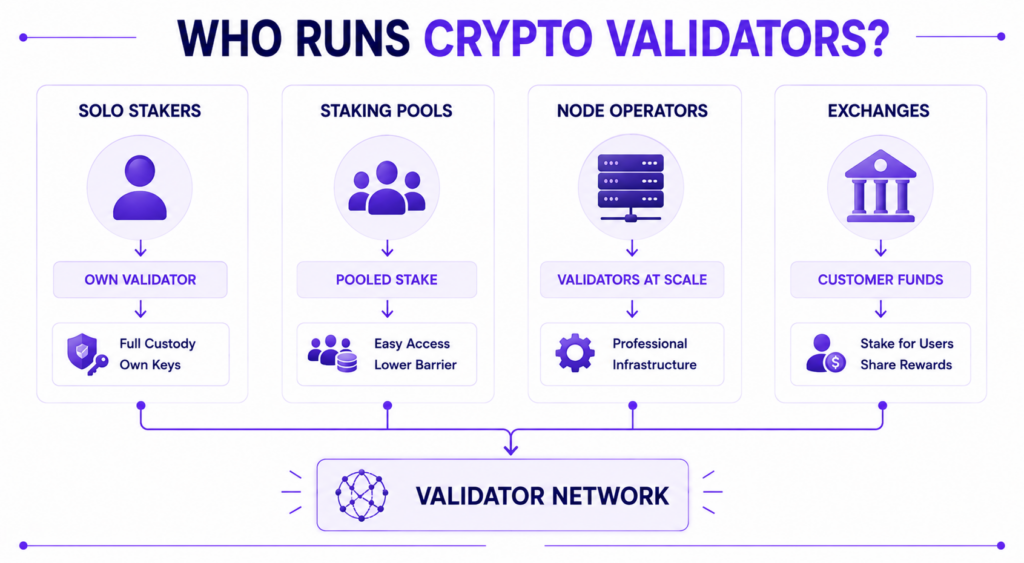
Validators aren’t all hobbyists in a basement, and they aren’t all giant firms either. In practice, crypto validator networks are held up by a mix of operators:
- Solo stakers — individuals running one or a few validators on home hardware, holding their own keys.
- Staking pools — services like Lido and Rocket Pool that pool many people’s coins, so you can stake without a full validator’s worth of tokens or the technical setup.
- Institutions and node operators — professional companies running validators at scale, for themselves and for clients.
- Exchanges — platforms that stake customer funds on their behalf and keep a share of the rewards.
That mix creates real tension. Pooling makes staking easy, but it also concentrates validators in a few hands — the opposite of what decentralization needs. Ethereum co-founder Vitalik Buterin flagged this exact risk:
“The theory is that larger stakers, including both wealthy individuals and staking pools, are going to run many validators on the same internet connection or even on the same physical computer, and this will cause disproportionate correlated failures.” — Vitalik Buterin, via Decrypt
If too many validators sit behind one operator or one server, they can fail — or be pressured — together. That is why solo stakers, who spread the network across thousands of independent machines, still matter even though pools are far more convenient.
Does Bitcoin Have Validators?
Not in the staking sense. Bitcoin uses Proof of Work, so no one puts up collateral to validate. Instead, thousands of full nodes check every transaction — signatures, balances, double-spends — while miners compete to produce blocks and collect the reward.
So when people search for a “bitcoin validator,” they usually mean a Bitcoin full node that verifies the chain’s rules without earning anything, not a Proof-of-Stake validator. On Bitcoin, validation and block production are two separate jobs; on Ethereum, one validator does both.
Validator vs. Full Node: How Do They Differ?
Every validator is a full node, but not every full node is a validator. The difference comes down to stake and the right to produce blocks.
A full node stores the entire ledger and independently checks every rule, but it doesn’t put up collateral and doesn’t earn rewards. A validator is a full node with money staked and an active role in consensus.
| Feature | Validator | Full node |
|---|---|---|
| Stores the full ledger | Yes | Yes |
| Independently checks every rule | Yes | Yes |
| Requires staked collateral | Yes | No |
| Proposes and confirms blocks | Yes | No |
| Earns rewards | Yes | No |
| Typical operator | Stakers, pools, exchanges | Individuals, businesses, explorers |
A full node is useful on its own: it lets you verify the chain without trusting anyone and gives applications a way to read on-chain data. For how validators compare with light nodes, archive nodes, and the rest, see our guide to the main types of blockchain nodes. Turning a full node into a validator is a separate, heavier commitment of money and uptime.
How Do You Become a Validator?
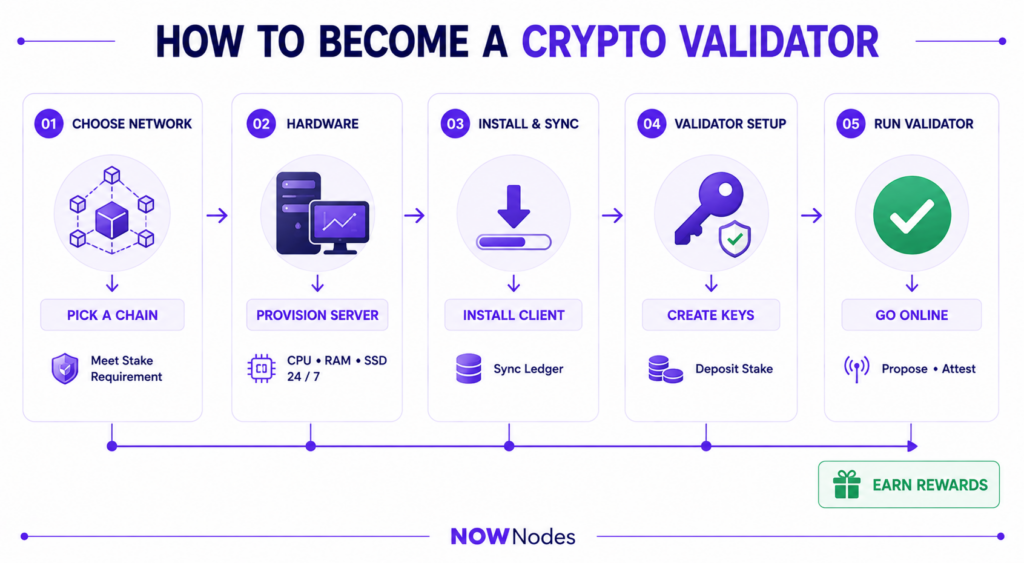
Running a crypto validator node is more approachable than it used to be, but it’s still a real commitment of money, hardware, and attention. The steps are broadly the same on every Proof-of-Stake chain:
- Pick a network and meet its stake. Each chain sets its own bar — 32 ETH on Ethereum, no fixed minimum on Solana (more on that below).
- Provision hardware. You need a machine that can stay online 24/7 with enough CPU, memory, and fast storage for the chain you chose.
- Install and sync the client. Download the network’s node software and let it pull down the full ledger. This can take hours to days.
- Generate validator keys and deposit your stake through the official contract or tool.
- Run it and keep it online. Once active, your validator proposes and attests to blocks. Downtime costs small penalties; steady uptime earns steady rewards.
That is the shape of it on almost any network. The details are what change from chain to chain.
What Each Network Requires
Stake and hardware requirements vary widely. A few 2026 examples show the range:
| Network | Minimum to run | Hardware reality |
|---|---|---|
| Ethereum | 32 ETH to activate; up to 2,048 ETH per validator since Pectra | Consumer-grade PC, SSD, stable connection |
| Solana | No protocol minimum, but competitive validators need large delegated stake | Heavy: 12+ cores, 256–512 GB RAM, NVMe, 1–10 Gbps |
| Most PoS chains | A set token amount or delegated stake | Home box to data-center server |
Two numbers are worth knowing. Ethereum still needs 32 ETH to activate a validator, but the Pectra upgrade in May 2025 raised the maximum a single validator can hold to 2,048 ETH, letting large operators consolidate many old validators into one.
Solana sets no minimum stake at the protocol level. What it demands instead is hardware and uptime. The official Solana requirements recommend at least a 12-core/24-thread CPU, 256 GB of RAM, and NVMe storage, and every validator pays to vote — a vote transaction for each block, costing up to about 1.1 SOL per day. One 2026 breakdown put the break-even point near 40,000 SOL of stake once hardware and voting costs are covered, per Valebyte’s validator analysis. Match the chain to the resources you actually have.
Validator Rewards, Commission, and Slashing
Validators get paid for honest work, but the pay is smaller and the risk larger than newcomers expect. On Ethereum in 2026, the base staking reward runs around 2.7% a year, with MEV (maximum extractable value) adding roughly another 0.5–1% for well-run nodes, based on 2026 staking data. Rewards come from new issuance plus a share of transaction tips, and the yield shrinks as more ETH is staked.
If you stake through a pool or delegate to someone else’s validator, that operator takes a commission. Rates vary a lot:
| Provider | Model | Commission on rewards |
|---|---|---|
| Lido | Non-custodial liquid staking | 10% |
| Rocket Pool | Non-custodial, permissionless | ~14% |
| Coinbase | Custodial exchange | 25% |
Those figures come from a 2026 liquid-staking comparison. Custodial exchange staking is the simplest way in but usually the most expensive — some platforms keep 25–40% of rewards. Running your own validator pays no commission to anyone, which is the main financial reason people do it.
How Does Slashing Work?
Slashing is the penalty that keeps validators honest. It’s an automatic, protocol-level punishment for provably malicious actions — proposing two different blocks for the same slot, or making contradictory attestations — not for honest mistakes or a brief outage.
On Ethereum, a slashing event triggers three things, per the official rewards-and-penalties documentation: an immediate penalty, a larger “correlation” penalty around 18 days later, and a forced exit over roughly 36 days. The immediate penalty is small since Pectra cut it to 1/4,096 of the validator’s balance — about 0.0078 ETH for a 32-ETH validator, down from 1 ETH before. The correlation penalty is the teeth: it scales with how many validators are slashed in the same window, so an isolated slip costs roughly 1% of stake, while a coordinated failure of many validators at once can wipe out most of it.
Going offline is treated far more gently. You leak small amounts while inactive, but you aren’t slashed. The design punishes cheating hard and laziness lightly — which is why slashing stays rare: fewer than 500 of Ethereum’s 1.2 million-plus validators have ever been slashed, according to Spark.
Do You Need to Run a Validator Yourself?
For most people, no. There are three ways to take part in a validator network without configuring a server:
- Stake through a pool or exchange and earn rewards on any amount, letting someone else run the machine.
- Delegate your tokens to a validator you trust on chains that support it, keeping custody while they do the work.
- Connect to existing nodes if you’re building an app, instead of running your own infrastructure.
That last point is where developers usually land. An app doesn’t need to be a validator to read balances, track validator status, or broadcast transactions — it just needs to talk to a node through an RPC (Remote Procedure Call) endpoint. Running that node yourself means managing storage, uptime, and client updates across every chain you support.
A provider like NOWNodes offers API access to nodes across 120+ blockchain networks, so wallets, staking dashboards, and validator-monitoring tools can reach the chain without operating the hardware. It doesn’t run validators for you or touch your stake — it handles the read-and-write access to the network, which is a different job from staking. Connecting to a node and running a validator are two separate commitments, and most teams only need the first.
The Bottom Line
A validator node is the unit of trust in a Proof-of-Stake blockchain: a staked computer that verifies blocks, earns rewards for honesty, and loses money for cheating. Strip away the jargon and it’s a simple bargain — put up collateral, follow the rules, get paid; break them, and the network takes part of your stake.
What makes validators matter isn’t any single machine but the crowd. Ethereum’s 1.24 million-plus validators are what let a system with no central authority still agree on one history and shrug off censorship — as long as they stay genuinely independent. Whether you run one yourself, stake through a pool, or just connect to a node to build, understanding what a validator does is the key to understanding how modern crypto networks stay secure.
None of this is financial advice. Staking yields, token prices, and network rules all move, so check the current figures before committing real funds.
FAQ
Can you run an Ethereum validator with less than 32 ETH?
Not directly — activating your own Ethereum validator requires a full 32 ETH deposit. You can still earn staking rewards on any amount by using a pool or liquid-staking service like Lido or Rocket Pool, or by delegating on chains that allow it. Those options run the validator for you and share the rewards minus a commission.
Will a validator get slashed just for going offline?
No. On Ethereum, downtime triggers a small inactivity penalty, not slashing. Slashing is reserved for provable consensus violations like signing two conflicting blocks. An offline validator slowly leaks a bit of its stake until it comes back online, then keeps the rest.
Is running a validator profitable in 2026?
It depends on your stake size, the token’s price, and your costs. Ethereum’s base reward sits around 2.7% a year before expenses, and running your own validator avoids pool commissions but adds hardware, electricity, and uptime obligations. On hardware-heavy chains like Solana, voting fees and server costs mean a validator often needs tens of thousands of tokens staked just to break even.
What is validator node hosting, and who is it for?
Validator node hosting means running your validator’s software on a cloud or dedicated server instead of home hardware, usually to get better uptime and network reliability. It suits operators who want to validate but can’t guarantee 24/7 power and connectivity themselves. You still control your own keys and stake — the host provides the machine, not the validator duties. Validator node management tools then handle monitoring, alerts, and client updates on top of that.
Which blockchains can you run a validator on?
Any Proof-of-Stake network. That includes Ethereum, Solana, Cardano, Avalanche, Cosmos, and Polkadot, along with most newer smart-contract chains. Proof-of-Work networks like Bitcoin don’t have validators — they rely on miners and full nodes instead, so there’s no stake to put up.