

Bitcoin hashrate is the amount of computing power miners aim at the network every second, counted as raw hash calculations. It is the closest thing Bitcoin has to a live pulse. A high hash rate means lots of machines fighting to mine the next block, and the chain stays both on schedule and hard to attack. A low one: the opposite.
That is the whole idea in one paragraph. The rest of this is the how and the why. How the hash rate sets mining difficulty, how it guards your coins, and why it lurches around the way it does.
What Is Bitcoin Hashrate?
Start with a single machine. A miner takes a block of transactions, runs it through a function called SHA-256, and gets back a 64-character string. It checks whether that string sits below a target value. Almost always it doesn’t, so the miner nudges one number and runs it again. Then again. A modern rig does this something like 200 trillion times a second.
Now add up every rig on Earth doing the same thing at once. That total, guesses per second across the whole network, is the hash rate. So if you want the hashrate meaning in plain words, here it is: the combined guessing speed of everyone mining.
Hashrate (Bitcoin) is the total number of SHA-256 computations that mining hardware runs per second while hunting for a block hash below the network’s target. No sensor measures it. It is estimated from how quickly blocks show up.
Notice what it doesn’t tell you. Not how many miners there are. Not what they earn. Only how much work is going in. Keep that straight and the rest of this falls into place.
How Do You Measure Hashrate?
In hashes per second, then scaled up hard, because the raw counts are absurd. Every jump is a thousandfold.
| Unit | Short | Hashes per second |
|---|---|---|
| Kilohash | KH/s | 1,000 |
| Megahash | MH/s | 1,000,000 |
| Gigahash | GH/s | 1,000,000,000 |
| Terahash | TH/s | 1,000,000,000,000 |
| Petahash | PH/s | 1,000,000,000,000,000 |
| Exahash | EH/s | 1,000,000,000,000,000,000 |
| Zettahash | ZH/s | 1,000,000,000,000,000,000,000 |
So where does the hash rate leave Bitcoin right now? Around 850 to 920 EH/s through mid-2026, give or take, depending on the tracker and how it smooths the data. Blockchain.com and CoinWarz both publish live charts if you want to watch it move. The network cleared 1 zettahash for the first time late in 2025. That is a thousand exahash, a 1 with 21 zeros after it. Genuinely hard to picture.
And every one of those figures is a guess. Since no rig phones home with its speed, analysts work the total out from block timing. More on that at the end.
Why Does It Matter?
Two jobs. It keeps blocks landing about every ten minutes, and it makes rewriting the ledger cost a fortune. Nobody runs Bitcoin. There is no head office, no server to seize, no off switch. All that coordination falls to miners burning electricity, and the hash rate is the meter on how much they are burning.
The deeper thing it solves is trust between strangers. Open the doors to anyone, put no one in charge, and you need cheating to cost more than it pays. Proof-of-work is that price tag.
How Hashrate Controls Mining Difficulty
Every 2,016 blocks, give or take a fortnight, Bitcoin resets its mining difficulty. Difficulty is just how small the winning hash has to be. Smaller target, longer odds.
Here is the loop. Blocks coming in too fast? The next reset raises difficulty. Too slow? It drops. The code checks how long the last 2,016 blocks actually took against the two-week goal, then corrects, which the Bitcoin Wiki walks through step by step. As of August 2026 that setting sat near 126 trillion, up from single digits a decade earlier.
The payoff is a coin supply that barely flinches no matter how many machines pour in. They don’t mint extra bitcoin. They just face a nastier puzzle. The reward per block stays on its clockwork path, currently 3.125 BTC after the April 2024 halving.
How It Keeps Attackers Out
Short answer: sheer scale. To undo recent payments, an attacker has to out-mine everyone else combined, more than half the network’s power. That is the famous 51% attack. Every honest terahash added makes the takeover pricier.
Run the rough math. Above 800 EH/s, half the network is roughly 400 EH/s. At maybe 270 TH/s from a top machine, you would need well over a million of the best miners ever built, plus the warehouses and a power station to feed them, to pull off a stunt the market spots within blocks and rejects anyway. Nobody has that sitting in a garage.
Researchers have put numbers on this. In a 2024 paper in the journal Financial Innovation, finance professor Robert I. Webb found that “hashrate fluctuations significantly influence security level changes,” which “underscores the importance of the hashrate in ensuring the security of the Bitcoin blockchain.” Translation: more work going in, harder the chain is to break.
Bitcoin Hashrate vs. Difficulty vs. Price
People blur these three all the time. They are not the same thing, and the order they move in tells you plenty.
| Metric | What it measures | Who sets it | How fast it moves |
|---|---|---|---|
| Hashrate | Actual mining power on the network | The miners, collectively | Continuously, minute to minute |
| Difficulty | How hard a valid block is to find | The protocol, on its own | Every 2,016 blocks (~2 weeks) |
| Price | What one BTC trades for | The open market | Constantly, all day |
Typical run of play: price climbs, mining gets juicier, rigs boot up, the hash rate rises, and about two weeks later difficulty catches up to pin blocks back at ten minutes. Price falls and the whole thing unwinds. Difficulty trails the miners. The miners mostly chase the money.
Who Actually Watches the Hashrate?
More people than you’d think, each for their own reason.
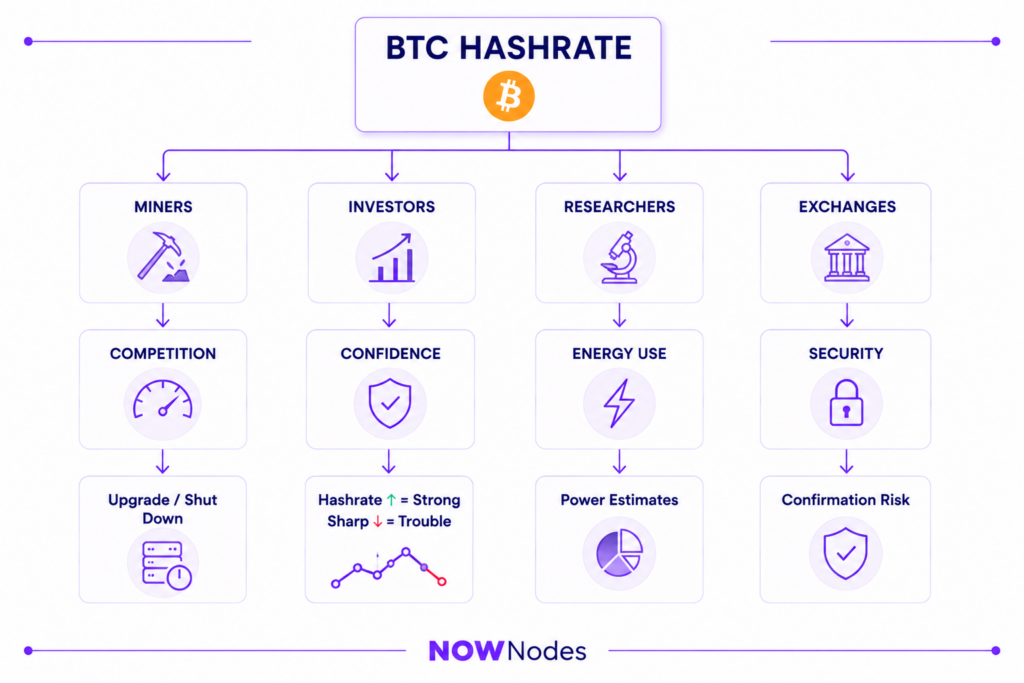
- Miners read it as the competition. Every rise in the hash rate trims their cut unless they upgrade, so it drives the call on running old machines, buying new ones, or pulling the plug.
- Investors and analysts treat it as a confidence meter. A steady grind upward says miners are putting real capital behind the network. A cliff says something broke. The “hash ribbons” indicator even tries to time miner capitulation off two moving averages of the hash rate.
- Researchers and regulators use it to ballpark energy use. The Cambridge Centre for Alternative Finance builds its electricity estimates partly from the hash rate and the hardware likely behind it.
- Exchanges use it to set risk. When the hash rate is huge, crediting a deposit after a few confirmations is safe, because unwinding those blocks would bankrupt whoever tried.
Picture an operator deciding whether to switch on 10,000 machines. They check today’s number, guess where the next difficulty reset lands, weigh it against their power contract, and only then flip the switch. The hash rate is the first input in the whole sum.
What Pushes the Hashrate Up and Down?
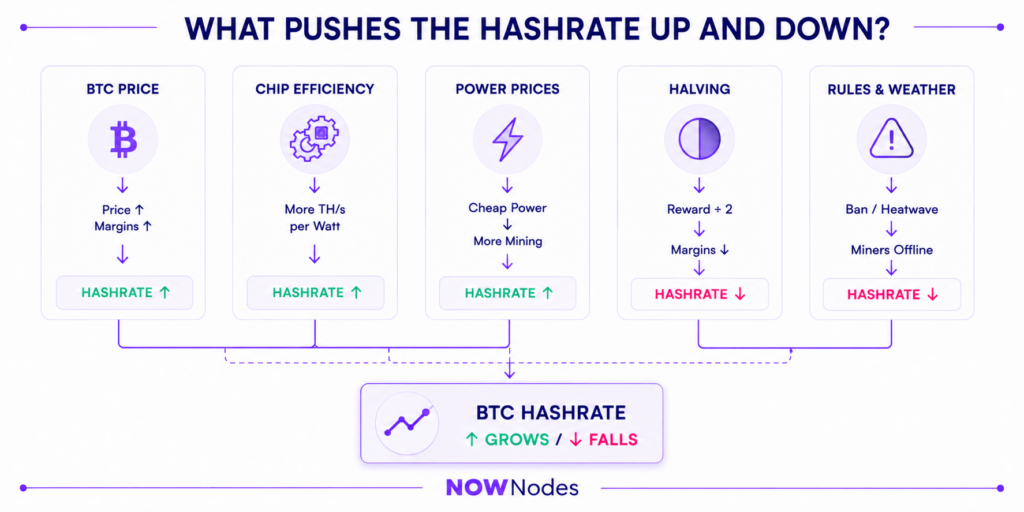
The hash rate drifts up over years and twitches by the week. A handful of forces do most of the work.
- Price. Higher BTC, fatter margins, more machines online. That is the main reason the BTC hashrate tends to track the market.
- Chip efficiency. A 2019 Antminer S9 sipped power for a trickle of output. Today’s S21 XP does 270 TH/s at 13.5 joules per terahash, and hydro-cooled units clear 500. Better chips lift the hash rate even at the same head count.
- Power prices. Miners hunt cheap electricity, so capacity slides toward wherever it’s cheapest and evaporates where rates spike.
- The halving. Every four years the reward is cut in half, gutting revenue overnight and forcing the weakest rigs to quit.
- Rules and weather. A ban or a heatwave can strip huge chunks offline in days.
The textbook case is China. On June 20, 2021, Sichuan ordered 26 mining farms dark, other provinces piled on, and a country running over 60% of global mining went quiet. More than half the hash rate vanished inside two months. And then? By that December it was back at record highs, this time humming out of Texas, Kazakhstan, and Russia. Biggest shock it ever took, shrugged off in half a year.
Where the Hashrate Stands in 2026
Early 2026 whipsawed. The network cleared 1 ZH/s around New Year, ran its seven-day average up toward 1.05 to 1.13 ZH/s in January, then cratered when a winter storm knocked Texas miners offline. That was its worst short drop since the China ban. A slice of capacity has also wandered off toward AI computing, which out-earns mining since the last halving.
Zoom out, though, and it is still climbing. CoinShares figures the total could reach roughly 1.8 ZH/s by year end. So the honest forecast is high and jumpy. Don’t expect a tidy line.
So Where Does the Number Come From?
This one trips people up. Nothing counts the world’s miners directly. The figure is reverse-engineered from what the chain does publish, mainly block timestamps and the current difficulty. Blocks arriving faster than that difficulty predicts means more power came online, so the estimate ticks up. Different sites average over different windows, which is why two of them rarely agree down to the decimal.
Anyone building a mining dashboard or an analytics tool has to reach that block data to work the number out for themselves. That means querying the network’s infrastructure, the software holding every block and the difficulty behind it.
Running that yourself means storing the full chain and nursing it around the clock, so plenty of teams rent access instead. NOWNodes, a blockchain infrastructure company, hands developers API access to Bitcoin and 120-plus other networks. You can pull difficulty, timestamps, and block height through one API and a Bitcoin block explorer without hosting a thing, and there are public endpoints for quick lookups against the same on-chain data the estimate leans on. The tooling itself is beside the point. The reminder underneath it isn’t: the figure everyone quotes is only as trustworthy as the block data it came from.
Conclusion
Strip it back and the hash rate is a work meter. How much computing muscle miners spend each second to find blocks and defend the ledger. It paces the chain through difficulty, and it prices out attackers by making 51% of the network hopeless to buy. That is why miners, analysts, researchers, and exchanges all keep one eye on it.
Just hold on to the caveat. The number is an estimate pulled off on-chain data, so it drifts between sources, and reliable access to that data is the whole game for anyone building on it. Mid-2026, it is high and restless, camped near the zettahash line after a record sprint and a brutal cold snap. Whatever this week prints, the logic never changes. More work guarding Bitcoin, harder Bitcoin is to break.
FAQ
Is More Hashrate Always Better?
For security, basically yes. More power means a costlier attack, full stop. For a single miner it cuts both ways, since a rising total means stiffer competition and thinner margins unless the hardware is efficient.
How Much Does One Miner Add?
A top air-cooled machine in 2026, say a Bitmain Antminer S21 XP, does about 270 TH/s. Sounds massive. Set against a network in the hundreds of exahash, it is a droplet in a reservoir, which is exactly why miners pool together.
Could the Hashrate Ever Hit Zero?
Not realistically. Even China’s 2021 crackdown, which lopped off half the total, never stopped mining. The rigs just moved. Zero would mean mining turning unprofitable everywhere on the same day.
Does Hashrate Move the Price?
Not directly. Price is supply and demand. Hash rate is mining activity. They often drift together because both answer to profitability, but the causation mostly runs price first, mining second, rarely the reverse.
Hashrate vs. Hashprice: What’s the Difference?
One is power, the other is pay. Hashprice is the daily revenue a miner earns per unit of hash rate, so it sags when difficulty climbs or BTC drops, even while the network’s power keeps rising.