
Chainstack is a blockchain infrastructure company that gives developers and enterprises managed access to node infrastructure across 70+ networks, positioning itself as what its own team calls “the control panel for blockchains.” Instead of running Geth, Erigon, or Solana’s Agave client yourself, you send requests to Chainstack’s hosted endpoints and get blockchain data back. It sits in the same category as NOWNodes, Alchemy, Infura, and QuickNode, and each of these providers solves the node-hosting problem with a different pricing model and a different target customer.
This overview walks through what Chainstack actually offers, who it’s built for, and where its request-unit pricing and enterprise focus create trade-offs a smaller or multi-chain team should know about before committing. For many of those teams, a flatter, broader-coverage provider like NOWNodes ends up being the more practical fit — a point this article returns to once Chainstack’s own model is on the table.
What Is Chainstack, Exactly?
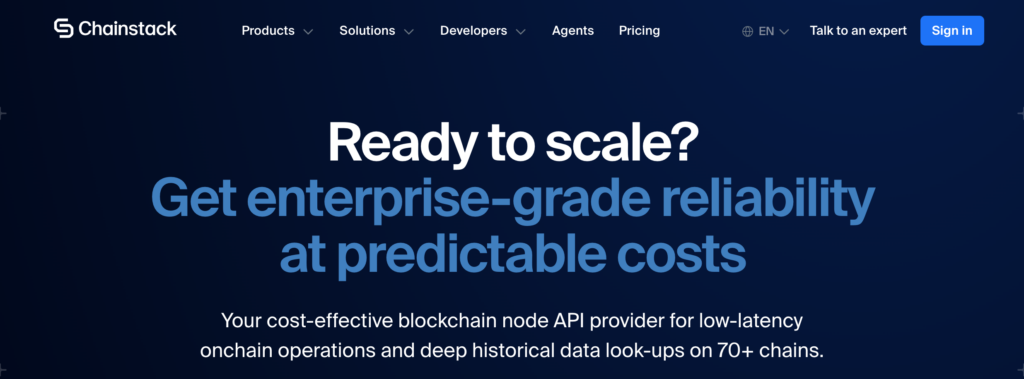
Chainstack is a managed node and API provider founded in 2018 by Laurent Dedenis and Eugene Aseev, headquartered in Singapore. The company describes its own product as a “cost-effective node API provider for low-latency onchain operations and deep historical data look-ups” across more than 70 blockchain networks.
A remote procedure call (RPC), in this context, is a way of asking a remote server to execute a function — such as reading a wallet balance — and return the result over a network connection, the way ethereum.org’s own JSON-RPC documentation describes it. Every blockchain client exposes this same basic interface; Chainstack’s product is running that client infrastructure so a customer doesn’t have to.
Chainstack leans into enterprise positioning more than most of its peers. Its site lists SOC 2 Type II and ISO 27001 certifications, and it names customers including Circle, Trust Wallet, Ripple, TradingView, and Anchorage Digital. That combination of compliance documentation and named enterprise logos is a deliberate part of how the company differentiates itself in a crowded field.
Why Do Businesses Need a Provider Like Chainstack?
Running a blockchain node in-house is a genuine operational commitment. A synced Ethereum full node currently needs roughly 650–700 GB of disk and grows by several gigabytes a week, and it has to be re-synced or patched through every protocol upgrade a network ships.
A managed provider absorbs that maintenance. You get an authenticated endpoint, the provider keeps client software current and hardware scaled, and your engineering team writes application logic instead of babysitting servers. This is the same trade-off covered in more detail in what RPC nodes and endpoints actually do — the node itself is infrastructure, not product, for almost every team that isn’t building infrastructure as the product.
Chainstack’s CEO, Laurent Dedenis, framed the company’s role directly in a Google Cloud customer case study: “Ultimately, we are an infrastructure provider that enables enterprises to run blockchain in an enterprise way — with the right security, reliability, and monitoring.” That framing explains why the product leans toward compliance tooling and dedicated deployments rather than a bare-bones free tier.
Who Actually Uses Chainstack?
Chainstack’s customer list and product structure point at a specific kind of buyer: regulated or larger organizations that need documented security posture alongside blockchain access, not just an API key.
- Financial institutions and payment platforms — companies like Ripple and TradingView using node access as part of a larger, audited product.
- Custody and compliance-focused firms — Anchorage Digital and similar businesses where SOC 2 and ISO 27001 documentation matters during vendor review.
- Wallets and consumer apps — Trust Wallet uses Chainstack for parts of its infrastructure, alongside its own and other providers.
- Data and analytics platforms — firms such as Kaiko pulling structured on-chain data for downstream products.
A small team shipping a prototype or a single-chain side project is a different case. Much of Chainstack’s enterprise tooling — SSO, dedicated clusters, compliance paperwork — goes unused at that scale, and that unused surface area is worth weighing against a simpler, request-based provider for the same job.
Chainstack’s Core Products
Chainstack splits its offering into several distinct products rather than one flat API, and picking the right one matters for both cost and reliability.
Global Nodes and Dedicated Nodes
Global Nodes are Chainstack’s shared, geo-balanced RPC endpoints, with requests routed to the nearest of the company’s data centers automatically. This is the default entry point and what most free and low-tier accounts actually use.
Dedicated Nodes are isolated infrastructure built for one customer, starting from roughly $678 a month according to Chainstack’s product pages. They remove the noisy-neighbor risk of shared infrastructure but require a meaningfully larger budget commitment than the request-based plans below.
Unlimited Node, Self-Hosted Nodes, and Archive Data
The Unlimited Node product is a flat-rate gateway starting around $149 a month with no hard request cap, aimed at teams whose traffic is too unpredictable for a fixed request-unit quota to price cleanly. Self-Hosted Nodes let a customer manage their own deployment with Chainstack handling automation and maintenance rather than hosting the endpoint directly.
Archive Data access retains full historical blockchain state beyond what a pruned node keeps, which matters for analytics tools, tax software, and any application querying data older than a few thousand blocks. Chainstack also offers gRPC data streaming for continuous data delivery instead of repeated polling, a pattern also available through NOWNodes’ multichain gRPC streaming.
How Much Does Chainstack Cost?
Chainstack bills primarily through request units (RUs) — a per-plan monthly quota, with overage charged per million requests once that quota runs out. Here’s the current published structure:
| Plan | Monthly price | Monthly RUs | RPS limit | Overage cost |
|---|---|---|---|---|
| Developer | Free | 3 million | 25 | $20 / 1M |
| Growth | $49 | 20 million | 250 | $15 / 1M |
| Pro | $199 | 80 million | 400 | $12.50 / 1M |
| Business | $499 | 200 million | 600 | $10 / 1M |
| Enterprise | $990 | 400 million | Custom | $5 / 1M |
Source: Chainstack’s published pricing page; figures are current as of publication and should be re-verified before budgeting against them.
The free Developer tier is genuinely usable for prototyping, capped at one node and 25 requests per second. Past that, jumping to Growth at $49 a month is a real cost step for a side project, and archive data, dedicated nodes, and single sign-on are gated behind the Pro and Business tiers rather than included from the start.
Chainstack vs. NOWNodes: How the Two Compare
Both providers solve the same core problem — hosted blockchain access without running your own node — but they price and scope it differently. The table below lines up the concrete differences rather than declaring a winner.
| Chainstack | NOWNodes | |
|---|---|---|
| Network coverage | 70+ blockchains | 120+ blockchains |
| Pricing model | Request units, tiered per plan | Flat request quota per plan |
| Free tier | 3M RUs/month, 25 RPS, 1 node | 100,000 requests/month, 1 API key |
| Entry paid plan | $49/month (Growth) | €20/month (Pro) |
| Dedicated infrastructure | From ~$678/month | Configurable per network, no fixed RPS cap |
| Compliance certifications | SOC 2 Type II, ISO 27001 | Not advertised on published pages |
| Positioning | Enterprise and regulated deployments | Multi-chain products, cost-predictable teams |
Chainstack’s advantage is real for a specific buyer: a regulated fintech or custodian that needs SOC 2 documentation ready for a vendor security review will find that on Chainstack’s site, and it isn’t something every competitor publishes. That compliance layer is priced into every plan, though, whether or not a given customer’s use case requires it.
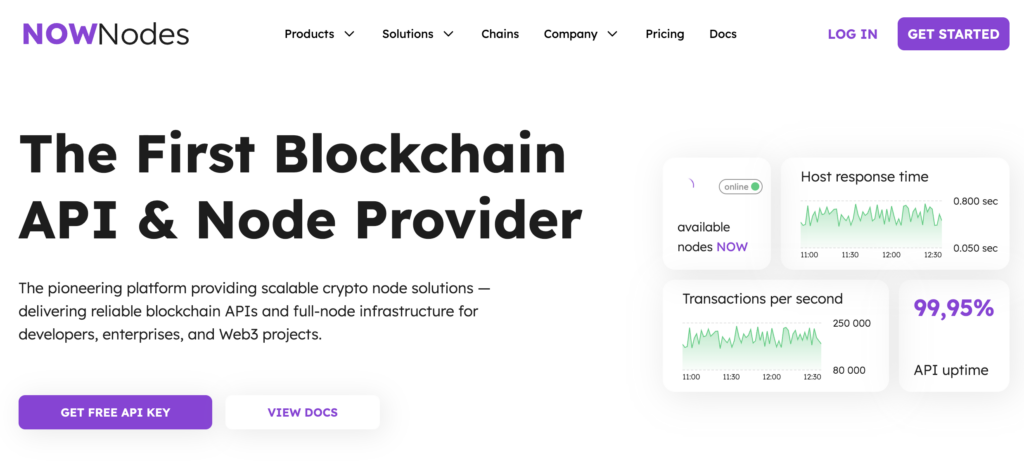
NOWNodes covers a wider set of non-EVM chains — Bitcoin, Dogecoin, Litecoin, Monero, and dozens of others sit alongside Ethereum and Solana under the same account — and its entry-level paid plan costs less than half of Chainstack’s Growth tier for a comparable request volume. For a multi-chain wallet, exchange, or explorer where Bitcoin-family coverage matters as much as EVM chains, that broader network list can matter more than either provider’s uptime number.
Neither model is objectively better across the board. A single-chain enterprise product with a compliance mandate has real reasons to pay for Chainstack’s certifications and dedicated infrastructure. A multi-chain product optimizing for predictable monthly cost and non-EVM coverage typically gets more value from a provider like NOWNodes’ pricing structure.
Switching From Chainstack: How Much Work Is It?
Because JSON-RPC is a standardized protocol, moving a working application from Chainstack to another provider is rarely a rewrite. Auston Bunsen, co-founder of QuickNode, made the general point plainly in an interview with Sacra: “most of the libraries are open source and provider-agnostic, so switching cost is almost nonexistent.”
An application built against eth_getBalance and eth_sendRawTransaction through a Chainstack endpoint can typically point at a different provider’s endpoint with a URL and API-key change. What actually needs review during a migration is provider-specific behavior: rate limits, response pagination on heavier calls, and which advanced methods — Trace, Debug, archive access — exist on one platform but not another.
That low switching cost is also why testing a second provider isn’t a big commitment. Running a staging environment against an alternative endpoint for a week or two is usually enough to compare latency, rate limits, and real cost under your own traffic pattern before touching production.
Limitations Worth Knowing Before You Commit
Chainstack’s request-unit model is the first thing to plan around. Because different RPC methods can consume different numbers of request units, a workload heavy on log scans or contract reads can burn through a monthly quota faster than the headline number suggests — check the exact cost of your most-used methods before estimating a plan.
Network coverage is the second consideration. Chainstack’s 70+ chains is broad, but it trails providers that also cover a wide non-EVM range; a product needing Bitcoin, Litecoin, or privacy coins like Monero alongside its EVM chains should verify current support rather than assume it, since several multi-chain providers cover more of that territory under one account.
Pricing structure is the third. Dedicated infrastructure starting near $678 a month, and paid tiers beginning at $49, put a real floor under Chainstack relative to some flatter-priced competitors — a cost worth modeling against your expected traffic before signing up, not after.
None of this makes Chainstack a poor product — its compliance documentation and enterprise support are genuine strengths for the buyer who needs them. The mismatch only shows up when the team in question is smaller, more cost-sensitive, or needs non-EVM chains that fall outside Chainstack’s list.
Conclusion
Chainstack is a solid choice for regulated or enterprise teams that need SOC 2 and ISO 27001 documentation alongside dedicated blockchain infrastructure, and its request-unit pricing scales predictably once you understand which of your RPC methods cost the most. For that specific buyer, the enterprise tooling is worth paying for.
For a multi-chain product, a cost-sensitive startup, or any team that needs Bitcoin-family and other non-EVM networks alongside Ethereum, a broader, flatter-priced provider such as NOWNodes is often the more practical starting point — covering 120+ networks under one account without the compliance layer’s added cost. Since switching between standards-compliant RPC providers is largely a configuration change, benchmarking both against your actual traffic before committing costs little beyond a week of testing.
FAQ
Is Chainstack free to use?
Chainstack’s Developer plan is free and includes 3 million request units a month at up to 25 requests per second across one node. That’s enough for prototyping, though production traffic or archive-data needs require moving to a paid tier.
What blockchains does Chainstack support?
Chainstack currently lists support for 70+ networks, including Ethereum, Solana, Polygon, Arbitrum, Base, and BNB Smart Chain. Coverage changes over time, so check Chainstack’s current network list for a specific chain before building against it.
Is Chainstack good for enterprise or regulated projects?
Chainstack’s SOC 2 Type II and ISO 27001 certifications, along with named customers like Circle and Anchorage Digital, make it a reasonable fit for teams that need documented compliance during vendor review. Smaller teams without that requirement typically don’t need the added cost this tooling carries.
How is Chainstack different from NOWNodes?
Chainstack bills through tiered request units and focuses its differentiation on compliance certifications and dedicated infrastructure for around 70 chains. NOWNodes uses flat request-quota pricing and covers 120+ networks, including a wider range of non-EVM chains such as Bitcoin, Dogecoin, and Monero, under one API key.
Does Chainstack offer a free trial for paid plans?
Chainstack’s published pricing doesn’t list a separate paid-plan trial; the free Developer tier itself is what most teams use to test the platform before upgrading. Check the current pricing page for any promotional terms before committing to a paid plan.