
Farcaster is a decentralized social protocol that lets anyone build a social app on top of a shared, portable network instead of a closed platform. Your username, followers, and posts live on open infrastructure rather than inside one company’s database, so you can move to a different app without losing any of it. The best-known app built on it is Warpcast, but Farcaster itself is the protocol underneath — and in 2026, that protocol has been through more change than most people who use it realize.
What Is Farcaster, Exactly?
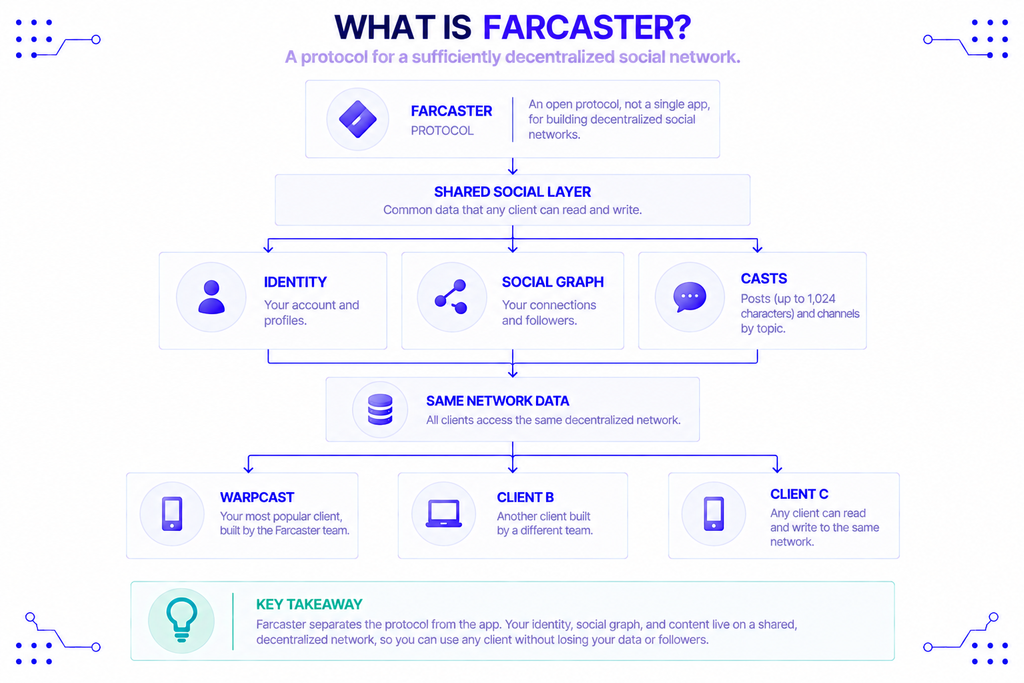
Farcaster is what its own documentation calls “a protocol for building sufficiently decentralized social networks,” not a single app you sign up for. That distinction matters: Twitter/X, Instagram, and TikTok are apps and protocols bundled together, so leaving one means abandoning your entire following. Farcaster splits those two layers apart, storing your identity and social graph on infrastructure no single company controls, so any developer can build a client that reads and writes to the same shared network.
Warpcast, made by Farcaster’s original team, is the most popular of those clients, similar to how Gmail is one app for reading email but not the only one. Posts on Farcaster are called casts, capped at 1,024 characters, and users organize them into topic-based channels the way subreddits organize Reddit.
Why Was Farcaster Built?
Centralized social platforms own the relationship between you and your audience, not you. Suspend an account or shut down a platform, and every follower, post, and connection built there disappears with it — there’s no way to export a social graph the way you’d export a contacts file.
Farcaster’s answer is to make that graph and your identity portable by design. Your Farcaster ID, or FID, is tied to your own Ethereum address rather than a platform’s internal user table, so no single app can delete your account or cut you off from the people who follow you. A second, more mundane problem it tries to solve is bots: creating an FID requires an on-chain transaction and ongoing storage rent, a small but real cost that plain email signups don’t have.
That second point is worth being honest about — it raises the bar, but it hasn’t eliminated the problem, a point critics have pushed on directly and one this guide comes back to further down.
Who Uses Farcaster?
Farcaster’s user base skews heavily toward the crypto-native crowd: developers, on-chain traders, and Web3 builders who already have an Ethereum wallet, rather than a general audience migrating from mainstream social apps. Early high-profile adopters, including Ethereum co-founder Vitalik Buterin and Base founder Jesse Pollack, cemented that crypto-first identity from the start.
What Do People Actually Do There?
Beyond posting casts and following channels, three use cases show up repeatedly:
- Token launches and trading. Clanker, an AI-powered token launcher that Farcaster’s team acquired outright in 2025, lets users deploy a token by replying to a bot in a cast.
- Mini apps. Interactive tools embedded directly inside a cast — minting an NFT, joining a poll, playing a game — without leaving the feed.
- AI agents and bots. A growing number of automated accounts post, reply, and trade on Farcaster programmatically, which is part of why wiring an AI agent into live blockchain data has become its own small industry around the protocol.
How Does Farcaster Work?
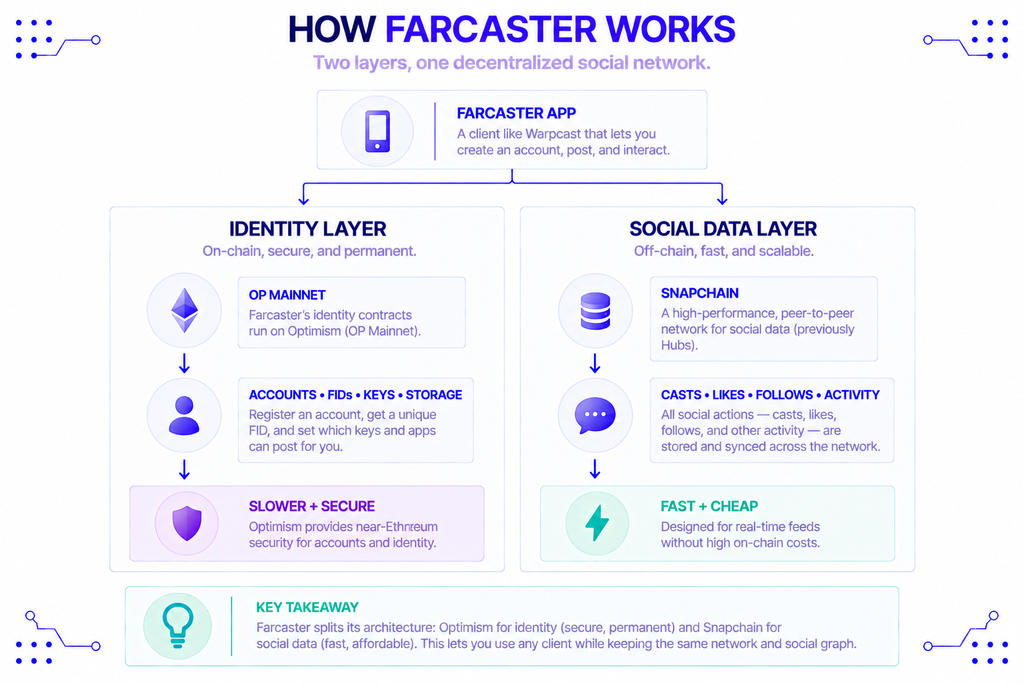
Farcaster splits its architecture into two layers, deliberately: a slow, expensive layer for identity that needs Ethereum’s security, and a fast, cheap layer for everyday posting that doesn’t.
Accounts, FIDs, and the Optimism Identity Layer
Registering a Farcaster account means sending a transaction to a set of smart contracts — the Id Registry, Storage Registry, and Key Registry — deployed on OP Mainnet, Optimism’s Ethereum Layer 2 network. That transaction assigns your address a permanent FID and establishes which apps and devices are allowed to publish casts on your behalf.
Optimism’s Layer 2 design is what makes this affordable: near-Ethereum security at a fraction of mainnet’s gas cost, the same trade-off covered in NOWNodes’ explainer on Optimism’s original execution engine. An application reading or writing to those identity contracts needs a working Optimism RPC connection to do it.
Hubs, Snapchain, and the Off-Chain Data Layer
Putting every cast, like, and follow directly on Ethereum would be far too slow and expensive for a real-time feed, so that traffic runs through a separate peer-to-peer network instead. Until April 2025, that network was a set of loosely synchronized servers called Hubs; Farcaster then replaced it with Snapchain, a purpose-built network resembling a blockchain’s node structure more closely, with actual consensus between nodes.
Written in Rust, Snapchain handles at least 10,000 transactions per second with sub-second finality, according to Datawallet’s technical breakdown of the migration. No cryptocurrency moves through Snapchain itself — it exists purely to keep every node agreeing on one canonical version of who posted what, and when.
Frames and Mini Apps
Frames launched in January 2024 as a way to embed a small interactive app directly inside a cast — mint an NFT, vote in a poll, check a price — without a click-through to another site. That format has since evolved into fuller Mini Apps, extending the same idea into trading interfaces and games that run natively in the feed rather than as a one-off embed.
Farcaster vs. Bluesky vs. Lens: How Do the Decentralized Social Options Compare?
Farcaster isn’t the only project trying to decentralize social media, and the three leading approaches solve the ownership problem in genuinely different ways.
| Farcaster | Lens Protocol | Bluesky | |
| Underlying infrastructure | Ethereum (OP Mainnet) for identity | Polygon, expanding to its own chain infrastructure | AT Protocol — no blockchain |
| Identity format | FID tied to an Ethereum address | Profile as an ERC-721 NFT | Decentralized identifier on a Personal Data Server |
| Native token | None | Yes | None |
| Data portability | Social graph readable by any client | On-chain profile ownership, transferable | Data movable between hosting servers |
| Approximate scale | Low hundreds of thousands of users | Similar order of magnitude to Farcaster | Tens of millions of users |
Bluesky’s AT Protocol skips blockchain entirely, betting that federation — independently run servers that sync with each other — solves the ownership problem without the gas fees or wallet requirement a blockchain-based approach carries. That trade-off shows up directly in the numbers: Bluesky’s user base runs into the tens of millions, according to a 2026 comparison from The Signal, dwarfing both of its blockchain-based peers combined.
What’s Happening to Farcaster in 2026?
Any current answer to “what is Farcaster” has to include what happened to the company behind it, because it changed hands this year. On January 21, 2026, Merkle Manufactory — the startup Dan Romero and Varun Srinivasan founded to build Farcaster — sold the protocol, its Warpcast app, and Clanker to Neynar, an infrastructure company that had already spent years building developer tools on top of the network.
Romero was direct about what the sale did and didn’t mean: “Farcaster is not shutting down. The protocol works and will continue to work,” he said, according to Decrypt’s coverage of the deal. Merkle returned the full $180 million it had raised to venture backers, including a16z Crypto and Paradigm, and Romero put the platform’s real usage at 250,000 monthly active users and more than 100,000 funded wallets as of December 2025 — figures worth noting given how often Farcaster’s raw activity numbers get disputed.
That dispute is real and predates the sale. Suji Yan, founder of Mask Network, put it bluntly in comments reported by The Defiant: “The data is all open. It’s an elephant in the room. Everyone should know that it’s just bots.” Independent analysis around the same period found Power Badge holders — accounts Farcaster’s own systems flag as active and not spammy — numbering only in the low thousands, a fraction of the platform’s total registered FIDs.
Neynar’s ownership didn’t settle things for long, either. On August 17, 2026, less than seven months after taking over, Neynar announced it was already looking for a new team to run Farcaster, Clanker, and its developer platform going forward. The company gave no single explanation, but crypto.news reported that gross protocol revenue had fallen from roughly $27.88 million in the first quarter of 2026 to about $245,690 by the third quarter — a decline steep enough to explain the search on its own. No successor or timeline had been named at the time of writing.
Where Does NOWNodes Fit In?
None of that ownership turnover changes the underlying mechanics: Farcaster’s identity layer still lives on OP Mainnet, and any wallet, bot, or analytics tool that wants to read or write FIDs, storage rentals, or key registrations still needs a working connection to that chain. NOWNodes provides RPC, WebSocket acess to Optimism alongside more than 120 other networks, so a team building on top of Farcaster’s on-chain layer isn’t running separate node infrastructure just for that one piece.
The same applies to anything built around Clanker’s token launches, which settle on-chain the same way any other Optimism transaction does. A developer connecting an AI agent to that data, rather than a human client, runs into the same need — which is the more general problem NOWNodes’ MCP Server is built to help with, by giving coding assistants a documented, structured way to reach blockchain data instead of hand-rolled API calls.
Conclusion
Farcaster is a genuinely different way to structure a social network — identity and data ownership on Ethereum, everyday posting on a fast off-chain network built for that purpose — and the underlying design hasn’t changed despite a turbulent year for the company running it. What has changed is who’s in charge and how sustainable the business looks: a $180 million wind-down, a new owner, and that owner already shopping for its own successor within seven months. Anyone building on Farcaster today should treat the protocol’s mechanics as stable and its corporate stewardship as very much unresolved.
FAQ
Is Farcaster the Same Thing as Warpcast?
No. Farcaster is the underlying protocol; Warpcast is one app built on top of it, made by Farcaster’s original team. Other developers can and do build separate clients that connect to the same network.
Do You Need Cryptocurrency to Use Farcaster?
Yes, in a limited way. Creating an account requires a small Ethereum transaction and ongoing storage rent, though many onboarding flows cover that initial cost so new users don’t need to hold ETH themselves first.
Is Farcaster Shutting Down?
No, based on the available evidence. Neynar, its current owner, is searching for a new operator as of August 2026, but no shutdown date or discontinuation has been announced.
Can I Use My Farcaster Account on More Than One App?
Yes. Because your identity and social graph live on the protocol rather than inside one app, any Farcaster-compatible client can display the same posts, followers, and channels.
What Happened to Farcaster Frames?
Frames, launched in January 2024, evolved into the broader Mini Apps format, which extends the same embedded-app concept from single interactive posts into fuller applications running inside the feed.