
Hedera Hashgraph is a public distributed ledger that reaches agreement without mining, without blocks, and without the energy bill that comes with both. Instead of stacking transactions into a chain, it weaves them into a graph — and that one structural choice is what makes it fast, cheap, and unusually fair. If you already understand blockchain, the quickest way to place it is this: same goal (a shared, tamper-resistant record everyone can trust), completely different machinery underneath. This guide walks from the plain idea up to the technical details, then lays the two approaches side by side so you can see exactly where they part ways.
The Basic Idea, in Plain Terms
Start with the problem every distributed ledger tries to solve: how do thousands of computers that don’t trust each other agree on the order of events, with no central referee? Blockchains answer with blocks and miners. Hashgraph answers with gossip and math.
Hashgraph: a consensus algorithm and data structure that records not just transactions, but the history of how information spread between computers — then uses that history to calculate agreement instead of voting on it out loud.
Hedera is the public ledger built on top of that algorithm. The token that powers it is HBAR — often written as hedera hbar — and it’s what users spend to pay for transactions and what secures the system through staking. Here’s the short version: hashgraph is the engine, Hedera is the car, and HBAR is the fuel.
Where the Technology Came From
Hedera didn’t appear out of nowhere. The hashgraph algorithm was invented by Dr. Leemon Baird, a computer scientist with a PhD from Carnegie Mellon, around 2015. He and Mance Harmon first commercialized it through a company called Swirlds, then launched the public-facing ledger.
The mainnet opened to developers on September 16, 2019, backed by roughly $124 million raised in a 2018 token sale. That timing matters. Hedera arrived after Bitcoin and Ethereum had already exposed the rough edges of blockchain — slow finality, high fees, enormous energy use — and it was engineered specifically to sidestep them.
One detail trips up older comparison articles, so it’s worth correcting. Hashgraph used to be patented and closed. In 2022 the governing council bought the intellectual property and open-sourced the code under the Apache 2.0 license. Then in September 2024, Hedera handed its entire codebase to the Linux Foundation as a project called Hiero — the first layer-1 public ledger to move its code to a neutral foundation. So the “it’s proprietary” objection you’ll still read online is out of date.
How the Ledger Reaches Consensus
This is the part that actually separates hashgraph from a blockchain, so it’s worth slowing down for. Two mechanisms do the heavy lifting: gossip about gossip, and virtual voting. You can read the full technical version in Hedera’s own documentation, but the plain-language version is below.
Gossip About Gossip
Nodes share information the way rumors spread. Each computer picks another at random and tells it everything it knows; that node does the same, and within a few rounds the whole community has the data. Plain gossip isn’t new.
The twist is that each message also carries a small bundle of metadata — who talked to whom, and when. So the network doesn’t just learn the transactions, it learns the exact history of how they spread. That history is the hashgraph: a directed acyclic graph (DAG) where every event points back to the two events before it. Because every participant ends up with the same graph, they all hold the same picture of what happened and in what order.
Virtual Voting and aBFT
Here’s the clever part. Once every node has the graph, they don’t need to send votes across the network to agree on order — the step that clogs traditional fault-tolerant systems with traffic. Each node already knows how every other node would vote, because it holds the same history, so it simply calculates the outcome on its own. That’s virtual voting, and it’s why consensus is quick without flooding the network.
The security bar this clears is asynchronous Byzantine Fault Tolerance (aBFT) — the strongest guarantee in the field. It means the ledger stays correct even if some nodes turn malicious and the network delays or drops messages. As Dr. Leemon Baird, the algorithm’s inventor, frames it, the design delivers “fast, fair, and secure” transactions even “in adversarial network environments.” Fairness here isn’t a slogan: because the graph records the true order in which transactions arrived, no participant can quietly reorder or delay them for personal gain — a power that block producers on many chains genuinely hold.
How It Differs From a Blockchain
Now the head-to-head. Both are distributed ledgers, both resist tampering, and both remove the need for a central authority. The differences are in how they get there.
Structure: Graph vs. Chain
A blockchain processes one block at a time. When two miners produce a block at once, one is kept and the other is discarded, along with the work that went into it. Hashgraph never throws anything away — every event is folded into the graph, which is why supporters describe it as “100% efficient.” No orphaned blocks, no wasted rounds.
Consensus, Speed, and Finality
Bitcoin and Ethereum reach finality slowly, and only in probability — you wait for confirmations because a transaction can still, in theory, be reversed. Hedera gives deterministic finality in roughly 3 to 5 seconds: once consensus is reached, it’s final, full stop.
Throughput follows the same pattern. The mainnet currently handles 10,000+ transactions per second for cryptocurrency transfers, and the algorithm itself has clocked over 250,000 TPS in lab benchmarks. Be skeptical of the “500,000 TPS” figure floating around older write-ups — that’s a theoretical ceiling, not a live number.
Cost, Energy, and Governance
Fees are fixed at about $0.0001 per transfer — a hundredth of a cent — and priced in US dollars rather than a volatile gas market. Energy use is where the gap is starkest. A study by University College London’s Centre for Blockchain Technologies found Hedera had the lowest energy use of the six networks it examined — on the order of 0.000003 kWh per transaction — and the council buys carbon offsets quarterly, making the platform carbon-negative.
Governance is the real trade-off, and it cuts both ways. A chain like Bitcoin is permissionless — anyone can run a node. Hedera is public but permissioned: consensus is handled by a Governing Council capped at 39 large organizations, each limited to two consecutive three-year terms so no single member entrenches itself. You gain accountability and stability; you give up some of the open, anyone-can-join ethos.
Here’s the comparison at a glance:
| Property | Hedera Hashgraph | Typical Blockchain |
|---|---|---|
| Data structure | Directed acyclic graph of events | Linear chain of blocks |
| Consensus | Gossip about gossip + virtual voting | Proof of Work / Proof of Stake |
| Finality | Deterministic, ~3–5 seconds | Probabilistic, minutes to hours |
| Live throughput | 10,000+ TPS | ~7–30 TPS (BTC/ETH base layer) |
| Fee per transfer | ~$0.0001, fixed in USD | Variable, often dollars |
| Energy per transaction | ~0.000003 kWh | High (PoW) to moderate |
| Governance | Permissioned council (≤39) | Usually permissionless |
What HBAR Actually Does
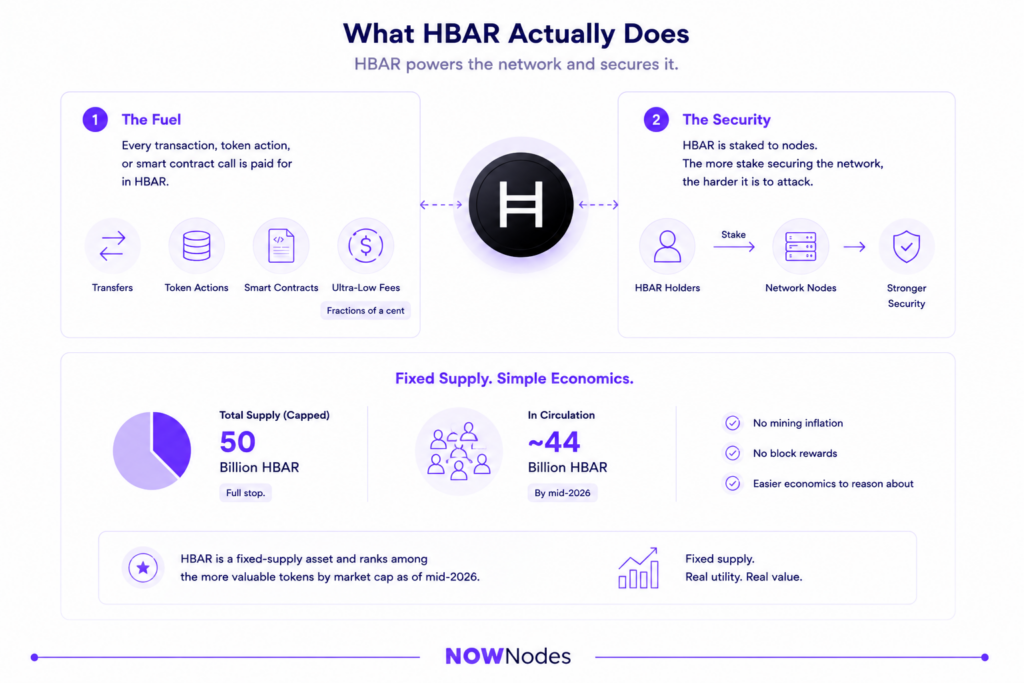
HBAR is the native asset, and it wears two hats. First, it’s the fuel: every transfer, token action, or smart-contract call is paid for in hedera hbar, at those fractions-of-a-cent rates. Second, it’s the security — holders stake HBAR to nodes, and the more stake standing behind the ledger, the harder it is to attack.
The supply is capped and known in advance: 50 billion HBAR, full stop, with roughly 44 billion in circulation by mid-2026. That fixed ceiling is one reason hedera crypto is often discussed alongside other large-cap assets, and by mid-2026 it sits among the more valuable tokens by market capitalization. There’s no mining inflation topping up the supply, which makes the economics easier to reason about than a chain that mints fresh coins to pay block rewards.
Who Uses the Platform, and for What
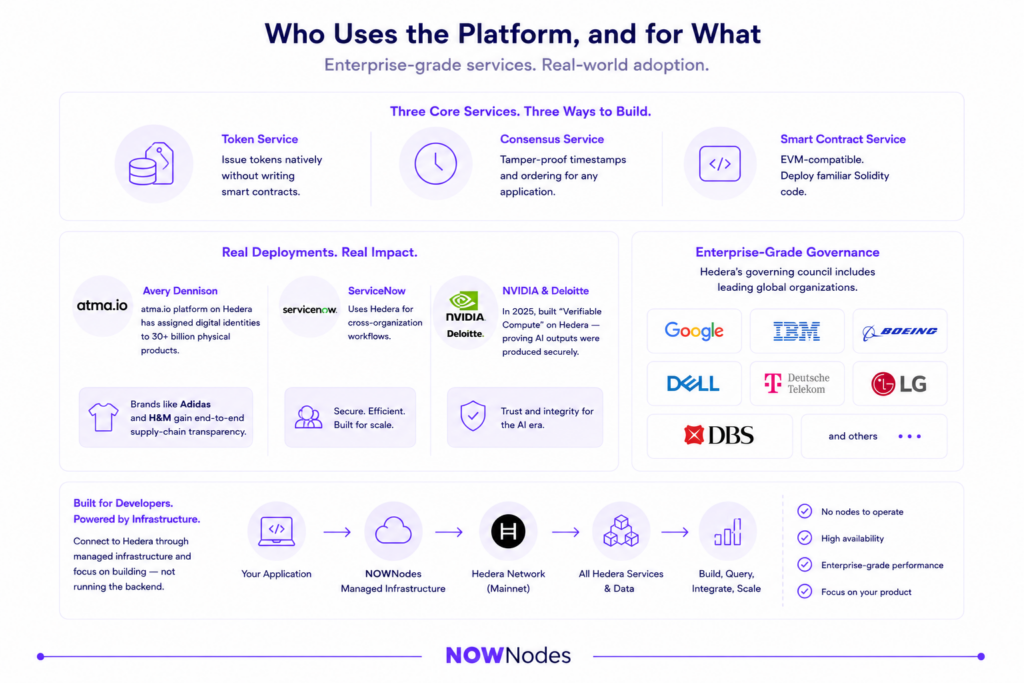
Theory is nice, but adoption is the real test. Hedera leans enterprise, and its three core services explain why. The Token Service lets companies issue tokens natively, without writing smart contracts; the Consensus Service supplies tamper-proof timestamps and ordering for any application; and an EVM-compatible contract service lets Ethereum developers deploy familiar Solidity code.
Real deployments back this up. Avery Dennison’s atma.io platform runs on Hedera and has assigned digital identities to more than 30 billion physical products, giving brands like Adidas and H&M end-to-end supply-chain transparency. ServiceNow uses the ledger for cross-organization workflows, and in 2025 Hedera worked with NVIDIA and Deloitte on “Verifiable Compute,” a way to prove that AI outputs were produced securely.
The council roster reads like a corporate directory — Google, IBM, Boeing, Dell, Deutsche Telekom, LG, and DBS Bank among them. For developers who want to build on or query the ledger, connecting through managed infrastructure is the fast path, so you can reach Hedera without operating the backend yourself with NOWNodes.
How to Buy and Store HBAR
If you want to buy Hedera Hashgraph, the process is the same as for any major asset. HBAR trades on most large exchanges — Binance, Coinbase, Kraken and others — where you can swap fiat or stablecoins for it. Confirm the ticker reads “HBAR” before you trade, since search results sometimes surface wrapped or copycat tokens.
For storage, HBAR is supported by wallets such as HashPack, built specifically for the ecosystem, alongside hardware options like Ledger for larger holdings. The usual rule applies: an exchange is fine for active trading, but self-custody in a wallet you control is safer for anything you plan to hold. And never share your seed phrase — no legitimate service will ever ask for it.
The Honest Trade-offs
No technology is free of compromise, so it’s worth being clear-eyed. Hedera’s speed, low fees, and efficiency are real and independently measured. But the permissioned council model means the ledger is more centralized at the governance layer than a chain like Bitcoin, even with the code now open source and community-run through the Linux Foundation.
Decentralization maximalists treat that as a red line. Enterprises often see it as exactly the accountability they need. Both readings are fair — the right answer depends on the use case, not on ideology.
Conclusion
Hedera Hashgraph swaps the blockchain’s chain-of-blocks for a graph, and its mining race for gossip and virtual voting. The payoff is concrete: deterministic finality in seconds, fees of a hundredth of a cent, throughput in the thousands of transactions per second, and energy use low enough to keep the platform carbon-negative. The cost is a permissioned governance model that some will welcome and others won’t.
If you take one thing away, let it be this: Hedera isn’t a faster blockchain — it’s a different structure aiming at the same goal, and understanding that difference is the whole point.
FAQ
Is Hedera Hashgraph a blockchain?
No, and that’s the point. Hedera Hashgraph is a distributed ledger, like a blockchain, but it uses a graph structure and the hashgraph algorithm instead of a chain of blocks and mining. Same broad purpose, different engineering.
What is HBAR used for?
HBAR pays transaction fees on the platform and secures it through staking. Fees sit at about $0.0001 per transfer and are priced in US dollars, so costs stay predictable.
Is it faster than Ethereum?
On the base layer, yes. Hedera handles 10,000+ transactions per second with 3–5 second finality, while Ethereum’s base layer settles far fewer and takes longer to finalize.
Is Hedera actually decentralized?
It’s public but permissioned. Anyone can use it and build on it, but consensus is run by a term-limited council of up to 39 organizations. The underlying code is open source under the Linux Foundation.
How do I buy Hedera Hashgraph?
HBAR is listed on major exchanges such as Binance, Coinbase, and Kraken. Buy it there, confirm the ticker is HBAR, then move it to a wallet like HashPack or a hardware device for long-term storage.
Why is it considered energy-efficient?
It doesn’t mine. Without proof-of-work, that University College London study measured energy use at roughly 0.000003 kWh per transaction, and the council offsets more carbon than the system emits.