
Open any Ethereum smart contract on GitHub and the code looks like a cross between JavaScript and C++ — curly braces, semicolons, functions, and a few keywords you won’t find anywhere else. That’s Solidity. It’s the language behind most of the value locked in DeFi, and understanding its syntax is the first real step toward reading, auditing, or writing smart contracts yourself.
This guide starts at the definition and works up to compiler internals, so it works whether you’ve never opened a .sol file or you’re deciding which compiler version to pin in production.
What Is Solidity?
Solidity is a statically typed, object-oriented programming language built specifically for writing smart contracts that run on the Ethereum Virtual Machine (EVM). It compiles human-readable code into EVM bytecode, which is what actually executes on-chain.
Gavin Wood proposed the language in 2014, and it first appeared publicly at Devcon0 that November. Development has continued since under the Ethereum ecosystem’s Solidity team, with contributions from Christian Reitwiessner, Alex Beregszaszi, and dozens of others. The language is open source, licensed under GNU GPL v3.0, and every file uses the .sol extension.
If you’re searching for a plain-language answer to “what is Solidity” or “define Solidity,” this is it: a purpose-built language for encoding rules — token transfers, voting, escrow, lending — into code that runs without a central server and can’t be quietly changed afterward.
Solidity meaning, in one line: a curly-braces language, similar in shape to JavaScript and C++, that compiles into bytecode the Ethereum network executes deterministically on every node.
What does Solidity code actually look like?
A minimal Solidity program is a contract — a bundle of state variables and functions, similar to a class in object-oriented languages. Here’s the “Hello World” version straight from the official docs:
// SPDX-License-Identifier: MIT
pragma solidity >=0.8.0 <0.9.0;

contract HelloWorld {
    function helloWorld() external pure returns (string memory) {
        return "Hello, World!";
    }
}
Five lines carry a lot of Solidity syntax at once: a license identifier, a pragma statement pinning the compiler version, a contract block, a function with visibility (external) and a state-mutability modifier (pure), and an explicit return type. Nothing here is decorative — each piece maps to something the compiler checks before it will even attempt to build bytecode.
Why Does Solidity Syntax Need to Be So Strict?
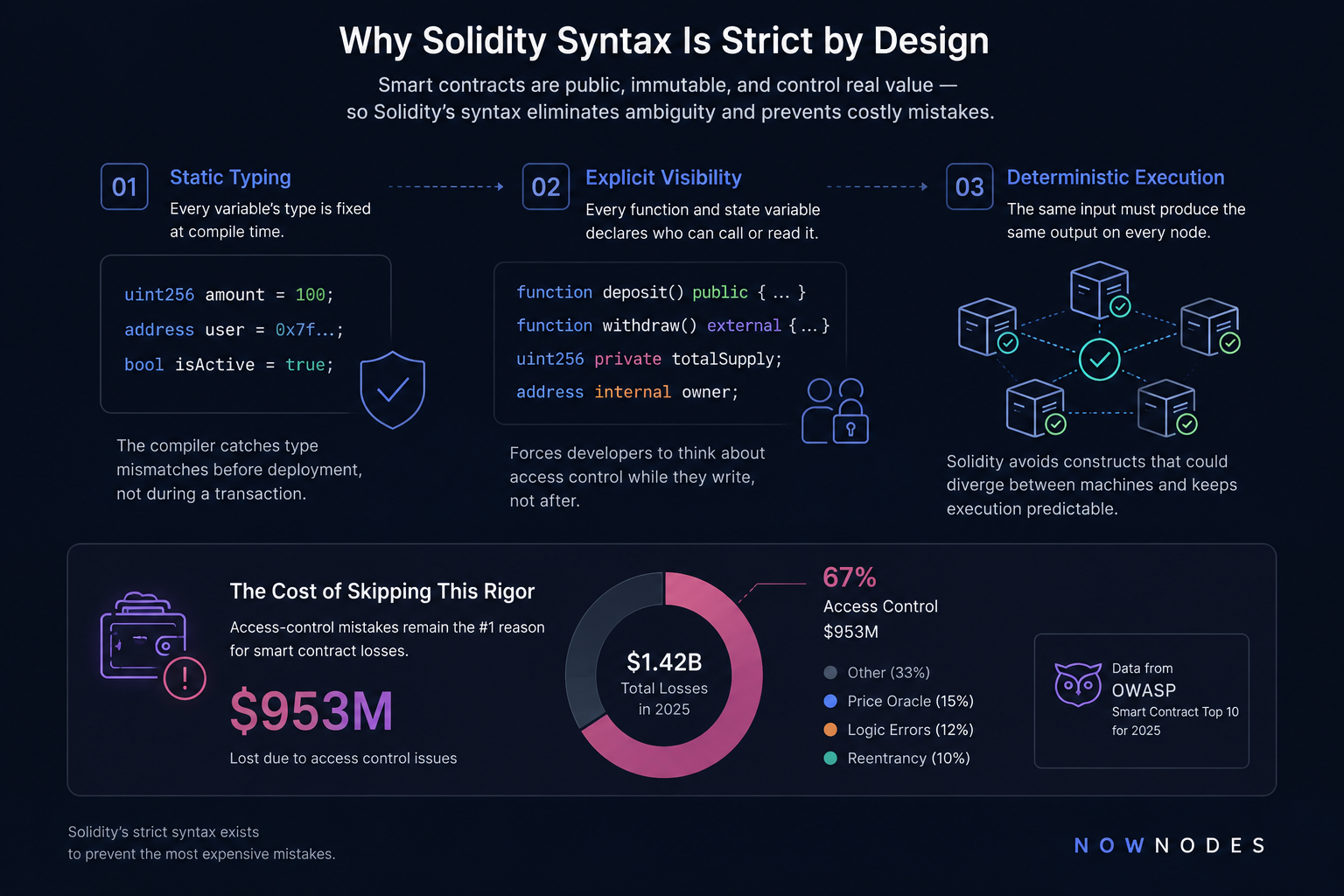
Because a smart contract’s code is public, immutable once deployed, and directly controls money. Ordinary software gets patched after a mistake ships; a Solidity contract usually can’t be. That single constraint shapes almost every syntax decision in the language.
Three properties push Solidity toward strictness that a typical scripting language doesn’t need:
- Static typing. Every variable’s type is fixed at compile time —
uint256,address,bool,string— so the compiler catches type mismatches before deployment instead of failing mid-transaction. - Explicit visibility. Every function and state variable must declare who can call or read it (
public,private,internal,external), which forces developers to think about access control as they write, not after. - Deterministic execution. The same input must produce the same output on every node in the network, so Solidity avoids constructs — like unbounded floating-point math — that could diverge between machines.
Skipping this rigor has a price tag. Access-control mistakes alone were tied to roughly $953 million of the $1.42 billion in documented losses catalogued in the OWASP Smart Contract Top 10 for 2025 — more than price-oracle manipulation, logic errors, and reentrancy combined. Solidity’s syntax rules exist largely to close exactly this category of bug at the source.
How does the compiler enforce it?
The solc compiler runs static analysis, type checking, and (optionally) formal verification before it will emit bytecode. According to the official Solidity documentation, the project aims for a non-breaking release roughly once a month, with about one breaking release per year, precisely so the syntax and its guarantees keep tightening as new bug classes are discovered.
A short list of what typically stops a contract from compiling:
- A missing or mismatched return type on a function.
- An unhandled implicit type conversion the compiler considers unsafe.
- A state variable used before its visibility is declared.
- A
pragmaversion range that doesn’t match the installed compiler. - An unreachable or duplicate function signature.
Each check trades a little developer friction for a bug that never reaches mainnet.
Who Actually Writes and Reads Solidity?
Solidity has one main home — Ethereum and EVM-compatible chains like Polygon, BNB Chain, Arbitrum, and Base — but the people working with it fall into fairly distinct groups.
- Smart contract developers write the core logic: token standards (ERC-20, ERC-721), DEX pools, lending markets, DAOs.
- Security auditors and researchers read Solidity line by line looking for logic flaws that automated tools miss, then verify fixes in follow-up reviews.
- Protocol and DevOps engineers compile, test, and deploy contracts, often scripting against a node connection to simulate transactions before mainnet.
- Students and career-switchers pick up Solidity as an entry point into Web3 engineering, frequently through interactive tools like Remix.
The Solidity Developer Survey 2025 — the project’s sixth annual survey — collected 1,095 responses from developers in 87 countries. Roughly 70% identified as smart contract developers, 12% as auditors or security experts, and 49% said they use Solidity daily. Notably, half of all respondents had two years of Solidity experience or less, which says something about how young — and how fast-growing — this language’s user base still is.
That mix of newcomers and veterans is part of why Solidity’s official documentation reads the way it does. As the project’s own GitHub README puts it, smart contracts are programs executed inside a peer-to-peer network where nobody has special authority over the execution, which is the whole reason the syntax has to be unambiguous enough for strangers to trust without knowing each other.
Solidity Syntax vs. Other Languages
Solidity borrows its look from JavaScript and its structure from C++, but it isn’t a clone of either. The table below lines up the comparison developers ask about most.
| Feature | Solidity | JavaScript | Rust (Solana programs) |
|---|---|---|---|
| Typing | Static | Dynamic | Static |
| Execution target | EVM bytecode | Browser/Node.js runtime | Solana runtime (BPF) |
| Visibility keywords | Required (public, private, etc.) | Optional / convention-based | Module-based (pub) |
| Overflow handling | Reverts by default since 0.8.x | No native protection | Panics on overflow (debug builds) |
| Mutability of deployed code | Immutable unless proxy pattern used | N/A (not deployed on-chain) | Immutable unless upgrade authority set |
| Primary use case | Ethereum & EVM chains | Web apps, general scripting | Solana & high-throughput chains |
The practical takeaway: Solidity syntax looks approachable to anyone who’s written JavaScript, but the static typing and mandatory visibility rules mean old JavaScript habits — loose typing, implicit conversions — will simply fail to compile.
Where does the syntax get harder?
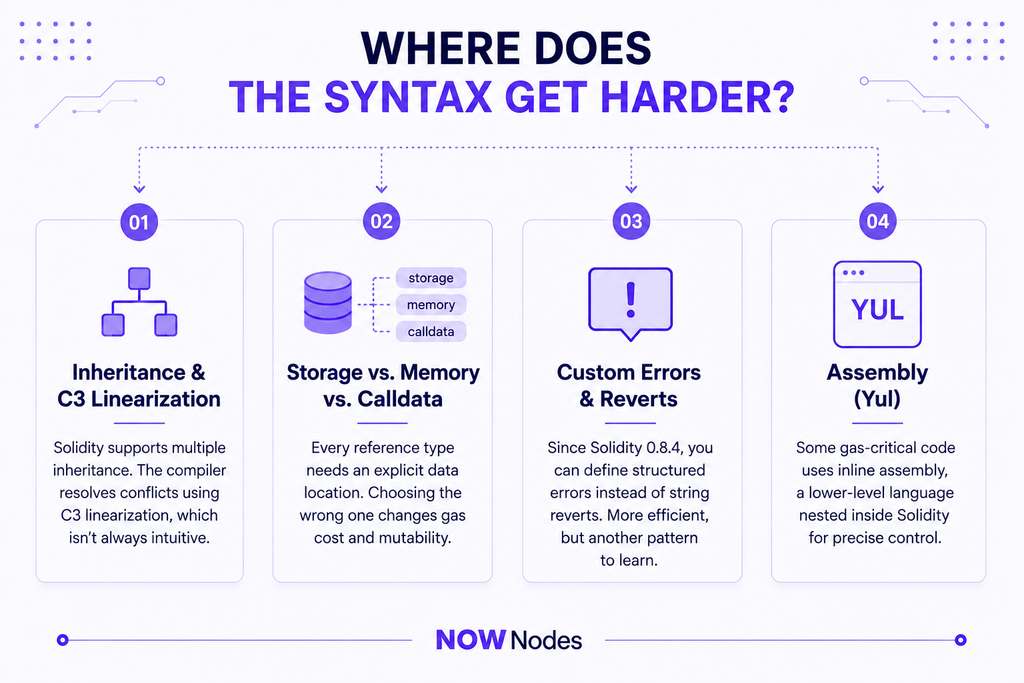
Basic contracts are genuinely simple once the keywords click. The complexity shows up in a handful of well-known trouble spots:
- Inheritance and C3 linearization — Solidity supports multiple inheritance, and the compiler resolves conflicts using a specific linearization order that isn’t always intuitive.
- Storage vs. memory vs. calldata — every reference type needs an explicit data location, and picking the wrong one changes both gas cost and whether a function can modify state.
- Custom errors and reverts — since Solidity 0.8.4, contracts can define structured errors instead of string reverts, which is more gas-efficient but adds another syntax pattern to learn.
- Assembly (Yul) — some gas-critical code drops into inline assembly, a lower-level language nested inside Solidity syntax for developers who need precise control.
What’s the current state of the language?
Solidity moves fast for a language this consequential. As of mid-2026 the stable release sits around version 0.8.36, and the project has not yet reached a 1.0 release — it still uses 0.y.z versioning specifically to signal that breaking changes remain possible. Recent releases have focused on an experimental SSA-form code generator aimed at solving the long-standing “stack too deep” compiler error, alongside routine security patches.
Pinning an exact compiler version with pragma solidity 0.8.28; — rather than a floating range — is now standard advice for any team that wants deterministic builds and a cleaner audit trail.
How Does Solidity Connect to the Rest of the Stack?
Writing correct syntax is only half the job — a contract also has to be tested against real chain state before it goes live. That means forking mainnet data, replaying transactions, and checking gas costs against an actual EVM environment rather than a local simulation alone.
That step depends on node access: a live connection to the blockchain that can answer queries like current balances, past transaction data, and event logs. Infrastructure providers such as NOWNodes supply that access as a service, offering RPC endpoints across more than 120 networks so developers can query mainnet and testnet state — including archive data going back to genesis — without operating their own node infrastructure. For Solidity developers specifically, that kind of connection is what turns a syntactically correct contract into one that’s actually been checked against live chain conditions before deployment.
Formal verification tools go a step further. Certora, for instance, uses a prover to mathematically check that a contract’s Solidity code satisfies specified properties — a heavier-weight complement to the compiler’s built-in type and visibility checks.
How to Start Reading or Writing Solidity
For a first-time reader, the fastest path runs through a browser rather than a local install.
- Open Remix, the official browser-based IDE, and load a sample contract instead of starting from a blank file.
- Read top to bottom: pragma, imports, contract declaration, state variables, then functions.
- Identify each function’s visibility and mutability (
view,pure,payable) before worrying about the logic inside it. - Compile and watch the errors — Solidity’s compiler messages are usually specific enough to teach the syntax rule you just broke.
- Deploy to a testnet, not mainnet, and confirm behavior against real transaction data before touching production.
Following that order — structure first, logic second — tends to make the language’s stricter rules feel like guardrails rather than obstacles.
FAQ
Is Solidity hard to learn compared to other languages?
Not especially, if you already know a curly-braces language like JavaScript or C++. The syntax itself is small; what takes longer is internalizing gas costs, storage layout, and the security patterns that keep contracts safe once real money is involved.
Where is the official Solidity documentation?
The canonical reference lives at docs.soliditylang.org, maintained by the Solidity core team and hosted alongside release notes, a style guide, and the full language specification.
Does Solidity work on chains other than Ethereum?
Yes. Any EVM-compatible chain — Polygon, BNB Chain, Arbitrum, Optimism, Base, and others — can run Solidity-compiled bytecode, since they all implement the same virtual machine Solidity targets.
What file extension does Solidity use?
.sol. Compiler tooling, IDEs, and block explorers all recognize this extension when parsing or verifying contract source code.
Can I convert Solidity code to another language later?
Not directly — Solidity compiles to EVM bytecode, and there’s no supported reverse path to a different smart contract language. Porting logic to a chain like Solana means rewriting the contract in that chain’s native language, such as Rust.