
If you’re new to crypto and wondering what is XRP — and why people keep saying “Ripple” when they seem to mean the same thing — this guide is for you. Here is XRP explained in plain language: Ripple is a company, XRP is a digital asset, and treating the two as identical is one of the most common beginner mistakes in the market. Understanding the XRP vs Ripple difference is the first step to not getting caught out.
This confusion has cost people real money: buying “Ripple coin” from sites that don’t exist, misreading supply headlines, panic-selling on company news that never touched the token. Here’s the breakdown that actually matters — for your wallet, not for a marketing deck.
Three names get used interchangeably, and they sit in three different categories. Ripple is a company in San Francisco. XRP is a digital asset. The XRP Ledger is an open-source blockchain nobody owns. The cleanest way to hold the distinction: the ledger is the road, the digital asset is the fuel, and the company is one large, influential driver on it. The road existed before that company adopted it, and it keeps running if the company disappears tomorrow.
The ecosystem now agrees the mix-up is worth fixing. In June 2026 the network formally renamed its core software to strip the company’s name out of the code — the strongest evidence yet that these three things are genuinely separate. We’ll come back to that.
Key Difference
Before the detail, the summary. This is the short answer to XRP vs Ripple — the whole comparison at a glance, which is all most readers want.
| XRP Ledger (XRPL) | XRP | Ripple | |
|---|---|---|---|
| What it is | A public blockchain | A digital asset | A private company |
| Launched / founded | June 2012 | Created 2012 with the ledger | 2012 (as OpenCoin) |
| Who controls it | No one — hundreds of independent nodes | No one; supply is fixed in protocol | Shareholders, CEO Brad Garlinghouse |
| Can it be shut down? | No | No | Yes — it’s a company |
| Purpose | Settlement, tokenization, built-in DEX | Fees, bridge currency, reserves | Selling payment software to banks |
| How you “get” it | Connect a node or wallet | Buy on an exchange | You can’t — it’s privately held |
Read that one row at a time and the Ripple vs XRP difference stops being fuzzy: different category, different origin, different failure mode. Everything below is why each row is true.
What Is the XRP Ledger?
The XRP Ledger is a public, decentralized blockchain that went live in June 2012, built by David Schwartz, Jed McCaleb, and Arthur Britto. It was designed for one job before anything else — moving value between parties in seconds, cheaply, without a bank in the middle.
XRP Ledger (XRPL): an open-source, permissionless blockchain optimized for payments, tokenization, and a native decentralized exchange. Anyone can run a server, submit transactions, or build on it without asking permission. The official docs are the authoritative reference.
Its numbers are unusually concrete for crypto. Transactions settle in 3 to 5 seconds, the network handles roughly 1,500 transactions per second, and the standard fee is 10 drops — 0.00001 XRP, a fraction of a cent. These aren’t projections. They’re what the ledger has done in production for over a decade.
It Doesn’t Use Mining or Staking
Here’s the single most misunderstood thing about this blockchain: there is no mining and no staking. Instead, servers reach agreement through a consensus protocol in which each participant follows a Unique Node List (UNL) — a set of validators it has chosen to trust not to collude.
The consequence is practical. Holding the digital asset gives you no vote and no validation power. On a proof-of-stake chain, capital buys influence over consensus; on this network, it doesn’t. That was a deliberate choice, and it’s central to the ownership question below.
What It Can Actually Do
The ledger ships features at the protocol level that other chains bolt on through smart contracts. A decentralized exchange has been built in since 2012. It also handles issued tokens, NFTs, escrows, and payment channels — and, more recently, permissioned domains, single-asset vaults, and a native lending protocol.
That built-in approach is a real tradeoff. You get audited, battle-tested primitives without deploying your own contract code, but less freedom than a general-purpose smart-contract environment. For payments and tokenization — the core XRP use cases — most builders find the trade favorable.
The Real Job of This Digital Asset
So how does XRP actually work? Its role is narrower than most people expect. The native asset of the ledger has three real jobs: paying transaction fees, meeting account reserve requirements, and acting as a bridge currency between assets that lack a direct market.
All 100 billion units were created at once when the ledger launched in 2012. There’s no mining, no issuance schedule, and no way to make more. If anything the supply shrinks — every transaction fee is destroyed rather than paid to a validator, so the total edges down permanently, transaction by transaction.
Drop: the smallest unit of the asset, equal to 0.000001 XRP. Fees are quoted in drops, which is why the figures look oddly precise. See the reserve rules for how drops and reserves interact.
The Reserve: Why You Can’t Spend Your Last Coin
This detail catches almost every new user. Your account must permanently hold a base reserve of 1 XRP, and each object it owns — a trust line, a DEX offer, an escrow — adds a 0.2 XRP owner reserve on top. That amount isn’t spendable; it exists to stop the shared ledger from bloating with junk data.
These figures aren’t set by anyone’s decree. Validators vote on them, and in December 2024 they cut the base reserve from 10 XRP to 1 and the owner reserve from 2 XRP to 0.2. Account activation got roughly ten times cheaper overnight — decided by network consensus, not by any company.
So Is XRP a Security? What the Court Actually Decided
The most consequential question here isn’t technical, it’s legal — and it finally has an answer. In July 2023, U.S. District Judge Analisa Torres ruled that sales on public exchanges were not securities transactions, while institutional sales to sophisticated buyers were.
In August 2024 the company was ordered to pay a $125 million penalty — a fraction of the roughly $2 billion the SEC had sought. Both sides then dropped their appeals, and the case formally closed in August 2025 (per CoinDesk).
The takeaway for a retail buyer: under that ruling, the asset bought on an exchange is not treated as a security. That’s rare regulatory clarity in U.S. crypto — and it hinges on how and to whom the token is sold, not on the token itself being blessed or condemned.
It Is Not “Ripple Coin”
There is no Ripple coin, Ripple token, or RippleCoin. The asset is XRP, full stop — anything selling you a differently named “Ripple asset” is sloppy or a scam. This is exactly why what is Ripple XRP remains one of the most-searched crypto queries: the naming has been muddled for a decade.
One genuine company-issued token does exist, and it’s separate: RLUSD, a dollar-backed stablecoin that runs on the ledger (and on Ethereum) and pays its fees in the native asset. It’s the company’s product. XRP is the network’s asset and predates it by more than a decade.
Ripple the Company: What It Sells and What It Controls
Ripple is a privately held technology company headquartered in San Francisco, founded in 2012 as OpenCoin and led today by CEO Brad Garlinghouse. It sells payment and custody software to banks, payment providers, and fintechs. It has employees, investors, offices, and a valuation — reportedly around $40 billion after a $500 million raise in November 2025.
Crucially, the company did not create the ledger and does not run it. The founders gifted 80 billion XRP to the company in 2012 to fund development and drive adoption. That gift is the origin of every “Ripple owns XRP” argument, and it deserves a straight answer rather than a defensive one.
The Escrow: What the Company Can and Can’t Do With Its XRP
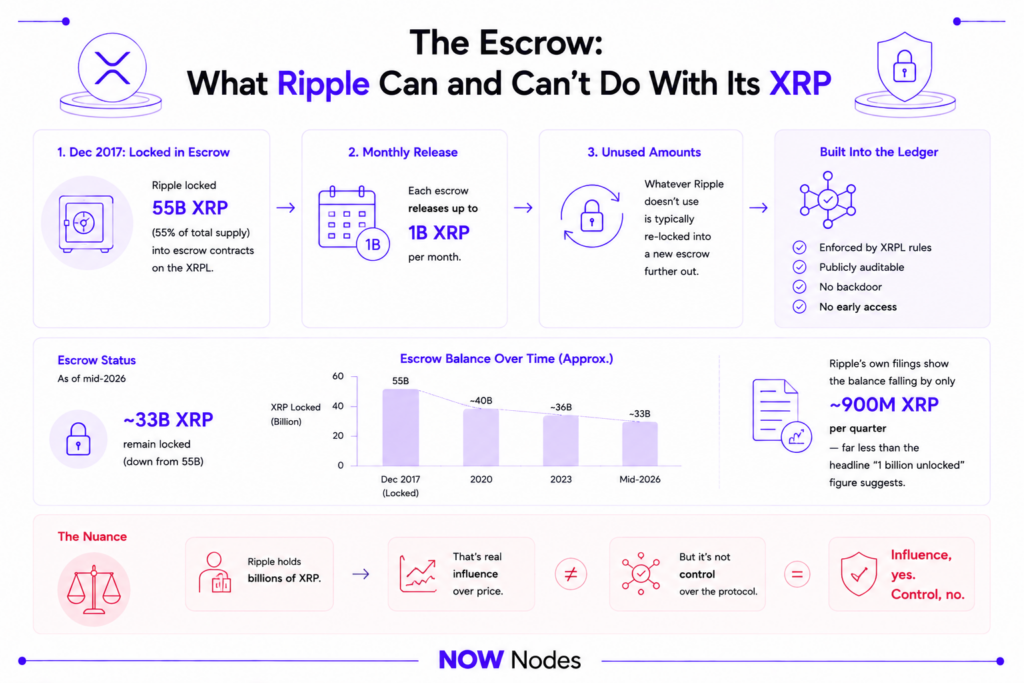
In December 2017 the company locked 55 billion XRP — 55% of the entire supply — into escrow contracts written directly into the ledger. Each releases up to 1 billion monthly, and whatever isn’t used typically gets re-locked into a new contract further out.
Here’s what critics and defenders both tend to miss. The XRP escrow isn’t a corporate promise — it’s enforced by the ledger’s own transaction rules, publicly auditable, with no backdoor for early access. As of mid-2026 roughly 33 billion remained locked, down from 55 billion, and company filings show the balance falling by only about 900 million per quarter — far less than the headline “1 billion unlocked” figure implies.
Still, holding billions of the asset is real influence, and pretending otherwise would be dishonest. Influence over price is not the same as control over the protocol — but it isn’t nothing, either.
What Ripple is doing
The company’s products are separate from the token, even where they touch it. Ripple Payments moves money across roughly 90 payout markets; Ripple Custody handles institutional storage; RLUSD is its stablecoin. In July 2026 the company secured full MiCA authorization, letting it operate across all 30 European Economic Area countries under a single license.
Some of those products use XRP as a bridge currency. Many don’t. A bank can be a customer and never touch the token — which is exactly why treating the company’s success as a proxy for the asset’s utility leads people astray.
Can Ripple Turn Off XRP?
This is the question underneath all the others, and it’s genuinely contested. The critics’ case: XRPL consensus relies on Unique Node Lists, and if the company publishes a widely used UNL, it holds effective veto power over what gets confirmed.
David Schwartz — one of the ledger’s original architects and the company’s CTO Emeritus — has answered that directly. Responding to Cyber Capital founder Justin Bons in February 2026, he put the design intent plainly:
“We carefully and intentionally designed XRPL so that we could not control it. We designed it so that we could not own or control it because that was the only way to ensure that nobody could own or control it.” — David Schwartz, co-creator of the XRP Ledger and Ripple CTO Emeritus
Schwartz called the idea that the company holds absolute power over the network “objectively nonsensical,” comparing it to claiming a majority miner could conjure a billion extra bitcoins. His technical point: each node independently counts validator agreements before confirming anything, so no publisher of a recommended list can rewrite the rules unilaterally.
Weigh it yourself instead of taking either side on faith. The network runs on hundreds of independent nodes, and validator lists are individual operator configuration — you can run a server with a UNL that excludes the company entirely. Whether a recommended list amounts to soft centralization is a legitimate debate, and reasonable engineers land on both sides. What no one can do is flip a single switch.
Why rippled Became xrpld: A Name Change That Actually Matters
For thirteen years the core server software was called rippled — “the Ripple daemon.” Every operator typed the company’s name into a config file to run an independent blockchain. It’s hard to design a more effective way to cement a misunderstanding.
That ended on June 15, 2026. Under proposal XLS-0095, version 3.2.0 renamed the binary from rippled to xrpld, changed rippled.cfg to xrpld.cfg, and renamed the internal ripple namespace to xrpl. The release notes document it as a breaking change requiring operators to migrate configuration and database paths.
The stated motivation was precisely the confusion this article is untangling: aligning the software’s identity with the ledger, not with a company that happens to contribute to it. The release also retired more than 30 long-active amendments and cut node memory usage by a reported 30–40%.
Adoption was gradual, which is its own quiet argument for decentralization. Weeks after release, roughly 89% of validators had crossed the 80% activation threshold — yet fewer than half of the network’s active nodes were actually running v3.2.0. Nobody could force the upgrade. Operators moved at their own pace, because no one is in a position to make them.
4 Myths About Ripple and XRP That Cost People Money
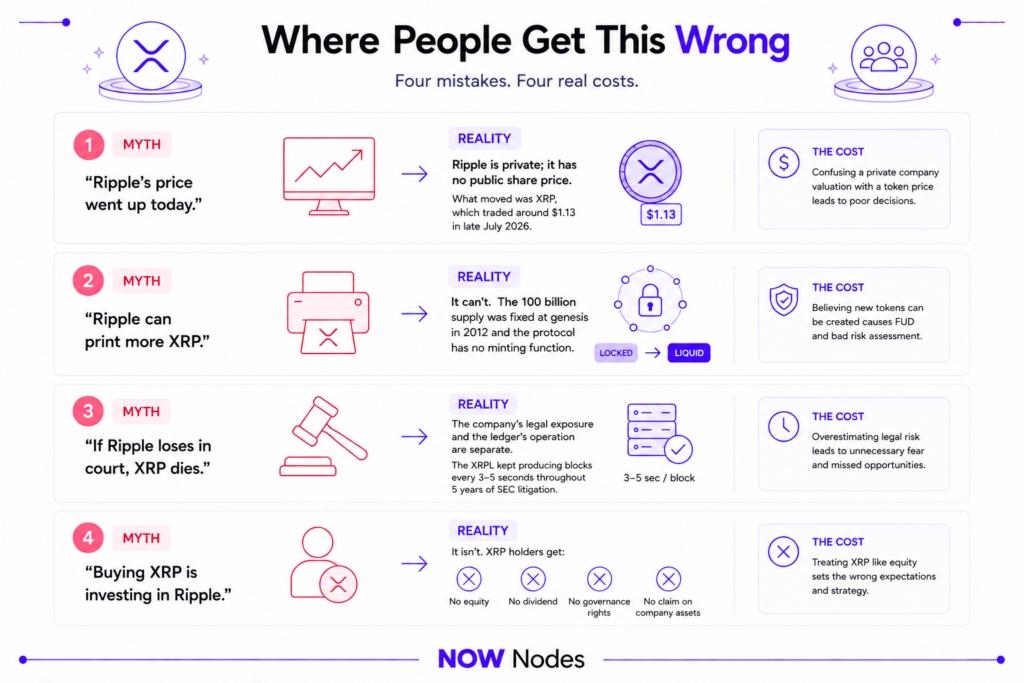
Four mistakes account for most of the confusion, and each carries a price tag.
- Myth: “Ripple’s stock went up today.” The company is private — there is no public share price. What moved was the digital asset, which traded near $1.13 in late July 2026. The company’s valuation and the token’s price are different numbers that move for different reasons.
- Myth: “Ripple can print more XRP.” It can’t. The 100 billion supply was fixed at genesis in 2012 and the protocol has no minting function. Escrow releases shift existing tokens from locked to liquid — they create nothing.
- Myth: “If the company loses in court, the token dies.” The case is over — and it didn’t. Exchange sales were ruled not to be securities, the company paid a $125 million penalty for institutional sales, and both sides dropped their appeals in 2025. Throughout five years of litigation, the ledger never stopped producing blocks.
- Myth: “Buying the token is investing in the company.” It isn’t. Holders get no equity, no dividend, no governance rights, and no claim on company assets. It’s a network asset, not a share in a business.
For Developers: Why This Distinction Changes Your Architecture
For builders, this stops being semantics and becomes architecture. If you’re writing software against the ledger, you’re integrating with an open protocol governed by validator consensus — not signing up as a customer of a company.
That has a concrete infrastructure consequence. Protocol changes arrive through amendments needing 80% validator support sustained for two weeks, not through a vendor’s roadmap. Your XRPL node has to track those amendments and stay on a current release, or it risks falling out of consensus and serving stale data.
Running that infrastructure yourself is entirely possible — and entirely your responsibility: syncing, storage tuning, migration steps like the rippled-to-xrpld path, and monitoring for amendment deadlines. Teams that would rather spend their attention on the application layer connect through a managed node provider such as NOWNodes instead of running the server themselves.
Conclusion
Strip away a decade of muddled headlines and the answer to XRP vs Ripple explained is simple. The XRP Ledger is a public blockchain from 2012 that settles in seconds for a fraction of a cent and answers to no owner. XRP is its native asset — 100 billion at genesis, deflationary by design, used for fees, reserves, and bridging. Ripple is a company that holds a lot of the asset, builds real products on the ledger, and cannot control it.
The strongest proof isn’t an argument — it’s a config file. When the network renamed its core software from rippled to xrpld in June 2026, the ecosystem itself drew the line this article has been drawing, in code, where it’s hardest to ignore. Schwartz’s framing holds: a system designed so its creators couldn’t own it is a system nobody owns.
If you’re weighing the asset, judge the ledger’s utility rather than the company’s press releases. If you’re building on it, treat it as the independent protocol it is — and plan your infrastructure accordingly.
FAQ
Can Ripple shut down the XRP Ledger?
No. The company runs some servers and publishes a recommended validator list, but the network is confirmed by hundreds of independent nodes worldwide, each choosing which validators to trust. If the company vanished tomorrow, those operators would keep producing blocks. As co-creator David Schwartz put it, the system was “designed so that we could not own or control it.” There is no off switch for anyone to flip.
Is XRP a good investment in 2026?
This isn’t investment advice — here’s the factual picture. The asset traded near $1.13 in late July 2026, with a market cap around $70 billion, roughly the sixth-largest cryptocurrency. Its U.S. legal status is unusually clear: a 2023 ruling found public-exchange sales weren’t securities, and the case closed in 2025. Supply is fixed at 100 billion and slowly deflationary. Those are facts, not a recommendation — weigh the volatility, real-world usage, and your own risk tolerance, and consider a licensed financial advisor before buying.
What happens if Ripple goes bankrupt?
The ledger keeps running. It’s open-source software validated by independent operators, not a service the company hosts, so blocks would still settle every three to five seconds. The company’s escrowed and operational XRP would be treated as corporate assets in a bankruptcy, which could affect market supply and price — but the network itself wouldn’t skip a beat. The road doesn’t close because one driver leaves.
How is XRP different from Bitcoin?
Both are fixed-supply digital assets, but the mechanics differ sharply. Bitcoin uses proof-of-work mining and targets ~10-minute blocks; this network uses validator consensus with no mining or staking and settles in three to five seconds. Bitcoin was designed as digital gold; this asset was built as a bridge currency for moving value between other assets. And here every fee is burned, so total supply slowly falls instead of being paid out to miners.
Do I need XRP to use the XRP Ledger?
Yes, a small amount. Every account must hold a base reserve — currently 1 XRP — and pay tiny fees in the asset, even if you mainly transact in issued tokens or a stablecoin like RLUSD. You don’t need much: activation costs about 1 XRP plus fractions of a cent per transaction. But you can’t operate an account on zero.
Does XRP use mining or staking?
Neither. The network reaches agreement through a consensus protocol in which each server follows a Unique Node List of validators it trusts. Holding the asset grants no validation rights and no governance vote — a deliberate departure from proof-of-stake designs, where capital buys influence over consensus.
Why was rippled renamed to xrpld?
Version 3.2.0, released June 15, 2026 under proposal XLS-0095, renamed the core server software to separate the ledger’s identity from the company. It’s a breaking change affecting binary names, config files, and database paths, so node operators have to migrate deliberately rather than upgrade in place.